
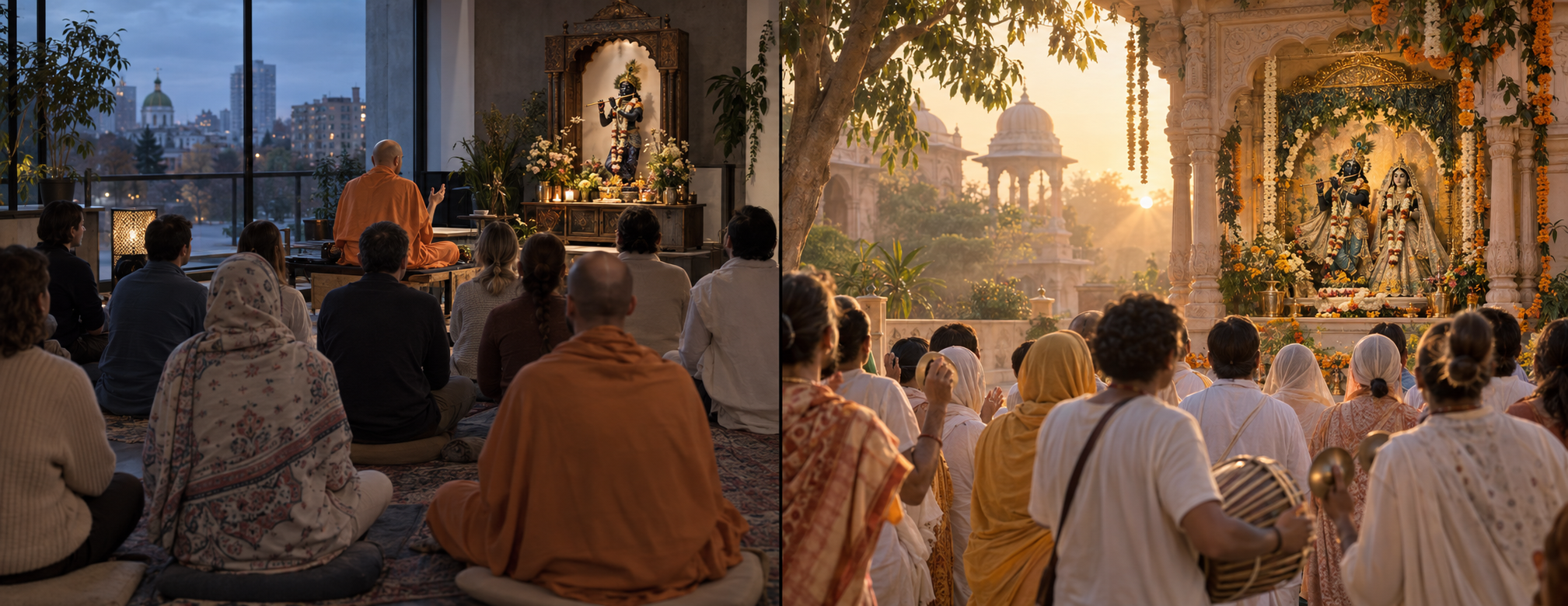
If you are trying to understand why ISKCON marked one September occasion with a lecture in Kyiv and another with darshan and kirtan in Vrindavan, the distinction matters. These were not interchangeable versions of the same program. Each directed attention toward a different relationship within Krishna bhakti.
The useful question is not which city hosted the more important observance. Ask what each observance invited you to remember, and then choose the form of participation that meets your present spiritual need.
One observance centers Krishna; the other honors the guru
In Kyiv, the observance on 4 September 2026 took the form of a Janmastami lecture. Janmastami commemorates the appearance of Sri Krishna, so a lecture on that occasion belongs especially to shravana, the discipline of hearing. You receive an account or teaching, examine what it reveals about Krishna, and allow that remembrance to affect your own conduct.
In Vrindavan, 7 September 2026 brought the 82nd Vyasa Puja celebration of H.H. Gopal Krishna Goswami Maharaja at ISKCON Vrindavan. The available presentation included live darshan and kirtan from Sri Sri Krishna Balaram Mandir.
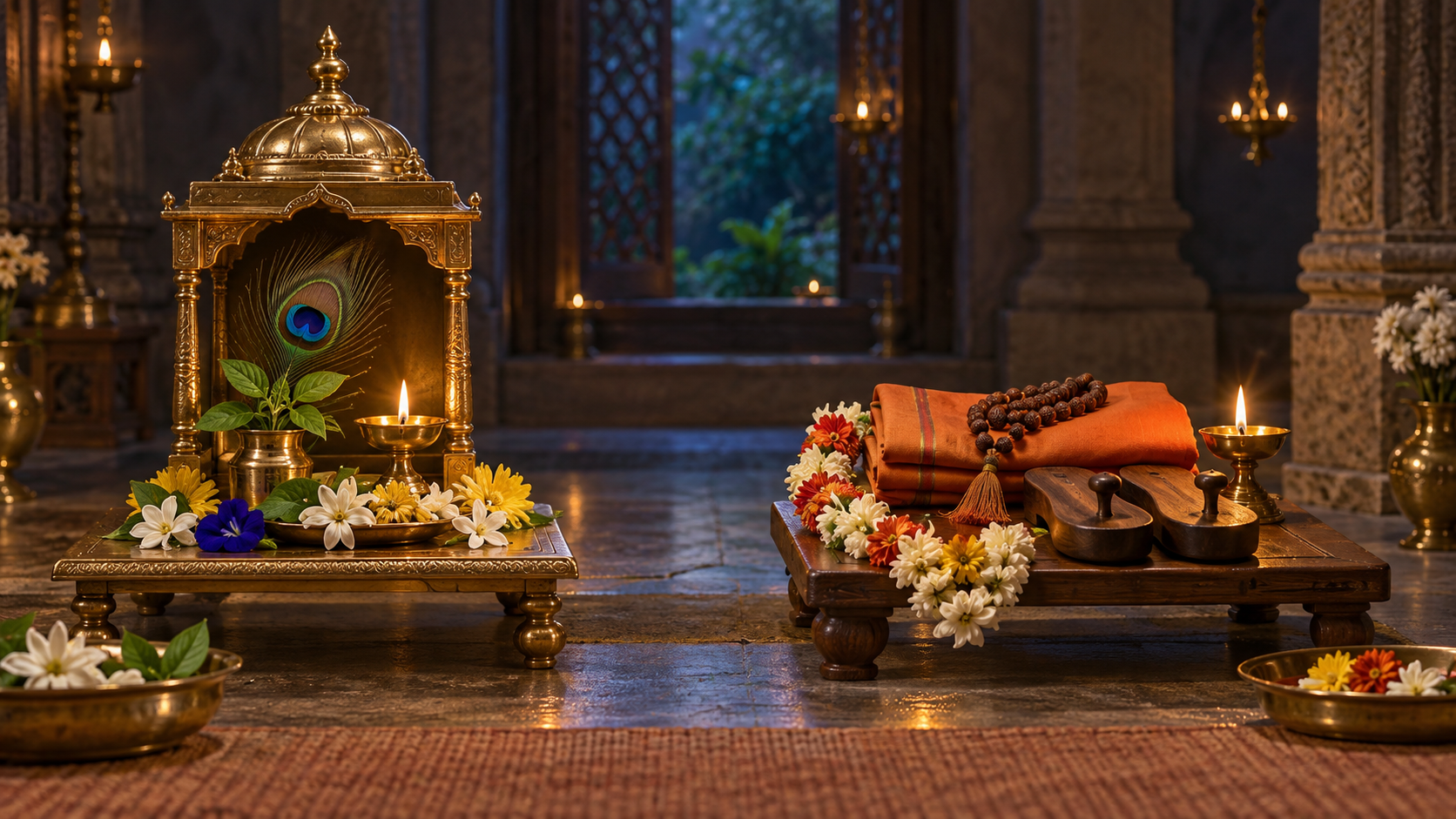
Vyasa Puja honors the spiritual master in relation to Vyasadeva and the disciplic succession. Within Gaudiya Vaishnava practice, that honor does not place the guru in competition with Krishna. It recognizes the teacher through whom Krishna’s teachings are received, preserved, explained and embodied. Krishna remains the center; the guru helps the disciple approach that center faithfully.
Key takeaways
- Kyiv’s 4 September observance was a Janmastami lecture, making attentive hearing the clearest mode of participation.
- Vrindavan’s 7 September observance was the 82nd Vyasa Puja of H.H. Gopal Krishna Goswami Maharaja, presented through temple darshan and kirtan.
- Janmastami directs remembrance toward Krishna’s appearance; Vyasa Puja cultivates gratitude for the spiritual teacher and parampara.
- You do not need to choose between devotion to Krishna and respect for the guru. In the Vaishnava understanding, properly directed guru-honor leads the disciple toward Krishna.
Read the place and format without inventing a story

The name Kyiv can easily pull a reader toward political assumptions. Resist that reflex here. The established facts identify a city, a date and a Janmastami lecture. They do not establish the size of the gathering, the conditions around it, the emotions of those present or the local circumstances in which the program occurred. The observance does not need an invented geopolitical drama to possess spiritual significance.
Apply the same discipline to Vrindavan. A live transmission of darshan and kirtan gives a real point of devotional contact, but a camera remains a window rather than the whole room. It does not automatically show every part of the ceremony, every offering or the experience of everyone inside the temple. Do not build a detailed account from what the program description does not establish.
When you discuss either observance, keep three kinds of statements separate:
- Established details: the place, date, named observance and published format.
- Traditional meaning: what Janmastami, Vyasa Puja, darshan, kirtan and hearing ordinarily mean within Krishna bhakti.
- Your response: what you learned, felt called to examine or decided to practice.
The third category is valuable, but it is personal. Present it as your response, not as evidence about a congregation you did not directly observe. This simple distinction keeps devotional writing sincere and prevents a meaningful occasion from becoming a vehicle for projection.
Choose the program that answers your present question
If you have limited attention, choose by spiritual purpose rather than by location, production quality or the apparent scale of the gathering.
- If your question is, “What should Krishna’s appearance awaken in my life?”, begin with the Kyiv Janmastami lecture. Listen for a teaching you can state accurately and an implication you can practice.
- If you need to move from analysis into prayerful attention, choose the Vrindavan darshan and kirtan. Let the visual encounter and sacred sound interrupt ordinary distraction.
- If you are trying to understand the place of the guru in ISKCON, focus on the Vyasa Puja observance. Ask how gratitude to a teacher differs from attachment to personality.
- If you are introducing both occasions to family or a study group, use them in sequence: first establish Krishna as the goal of devotion, then explain the guru as the servant and transmitter who guides the disciple toward that goal.
Do not rank the programs by which one looks more elaborate on screen. A lecture can demand deep inward work even when its presentation is simple. Kirtan and darshan can engage the whole person even when they do not provide a discursive explanation. These are different devotional instruments, and each should be used for the work it is suited to perform.
Turn remote viewing into an act of sadhana

Online access can connect you with a sacred occasion, but it can also reduce that occasion to background media. The difference usually lies in how you approach it. Use the following sequence whether you are joining a live transmission or viewing an available recording.
- Name your purpose before you begin. Write one sentence such as, “I am listening to understand what remembrance of Krishna should change in me,” or, “I am joining this kirtan to cultivate gratitude and attention.” A clear intention prevents passive consumption.
- Remove the second screen. Do not read messages or browse while the lecture, darshan or kirtan continues in another window. Divided attention may preserve the sound while losing the act of hearing.
- Respond according to the format. During a lecture, identify the central teaching and its practical consequence. During kirtan, join the sacred name if you know the mantra and can do so respectfully. During darshan, look deliberately, offer pranam according to your practice and resist treating the temple image as scenery.
- Separate quotation from recollection. If you share a teaching afterward, use quotation marks only when you have the exact words. Label your own summary as a paraphrase. This is especially important when a devotional statement may circulate beyond the original audience.
- Complete the encounter through service. Choose an action connected to what you actually received: renew a neglected practice, assist a local temple or devotee, study a teaching more carefully, or repair a duty you have been avoiding. Do not manufacture an instruction that was never given merely to make the experience sound dramatic.
This approach also protects you from a common digital habit: collecting sacred events without allowing any one of them to become formative. A long viewing history is not the same as sustained remembrance. One teaching honestly practiced may matter more than many programs consumed in haste.
Carry both observances into your community accurately
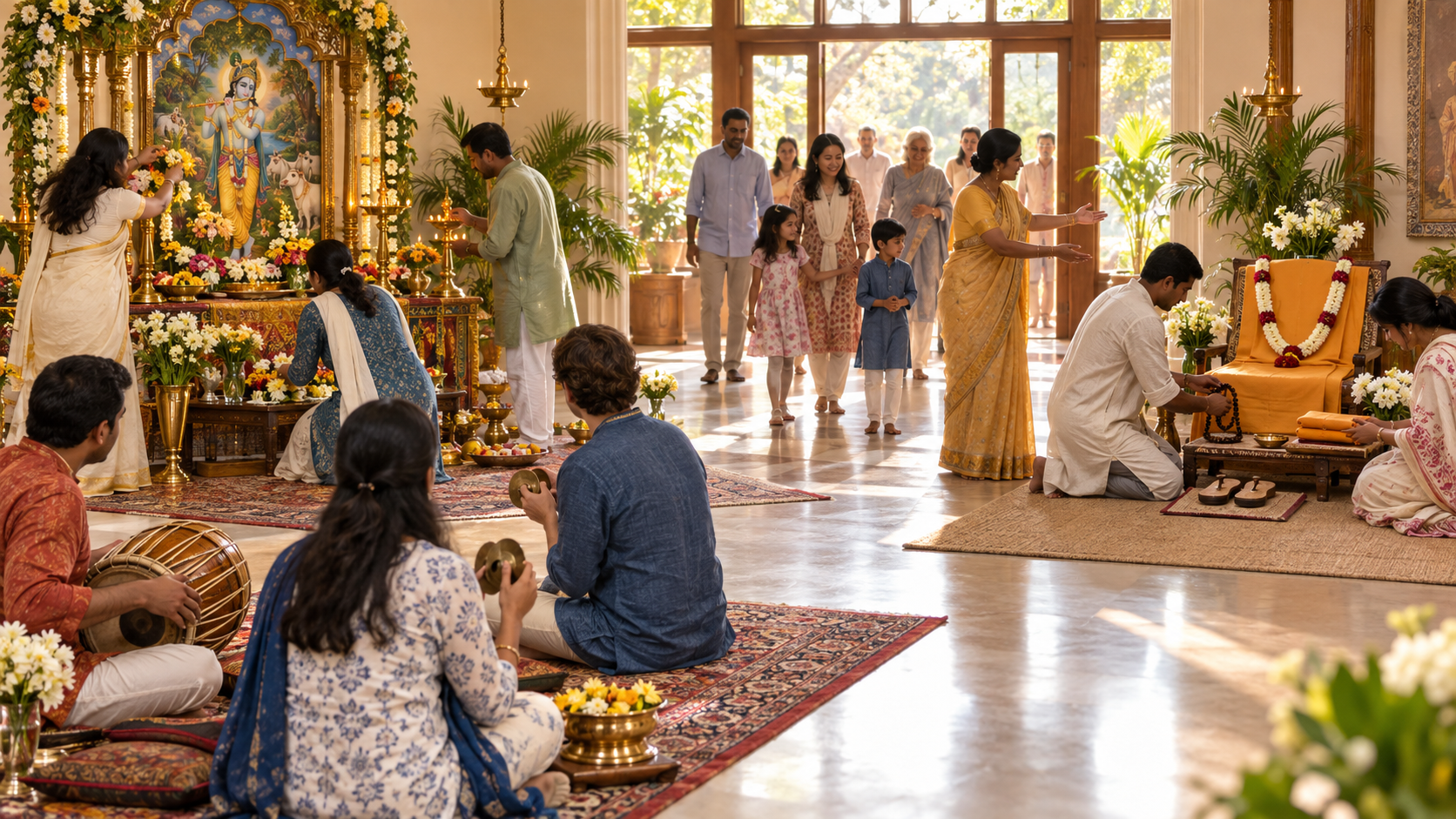
If you write a community notice, lead a discussion or explain these occasions to someone unfamiliar with ISKCON, precision is itself a form of respect. Do not call both programs Janmastami celebrations. Do not describe the Vyasa Puja merely as a birthday tribute. Name it as the 82nd Vyasa Puja celebration of H.H. Gopal Krishna Goswami Maharaja and explain its relationship to guru, Vyasa and parampara.
Avoid the opposite error as well: do not present guru-honor as personality worship detached from teaching. The meaningful question is what the teacher transmits and how the disciple receives it. Honor becomes spiritually intelligible when newcomers can see its connection to Krishna, scripture, disciplic succession and service.
The difference in format also deserves attention. Kyiv’s lecture foregrounded hearing and reflection. Vrindavan’s presentation foregrounded temple darshan and kirtan within a Vyasa Puja setting. Shared fidelity does not require every ISKCON community to express an occasion through an identical program. When you notice the difference, ask what each form makes possible instead of treating variation as inconsistency.
Begin with the observance that addresses your immediate need, then make room for the other. Hear about Krishna with enough care to change something, honor the teacher without losing sight of the divine center, and let your attention conclude in a concrete act of seva. That is how two programs in Kyiv and Vrindavan can become more than entries on a devotional calendar.
References
- Dandavats – September 4, 2026 – Kyiv, Ukraine – Janmastami Lecture
- Dandavats – 82nd Vyasa Puja Celebration of H.H. Gopal Krishna Goswami, ISKCON Vrindavan, 7 September 2026
