
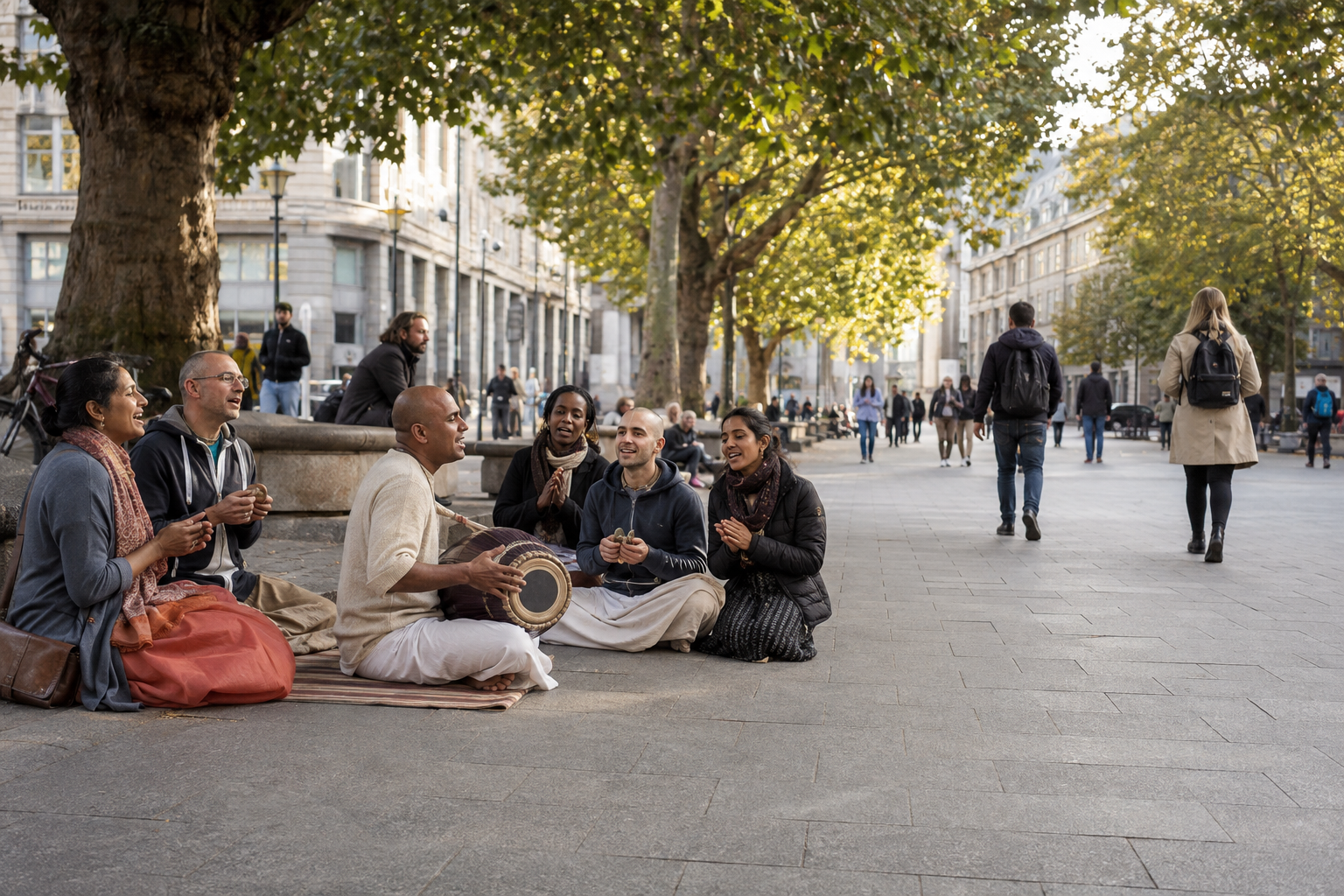
You want to share Krishna’s holy name in public, but you do not want devotion to become a performance, an argument, or an intrusion. That tension is healthy. It makes you ask not merely whether you can be visible, but what people will encounter through your visibility.
The answer is neither to hide your faith nor to demand that strangers validate it. Public Krishna devotion works when the chanting remains an offering, the devotees remain disciplined, and every passerby remains free to listen, join, ask, or continue walking.
Decide what your public devotion is meant to do
Before choosing a route, instruments, clothing, or publicity, decide what you are offering. Harinama is the congregational chanting of the holy names in public. It is not primarily a street concert, a demonstration of numerical strength, or a device for collecting attention.
This distinction changes your conduct. A performer asks whether the crowd was impressed. An activist asks whether the crowd was persuaded. A devotee first asks whether the chanting was attentive, whether the group served the holy name well, and whether strangers were treated with dignity.
For a devotee in America, the practical challenge is to turn the freedom, confidence, and public energy of American life toward meaningful service to Krishna. That does not require copying the social style of Bharat or concealing the tradition behind vague spiritual language. It requires presenting an authentic Vaishnava practice with enough cultural intelligence that people can approach it without being pressured.
Write a brief aim before organizing anything. It might be to chant steadily in a public place, give curious people a welcoming point of contact, and help participating devotees remember Krishna. If a proposed activity does not serve that aim, leave it out.
Choose the smallest format you can hold well
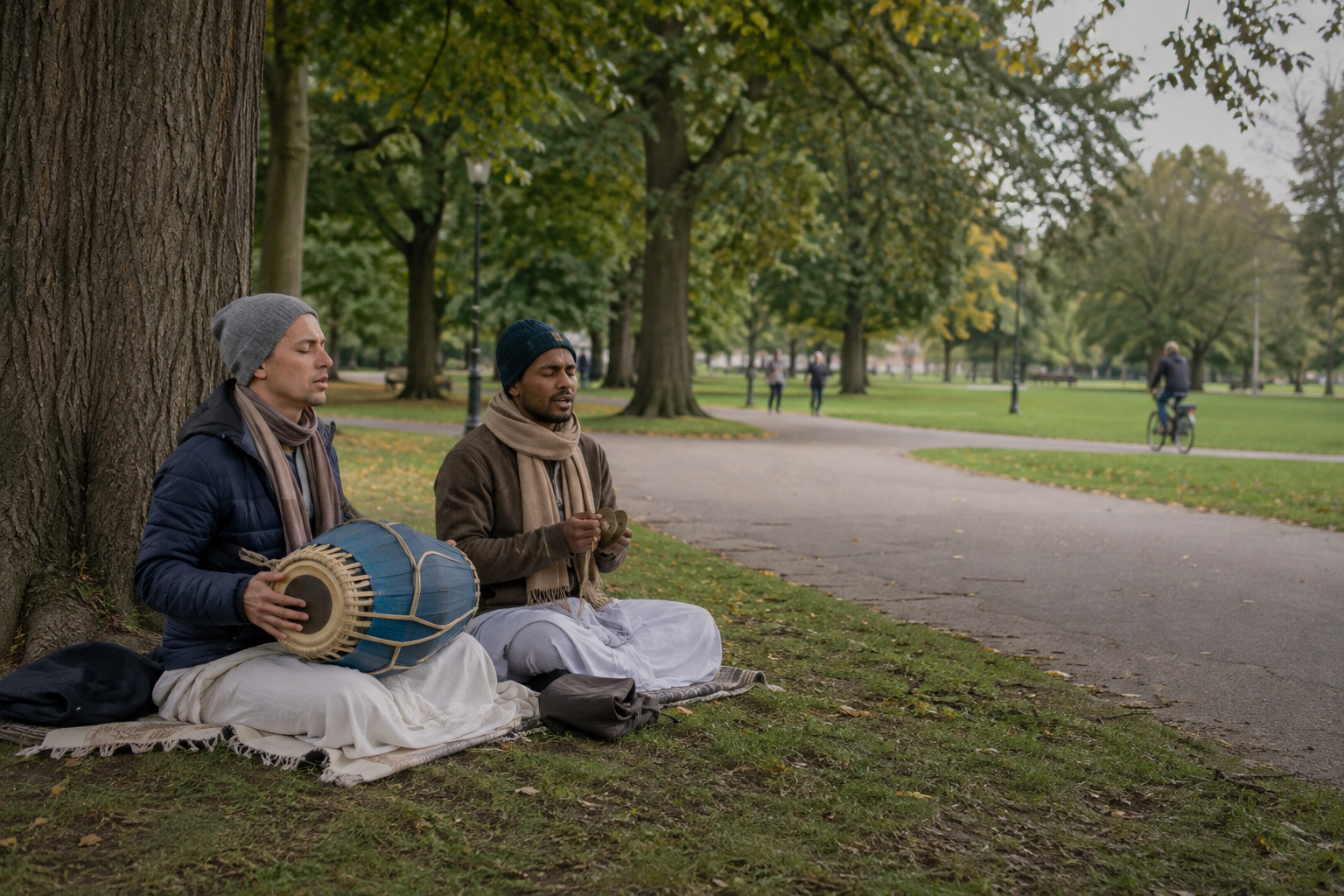
Public Krishna devotion does not have to begin with a large procession. Match the format to the experience of your group, the setting, and the practical responsibility you can actually carry.
- If you are new, join an established harinama before trying to lead one. Notice how experienced devotees manage pace, volume, instruments, questions, road crossings, and the emotional temperature of the group.
- If your group is small, use a stationary kirtan in a suitable permitted space. A stable gathering is easier to supervise than a moving procession.
- If the setting is unfamiliar, visit it without instruments first. Observe pedestrian flow, entrances, residential edges, quiet areas, and places where a group would obstruct ordinary movement.
- If you are ready for a moving harinama, use a route that the whole group can follow without separating. The lead chanter should not move faster than the people responsible for keeping the group coherent.
- If families, elderly devotees, or newcomers are participating, choose a setting with an easy exit. No one should feel spiritually inadequate because they cannot remain for the full activity.
Scale is not automatically a sign of spiritual quality, but a capable group can make a strong public offering. A London harinama brought a team of 25 devotees to Oxford Street, showing how an organised devotional party can carry the holy names into a prominent urban setting. The lesson is not that every community needs a famous street or a large team. It is that aspiration must be matched by coordination.
Do not call an event small merely because few people attend. If the chanting is steady, the group remains considerate, and an interested person can discover where to learn more, the essential work has been done.
Build a harinama that others can trust
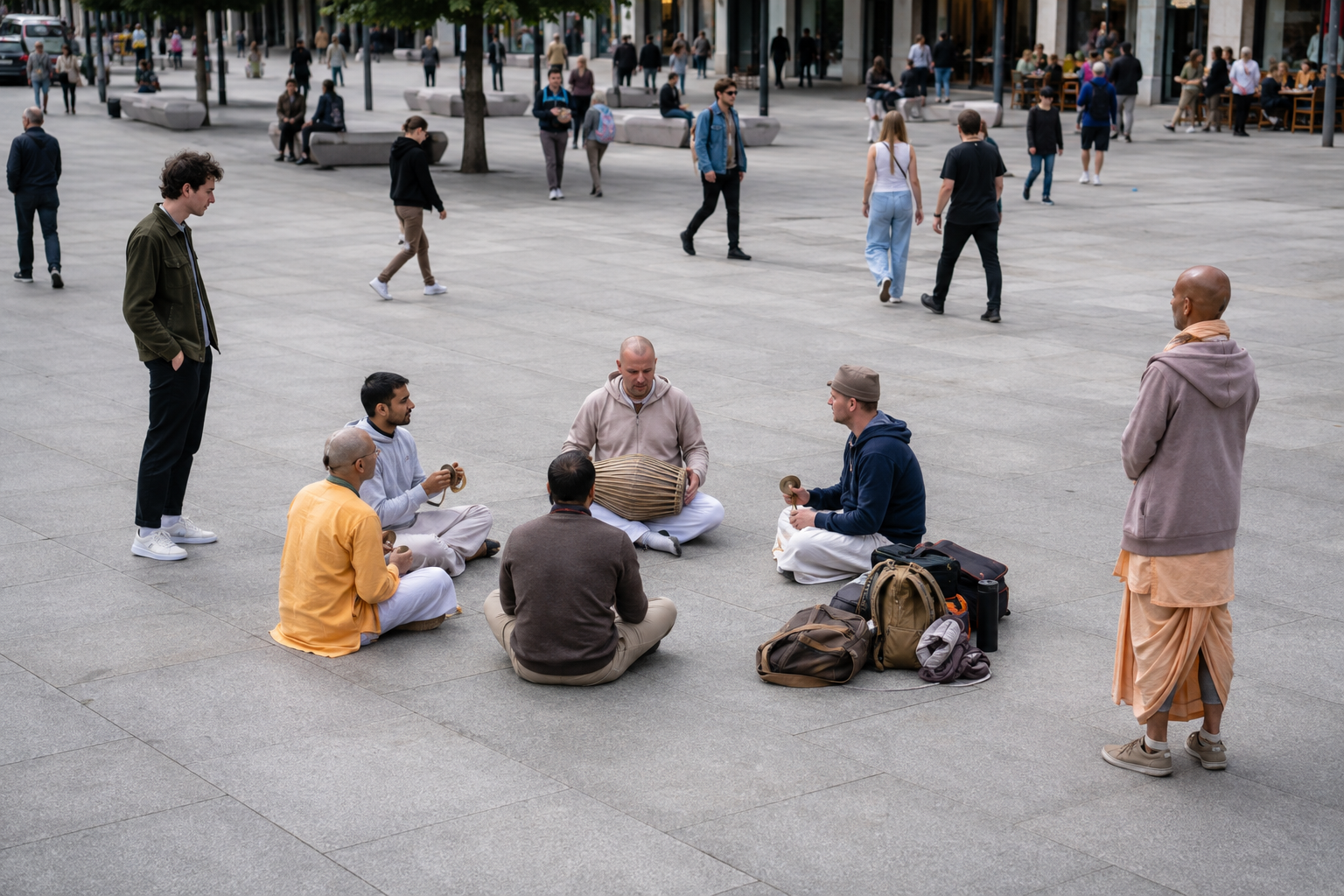
A public devotional event needs spiritual preparation and ordinary competence. Neglect either one and the weakness becomes visible. Use the following sequence when you are responsible for organizing.
- Confirm responsibility. Identify who is leading the kirtan, who is watching the route or gathering space, who will answer public questions, and who can stop the activity if conditions become unsafe or disruptive.
- Check the rules that apply to the location. Before using amplification, distributing anything, occupying a fixed space, or leading a moving group, verify requirements with the relevant municipality, property owner, transit authority, or event organiser. A devotional motive does not remove the need to respect local rules. If the position is unclear, begin at a temple, private venue, or established permitted event.
- Agree on the musical format. Select chants, instruments, and a pace that the participants can sustain together. Constantly changing melodies or accelerating the tempo may excite practiced musicians while leaving newcomers unable to participate.
- Brief the group on conduct. Cover pedestrian access, road crossings, interaction with officials, photography, responses to hostility, and what to do if someone becomes separated. This conversation should happen before the chanting begins.
- Create a clear path for genuine interest. Carry accurate temple or community information and designate approachable devotees who can step aside for conversation. Do not make a curious passerby compete with drums or chase a moving procession to ask a question.
- Review the event after it ends. Ask whether the chanting stayed prayerful, whether the group obstructed anyone, whether responsibilities were clear, and what should change before the next outing. Do not use social-media reach as the sole measure of success.
Recording deserves particular care. A public place may be visible, but visibility is not the same as willing participation in your promotional material. Avoid centering identifiable bystanders, especially children, without appropriate permission. The camera should document service without turning strangers into props.
Let your conduct translate the holy name
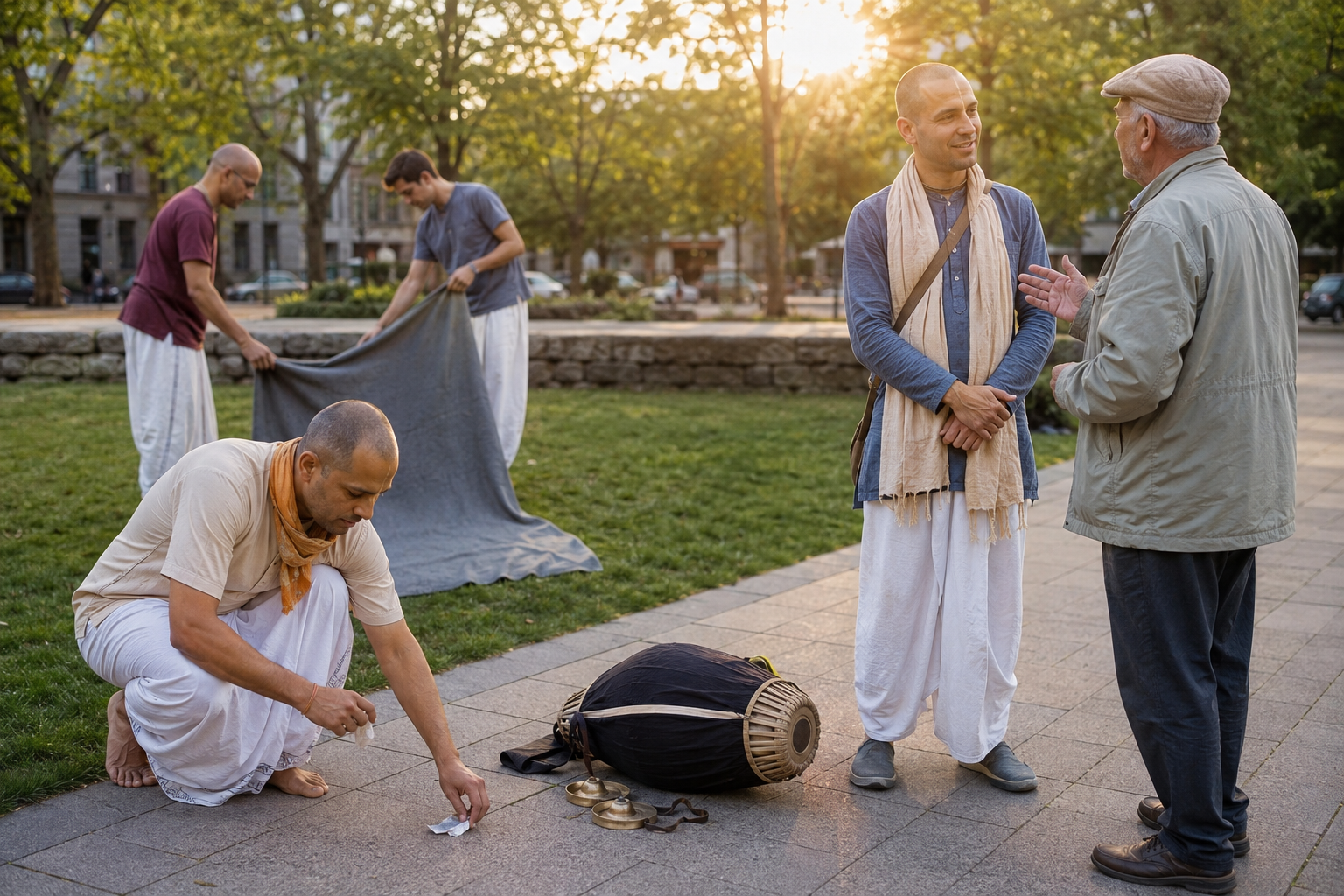
Many people who encounter harinama in a Western city will not know the theology behind it. Before they understand a single Sanskrit term, they will notice whether devotees are peaceful, attentive, clean, courteous, and aware of their surroundings. Your conduct becomes the first translation.
Leave space around the group. Do not surround a reluctant person, block a doorway, or treat eye contact as consent to a conversation. An invitation remains devotional only while refusal remains easy.
When someone asks what you are doing, answer plainly: you are chanting names of God in the Vaishnava tradition and people are welcome to listen or participate. Begin there. Do not bury a sincere question beneath a lecture. If the person wants a deeper discussion, move away from the instruments and listen before answering.
If someone mocks the chanting, do not turn the encounter into a contest. The public practice is testing your own steadiness as much as it is reaching anybody else. A hostile exchange can make the group forget Krishna while continuing to say Krishna’s name. The responsible response is usually to keep moving, lower the temperature, or let the designated organiser deal with the situation.
Enthusiasm also needs discipline within the group. Watch for devotees who are exhausted, overstimulated, unable to keep pace, or uncomfortable with an interaction. Public devotion is not strengthened by making participants suppress reasonable limits. A group that cares for its own members is better able to welcome others.
Avoid triumphal language about conquering a city or defeating its culture. The worthwhile victory is over hesitation, vanity, hostility, and the desire to control how others respond. Western public life does not need a diluted Krishna devotion, but it does need devotees who can distinguish confident presence from domination.
Key takeaways
- Treat public chanting as an offering, not a performance or confrontation.
- Join an experienced harinama before organising your own, especially if you have not managed a moving group in a busy public setting.
- Match the scale to your real capacity. A well-held stationary kirtan is better than an ambitious procession that becomes disorderly.
- Verify local requirements before using amplification, distributing materials, or occupying public space.
- Make participation voluntary in practice, not merely in theory. Keep paths open and let uninterested people pass without pursuit.
- Measure success by devotional attention, responsible conduct, group care, and a clear welcome for sincere interest.
Your next step need not be dramatic. Attend an established public kirtan, take responsibility for one practical task, and observe what helps the holy name remain at the centre. When your community can combine spiritual purpose with dependable conduct, public visibility stops being a source of anxiety and becomes disciplined seva.
References
