
You may have encountered Prakasha and Vimarsha in a discussion of Srividya and come away with two vague translations: light and reflection, or consciousness and energy. Those words point in the right direction, but they can also create the wrong picture of two cosmic ingredients joined together after the fact.
The working distinction is more precise. Prakasha is the luminosity by which anything can appear in awareness. Vimarsha is awareness knowing itself and expressing its own possibilities. Srividya treats them as two inseparable principles at the heart of existence. The practical question, therefore, is not which one is higher. It is how one reality can both shine and recognize itself.
The essential distinction: illumination and self-recognition
Prakasha literally suggests illumination, but physical light is only an analogy. A lamp reveals visible objects, yet it does not explain how a sight, sound, thought, memory, or absence becomes present to you. Prakasha points to conscious presence itself: the condition under which any experience can appear.
Vimarsha is often translated as reflection, but it is not merely thinking about an experience after it has happened. It is the reflexive power by which consciousness is aware of itself. It also names consciousness as active capacity rather than passive background: the power to recognize, differentiate, articulate, and manifest experience.
| Term | What it points to | Common misreading | Useful correction |
|---|---|---|---|
| Prakasha | The luminosity or presence of consciousness | Visible light, a mystical glow, or a special object | Notice that every object, including darkness and thought, must become present in awareness |
| Vimarsha | Consciousness knowing itself and exercising its power | Analysis, self-talk, or intellectual reflection | Notice the immediate fact that experience is known before you explain it |
| Their unity | Self-luminous awareness inseparable from self-knowing power | Two substances that later interact | Separate the terms for understanding, but do not divide the reality they indicate |
This last correction matters most. Language forces us to describe Prakasha and Vimarsha separately, just as we may distinguish fire from its capacity to burn. The distinction helps analysis; it does not establish two independently existing realities. If an explanation leaves you with a passive consciousness on one side and an unrelated energy on the other, it has lost the Srividya point.
Why Srividya refuses to separate consciousness from power
Imagine Prakasha without Vimarsha. You would have an illumination that could not recognize itself, disclose anything, or exercise any capacity. It would resemble an inert abstraction rather than living consciousness. Now imagine Vimarsha without Prakasha. You would have activity with no conscious ground and recognition with nothing capable of knowing. Each imagined half becomes unintelligible without the other.
The pair therefore protects two truths at once. Consciousness is not just another object inside the world, because it is that through which a world becomes present. Yet consciousness is not an empty spectator standing apart from manifestation, because its self-knowing power is inseparable from it. Creation, in this framework, is not something added to consciousness from outside. It is the expression of conscious power.
This is why the language of consciousness and energy needs care. Energy here should not be reduced to a measurable physical force. It means power or capacity: the dynamic aspect through which awareness recognizes and expresses itself. Likewise, consciousness does not mean a private stream of thoughts inside one person’s head. Thoughts are among the things illuminated; they are not the illuminating principle itself.
When you encounter the corresponding language of Shiva and Shakti, do not turn it into a ranking in which a superior masculine consciousness controls an inferior feminine energy. Nor should you reduce it to biological sex. The polarity expresses distinguishable but inseparable aspects of reality. Vimarsha is not a subordinate assistant to Prakasha. Without self-recognition and power, luminosity would not be the fullness of consciousness described by this tradition.
This interpretation belongs to the non-dual vision being expressed here; it should not be imposed on every Hindu philosophical school as though all use the same vocabulary in the same way. When reading across traditions, first ask how that particular tradition understands consciousness, manifestation, and the relation between them.
Three misreadings that obscure the teaching
- Chasing Prakasha as an extraordinary light: Inner luminosity does not require a visual flash. A flash, image, or subtle sensation would itself be an appearance needing awareness in order to be known. Look first at the fact of appearing, not for a spectacular object.
- Reducing Vimarsha to mental commentary: The thought that says, I am aware, is a mental event. Vimarsha points more fundamentally to the self-knowing character of awareness that makes even that thought knowable. Do not confuse the description with what permits the description to occur.
- Using consciousness to dismiss the world: If manifestation belongs to the expressive power of consciousness, ordinary life cannot simply be discarded as foreign to the sacred. The disciplined response is to examine how experience arises within awareness, not to declare every duty, relationship, or consequence unreal.
A related mistake is to identify Prakasha with stillness and Vimarsha with disturbance, then try to destroy the second to reach the first. Stillness can appear, movement can appear, and the transition between them can appear. All are illuminated and known. Quiet may support contemplation, but the unity of Prakasha and Vimarsha cannot depend on maintaining one preferred mental state.
A direct contemplation that does not imitate initiation
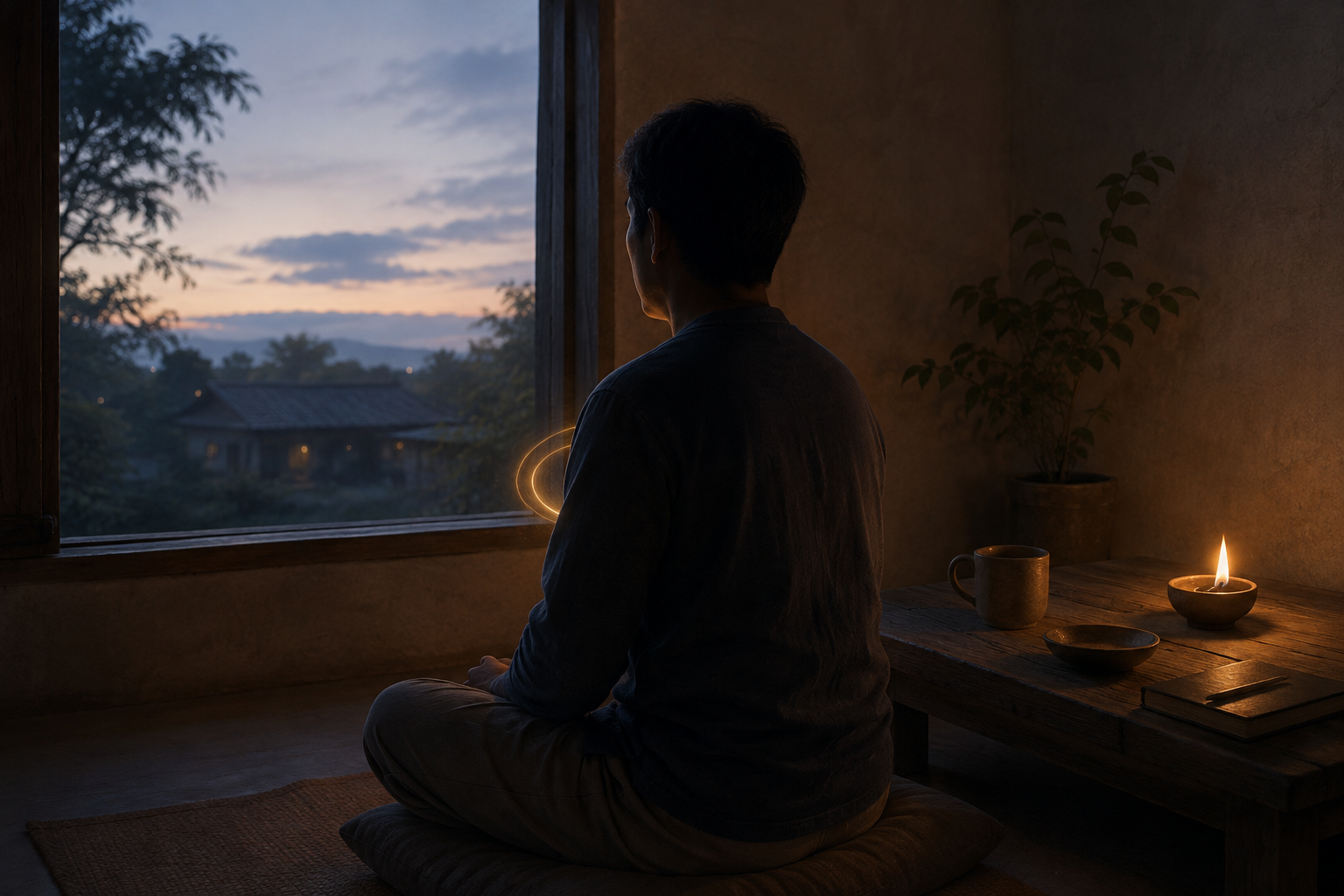
You can test whether you understand the distinction through ordinary experience. This is philosophical contemplation, not a substitute for lineage-specific instruction in mantra, yantra, ritual worship, or other formal Srividya disciplines. Its purpose is modest: to make the terms intelligible without pretending that a short exercise confers initiation or proves an entire metaphysical system.
- Choose an uncomplicated appearance. Sit without distraction and attend to a sound, a bodily sensation, or the movement of breathing. Do not search for an unusual state.
- Notice presence before interpretation. Before naming the sound or judging the sensation, recognize the simple fact that something appears.
- Turn from the object to its appearing. Ask what allows this experience to be present at all. Do not manufacture a verbal answer. Let the question redirect attention from the object to awareness.
- Notice that the appearance is known. Experience is not merely present like an unknown mark in a sealed room. Its presence and its being known are given together. This offers an entry into the meaning of Vimarsha.
- Look for the alleged boundary. Can you locate Prakasha first and Vimarsha later, as two successive objects? Or are illumination and knowing distinguishable only when thought describes the event?
- Include the next thought. If a thought says that you understood, failed, became distracted, or felt nothing, treat that thought as another illuminated and known appearance. You do not need to fight it.
- Return to ordinary activity. Carry the same inquiry into seeing, speaking, deciding, or listening. The teaching becomes useful when it changes how you notice experience, not when it remains confined to a quiet seat.
Do not expect to find consciousness as an object beside sounds and sensations. Prakasha names that by which objects become present, so turning it into one more thing to observe defeats the inquiry. The more useful question is whether anything you observe stands outside appearing and knowing.
This contemplation gives you a phenomenological foothold, not a final proof. It can show why the distinction is meaningful in experience. The larger claim that consciousness and its power constitute the heart of existence belongs to the philosophical vision of Srividya and must be understood on its own terms.
Key takeaways for reading and practice
- Prakasha is conscious luminosity, not ordinary physical light or a vision to be acquired.
- Vimarsha is consciousness’s immediate self-knowing and expressive power, not merely analytical thought.
- The terms mark a real distinction in meaning, but not two independent substances.
- Prakasha without Vimarsha would be an inert abstraction; Vimarsha without Prakasha would lack a conscious ground.
- Manifestation is understood here as an expression of conscious power, not as something wholly external to consciousness.
- Ordinary perception offers a useful point of contemplation, but it does not replace formal guidance in Srividya practice.
The next time you meet these terms, apply one test: does the explanation preserve their inseparability? If it turns Prakasha into a remote absolute, Vimarsha into mere thought, or the world into an unrelated second reality, pause and correct the frame.
Then bring the teaching back to the next ordinary moment. Notice what appears, notice that it is known, and see whether those are ever truly two events. That inquiry is a sound beginning. If you proceed into formal Srividya, ask your teacher how the same unity is embodied in the symbols and disciplines of the lineage rather than assembling advanced practices from disconnected instructions.
References
