

If your temple’s safety system depends on everyone believing that a priest is a good man, you do not yet have a safety system. Character matters, but reverence, reputation and ritual knowledge cannot do the work of screening, boundaries, supervision and a credible complaint process.
The danger becomes acute when spiritual authority is combined with fear and privacy. In Oshawa, a family hired a visiting pandit who was later arrested and charged with sexual assault after a woman alleged that he told her she was possessed, isolated her for a supposed healing ceremony and assaulted her. A charge is an allegation unless guilt is established through due process. The practical lesson is not to distrust every priest. It is to ensure that no priest, guru, teacher or ritual specialist can acquire unchecked power over a devotee.
Key takeaways for temple leaders and families
- Screen every person whose religious role gives them private access to devotees, including visiting and independently hired priests. Reputation is not a substitute for verification.
- Require informed consent for touch, privacy and unusual ritual actions. A devotee must be free to stop a ceremony without argument or threats of spiritual harm.
- Do not permit a claim of possession, impurity, a curse or supernatural danger to become a reason for secrecy, isolation, undressing or unwanted contact.
- Publish reporting paths that do not depend on the accused person’s friends, relatives or chain of authority.
- Respond to an allegation by protecting people, preserving information and involving the appropriate professionals. Do not force reconciliation, conduct an amateur interrogation or treat an allegation as a proven verdict.
- When misconduct is established, name it as adharma, remove the offender’s access and examine the institutional failures that allowed the conduct to occur.
Vetting must cover access, not just official titles
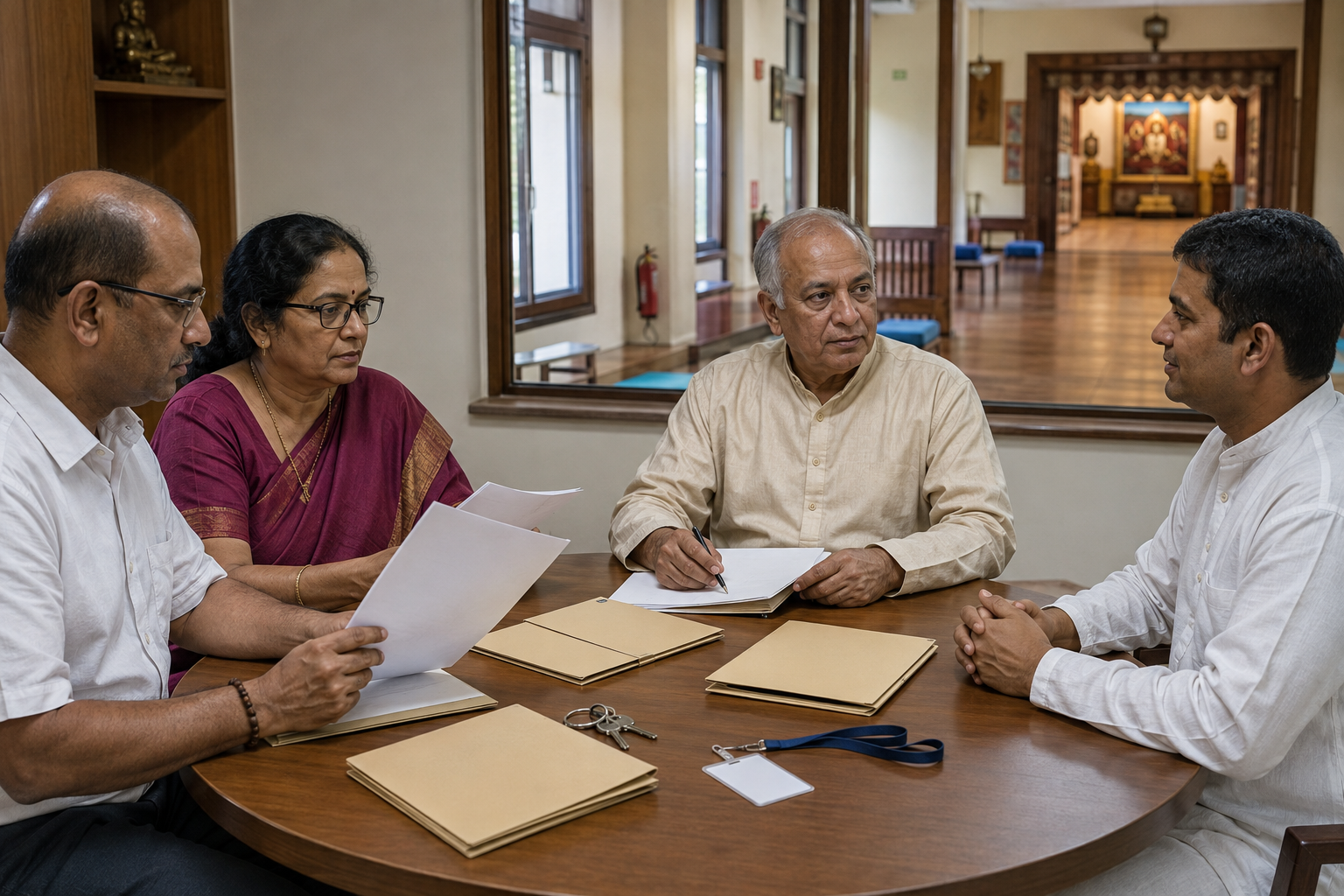
Temples often screen formal employees while leaving a large informal circle untouched. That gap can include visiting pandits, guest teachers, volunteers, spiritual counsellors and people recommended by respected families. The relevant question is not whether someone is on the payroll. It is whether the temple’s name or facilities give that person authority and access.
Begin with a role inventory. List everyone who meets devotees privately, enters homes on the temple’s recommendation, works with children, assists adults who need support, handles sensitive personal information or presents themselves as acting for the temple. Apply the safeguarding process before access begins, not after someone has become popular or difficult to challenge.
A documented screening process should include:
- Verification of identity and current contact information.
- A criminal-record or equivalent background check where it is lawful, relevant and available. The temple should obtain local advice about consent, privacy, permitted checks and record retention.
- Direct contact with previous temples, employers or institutions. Use independently verified contact details where possible rather than relying entirely on names and numbers supplied by the applicant.
- Questions about prior dismissals, restrictions, substantiated disciplinary findings and any refusal by another institution to permit work involving private access.
- Verification of claimed training, affiliation or authorization when the person relies on those credentials to gain trust.
- A signed code of conduct that applies in the temple, online, during travel and inside private homes.
- Fresh review whenever a person’s duties change, credible concerns arise, or an existing check expires under the relevant local system.
A background check is a gate, not a guarantee. It can reveal only information that was recorded, retained and available to the search. Someone with no disclosed record can still violate boundaries. That is why screening must operate alongside supervision, consent rules and accessible reporting.
Cross-border invitations deserve the same scrutiny as local appointments. Travel documents, clerical clothing, family recommendations and public religious activity do not establish a person’s safety. A host temple or family should confirm identity, references, planned duties, accommodation and the boundaries governing private ceremonies before issuing an invitation.
Do not turn vetting into gossip. Share sensitive information only with people who need it for a legitimate safeguarding decision, secure the records and obtain legal advice before communicating allegations or employment details. Equally, do not use privacy as an excuse to conceal a substantiated finding from those responsible for preventing further access.
Ritual authority never cancels bodily autonomy

A sacred purpose does not make every proposed action appropriate. Before a ceremony, the devotee should know its purpose, location, expected participants, approximate sequence, anticipated physical contact, clothing requirements and charges. If an unusual need emerges, the priest should explain it and obtain fresh consent rather than treating the original agreement as unlimited permission.
Silence, uncertainty or obedience is not a reliable substitute for consent. Nor is agreement meaningful when it is produced by threats that refusal will cause divine punishment, family disaster, continued possession or spiritual contamination. The person may pause or end the ritual, leave the room and contact someone they trust.
A temple code should make the following boundaries explicit:
- No sexual contact or sexualized conduct may be presented as ritual, initiation, healing, blessing or spiritual instruction.
- Any legitimate touch must be explained before it occurs and limited to what the devotee has accepted.
- A change of clothing must occur privately and away from the priest. A ritual must not be improvised to require nudity or intimate exposure.
- A priest must not lock a door, obstruct an exit, take away a person’s telephone or prevent a chosen support person from remaining nearby.
- Private pastoral conversations should occur in a setting that preserves reasonable confidentiality without creating physical isolation. The devotee should be able to request an open door or a trusted support person.
- Children and adults who depend on others for assistance require safeguards suited to their needs, including the presence of a responsible support person and compliance with local protection laws.
- No religious worker may demand secrecy about conduct that made a devotee feel unsafe or use spiritual status to discourage a complaint.
- Ritual care must not be represented as a substitute for medical, psychological, emergency or legal help.
A safeguarding policy does not need to settle every theological question about possession, curses or spiritual affliction. It does need to prohibit the use of such claims to create panic, dependency, secrecy or unwanted bodily access. If someone is distressed, disoriented, injured, at risk of self-harm or unable to make a free decision, stop the ritual and seek appropriate professional help. Do not diagnose the person or intensify fear.
If you are arranging a ceremony at home
Ask the temple or organizer to confirm who the priest is, how the person was vetted and whom you can contact if something goes wrong. Agree on the ceremony’s general form and fees in advance. Keep a trusted person present or close enough to enter immediately. Do not accept a sudden demand for total privacy merely because it is framed as spiritually necessary.
If a ritual leader frightens you, blocks your exit, asks you to conceal what will happen or touches you without permission, end the ceremony. Move to a safe place and contact someone you trust. If there is immediate danger, call local emergency services. Preserve relevant messages, booking records and payment information, but do not put yourself at further risk to gather evidence.
Build reporting and response around safety and fairness

A complaint route is ineffective if every report goes to the head priest or to a committee dominated by the accused person’s close associates. Publish an internal safeguarding contact and a genuinely independent route outside the accused person’s authority. Display them at the temple, on the website and in confirmations sent for home ceremonies. Explain how children, visitors, volunteers and people who do not speak the temple’s main language can raise a concern.
The reporting notice should say what kinds of concerns can be raised, how information will be handled, when confidentiality may have to be limited, and that retaliation is prohibited. Accept reports about visiting priests and off-site conduct when the temple arranged, endorsed or facilitated the access. Allow a trusted person to help someone report. An anonymous channel can help reveal a risk, although the temple should explain that anonymity may limit investigation and follow-up.
A credible allegation may indicate that other people have relevant experiences. In the Oshawa case, police expressed concern that there could be further victims. If outreach becomes necessary, coordinate it with the appropriate authorities and legal advisers. Use neutral wording, provide a safe reporting route and do not publish identifying details about the affected person.
What to do when someone reports harm
- Listen without challenging, blaming or pressing for unnecessary detail. Ask what the person needs for immediate safety and whether the accused still has access to them or others.
- Call emergency services when someone faces immediate danger or needs urgent medical attention. Determine local reporting duties promptly, especially when a child or an adult requiring protection may be involved. Those duties vary, so the temple should obtain qualified local advice before a crisis.
- Do not promise absolute secrecy. Explain that information will be restricted to people who need it for safety, legal compliance and a fair process.
- Record the person’s own words accurately. Preserve relevant schedules, booking forms, messages, access records and available security footage. Do not edit records, circulate them in informal messaging groups or demand access to the person’s private devices.
- Restrict the accused person’s access while an appropriate assessment proceeds when continued access could create risk. Describe this as an interim safety measure, not a finding of guilt, and obtain employment or legal advice where necessary.
- Give the affected person information about independent victim support, medical care, counselling, police and legal options. For an adult able to decide, respect their choices except where immediate danger or a legal reporting duty requires action.
- Refer suspected criminal conduct to the appropriate authorities. An internal committee may address access and discipline, but it must not obstruct, replace or contaminate a criminal investigation.
- Protect the reporter and witnesses from retaliation, pressure, ostracism and attempts to force withdrawal. Continue checking whether they can participate safely in community life.
Do not ask an affected person to confront the accused, accept a private apology, undergo another ritual or join a mediation session. Reconciliation may be meaningful in some disputes, but it is not a safe first response to alleged sexual or coercive abuse. Forgiveness cannot be demanded, and it does not erase accountability.
Fairness applies in both directions. Temple leaders should not declare guilt merely because an accusation has been made, and they should not declare innocence merely because the accused is revered. Use neutral language, separate interim protection from final discipline, avoid public speculation and rely on competent investigators and lawful processes.
Make safeguarding part of temple governance

A policy that exists only in a folder will fail when a respected person is accused. The governing body should assign named responsibility for safeguarding, designate an alternate when the lead has a conflict and give those people authority to impose immediate access restrictions. The priesthood must be subject to the policy, not in sole control of it.
Training should use realistic situations: an unexpected request for a private healing ritual, a child who discloses uncomfortable touching, a volunteer who notices repeated isolation, a family that wants secrecy and a complaint involving a major donor. Participants should practise whom to contact, what to record, what not to promise and when outside help is required.
The governing body should also verify that:
- The code covers employees, office-bearers, volunteers, visiting teachers and independent religious workers presented under the temple’s name.
- Home visits, transport, overnight events, online communication and private instruction have clear boundaries.
- Screening records, incident files and access restrictions are stored securely and reviewed by authorized people.
- Conflicts of interest require recusal. No relative, close associate or direct subordinate of the accused controls the response.
- Insurance arrangements and contracts are consistent with the safeguarding policy and local law.
- Every incident triggers a review of the system as well as the individual’s conduct. The question is not only who acted wrongly, but what access, warning or governance failure made the harm easier.
- Community communication distinguishes allegation, charge, interim restriction and established misconduct instead of collapsing them into a single verdict.
When misconduct is established, leadership should condemn it plainly as adharma, end the offender’s access, cooperate with lawful accountability and communicate enough to protect the community without exposing the affected person. Calling an offender fake does not answer how access was granted or why warning signs were missed. A credentialed or knowledgeable person can still abuse authority; the system must be built for that possibility.
Protecting Dharma does not mean protecting an institution from embarrassment. It means protecting people, telling the truth carefully and refusing to let sacred authority become a shield for coercion. At your next governing meeting, assign ownership of the policy, suspend unsupervised high-risk access until safeguards are in place, and keep the item open until screening, ritual boundaries and reporting routes are operating in practice.
References
