
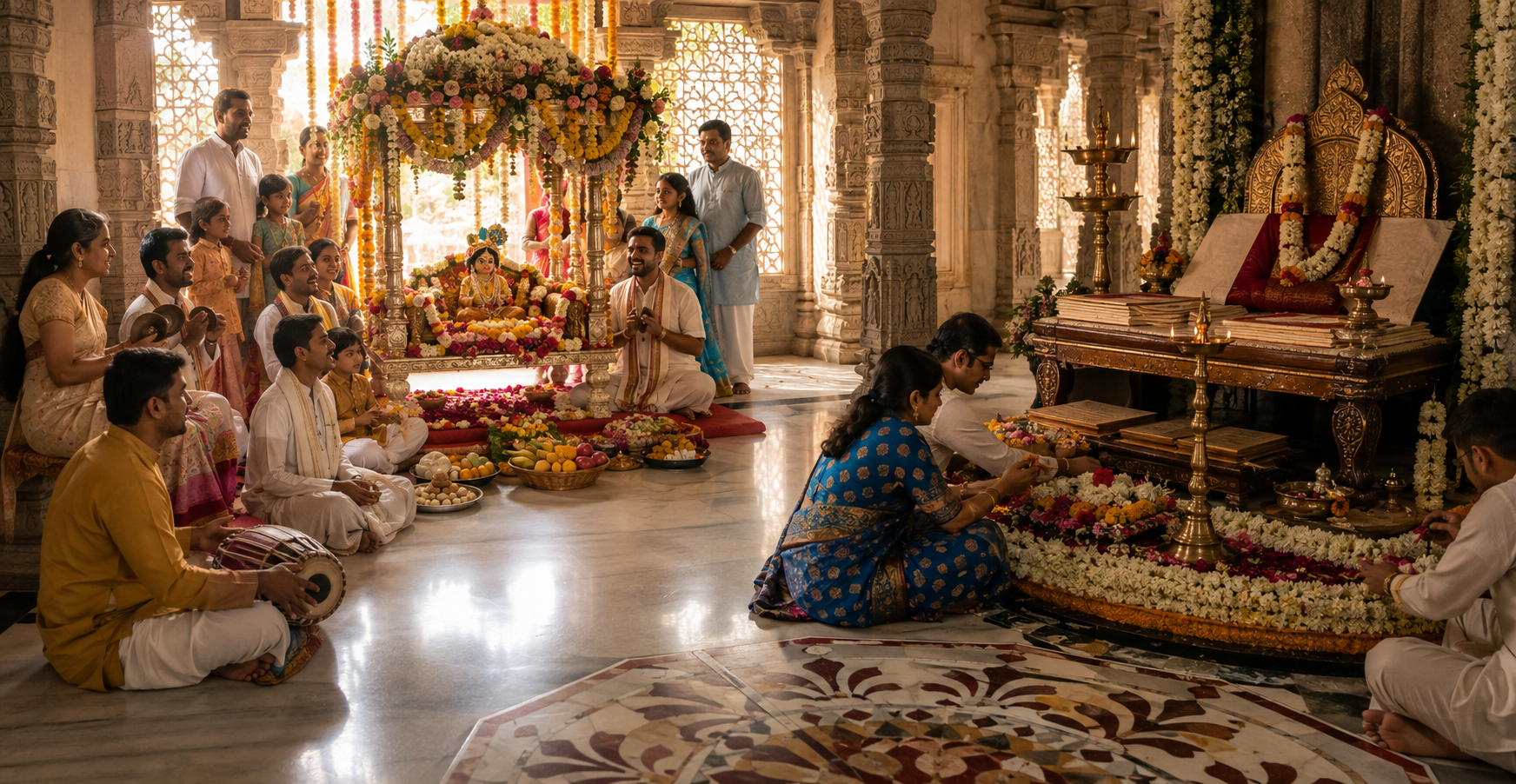
If your temple calendar places Nandotsava and Vyasa Puja in the same program, do not assume they are two names for one festival. You are entering two related but distinct devotional movements: welcoming Krishna with communal joy, and honoring the lineage through which dharmic knowledge reaches you.
That distinction settles the practical questions. It tells you what to celebrate, whom to honor, what kind of offering to prepare, and how to participate without importing customs from a different lineage.
One calendar day can carry two devotional intentions
Nandotsava follows Krishna Janmashtami and celebrates the joy surrounding Lord Krishna’s birth. Its devotional setting is the household of Nanda in Vraja, where the arrival of child Krishna becomes a cause for shared happiness. That gives Nandotsava its characteristic direction: joy moves outward through kirtana, hospitality, prasada, generosity, and service to the assembled devotees.
Vyasa Puja turns your attention toward sacred transmission. Vyasadeva represents the preservation and teaching of Vedic knowledge. In many Vaishnava lineages, a spiritual master or acharya is honored as a representative of Vyasa because that teacher carries shastra through a living guru-parampara. The worship is therefore not ordinary admiration for a personality. It is gratitude for the faithful transmission of dharma.
The two observances can share a date without losing their separate meanings. Nandotsava asks, “How will we share the joy of Krishna’s appearance?” Vyasa Puja asks, “How did this wisdom reach us, and how are we responding to it?” In Perth, for example, Sri Vyasa Puja was scheduled for Saturday, 5 September 2026. Local timings and ceremonial details still belong to the hosting temple, so check its current program rather than relying on a general festival description.
Ask four questions before you arrive
“Vyasa Puja” does not identify a completely uniform ceremony. Depending on the sampradaya and calendar, the name may be associated with Vyasadeva, Guru Purnima, or the annual observance for a particular acharya. Before preparing an offering or promising to attend a certain portion, find out exactly what your temple is holding.
- Whose Vyasa Puja is being observed? Ask whether the worship is for Vyasadeva, a founder-acharya, the temple’s spiritual master, or another teacher recognized by that lineage.
- What is the order of events? Confirm the times for darshana, kirtana, formal puja, readings or spoken offerings, arati, and prasada. The Nandotsava celebration and Vyasa Puja may occupy different parts of the program.
- How are offerings received? Some communities collect written homages beforehand, some permit selected offerings to be read aloud, and others ask participants to offer flowers through an arranged procedure. Do not assume that arriving with an item guarantees it can be placed on the altar.
- Which local rules affect your visit? Ask about fasting or prasada arrangements, dress expectations, photography, seating, children’s participation, and volunteer needs. A brief message to the organizers prevents confusion at the temple door.
If you cannot obtain details, attend as a respectful listener. Follow the announced sequence, accept guidance from the pujaris and organizers, and do not improvise a mantra, altar placement, or ritual gesture. Customs that look similar from a distance can carry different meanings within different lineages.
Participate with two distinct intentions
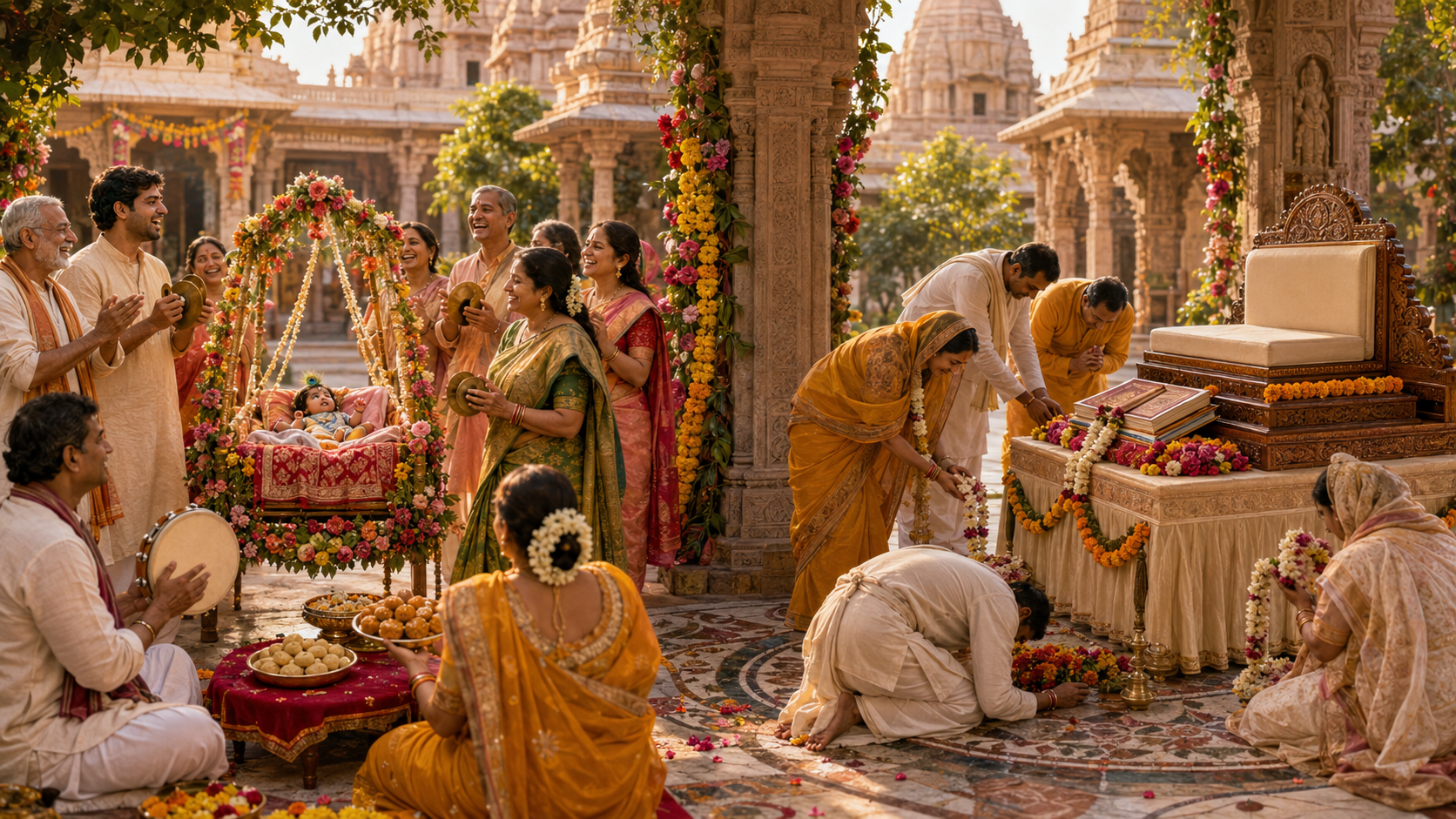
Let Nandotsava turn happiness into hospitality
The easiest way to miss Nandotsava is to consume it as a colorful program. Its joy becomes devotional when you help that joy reach someone else. Choose at least one form of participation that serves Krishna and the gathered community.
- Join the hearing and chanting. Give the kirtana and Krishna-katha your attention instead of treating them as background for conversation or photography.
- Offer through the temple’s system. If you want to bring food, flowers, clothing, or another item, ask first what is accepted and where it should go. Personal enthusiasm does not override altar discipline.
- Take a practical seva. Serving prasada, welcoming visitors, helping families find space, cleaning after the feast, or supporting an assigned task gives the celebration a communal form.
- Include newcomers without pressuring them. Explain quietly what is happening, show them where to sit, and let them observe before expecting them to copy gestures they may not understand.
For children, give the day one clear devotional center. They can hear how Nanda’s household rejoiced, help with an approved decoration, join a simple kirtana, or assist an adult with prasada service. A small responsibility usually teaches more than a long explanation delivered while the ceremony is moving.
Make Vyasa Puja gratitude accountable
A Vyasa Puja offering should reveal what you have received and what you intend to do with it. Inflated praise can sound devotional while avoiding that responsibility. A short, truthful offering is stronger.
- Name one teaching. Identify a teaching from the acharya or guru that you actually understand. Avoid a catalogue of titles and accomplishments unless the occasion specifically calls for it.
- Describe its correction. State plainly what misunderstanding, habit, or neglect the teaching exposed in you. Keep the focus on spiritual instruction, not on an unrelated autobiography.
- Name one practice. Say how you will respond through study, sadhana, seva, conduct, or a duty already recognized by your tradition. Choose something concrete enough that you can remember it after the ceremony.
- Close with gratitude. Thank the teacher for transmitting dharma without claiming realization, intimacy, or obedience that you do not possess.
If you have not accepted the person being honored as your guru, you can still listen respectfully and appreciate the role of the guru-parampara. You do not need to imitate the language of discipleship or make a vow that is not yours. Honest reverence preserves the seriousness of both the relationship and the ceremony.
A home observance should follow your actual tradition
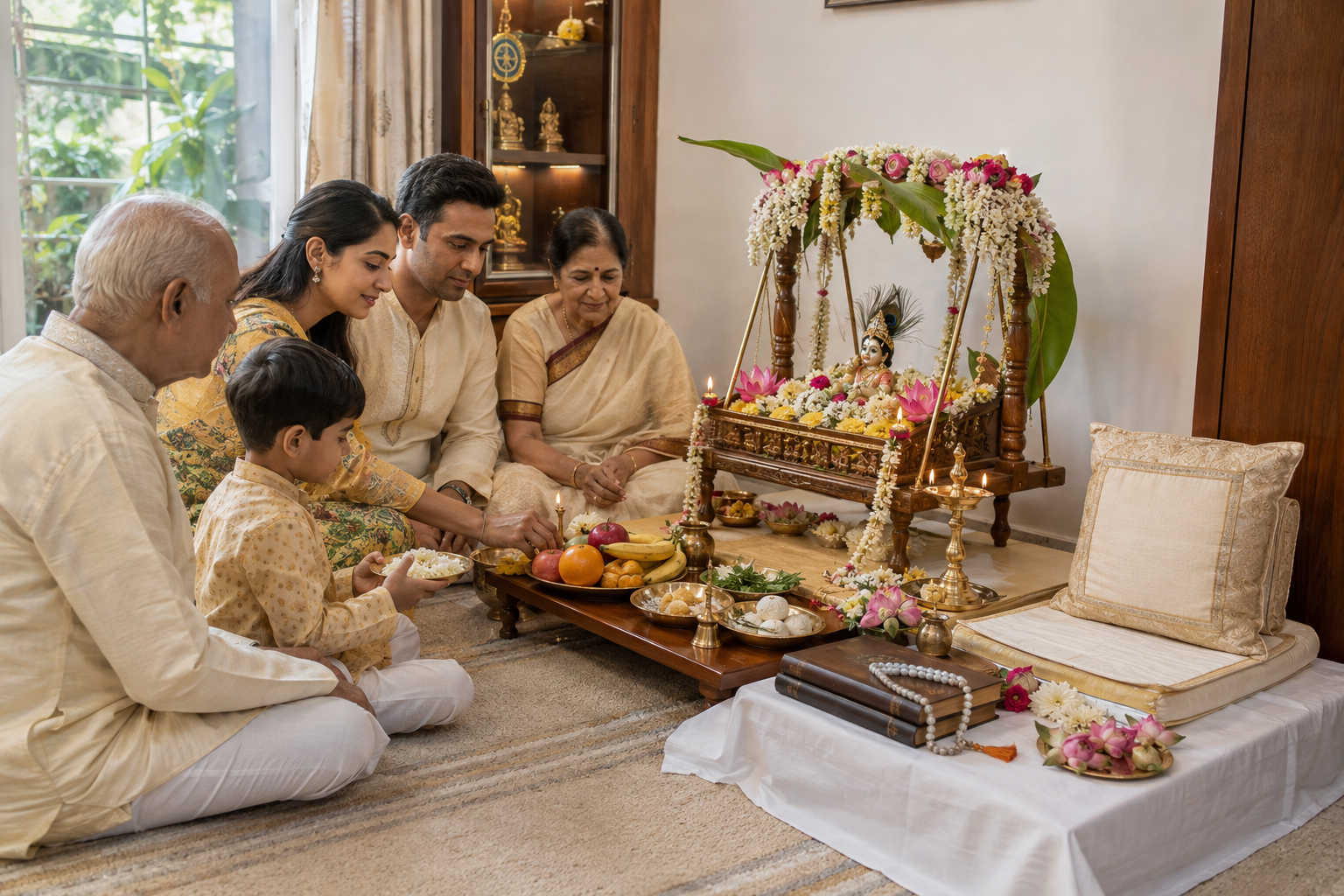
A home observance does not need to reproduce a large temple program. It does need a clear devotional center and respect for your household’s established practice. If your family follows a particular puja-paddhati, use it. If it does not, keep the observance simple rather than assembling a new ritual from unrelated videos.
- Clarify whom you are honoring. State that Nandotsava celebrates Krishna’s appearance. For Vyasa Puja, identify Vyasadeva, your lineage, and any particular acharya your tradition authorizes you to honor.
- Prepare the space. Clean the altar area and arrange only the images, lamps, flowers, and implements normally used in your home worship. Do not place a teacher’s image on the altar merely because you saw another community do so.
- Observe Nandotsava. Sing Krishna’s names, read your tradition’s account of the birth celebration, and prepare a vegetarian offering according to your household rules. Share the resulting prasada rather than making the meal the private reward at the end.
- Observe Vyasa Puja. Read a passage from the teacher or lineage being honored. Offer your written gratitude privately or aloud with your family. Flowers, incense, aarti, and formal mantras should follow the practice you have received.
- Complete one outward service. Share prasada, support a temple, help a devotee, or carry out a neglected duty. This prevents both observances from ending at the level of ceremony.
If personal guru worship is not part of your tradition, do not manufacture it. You can honor Vyasadeva and the teachers through whom you have genuinely received dharmic knowledge, or concentrate your home program on Nandotsava. Fidelity is more important than copying the most elaborate celebration you can find.
Key takeaways
- Nandotsava celebrates Krishna’s birth through shared joy, hospitality, prasada, kirtana, and seva.
- Vyasa Puja honors Vyasadeva and, where the lineage directs, an acharya or guru who transmits sacred teaching.
- When both appear on one temple calendar, preserve their different intentions instead of treating one name as a synonym for the other.
- Before attending, confirm whose Vyasa Puja is being held, the event sequence, the procedure for offerings, and the temple’s local rules.
- At home, use the worship you have actually received; do not invent mantras or copy another lineage’s altar practice.
Before the observance begins, do three things: check the temple schedule, choose one concrete seva, and write four honest sentences of gratitude. You will arrive ready to participate rather than merely watch, while allowing both Krishna’s welcome and the guru-parampara’s gift to retain their proper place.
References
- Dandavats – Live Sri Vyasa Puja Celebration (The Most Blessed Event)
- Dandavats – Nandotsava Explained | The Celebration of Lord Krishna’s Birth
