
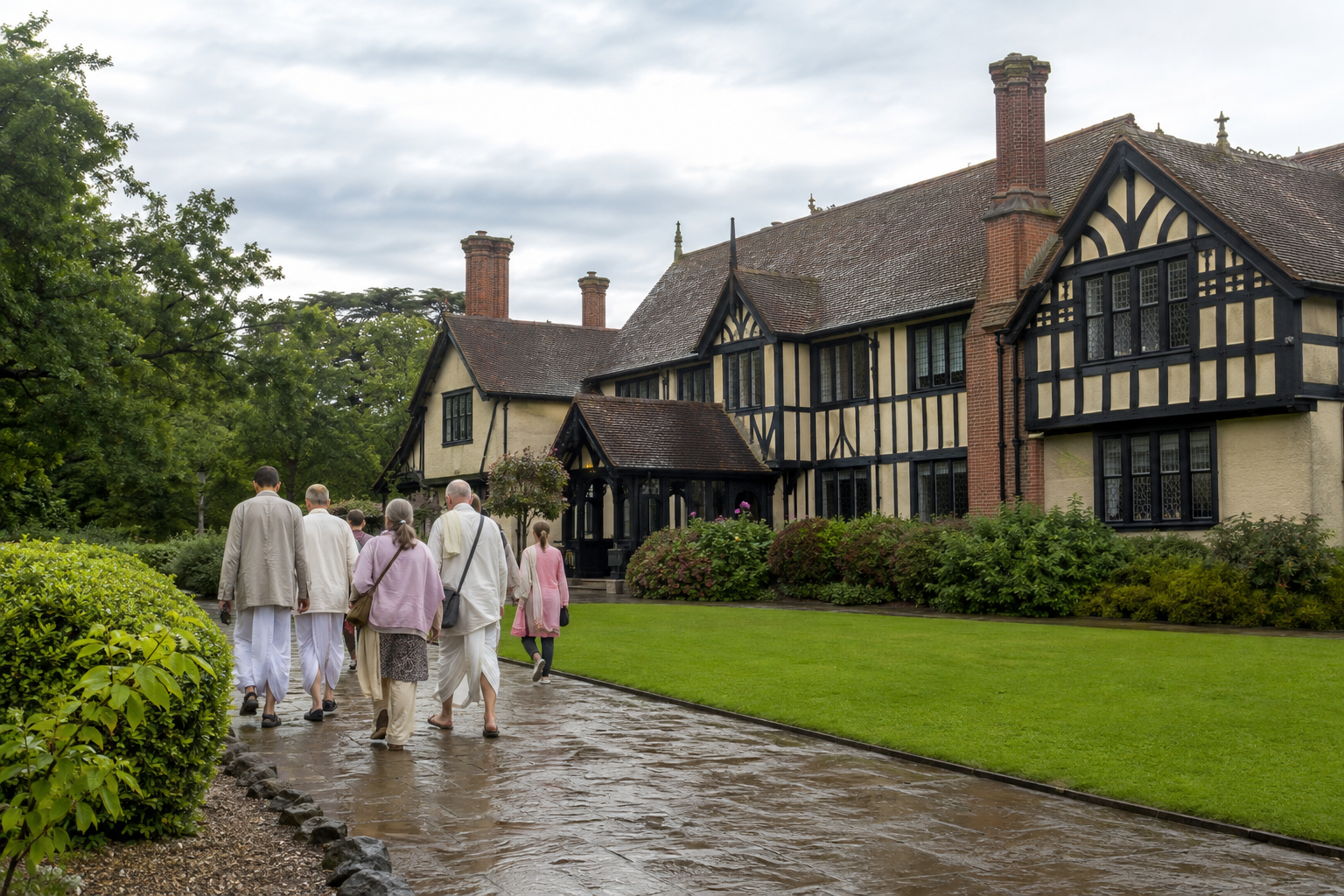
If you are deciding whether to visit Bhaktivedanta Manor, the most useful thing to know is that it should be approached as a working place of worship. Its beauty may draw your attention first, but its purpose is Krishna bhakti: devotion expressed through worship, sacred sound, service, teaching and the sharing of prasada.
This profile will help you understand what kind of temple it is, what to notice once you enter and how to participate respectfully even if you have never attended an ISKCON programme.
A Gaudiya Vaishnava temple in the United Kingdom
Bhaktivedanta Manor is the United Kingdom’s largest ISKCON temple. That description identifies its institutional scale, but you need its religious identity to understand the place properly.
ISKCON belongs to Gaudiya Vaishnavism, a Hindu Vaishnava tradition centred on loving devotion to Krishna. A.C. Bhaktivedanta Swami Prabhupada founded ISKCON and carried this devotional tradition to communities outside Bharat. The name Bhaktivedanta therefore points to a lineage of disciplined devotion rather than serving merely as a commemorative label.
Gaudiya Vaishnava thought is often associated with acintya-bheda-abheda: the teaching that the individual being and the Divine are simultaneously distinct and connected in a way that exceeds ordinary categories. In practice, this philosophy becomes bhakti. The devotee does not seek merely to hold an idea about Krishna, but to cultivate a relationship through remembrance, worship, chanting and seva.
This makes Bhaktivedanta Manor specifically Hindu and specifically Gaudiya Vaishnava. Calling it only a meditation centre, a cultural venue or a generic expression of Indian spirituality erases the theology that gives its practices meaning. You do not need to share that theology to visit, but you should allow the temple to describe itself on its own terms.
Read the worship before you read the architecture
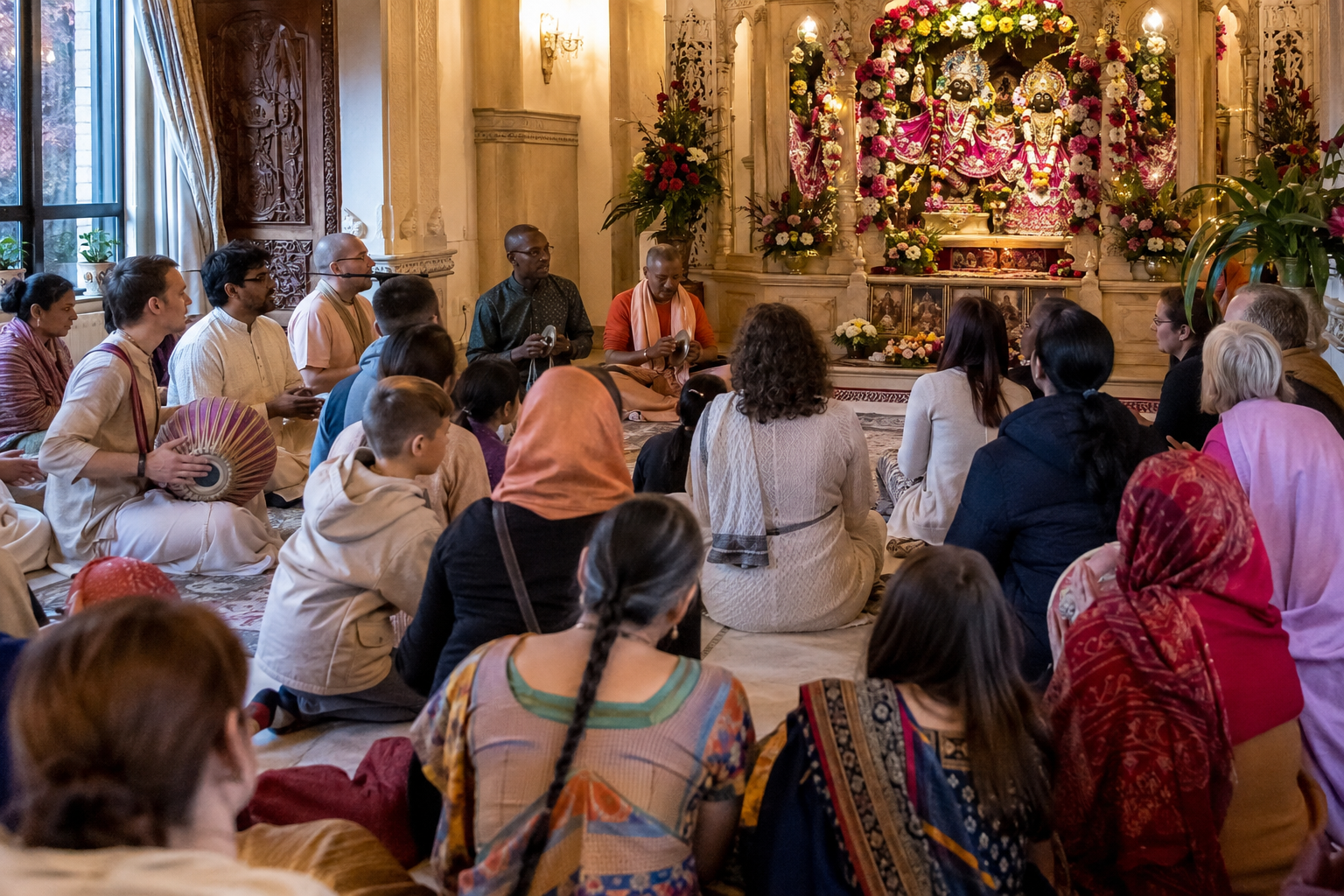
A first-time visitor can spend so much attention on the building and visual details that the living structure of the temple is missed. Look instead for three connected movements: darshan, kirtan and seva.
Darshan means more than looking at an image. Within murti worship, the deity is approached as a personal divine presence rather than as decorative religious art. Devotees may stand quietly, bow, offer prayers or simply direct their attention towards Krishna. If you are unfamiliar with the practice, pause and observe. You do not have to imitate another person’s gesture to show respect.
Kirtan is congregational devotion through sacred sound. Its repeated call-and-response form can appear simple, but repetition is part of the discipline: attention is repeatedly brought back to the divine names. You can listen until you understand the rhythm, then join the response if you feel comfortable. Participation should be attentive, not performative.
Seva means service offered with devotional intention. It corrects a common misunderstanding of bhakti as emotion alone. Preparing a space, welcoming a guest, caring for sacred objects, singing, cooking or completing an ordinary practical task can all become devotional when offered to Krishna. If you notice worshippers engaged in apparently mundane work, do not assume that the spiritual programme has stopped. The work may be part of it.
Prasada brings these movements together. It is food that has first been offered to Krishna and is then received as grace. If prasada is available during your visit, accept only what you intend to eat and treat it with care. Its meaning is not exhausted by describing it as vegetarian food or complimentary hospitality.
How to prepare for a respectful first visit
The exact character of your visit will depend on the programme taking place. A festival gathering, a congregational kirtan and a quieter period of worship will not offer the same experience. Check the temple’s current public timings and visitor instructions before travelling rather than relying on an old event notice or a third-party listing.
- Decide what you hope to attend. If you want to understand the devotional life, look for an advertised worship, kirtan or teaching programme. If you mainly want a quiet introduction, avoid assuming that a major festival day will provide it.
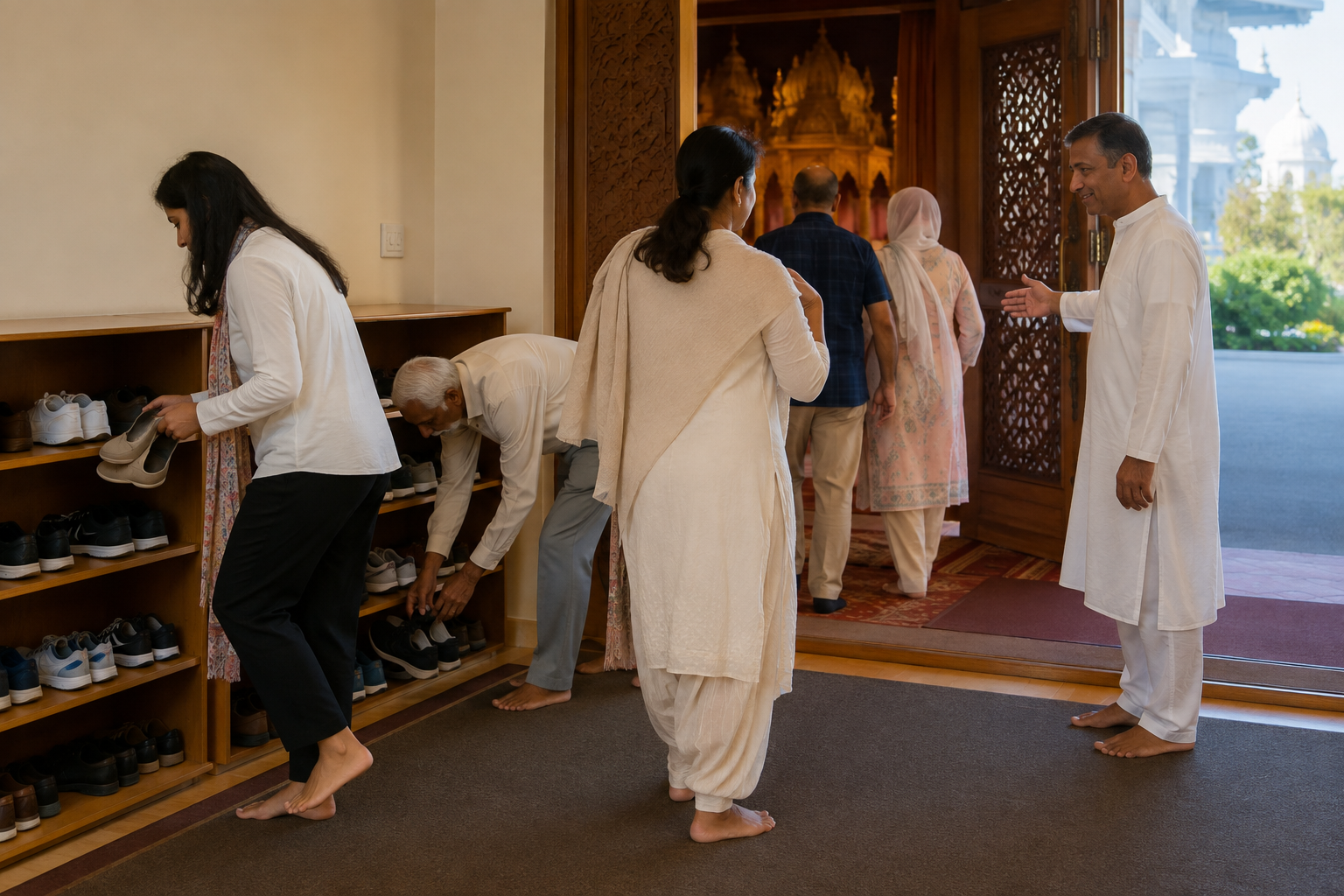
- Wear clean, modest clothing that permits you to sit and move comfortably. Choose footwear that can be removed easily, then follow the directions given at the temple rather than guessing where shoes are permitted.
- Arrive before the programme begins. That gives you time to identify the worship area, silence your phone and ask a practical question without interrupting prayer or teaching.
- Let local instructions govern photography. Do not assume that permission to photograph the building also permits photographs of deities, ceremonies, children or individual worshippers.
- If you have a food allergy or medical dietary restriction, ask what is in a preparation before accepting it. Vegetarian food can still contain dairy, nuts, gluten or other allergens, and its sacred status does not remove that practical risk.
Once inside, choose a place where you can observe without blocking a passage or standing directly in front of seated worshippers. Keep conversation low. If you are unsure what is happening, ask a volunteer or regular attendee after the immediate act of worship rather than speaking over it.
Three questions will resolve most uncertainty: “What is happening now?”, “Where should I sit?” and “Is it appropriate to take a photograph here?” Specific questions are easier to answer than a broad request for every rule, and they show that you recognise the temple as a community with its own devotional rhythm.
Participate without pretending that every tradition is identical
If you come from another Hindu sampradaya, much may feel familiar: darshan, aarti, mantra, prasada, reverence for the guru and the understanding that religious knowledge must be lived. The theological language and style of worship may nevertheless differ from those of your own lineage. Shared dharma does not require us to flatten those differences.
You can honour the hosts while retaining your own sampradaya’s convictions. Listen for how Krishna is addressed, how the guru-parampara is understood and how communal singing shapes the gathering. These details tell you more about Gaudiya Vaishnavism than a quick survey of the building can.
If you are not Hindu, begin with the same discipline: observe before interpreting. A murti is not an idol in the casual sense of an object mistaken for God, kirtan is not simply a musical performance, and prasada is not merely a meal. Those descriptions import categories that practitioners themselves would not accept.
You are free to listen without chanting, to stand without bowing and to decline food courteously. Honest restraint is better than copying gestures for appearance. If you do participate, do so because you understand the invitation well enough to receive it respectfully.
Why the Manor matters in the Dharmic diaspora
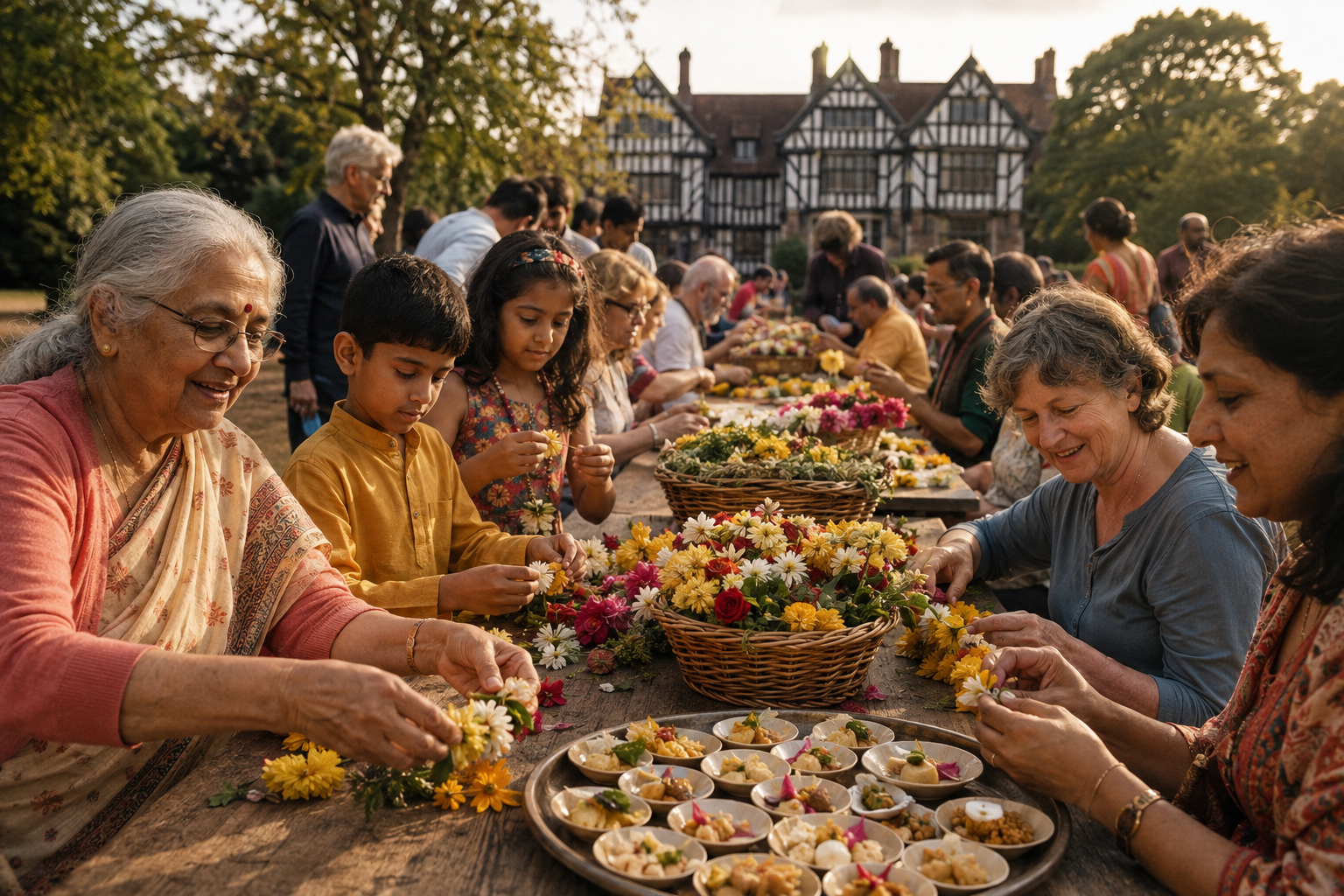
Its status as the country’s largest ISKCON temple matters for more than institutional prestige. A tradition remains alive outside its place of origin when practice can be repeated: worship can recur, sacred vocabulary can be taught, food can carry religious meaning, and relationships of service can form around a shared centre.
Bhaktivedanta Manor represents Krishna bhakti taking durable public form in Britain. For Hindu families, that kind of presence can make dharma part of ordinary communal life rather than something remembered only through ancestry. For neighbours and first-time visitors, it makes Hinduism visible as a complete religious tradition with theology, ritual, ethics, discipline and community.
A pro-Hindu reading does not need to turn the temple’s size into a civilisational scoreboard. The stronger point is continuity. A Dharmic institution abroad should be judged by whether it helps people practise, understand and transmit a tradition without reducing it to spectacle. When you visit, look for that continuity in the relationship between worship, learning, service and hospitality.
Key takeaways
- Bhaktivedanta Manor is the United Kingdom’s largest ISKCON temple and belongs to the Gaudiya Vaishnava tradition of Krishna bhakti.
- Approach it as an active sacred space, not merely as an architectural or cultural attraction.
- Darshan, kirtan, seva and prasada are connected forms of devotion, not separate visitor amenities.
- Check current timings, dress modestly, follow footwear directions and ask before taking photographs.
- You may observe without imitating unfamiliar gestures; informed respect matters more than outward performance.
- Notice both shared Hindu foundations and the temple’s distinct Gaudiya Vaishnava theology.
Choose a programme that matches what you want to understand, verify the practical details before leaving and arrive with enough time to become attentive. Bhaktivedanta Manor is best encountered when you allow its devotional life, rather than its scale alone, to explain why the place matters.
References
