
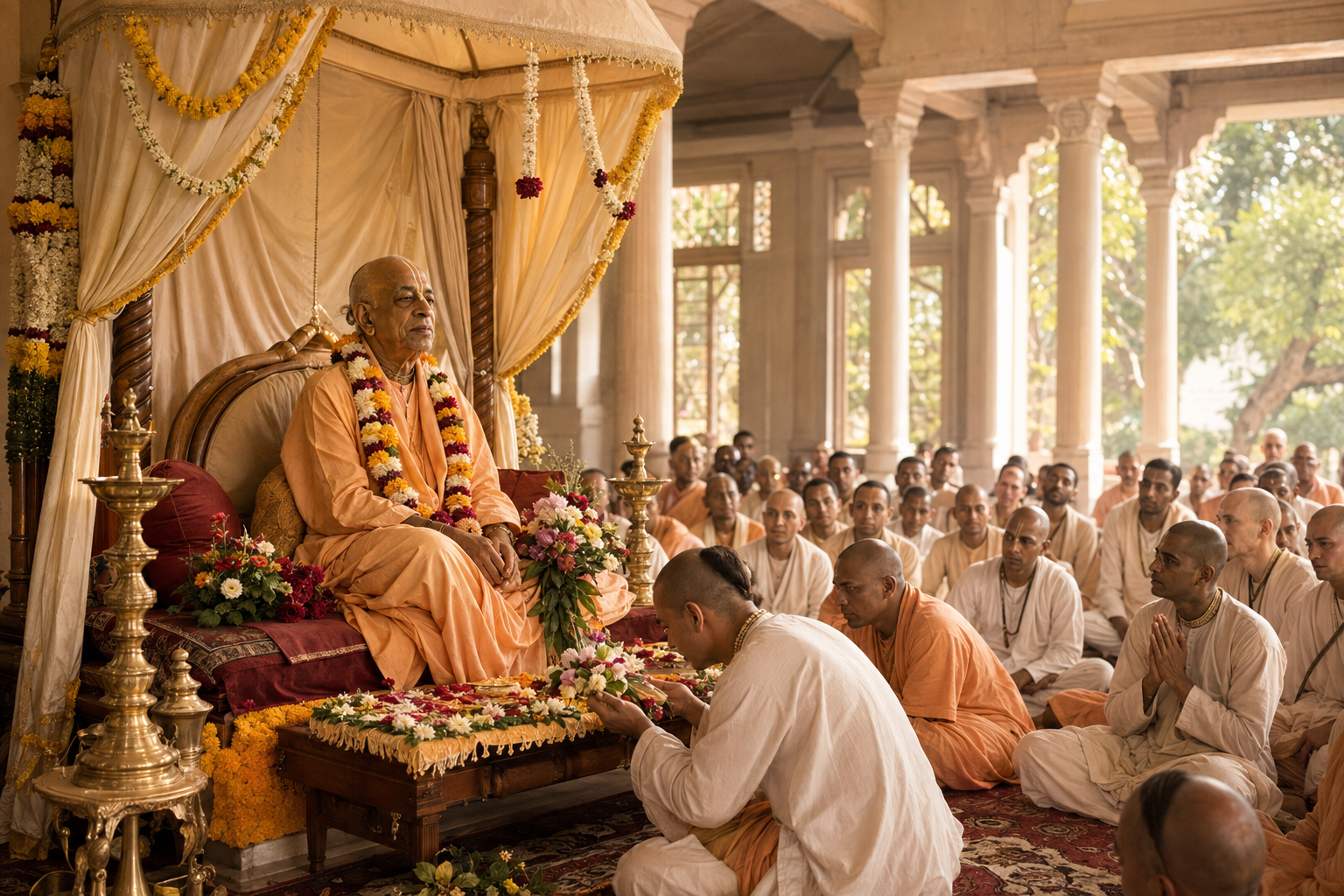
You may be deciding whether to attend a temple, join online, or observe Srila Prabhupada’s 130th Vyasa Puja quietly at home. The practical question is not simply where to watch. It is how to let the occasion shape your hearing, gratitude, and service.
On 5 September 2026, devotees can enter the observance through a live virtual event from Bhaktivedanta Manor in Watford and a live Mangala Arati darshan from Sri Sri Krishna Balaram Mandir in Vrindavan. These are not competing experiences. Each can help you approach the day attentively, wherever you are.
Vyasa Puja is gratitude expressed through discipleship
Within Gaudiya Vaishnava practice, Vyasa Puja honors the spiritual master as a representative of Vyasa and the disciplic transmission of sacred knowledge. That distinction matters. The day is not merely a birthday tribute to an admired religious personality. It asks what you have received through the acharya and what you are doing with that gift.
Celebration has its place: beautiful darshan, kirtan, offerings, remembrance, and the fellowship of devotees. Yet the inner measure of the observance is discipleship. Hearing should lead to application. Gratitude should become responsibility. Praise should sharpen, rather than replace, your willingness to serve.
Before joining the celebration, sit with three questions:
- Which teaching received through Srila Prabhupada has actually changed the way you live?
- Where do you already know the teaching but still postpone acting on it?
- What service can you undertake or strengthen after the celebration ends?
Your answers need not sound impressive. A plain and honest answer is more useful than ceremonial language that leaves your habits untouched.
Choose the form of participation that helps you pay attention
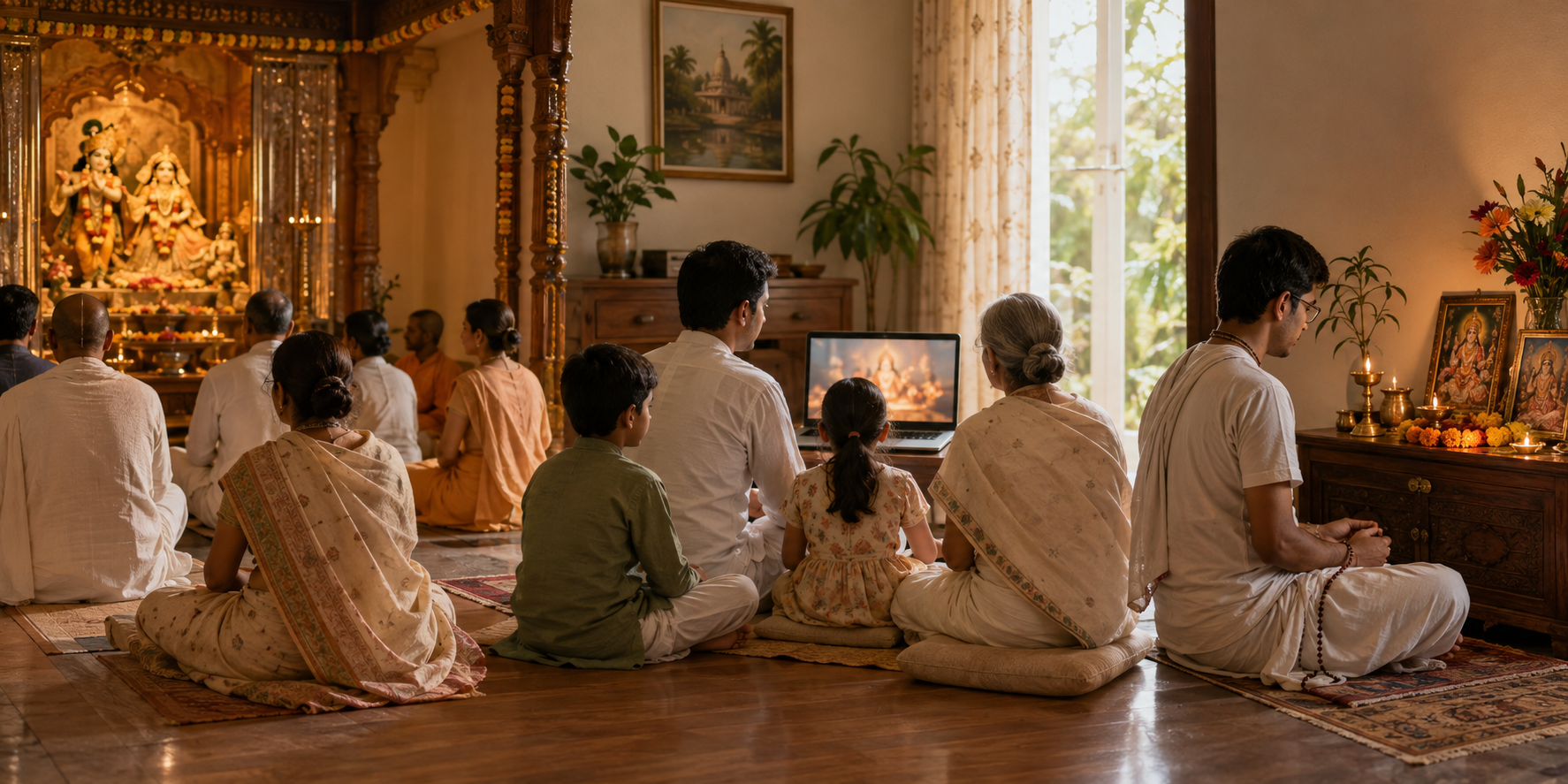
Bhaktivedanta Manor is presenting its observance as a virtual event live from the Hare Krishna temple in Watford. This is a natural choice if you want to connect with a community celebration and receive the occasion through a temple program.
The Vrindavan broadcast brings you Mangala Arati darshan from Sri Sri Krishna Balaram Mandir. Mangala Arati belongs to the prayerful opening of the temple day, so this option can anchor your observance in worship and darshan rather than commentary about the occasion.
Confirm the exact start time and current broadcast status through the event links before arranging your day. Avoid depending on a screenshot or forwarded message whose timing may be incomplete. If time zones or responsibilities prevent you from joining live, do not treat the entire observance as lost. Set aside an undistracted period for prayer, hearing, remembrance, and a written offering.
You also do not need to keep switching between broadcasts. Choose the setting in which you are most likely to remain present. A single program followed with reverence is better than several open tabs competing for your attention.
Prepare for the livestream as an observance, not background media
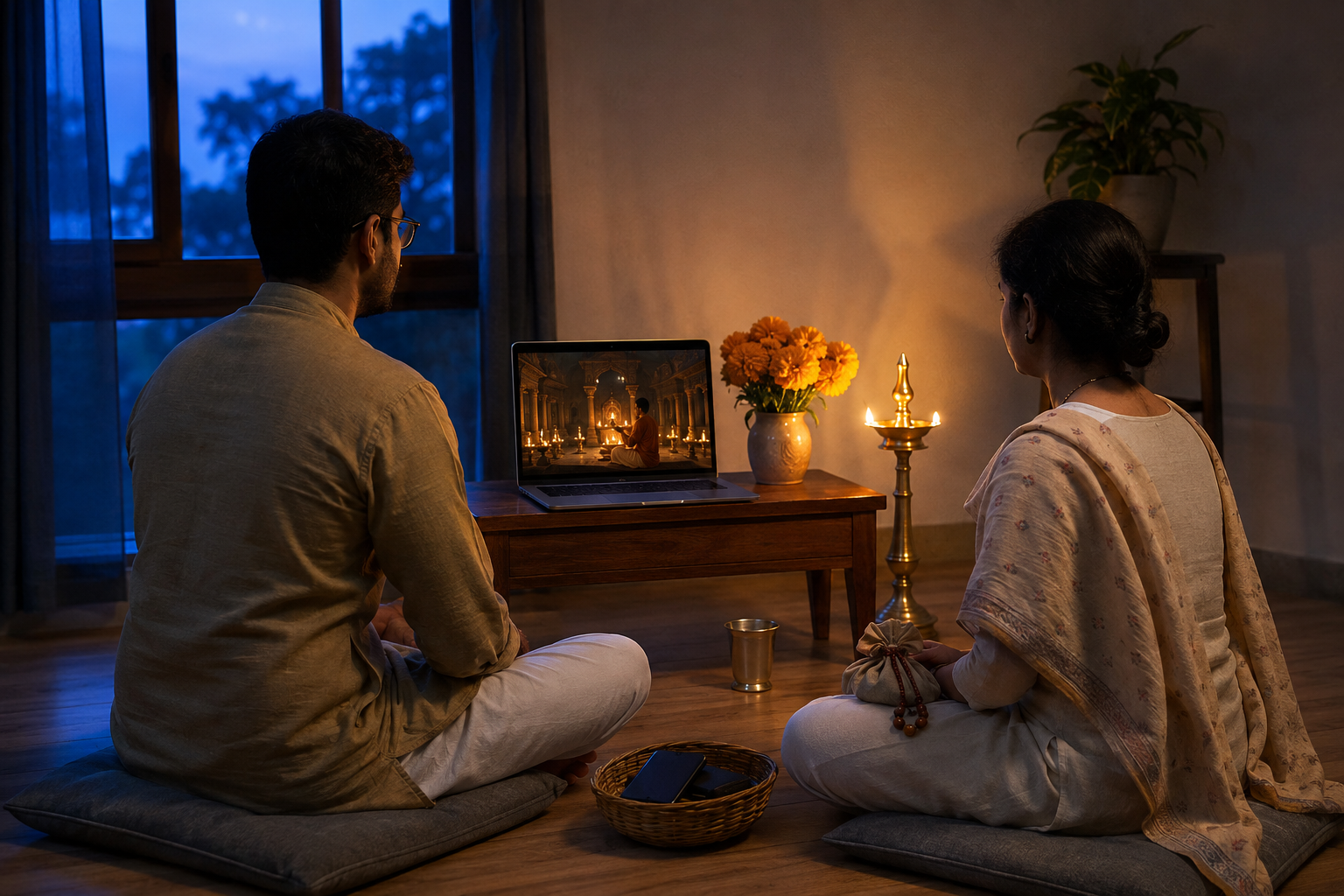
A sacred broadcast is easy to reduce to ordinary online content. The device is the same one that carries messages, news, and entertainment, so distraction enters almost automatically. A little preparation changes the quality of participation.
- Confirm access beforehand. Open the event page, check the timing, and make sure your sound and connection work. Technical scrambling during worship pulls attention away at exactly the wrong moment.
- Name your intention. Complete this sentence privately: “I am observing this Vyasa Puja to remember what I have received and to become more faithful in ________.” The blank turns a general celebration into a personal act of discipleship.
- Make the space deliberate. Put away unrelated tabs, silence avoidable notifications, and sit somewhere you can participate without treating the broadcast as background noise.
- Keep a notebook nearby. Record the teaching, remembrance, or question that most directly concerns your present conduct. Do not try to transcribe everything.
- Prepare an offering in your own words. Write what you are grateful for, where you have fallen short, and what service you intend to carry forward. Sincerity matters more than ornament.
During Mangala Arati or the temple program, join the prayers you know and observe respectfully when you do not know them. You do not have to perform familiarity. Attention, humility, and a willingness to learn are themselves meaningful forms of participation.
If you are observing with family or friends, give everyone room to contribute. A child may offer a drawing, a reader may share a remembered teaching, and another person may lead prayer or kirtan. Keep the focus on offering rather than presentation. The purpose is not to reproduce a large temple festival inside the home; it is to make the home receptive to the occasion.
Let your offering become a practice you can keep
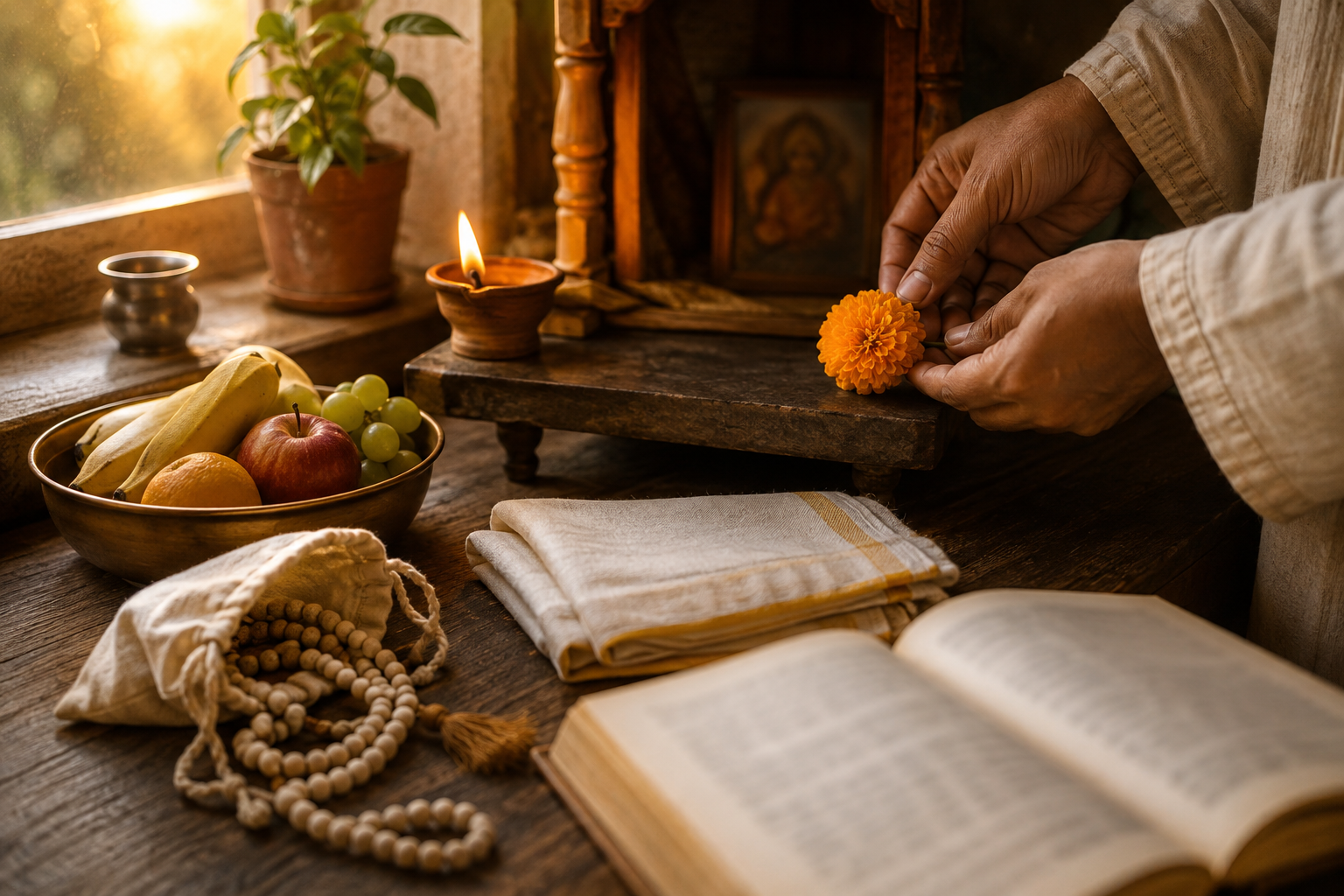
The most common weakness in a commemorative day is the gap between inspiration and the next ordinary day. Emotion rises during worship, but no decision is attached to it. When routine returns, the resolve has nowhere to go.
Close that gap before the celebration ends. Choose a commitment that is concrete enough to schedule and modest enough to sustain. It might concern attentive chanting, regular hearing, study of a selected teaching, support for a temple activity, sharing prasada, or dependable service to another devotee. Choose what addresses your real weakness, not what sounds most devotional when announced.
Write the commitment in this form: “Because I have received ________, I will offer ________. I will begin ________, and I will review my consistency on ________.” Fill every blank. If the promise has no action, starting point, or moment of review, it remains a sentiment rather than a practice.
Be especially careful with grand vows made in a heightened mood. A smaller service kept faithfully carries more weight than an ambitious declaration abandoned when enthusiasm settles. Vyasa Puja should strengthen steadiness, not create a brief performance of intensity.
You can also preserve a short written offering after the event. Revisit it when your practice feels mechanical or your sense of purpose becomes blurred. Its value is not as memorabilia. It is a record of what you understood yourself to owe in gratitude.
Key takeaways
- Srila Prabhupada’s 130th Vyasa Puja observances on 5 September 2026 include a live virtual event from Bhaktivedanta Manor and live Mangala Arati darshan from Sri Sri Krishna Balaram Mandir in Vrindavan.
- Check the event links for exact timing and current broadcast status rather than relying on incomplete forwarded information.
- Approach Vyasa Puja as guru-puja: identify what you have received, where you need to apply it, and how gratitude will become service.
- Prepare your physical and digital space so the livestream does not become background media.
- End the observance with a written, scheduled commitment that can survive the return of ordinary routine.
When you close the broadcast, do not leave your best intention inside the event. Put its next action on your calendar, begin it in the setting where it must actually live, and let the 130th Vyasa Puja be remembered by the service it set in motion.
References
- Dandavats – Bhaktivedanta Manor Presents: Srila Prabhupada Vyasa Puja – 5th Sept 2026
- Dandavats / YouTube – 130th Vyasapuja Celebration of H.D.G. A. Bhaktivedanta Swami Prabhupada, 05-09-2026
