
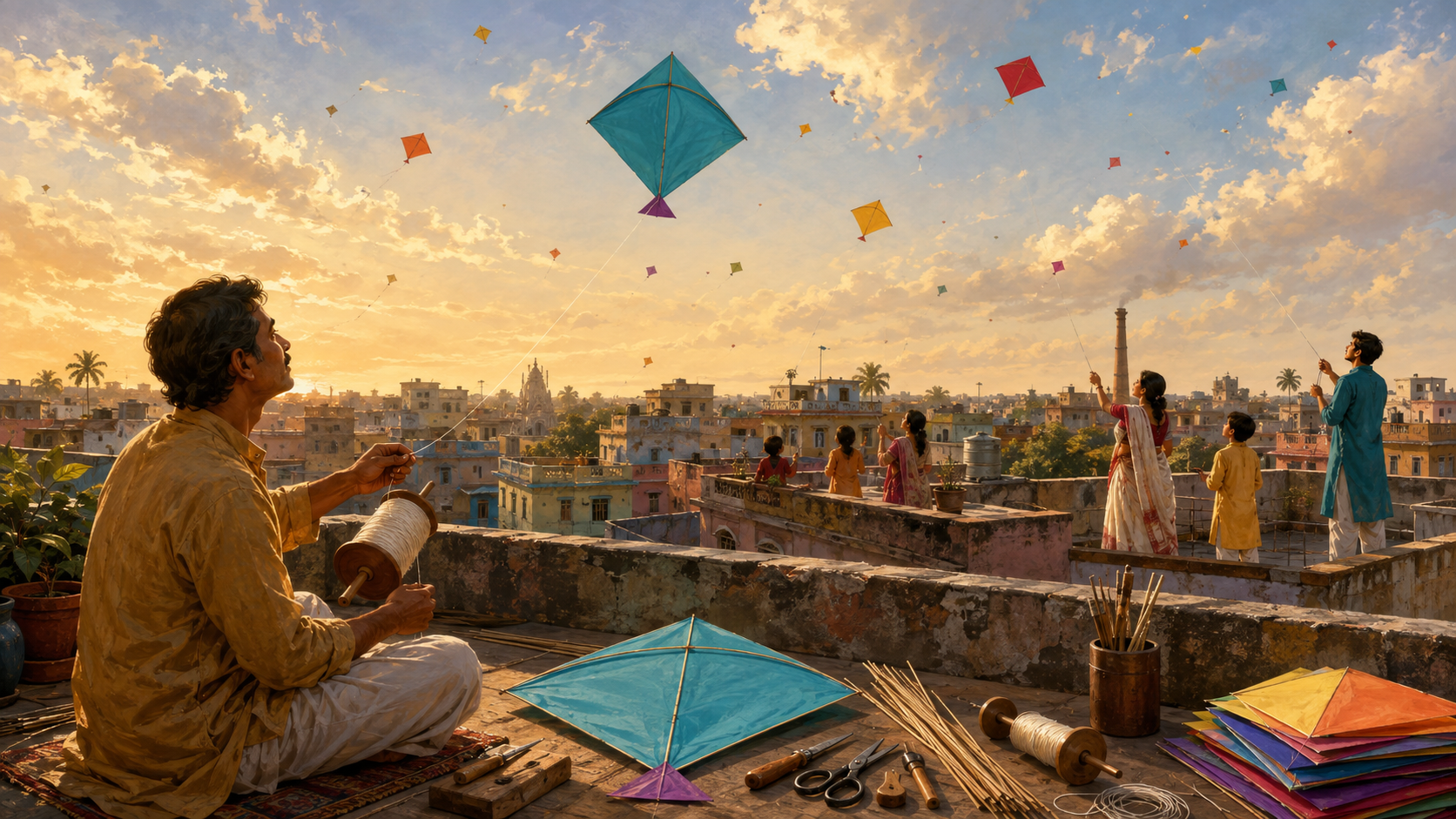
If you have watched Bengal’s sky fill with kites on Biswakarma Puja, you may have wondered whether the flying is worship, recreation, or simply a seasonal custom. The most useful answer is that it can hold all three meanings, provided we begin with the deity being honored rather than treating the kite as an isolated spectacle.
Look closely at what a kite demands: design, proportion, patient adjustment, control of tools and responsiveness to changing conditions. Those qualities bring the celebration into the domain of Bhagavan Vishwakarma. When you understand that connection, you can participate without either draining the day of its joy or forgetting its devotional center.
The connection begins with the divine craftsman
Biswakarma Puja, celebrated with particular fervor in Bengal and parts of eastern India, honors Bhagavan Vishwakarma as the celestial architect and divine craftsman of the universe. He represents the intelligence that gives useful form to an idea: the capacity to envision, construct, refine and innovate.
A kite is a fitting object through which to encounter those qualities. It is made rather than merely found. Its frame and sail must work together. Small errors in balance become visible once it meets the wind. The flyer must then judge tension and direction instead of relying on force alone. Craftsmanship is no longer an abstract virtue; you can see its consequences moving across the sky.
The association with flight has another resonance. Bhagavan Vishwakarma is remembered as the maker of the gods’ weapons, palaces and aerial chariots. A human-made object rising into the air therefore belongs naturally within the imaginative world surrounding the divine architect. You need not claim that every kite literally represents an aerial chariot. The stronger connection lies in the meeting of construction, ingenuity and flight.
This also explains why the custom should not be used as a test of whether another community observes Vishwakarma Puja correctly. Kite flying is a regional Bengali expression of the celebration. Dharmic traditions frequently carry shared reverence through local forms, and regional variation does not make one community’s devotion less complete.
What the kite lets you notice about skill
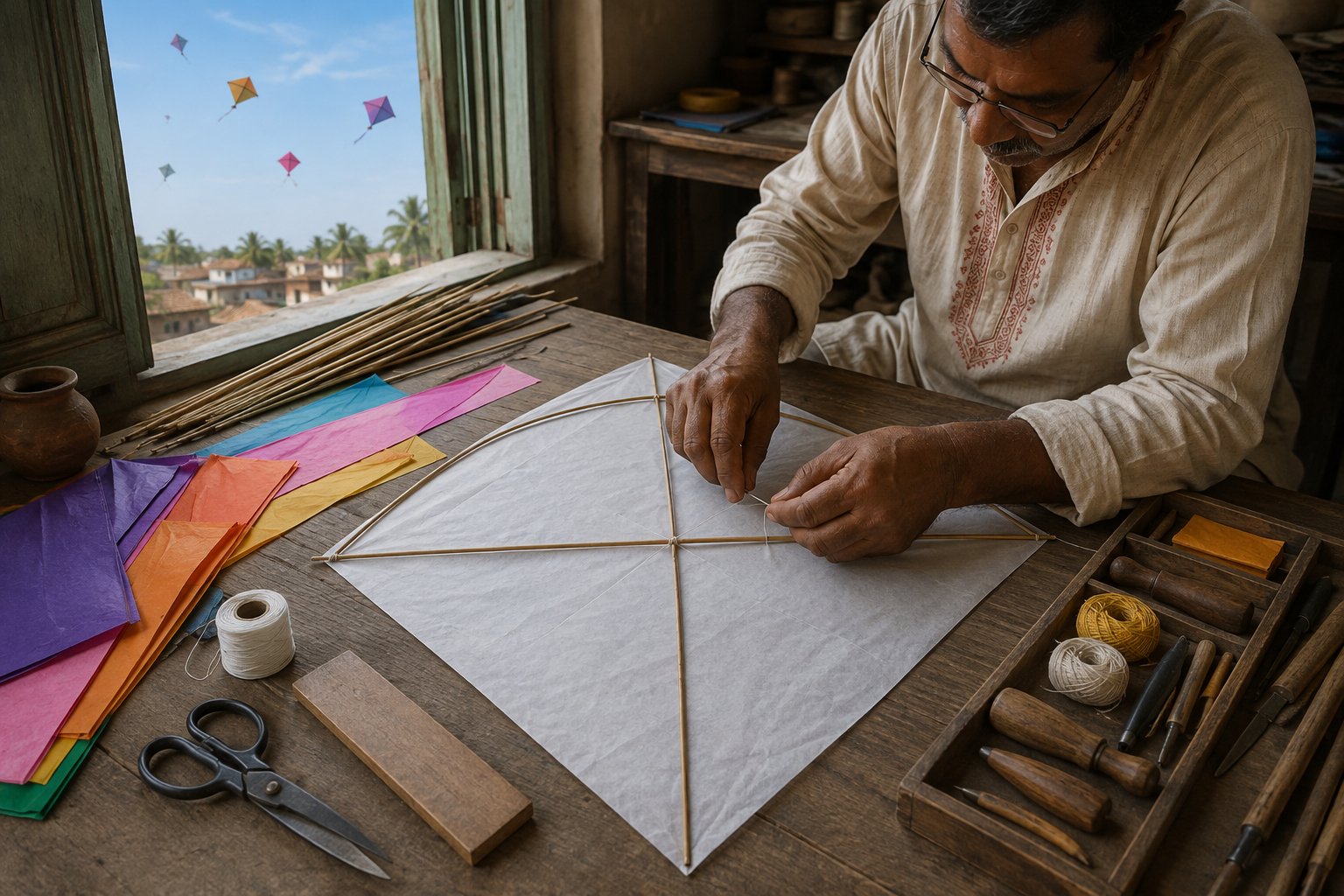
It is tempting to give the kite one fixed symbolic meaning and stop there. A better approach is to watch the activity itself. Several qualities associated with good work become visible while a kite is being prepared and flown:
- Design has consequences. A kite may look attractive on the ground, but the wind reveals whether its parts actually work together. The lesson for any craft is direct: appearance cannot compensate for poor construction.
- Mastery includes responsiveness. The flyer cannot command the wind. Skill lies in noticing what has changed and adjusting without panic or stubbornness.
- Control is not the same as domination. Pulling harder at the wrong moment does not solve every problem. Good handling depends on measured tension, release and correction.
- Innovation still needs discipline. Experimenting with form or technique can improve the result, but an idea must survive contact with real conditions before it proves useful.
- Achievement is rarely solitary. One person may make the kite, another may help launch it, and a newcomer may learn by watching experienced hands. The visible flight carries several forms of contribution.
These are contemplative possibilities, not a demand that every family explain the tradition in identical words. If you are teaching a child, choose one concrete observation. Ask what changed when the kite dipped, why a careful adjustment worked, or how the maker balanced the parts. That conversation will convey more about Vishwakarma’s domain than a long speech detached from the activity.
How to keep devotion and celebration connected
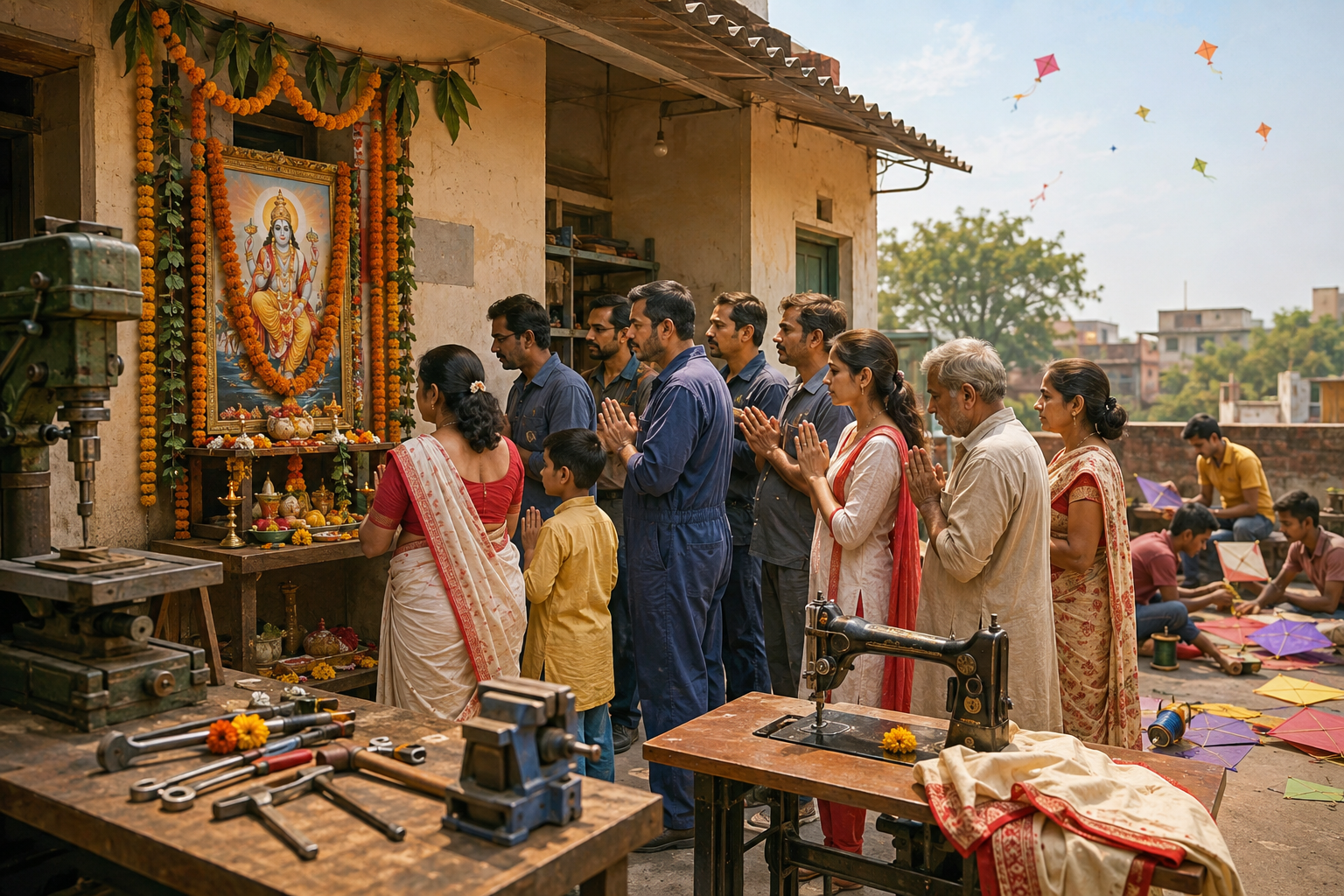
The easiest way to lose the custom’s meaning is to let the flying become a generic contest with the festival’s name attached. The answer is not to suppress the enjoyment. It is to place the enjoyment inside a clear devotional frame.
- Begin with your family’s established puja practice. Do not replace an inherited procedure with an improvised ritual built around the kite. Flying can complement the worship without pretending to be the whole of it.
- Name the connection before you fly. A simple explanation is enough: the day honors Bhagavan Vishwakarma, and the kite allows us to celebrate workmanship, ingenuity and flight.
- Pay attention to the maker. Examine how the kite was constructed and balanced. If someone in your gathering made it, invite that person to explain one decision. If it was purchased, you can still notice the skill embodied in the object.
- Teach one practical skill patiently. Show a newcomer how to handle the line, respond to the wind or assist with a launch. Passing on competence is more aligned with the spirit of the day than using expertise to exclude others.
- Keep competition subordinate to conduct. If friendly rivalry is part of your gathering, agree on safe boundaries and refuse methods that turn entertainment into injury or hostility.
- End by collecting the line and damaged material. Responsible workmanship includes what happens after an object has served its immediate purpose.
This approach avoids a false choice. You do not have to label every enjoyable activity a formal rite, and you do not have to strip enjoyment from a religious celebration. The kite acquires devotional depth through remembrance, disciplined action and the way participants treat one another.
Safety is part of honoring skilled work
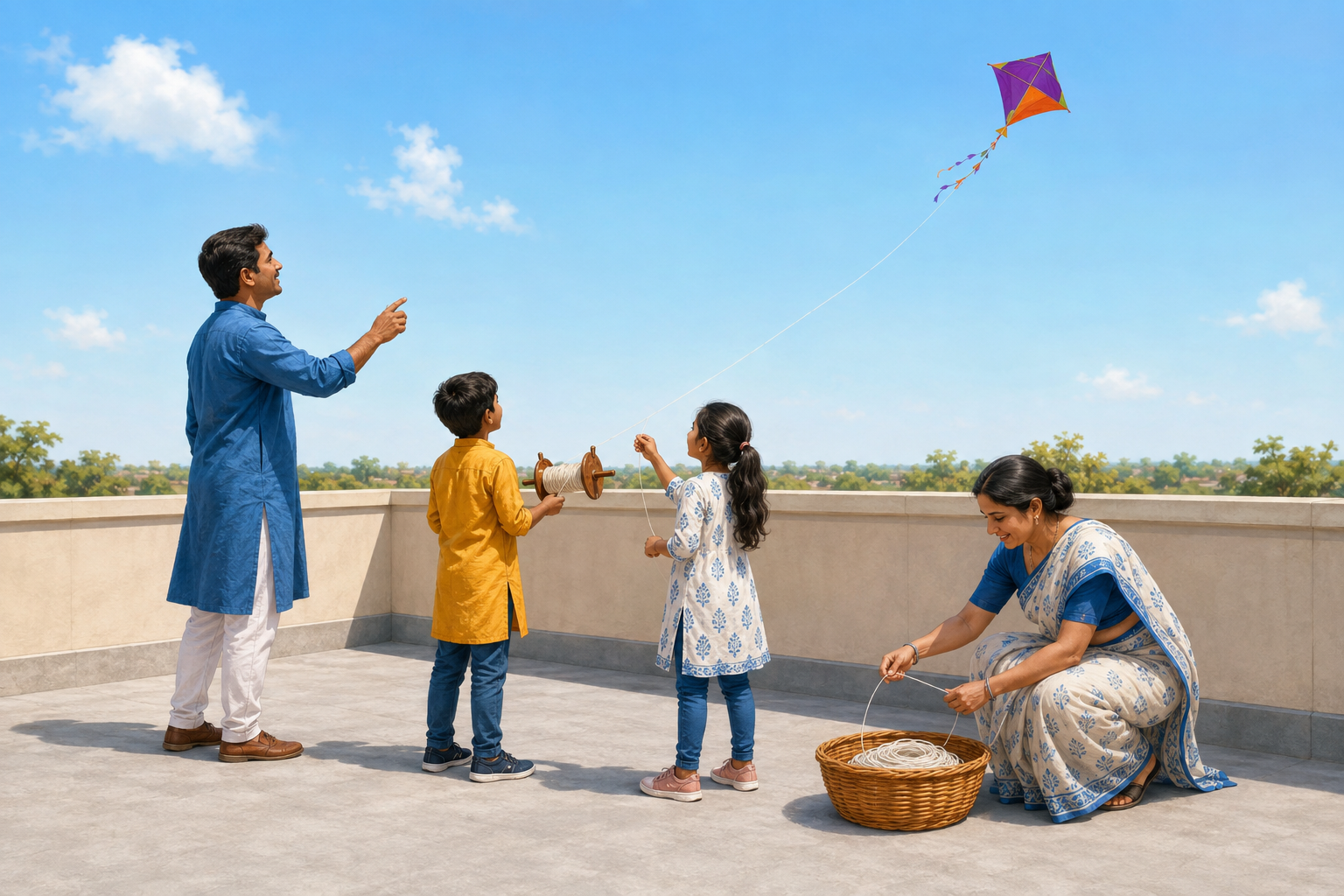
A celebration of craftsmanship becomes self-defeating when careless materials or reckless flying place other people in danger. Treat safety as part of the observance, not as an unrelated warning added at the end.
- Fly only in an open place where kite flying is permitted. Stay well away from overhead electrical lines, traffic, unstable roof edges and other places where a sudden pull could cause a fall or collision.
- Do not use abrasive, cutting or otherwise hazardous line. It can injure flyers, passersby and animals, and a severed length can remain dangerous after the celebration has ended.
- Never attempt to retrieve a kite or line caught on electrical equipment. Keep away from it and notify the responsible utility or local authority if it creates a hazard.
- Supervise children around spools, loose line and crowded flying areas. Give them a defined place to stand and a clear instruction about when to release the line.
- Stop when weather or crowding makes reliable control difficult. Preserving the kite is never more important than preventing an injury.
- Retrieve loose line and fragments only when they can be reached safely. Do not enter traffic, climb an unsafe structure or trespass in pursuit of a fallen kite.
The principle is simple: skill includes foresight. If you know a material or location can turn a moment of pleasure into harm, choosing a safer alternative is not timidity. It is sound judgment of the kind the celebration should cultivate.
Key takeaways
- Bengal’s kite-flying custom is best understood through Bhagavan Vishwakarma’s association with divine craftsmanship, innovation and aerial creations.
- The kite makes workmanship visible because its design, balance and handling are tested in changing wind.
- Kite flying is a regional expression of Biswakarma Puja, not a universal requirement by which every community’s observance should be judged.
- You can preserve the devotional connection by naming the deity, noticing the maker’s skill, teaching patiently and keeping rivalry within humane limits.
- Safe line, a suitable flying place, supervision and complete cleanup are part of responsible celebration.
At the next Biswakarma Puja, make one deliberate choice before the kite rises. Tell a younger participant why the day honors the divine craftsman, ask someone how the kite was made, or set a clear safety rule for the gathering. Then launch it. The sky will still offer all the delight of the custom, but the hands holding the line will know what they are celebrating.
References
