
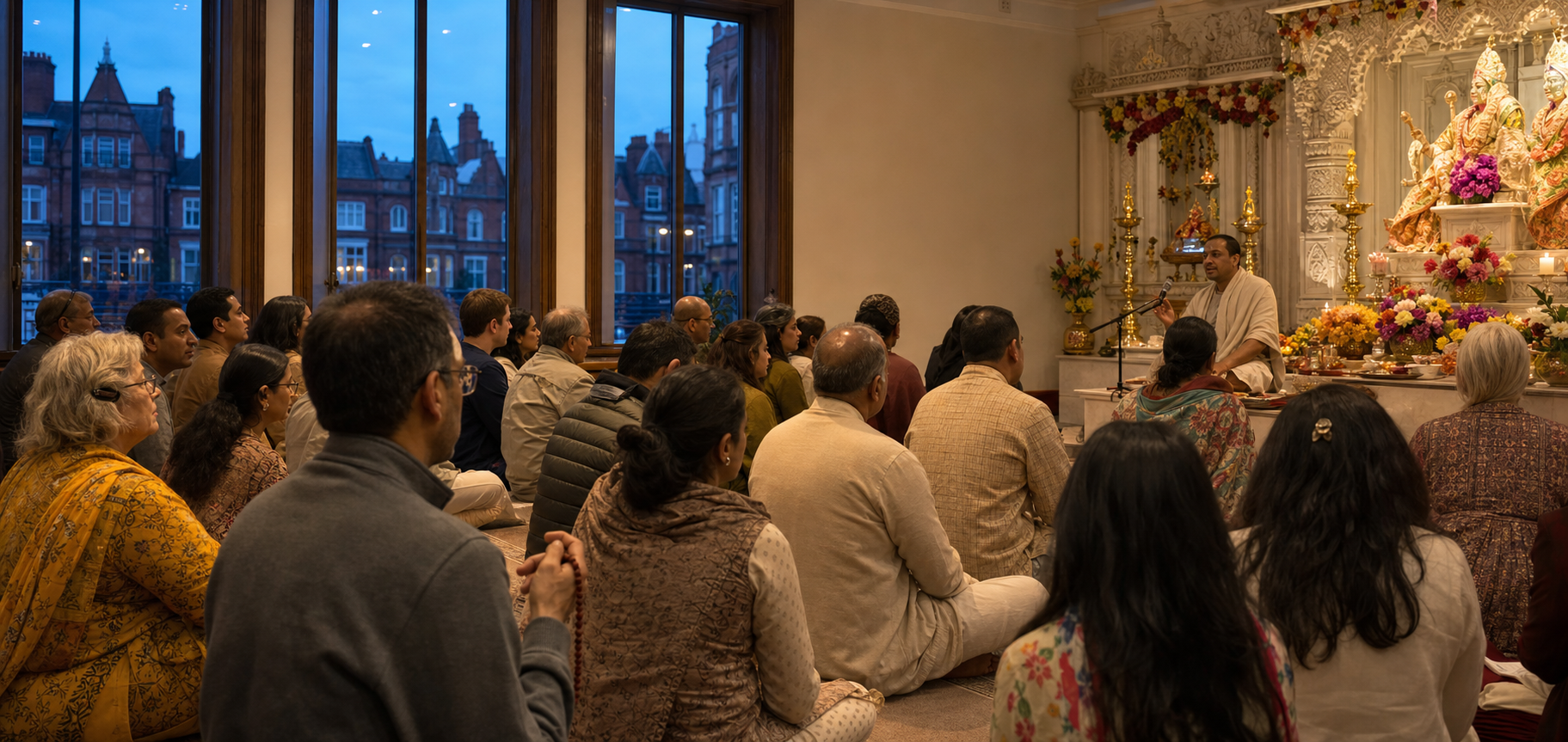
If you have encountered a rasa teaching at ISKCON Birmingham, you may wonder how local temple history and an advanced theological subject belong in the same conversation. The useful answer is simple: roots show you how devotional life is received and sustained; rasa shows you what purified devotion can mature into.
The Birmingham session connecting HH Subhag Swami, the community’s roots, and a rasa class places those questions side by side. Hear them in the right order, and rasa becomes a reason to practise more faithfully. Reverse the order, and profound theology can be reduced to sentiment, curiosity, or spiritual self-labelling.
Begin with roots: lineage, place, and practice
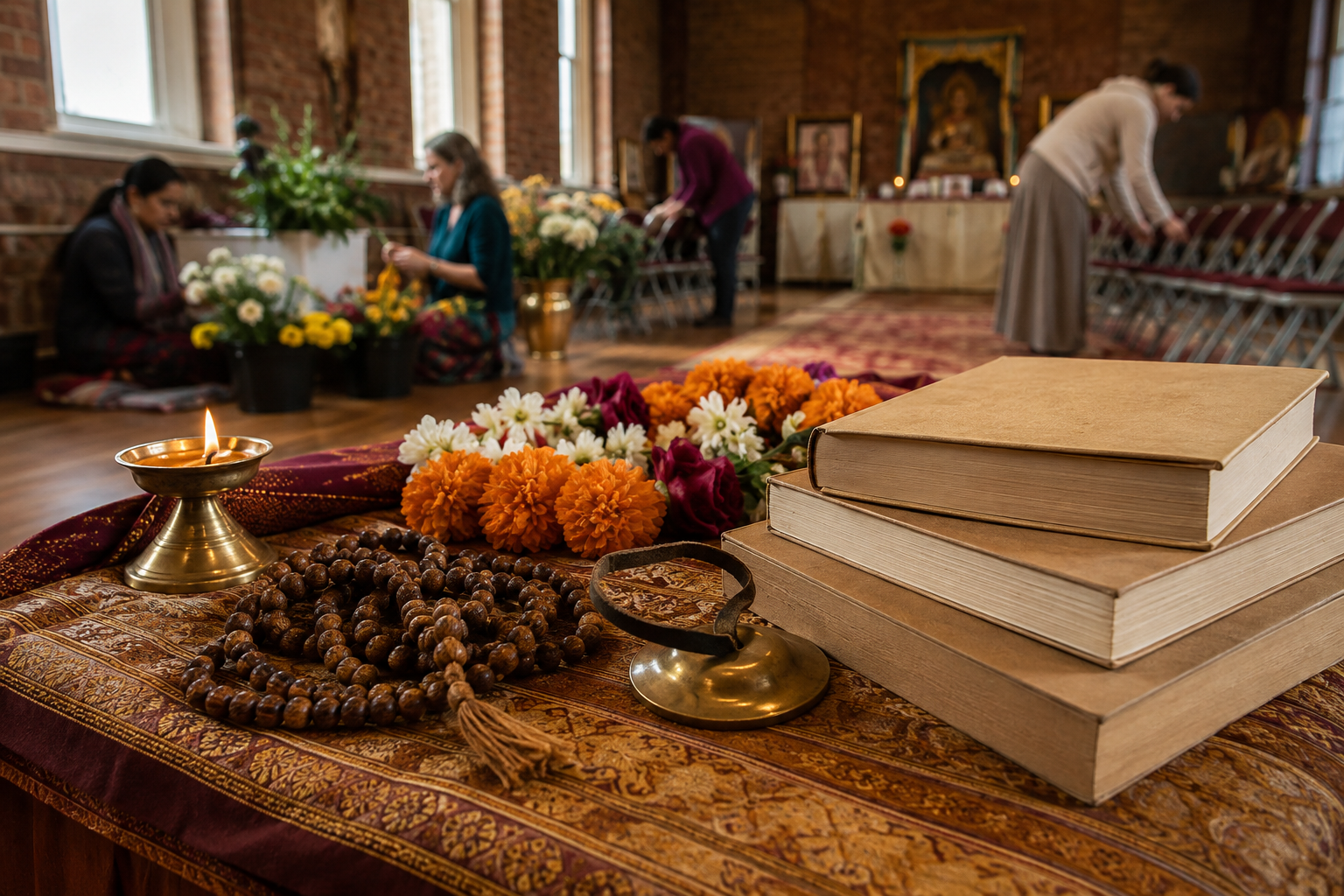
In a Vaishnava setting, roots are more than an origin story. They include guru-parampara, the transmission of teachings through disciplic succession; the scriptural principles that give the tradition its shape; and the practices through which those principles become lived devotion. In ISKCON, that inheritance is closely associated with A.C. Bhaktivedanta Swami Prabhupada and his emphasis on hearing, chanting, remembrance, worship, and service to Krishna.
Local roots matter in a different but connected way. A temple is sustained through actual people performing worship, organising gatherings, preparing prasada, teaching newcomers, maintaining standards, and serving through changing circumstances. When you hear about Birmingham’s roots, listen for the devotional choices beneath the chronology. A name or event matters not merely because it came first, but because it shows what devotees valued enough to preserve.
A useful way to take notes is to separate what you hear into three kinds of inheritance:
- Lineage: the teachers, teachings, and forms of authority through which bhakti is received.
- Local memory: the people, places, services, and sacrifices that formed the Birmingham community.
- Living instruction: what the history asks you to practise now rather than merely admire.
This distinction prevents two common mistakes. One is treating temple history as nostalgia. The other is using lineage as a badge of belonging while neglecting the discipline that the lineage transmits. If a story about the community’s beginnings does not change how you regard seva, hospitality, worship, or responsibility, you have probably heard only its outer shell.
Understand rasa as relationship, not emotional intensity

Rasa can be translated as taste, flavour, essence, or relishable experience. In Gaudiya Vaishnava theology, it refers to the spiritually relishable quality of a particular relationship with Krishna. It is therefore much more precise than saying that a person felt peaceful during kirtan, cried while hearing Krishna-lila, or found a class emotionally moving.
A common introductory map names the following primary devotional relationships:
- Shanta: peaceful, reverential appreciation of Krishna.
- Dasya: devotion expressed through the relationship of service.
- Sakhya: intimate friendship with Krishna.
- Vatsalya: protective, parental affection toward Krishna.
- Madhurya: the relationship of Krishna’s beloved, expressed in the language of divine conjugal love.
These terms are not personality types, devotional brands, or positions that you select because one sounds more attractive than another. Nor should they be flattened into ordinary human psychology. Madhurya, for example, cannot be understood responsibly as secular romance transferred to a religious setting. Each rasa belongs to a theological account of perfected, Krishna-centred love in which selfish possession has been displaced by devotion.
That gives you a practical guardrail: do not infer your eternal relationship with Krishna from a passing mood. Tears, tranquillity, excitement, or fascination may accompany sincere devotional activity, but emotional intensity alone does not establish spiritual realization. During a rasa class, ask what relationship is being described, who embodies it, what quality of devotion it reveals, and what response is appropriate for a practitioner at your present stage.
Roots and rasa belong to one devotional sequence
Gaudiya Vaishnava teaching commonly organises spiritual understanding through sambandha, abhidheya, and prayojana. Sambandha concerns the fundamental relationships among Krishna, the living being, the world, and divine energy. Abhidheya concerns the devotional practices undertaken in light of those relationships. Prayojana concerns the ultimate fulfilment of devotion in pure love of Krishna.
Rasa belongs near the mature fruit of that sequence. It becomes intelligible through a sound understanding of relationship and a life of devotional practice. This is why roots are not a preliminary subject to discard once the discussion becomes more elevated. They protect the meaning of elevation itself.
Without roots, rasa can be mistaken for imaginative role-play or a shortcut to an advanced identity. Without rasa, roots can become an archive of personalities and dates with no clear sense of bhakti’s destination. Held together, they show a complete movement: devotion is received through a lineage, embodied in practice, sustained by a community, and directed toward love of Krishna.
When a class moves between history, doctrine, practice, and descriptions of Krishna-lila, use three questions to keep your bearings:
- What relationship is being established? Identify the theological principle rather than extracting an isolated image.
- What practice follows from it? Look for the corresponding discipline of hearing, chanting, remembrance, worship, or service.
- What fruit is being described? Distinguish the mature state of devotion from the immediate duty of the listener.
This sequence lets you appreciate advanced teaching without pretending that hearing a description and possessing the realization described are the same thing.
Use a rasa class at your actual stage of practice

You do not need to avoid rasa teachings because they are subtle. You do need to hear them with patience, context, and discipline. The following method keeps the class connected to sadhana rather than spiritual self-display.
- Set a service-oriented intention. Begin with the question, “What should this teaching change in my hearing, chanting, conduct, or service?” That question is safer and more fruitful than beginning with, “Which rasa is mine?”
- Mark the level of each statement. Distinguish local history, philosophical conclusion, description of lila, and practical instruction. A statement about an eternal associate of Krishna is not automatically an instruction to imitate that associate.
- Retain the teacher’s qualifiers. Words such as grace, qualification, purification, guidance, and maturity carry doctrinal weight. Removing them can turn a careful teaching into a claim it never made.
- Do not assign identities to yourself or others. Rasa terminology should deepen reverence for Krishna and his devotees, not create a new hierarchy of social prestige within a congregation.
- Ask a practice-level question. If something remains unclear, ask how a person at your stage should respond. This invites guidance that can be applied without forcing an answer about advanced realization.
- Test your hearing by its fruit. Look for greater attentiveness, steadier service, respect for devotees, and less eagerness to advertise yourself. If the class leaves you mainly wanting to rank devotees or claim an exceptional inner status, reconsider how you have understood it.
This approach also helps when unfamiliar Sanskrit appears. Write down the term as accurately as you can, keep it attached to the teacher’s explanation, and resist building a private doctrine from a translated word or an isolated online quotation. In rasa theology, context is not decoration; it determines what a term is doing.
Key takeaways for your next class
- Hear roots at both levels: the disciplic transmission of bhakti and the local service through which a temple community survives.
- Treat rasa as a theology of perfected relationship with Krishna, not as a label for temporary emotion.
- Keep mature devotional fruit connected to sambandha, disciplined practice, and guidance.
- Separate historical recollection, philosophical teaching, lila, and direct instruction in your notes.
- Ask what the teaching requires from your present practice before asking what it reveals about an advanced spiritual identity.
- Judge your understanding by humility, attentiveness, and dependable seva rather than by emotional drama.
At your next Birmingham programme, divide a page into two headings: “root” and “fruit.” Under the first, record what grounds the teaching in lineage, community, and practice. Under the second, record the devotional quality toward which it points. Then choose one grounded response: listen to japa more carefully, fulfil a seva commitment, welcome another visitor, or take a sincere question to a qualified practitioner.
Approached this way, rasa does not pull you away from ordinary devotional responsibility. It reveals why that responsibility matters. Let the teaching increase your attraction to Krishna while giving the ego less to display.
References
