
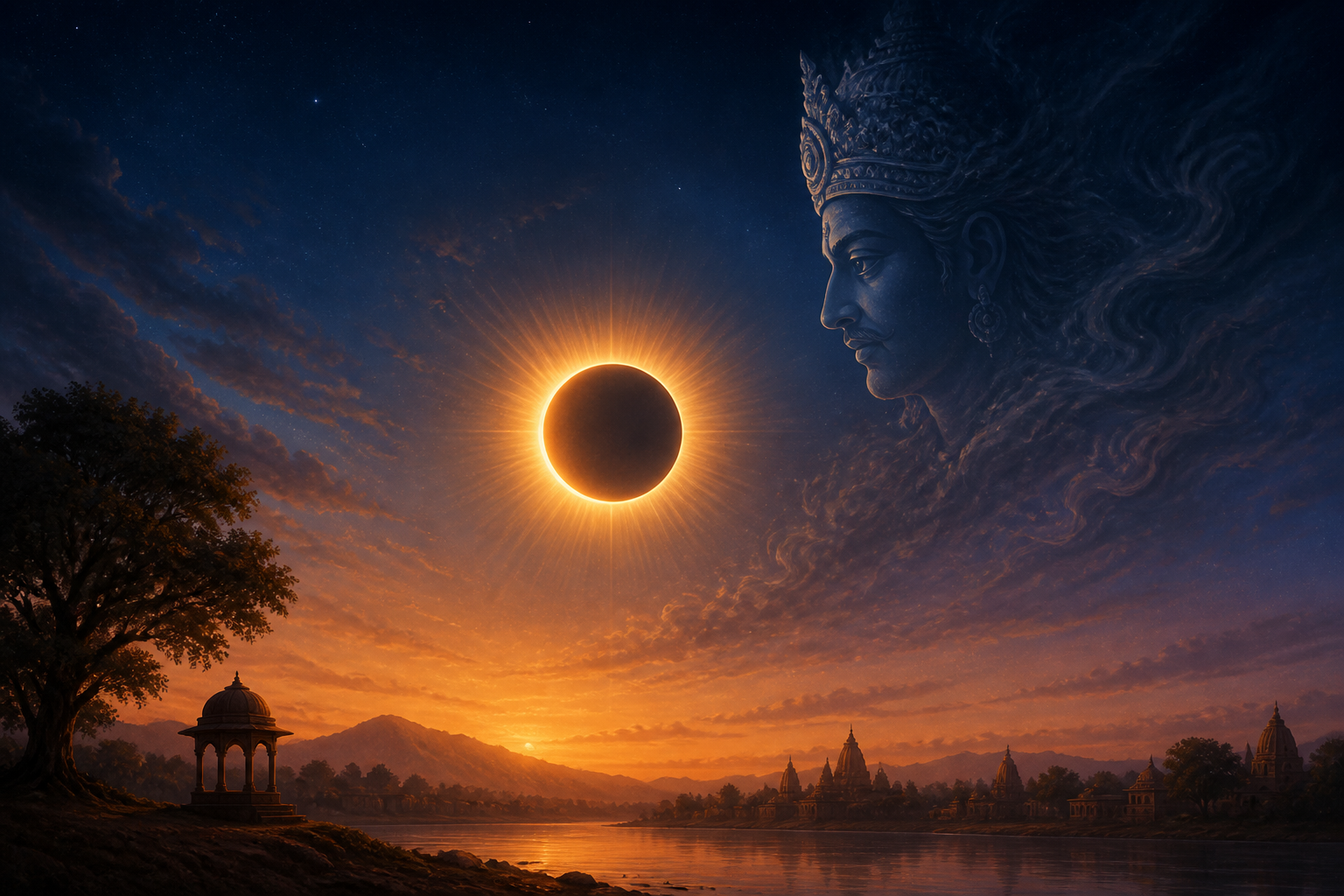
When an eclipse approaches, you may hear that Rahu brings confusion. Then someone else says Rahu is only a mathematical point. If you are trying to understand Hindu tradition without surrendering either reason or reverence, those claims can seem impossible to reconcile.
The contradiction disappears once you separate the physical event from its ritual, astrological, and contemplative meanings. Rahu explains where an eclipse can occur, while the eclipse supplies a powerful image of how clear judgment can become temporarily obscured. You can respect both meanings without turning symbolism into fatalism.
Begin with what Rahu actually is
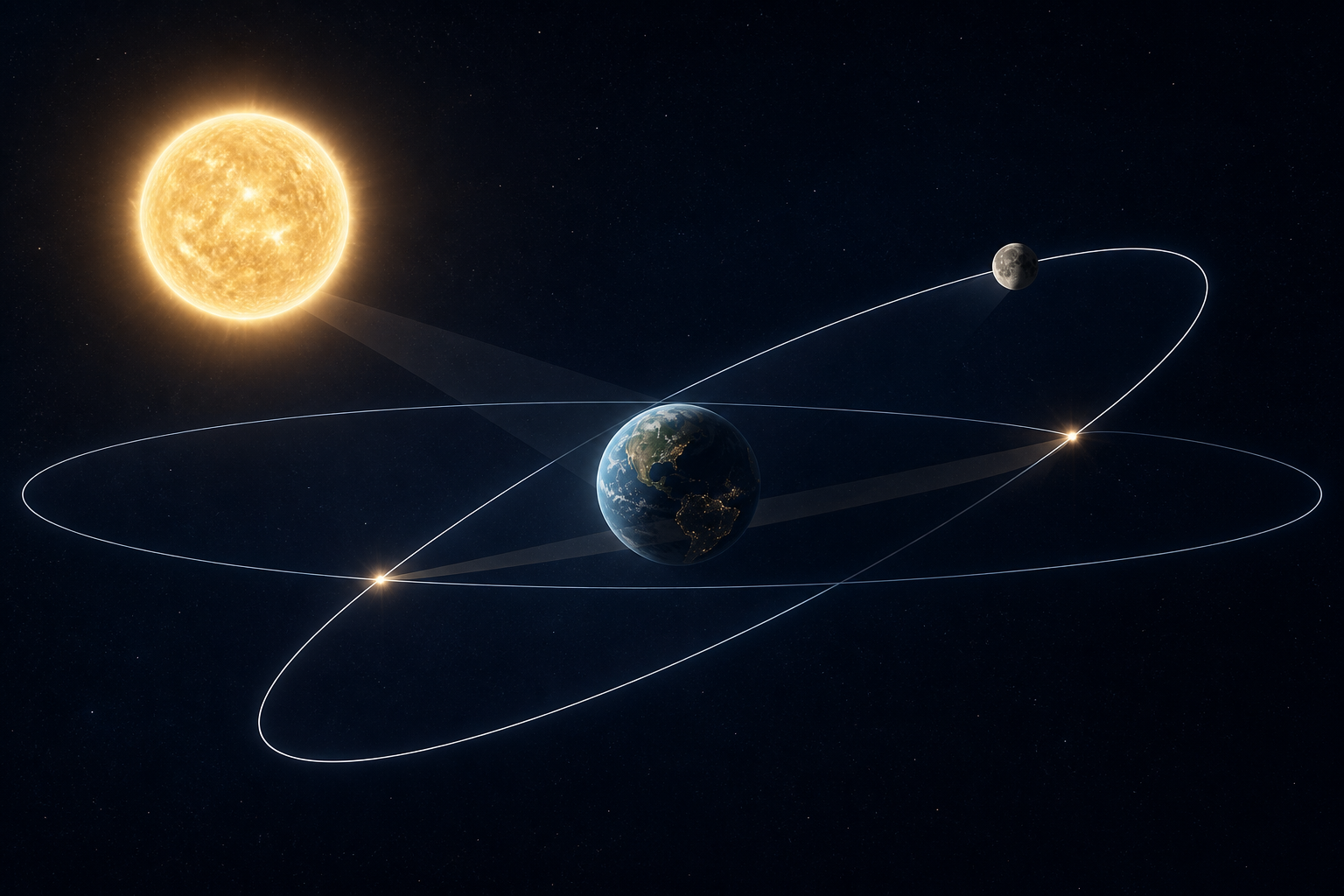
Within the Navagraha framework, Rahu differs from the visible members of the system because it has no material globe. Rahu is the ascending lunar node: the crossing at which the Moon moves northward through the apparent path of the Sun in the sky.
This is not an arbitrary connection imposed on eclipses after the fact. An eclipse becomes possible when the Sun, Moon, and Earth align close to a lunar crossing point. Rahu’s relationship with eclipses is therefore geometric before it is symbolic.
Calling Rahu a shadow point does not mean that it is imaginary or meaningless. A coordinate can govern navigation without being a material object. In the same way, a node can identify a real celestial relationship without being another body floating in space. This is also why translating every graha as a modern physical planet creates confusion of its own: the traditional category includes an influence defined by relationship and position, not only by visible substance.
The traditional image of a shadow overtaking a luminary gives that geometry a form the mind can contemplate. It should not be forced into the role of modern physics, but neither should it be dismissed as failed astronomy. Geometry answers how the alignment occurs. Sacred symbolism asks what the experience of sudden obscuration can teach you.
Why an eclipse is such a precise image of confusion
Confusion is not always a lack of information or intelligence. Often, the relevant truth is still present, but something has interrupted your ability to see it in proportion. Fear magnifies one possibility. Desire hides an inconvenient fact. A vivid appearance displaces quieter evidence. You have not lost the light; you have lost an unobstructed view of it.
An eclipse expresses this condition with unusual precision. The luminary has not been destroyed, yet its ordinary appearance is interrupted. The change is temporary, yet it can feel overwhelming while it is happening. The shadow commands attention precisely because the underlying order is usually so dependable.
Used as a tool for self-examination, Rahu helps you notice four common forms of mental obscuration:
- You mistake partial knowledge for the whole picture.
- You treat emotional intensity as proof that something is important or true.
- You interpret a temporary disruption as a permanent loss.
- You allow attraction, fear, or fixation to make the decision before discernment begins.
This is close to the practical meaning of moha: judgment clouded by attachment, aversion, or misperception. The lesson is not that intelligence vanishes whenever an eclipse occurs. It is that even a steady source of illumination can appear absent when the relationship between observer, light, and obstruction changes.
That distinction protects the tradition from two opposite mistakes. Treating the symbol as a mechanical claim that every person must become irrational during an eclipse turns spiritual language into fatalism. Treating it as worthless because Rahu is not a physical object ignores what symbolic teaching is designed to do. A mature reading asks what kind of truth is being expressed before accepting or rejecting the claim.
Keep astronomy, ritual, Jyotisha, and contemplation separate
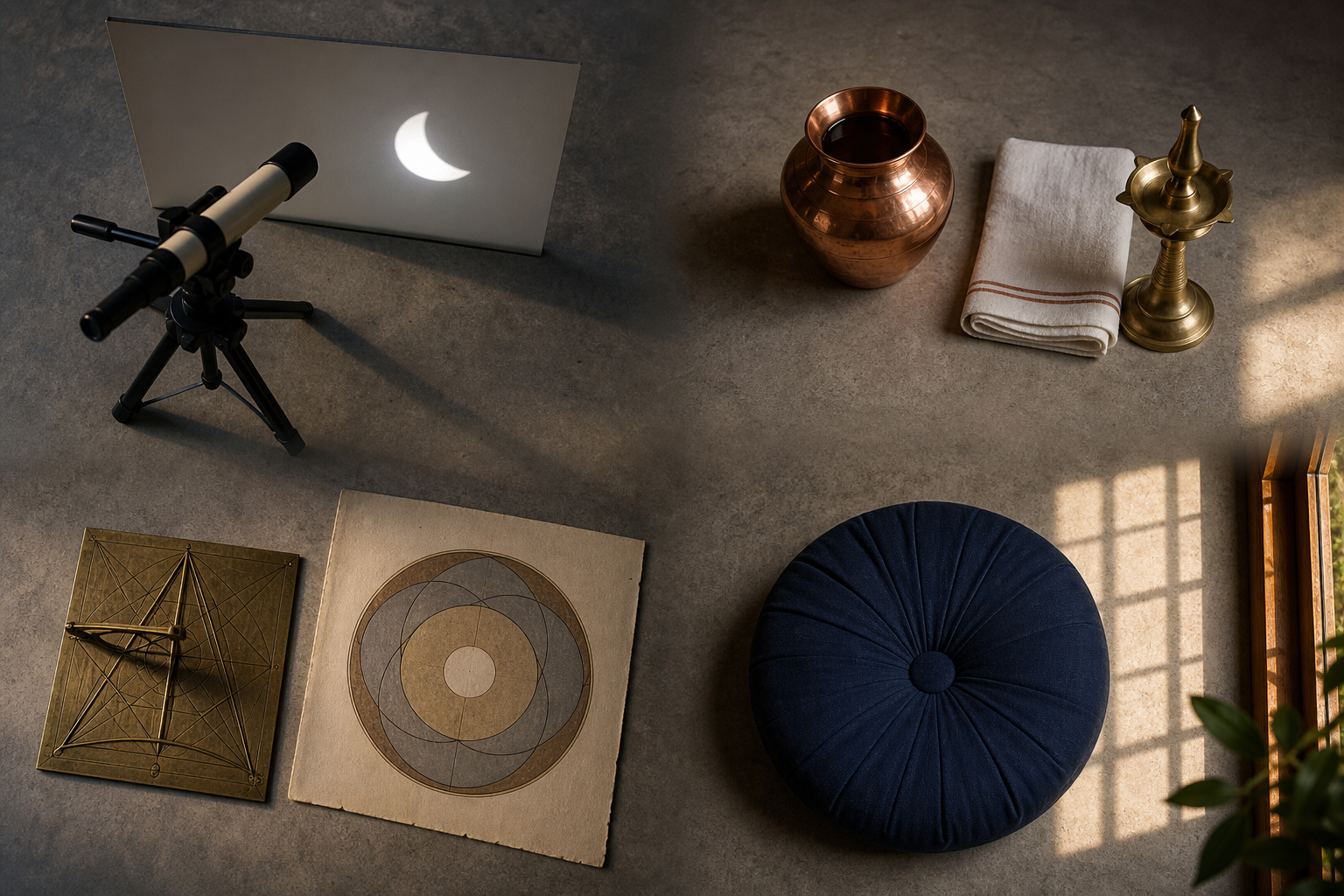
Many arguments about Rahu begin because people move between different layers without announcing the shift. A ritual instruction is presented as astronomy, an astrological interpretation becomes a universal prediction, or a contemplative metaphor is treated as a material object. Use the following distinctions whenever an eclipse claim reaches you.
| Layer | What it addresses | The useful question | The common mistake |
|---|---|---|---|
| Astronomy | The geometry that permits an eclipse | How are the celestial bodies aligned? | Imagining Rahu as another material globe |
| Ritual tradition | Practices observed by a family, temple, region, or sampradaya | What does my actual tradition ask me to observe? | Presenting one local custom as a rule for every Hindu |
| Jyotisha | The interpretation of Rahu within an astrological framework | Is this a general symbol or a chart-specific judgment? | Turning an interpretive indication into an unavoidable verdict |
| Contemplation | The condition of your perception and judgment | What is obscuring clarity in me right now? | Blaming Rahu while ignoring fear, desire, or missing information |
You do not have to choose one layer and ridicule the others. You do have to keep each claim within its proper scope. Astronomical calculation can tell you when an eclipse occurs. A living tradition can tell you how its members mark that period. Jyotisha can offer interpretation according to its own discipline. Contemplation can turn the event inward as a test of discernment. None automatically proves every conclusion drawn in the others.
This also helps when Hindu observances differ. Variation does not necessarily mean that one family understands Rahu and another does not. Ritual disciplines develop within particular lineages, places, and inherited practices. The responsible question is not which forwarded message sounds strictest. It is which practice belongs to the tradition you are actually following.
What to do when eclipse talk creates fear
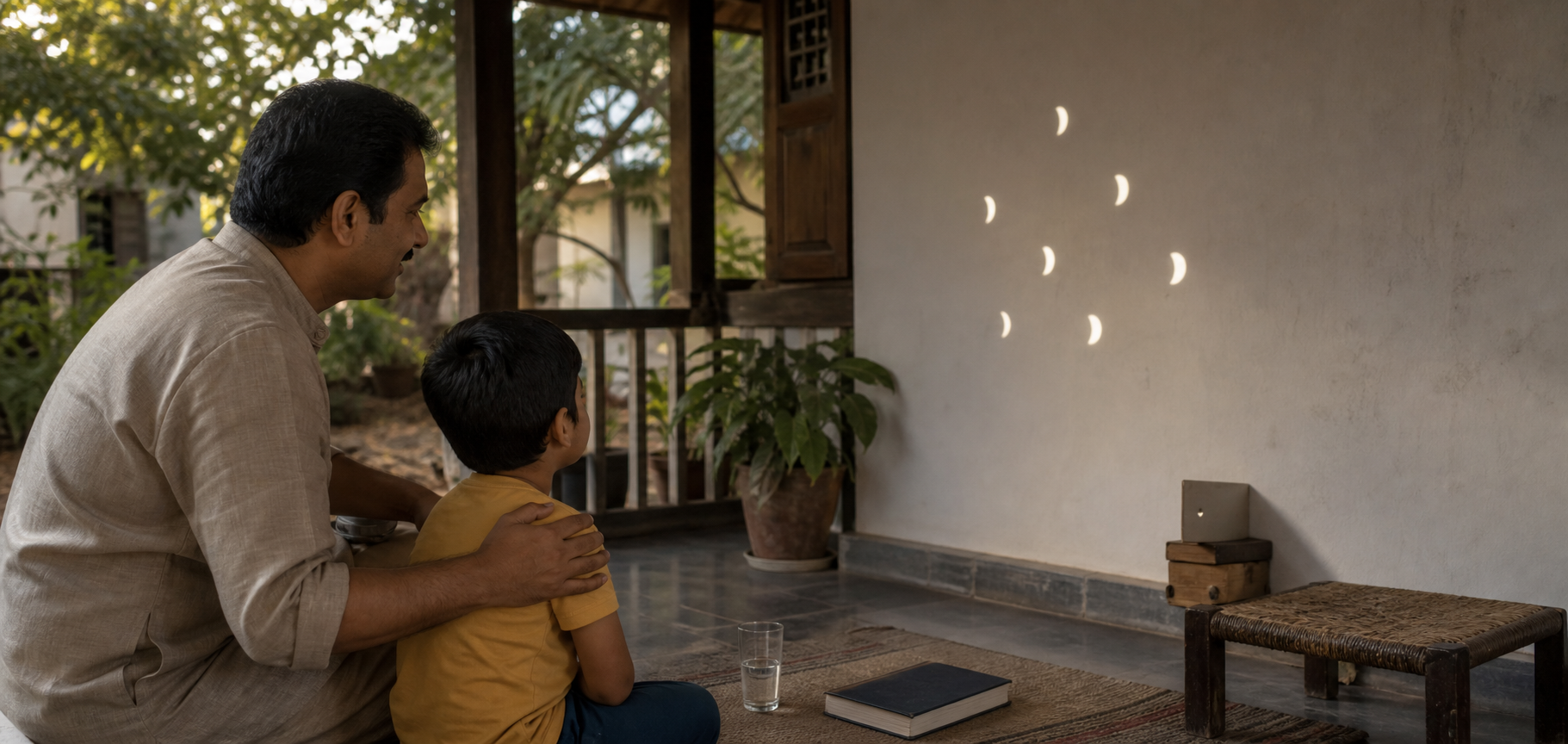
First, sort the claim before reacting
- Restate the claim concretely. Is it about the physical eclipse, a customary observance, an astrological interpretation, or the state of your mind? A vague warning often becomes less frightening as soon as its category is named.
- Ask about scope. Does the instruction belong to your family, temple, region, or sampradaya? A genuine local practice may deserve respect without becoming a universal rule for all Hindus.
- Separate sacred timing from automatic causation. A community may treat an eclipse as a significant time for discipline or prayer. That does not by itself establish that every person’s reasoning is involuntarily disabled.
- Follow inherited practice deliberately. If you have guidance from your family, guru, or temple, understand the purpose and observe it with steadiness. If you do not have such guidance, do not assemble a severe routine from alarming social-media messages. A bounded practice such as prayer, japa, meditation, or quiet reflection is more coherent than improvised fear.
- Pause a decision only for a real reason. If a frightening prediction has made you agitated, wait until you can examine the matter calmly. That is sound discernment on any day. Do not use Rahu as an indefinite excuse to avoid duties, conversations, or evidence you would otherwise face.
Then examine the shadow in your own judgment
Before responding to an eclipse prediction, write down four answers. Keeping them on paper prevents fear from changing the question while you are trying to answer it.
- What do I know directly? Record the observable fact without adding a forecast.
- What am I inferring? Identify every conclusion that depends on interpretation rather than direct knowledge.
- What do I strongly want or fear? Name the emotion that may be enlarging one part of the picture.
- What would dharma require if I had never heard this prediction? Return to the duty, truthfulness, restraint, or care that remains valid regardless of mood.
This small exercise turns Rahu’s symbolism into sadhana. You stop asking whether a shadow has taken control of you and begin noticing the conditions under which you surrender control of your judgment. Clarity does not require certainty about every outcome. It requires the ability to distinguish fact, interpretation, emotional pressure, and duty.
Key takeaways
- Rahu is the ascending lunar node, a real positional relationship rather than a physical planet.
- Rahu’s association with eclipses begins with celestial geometry and then acquires ritual, astrological, and contemplative meanings.
- The eclipse symbolizes confusion because light remains present while access to it is temporarily obscured.
- Astronomical explanation, inherited observance, Jyotisha interpretation, and spiritual self-inquiry answer different questions.
- No general warning should become an excuse for panic or helplessness. Follow your tradition deliberately and test your judgment honestly.
The next time you hear that Rahu is causing confusion, do not begin with belief or dismissal. Identify the layer of the claim, ask what is actually obscured, and return to the clearest duty in front of you. That is how a shadow becomes an occasion for viveka rather than another reason to fear it.
References
