

If you remember Utanka only as the disciple who chased a serpent for a pair of earrings, you may miss the part of his story that matters when you make a promise of your own. His quest asks a difficult question: what turns a demanding obligation into dharmic service rather than mere obedience?
The answer lies in the structure of the quest. Utanka accepts a specific responsibility, prepares himself badly and then correctly, listens to a warning, persists through obstruction, receives help without becoming passive, and finishes only when the person he serves has what she requested. Read that sequence carefully, and guru-dakshina becomes a discipline you can examine rather than a slogan you are expected to admire.
The obligation begins after formal instruction ends
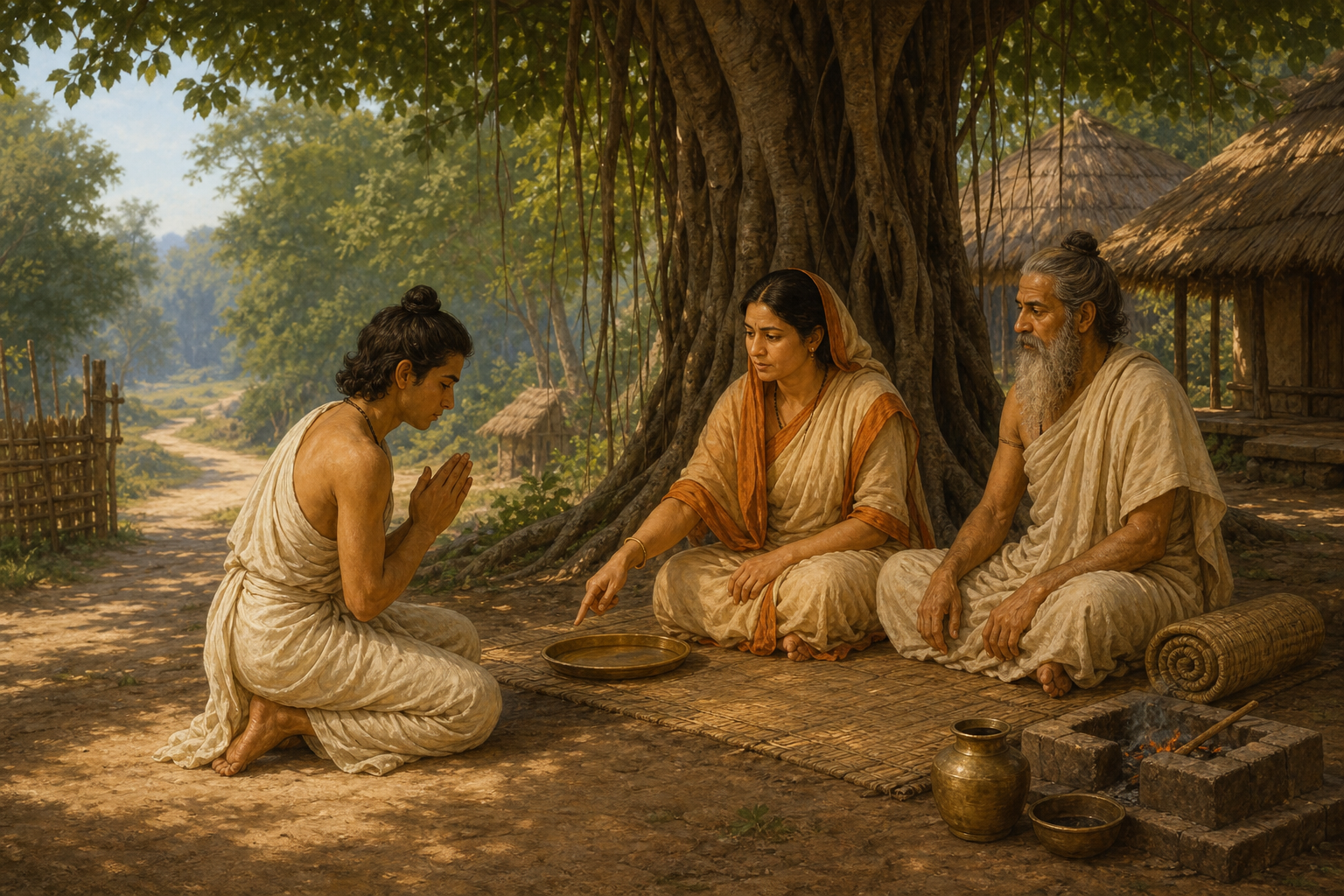
Utanka studies under Sage Veda, who had himself been a disciple of Ayoda Dhoumya. He does more than attend lessons: he serves his teacher and the teacher’s household with sustained care. When Veda is satisfied and permits him to leave, Utanka asks what he should offer as guru-dakshina.
That order is essential. The teaching is not portrayed as a commodity held back until the student pays. Veda has already taught him, observed his conduct and granted him leave. Dakshina comes afterward as the disciple’s acknowledgement of a relationship that has formed him. It is reciprocal gratitude, not a purchase price for knowledge.
Veda directs Utanka to ask his wife what would please her. She requests the earrings worn by the queen of King Poushya and needs them for an approaching household observance. The beneficiary, object and time of completion are therefore clear. Utanka is not told vaguely to prove his loyalty. He is entrusted with a defined service.
The guru’s wife also matters in her own right. Utanka’s education has been sustained by a household, not by an isolated teacher appearing only for lessons. His dakshina acknowledges that wider field of care. If you want to repay a teacher, mentor or institution, this is the first practical lesson: look beyond the most visible person. Ask who prepared the space, protected the time, carried the administration or absorbed the inconvenience that made your learning possible.
A useful expression of gratitude should answer three questions before you promise it: Who will actually benefit? What exactly is needed? What will count as completion? If those answers remain vague, clarify them. Difficulty by itself does not make an offering sacred.
Purity is the difference between urgency and readiness
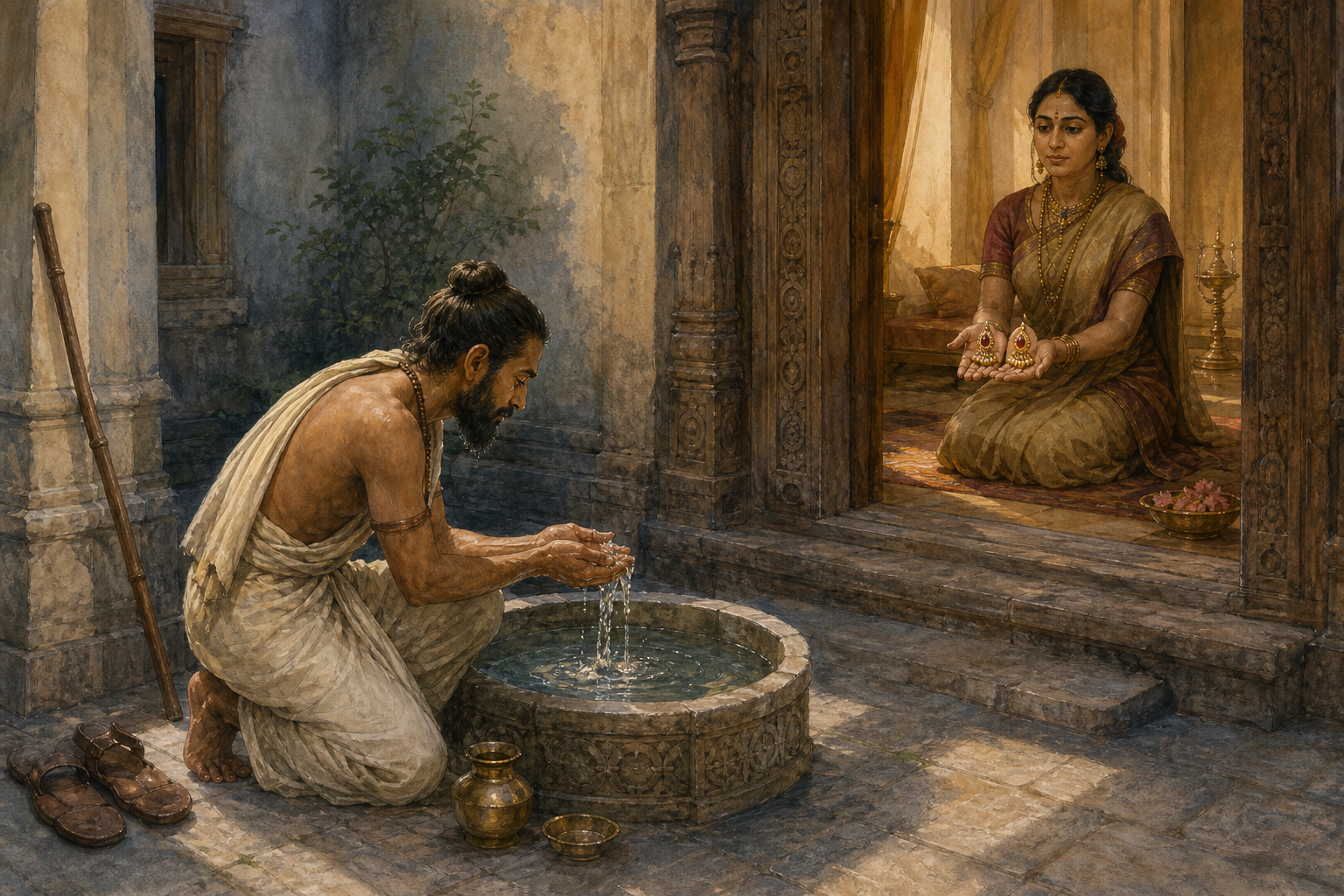
At Poushya’s court, Utanka initially cannot see the queen. He is told that he is not in the proper state of purity to enter her presence. He then recognizes that he had eaten while travelling and had not attended properly to purification. After correcting himself, he is able to approach her.
This moment can be misunderstood in two opposite ways. One reading dismisses it as an irrelevant ritual obstacle. Another turns ritual purity into a judgment about a person’s permanent worth. Neither fits the work the episode is doing. Utanka’s condition is correctable. The issue is his present readiness for a particular act, not an unchangeable verdict on who he is.
His devotion is genuine, but devotion does not excuse carelessness. The discipline of achamana and purification forces him to stop, notice his condition and approach the next stage deliberately. The quest advances only when inner intention and outward preparation are brought into alignment.
You can apply that distinction without pretending that every modern task requires the same ritual procedure. Before a consequential promise, examine three forms of readiness:
- Physical readiness: Are fatigue, hunger, illness or haste impairing your judgment?
- Procedural readiness: Have you followed the form appropriate to the responsibility rather than assuming good intentions are enough?
- Mental readiness: Are you attentive to the person being served, or are you rushing toward the satisfaction of calling yourself devoted?
The queen gives Utanka the earrings, but she also warns him that Takshaka desires them. That warning is part of the gift. Utanka receives both the object and the knowledge needed to protect it. When someone entrusts you with a responsibility and identifies a known vulnerability, treat the warning as an instruction, not as nervous commentary. Devotion that ignores relevant information is still negligence.
The strange ordeals test discernment as well as endurance
Even before reaching Poushya, Utanka encounters an imposing rider and a great bull. He is told to consume the bull’s dung and urine. He resists, then complies after being told that his own teacher had done the same. The episode later identifies what he received with amrita and divine protection.
This is not an instruction to consume animal waste. Turning an exceptional epic encounter into a literal health practice would erase the narrative’s own explanation and could cause harm. Its practical force lies elsewhere: Utanka meets something repellent in appearance whose reality he cannot yet perceive, and the protection it conveys becomes intelligible only after the ordeal.
On the return journey, Takshaka takes the earrings and disappears into the realm of the Nagas. Utanka does not abandon the commission merely because the obstacle exceeds ordinary human reach. He pursues the thief, struggles to gain entry, invokes assistance and continues acting when assistance arrives. Divine help expands what he can do; it does not do his duty in his place.
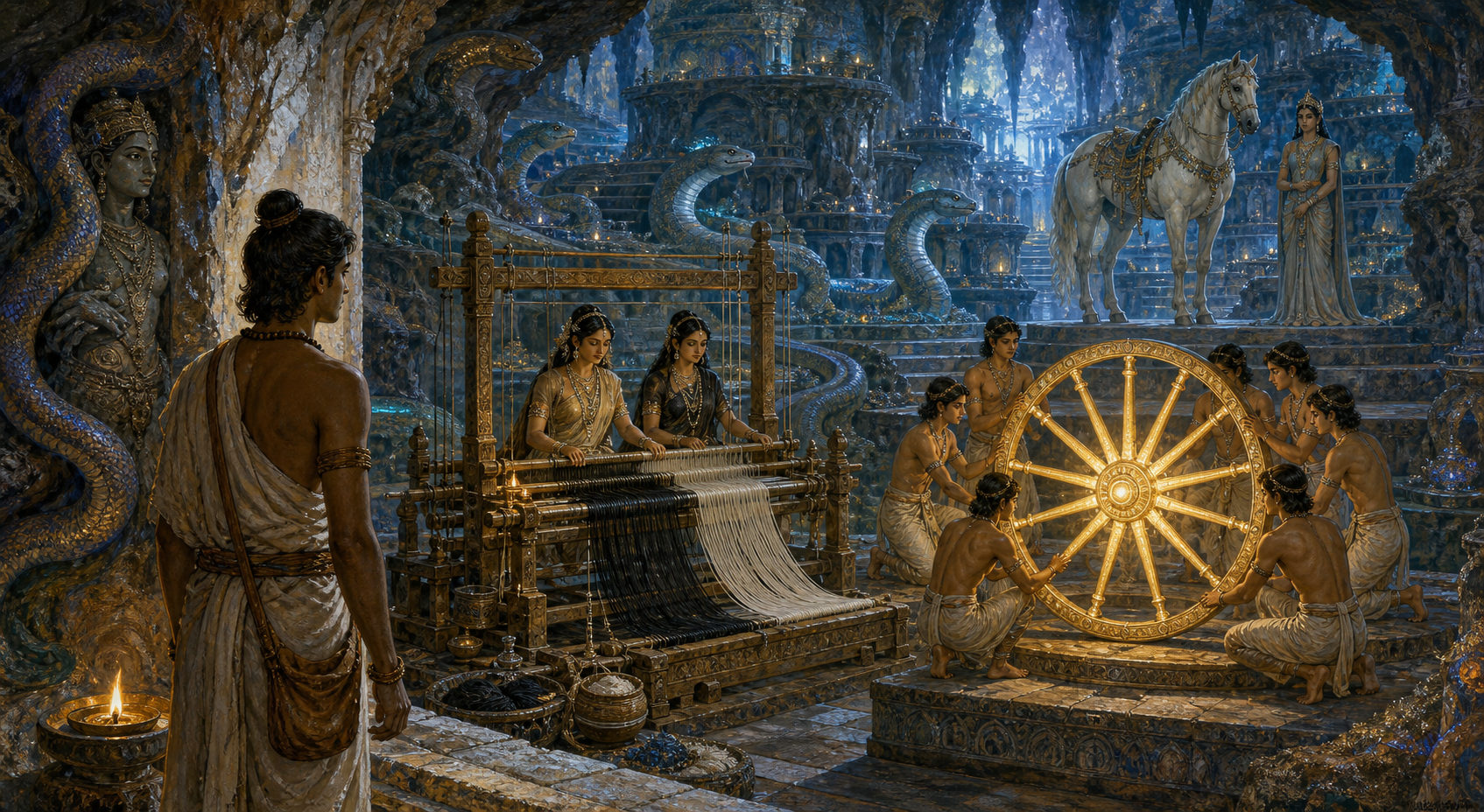
Within that other realm, Utanka beholds women weaving black and white threads, a wheel with twelve spokes turned by six youths, and a powerful man with a horse. His teacher’s later explanation connects these images with day and night, the year and its seasons, divine agency, Agni and amrita. The quest has moved from one household’s request into an ordered cosmos. A promise that looked private is shown to participate in a larger pattern of time, reciprocity and sacrifice.
The horse becomes the means by which unbearable smoke fills the serpent realm, compelling Takshaka to return the earrings. Utanka then receives the speed required to reach the guru’s household before the observance. He succeeds through a combination of perseverance, right relationship and aid he could never have manufactured alone.
That combination corrects two common errors. The first is fatalism: waiting for grace while refusing to move. The second is self-sufficiency: treating help as a stain on personal achievement. Utanka pursues, asks, receives and acts. When your own duty reaches the edge of your competence, the dharmic response is not to pretend that the edge does not exist. Name the obstacle, seek qualified help and remain responsible for the result.
A demanding promise still needs ethical boundaries
Utanka’s severity can tempt a modern reader to equate spiritual worth with unquestioning compliance. That is a dangerous conclusion. A guru-shishya narrative does not give every person called a teacher unlimited authority over a student. Trust remains bounded by dharma.
No appeal to guru-bhakti turns exploitation into sacred discipline. Demands for secrecy around abuse, sexual access, self-harm, illegal conduct or financial surrender do not become righteous because someone labels them dakshina. The episode’s own commission has a named beneficiary, a concrete object, an intelligible purpose and a recognizable point of completion. Those boundaries matter.
Before accepting a serious obligation in the name of gratitude, test it with five questions:
- Is the relationship legitimate? Gratitude may arise from freely received teaching and care; fear, manipulation and manufactured indebtedness are different foundations.
- Is the request defined? You should be able to say what is being asked, for whom and by when.
- Are the means dharmic? A worthy goal does not sanctify deception, abuse or preventable harm.
- Have relevant warnings been included? Known risks must shape the plan, just as the queen’s warning should shape Utanka’s custody of the earrings.
- Can completion be recognized? An obligation that expands whenever you approach its end may be control disguised as service.
This test does not make gratitude cold or contractual. It protects gratitude from being captured by ego on one side and coercion on the other. A bounded commitment can be wholehearted precisely because you know what you have promised.
Utanka’s success is also measured at the receiving end. Recovering the earrings is not enough; possessing them is not enough; surviving the Naga realm is not enough. He must place them in the hands of the guru’s wife in time for their intended use. If you have promised to deliver something, measure completion by the recipient’s usable outcome, not by the amount of effort you spent.
Key takeaways for a modern reader
- Guru-dakshina expresses gratitude after learning; it is not the purchase price of sacred knowledge.
- Utanka serves a teaching household, reminding you to recognize the less visible people who made your education possible.
- Purity in this episode is correctable readiness. Sincerity must be joined to attention, preparation and proper procedure.
- A warning that accompanies a responsibility is part of the responsibility. Record it and plan around it.
- Perseverance includes asking for help. Assistance enlarges Utanka’s capacity without removing his accountability.
- A promise is complete when its intended beneficiary can use what was promised, not when the performer feels sufficiently heroic.
- Trust is never a blank cheque. A modern request made in a guru’s name must still be tested against dharma, safety and clear boundaries.
The next time you feel moved to repay a teacher, do not invent an ordeal to prove your devotion. Write down five things: the recipient, the needed outcome, the deadline, the ethical boundary and the signal of completion. Then make the smallest clear promise that genuinely serves, prepare yourself properly, and carry it through. That is where Utanka’s difficult journey becomes usable in your own life.
References
