
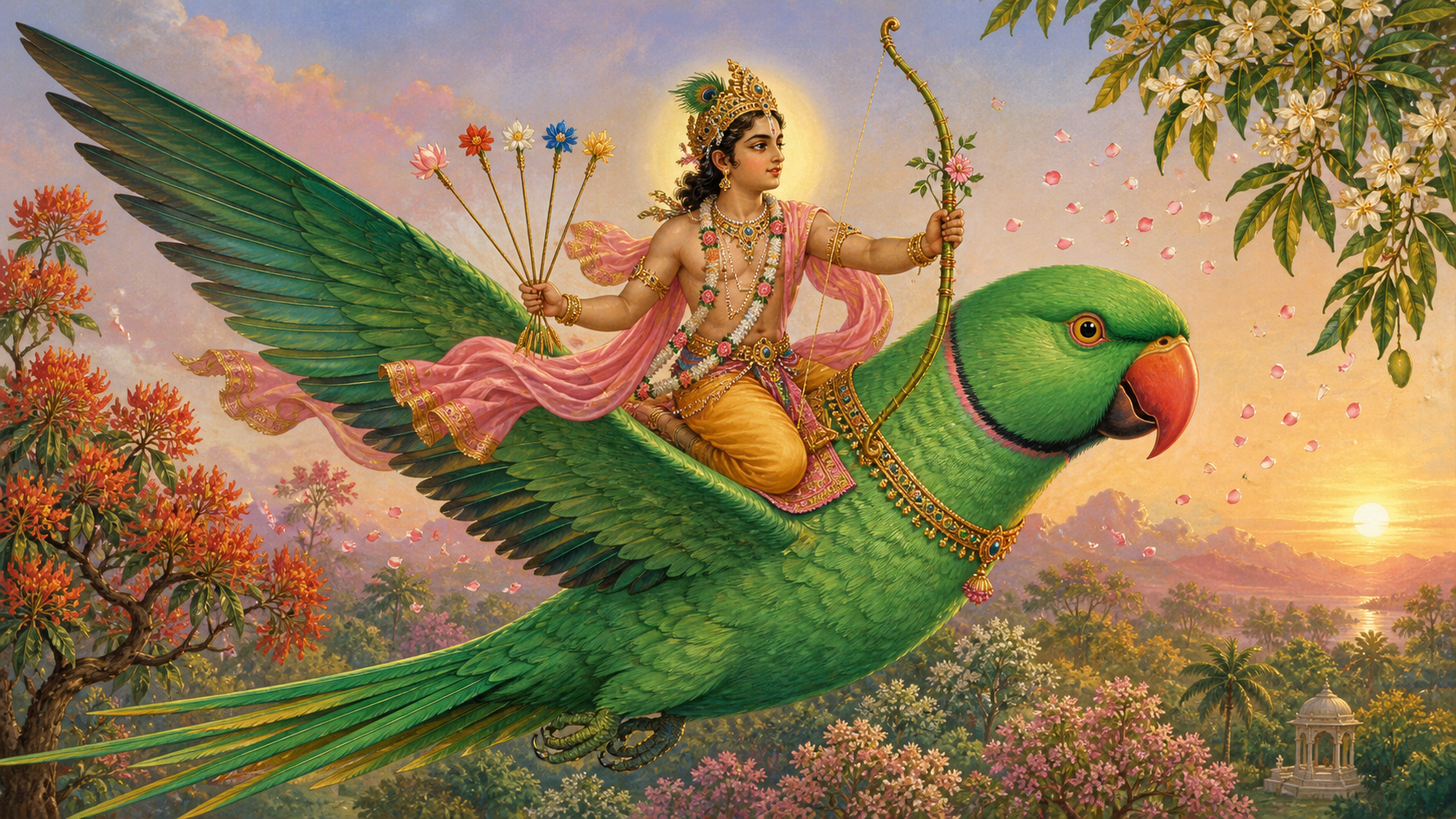
You notice the parrot beside Kamadeva in a painting or temple image and wonder why the god of love would choose this particular bird. Treating it as a decorative companion misses the question the image is asking: how does desire travel from an unseen impulse to a force that changes what you think, say and do?
Kamadeva’s parrot makes that movement visible. It connects desire with mental formation, expressive speech, imitation and fruition. Read carefully, the bird also carries a warning: a desire repeated in your own voice may still have come from somewhere else.
The vahana shows how the deity’s power moves
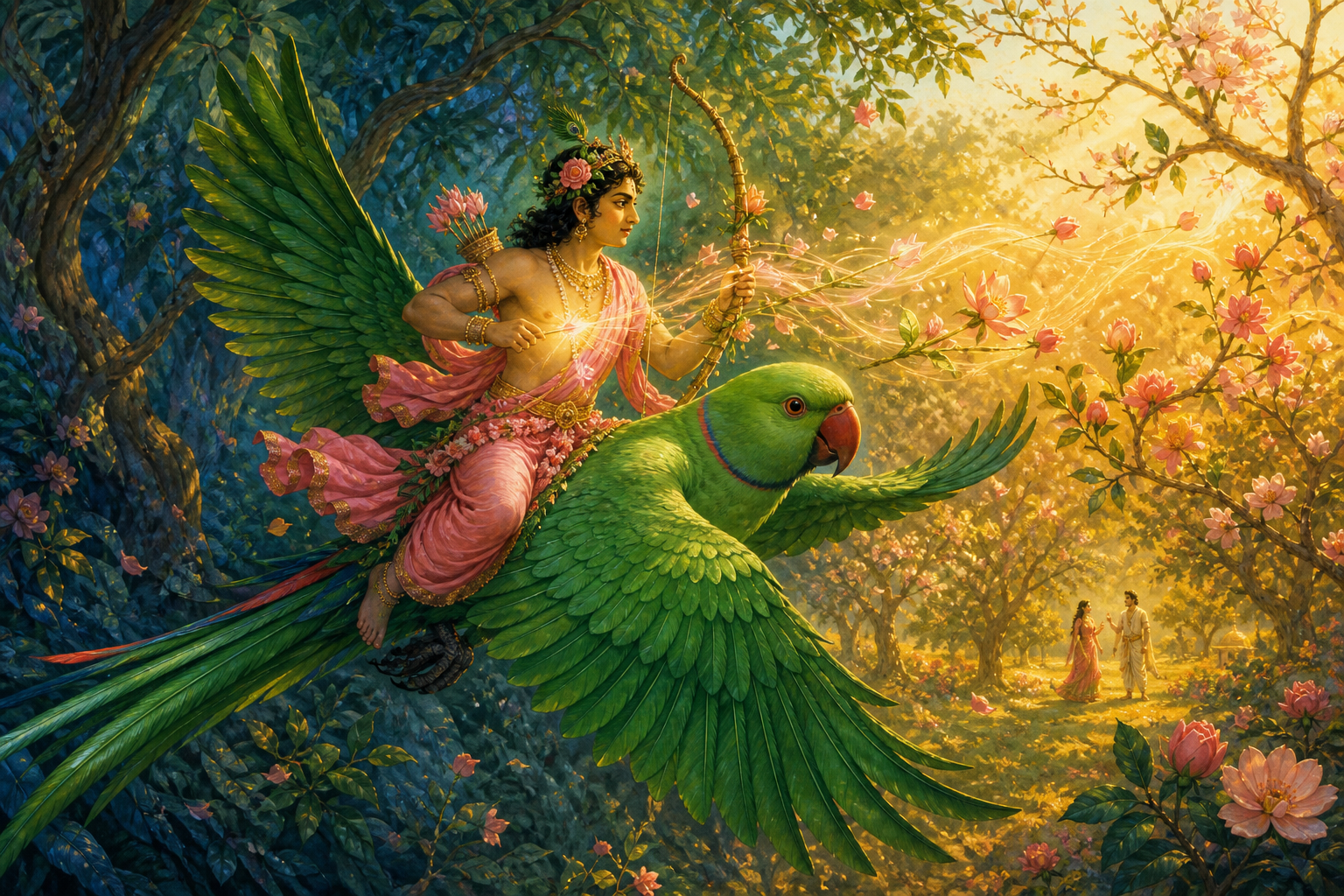
A vahana is usually translated as a vehicle or mount, but its iconographic work is larger than transportation. The creature carries the deity while also revealing something about the deity’s power. Its habits, movement and recognizable character give visible form to a force that would otherwise remain abstract.
The useful question, then, is not simply why Kamadeva needs an animal to ride. Ask what becomes easier to see when kama is carried by a parrot.
Kamadeva, also known as Manmatha, Madana and Kandarpa, personifies desire, attraction and aesthetic delight. Kama in this image should not be reduced to sexual appetite. It includes the pull toward beauty, companionship, pleasure, expression and desired experience. The parrot makes that pull seem alert, mobile, vivid and vocal.
This gives you a reliable method for reading other vahanas as well. Begin with the deity’s domain. Then notice what the creature does naturally. Finally, ask how those qualities reveal both the energy’s promise and its danger. Do not detach the animal from the deity and turn it into a free-standing omen.
The parrot joins speech, imitation and fruition
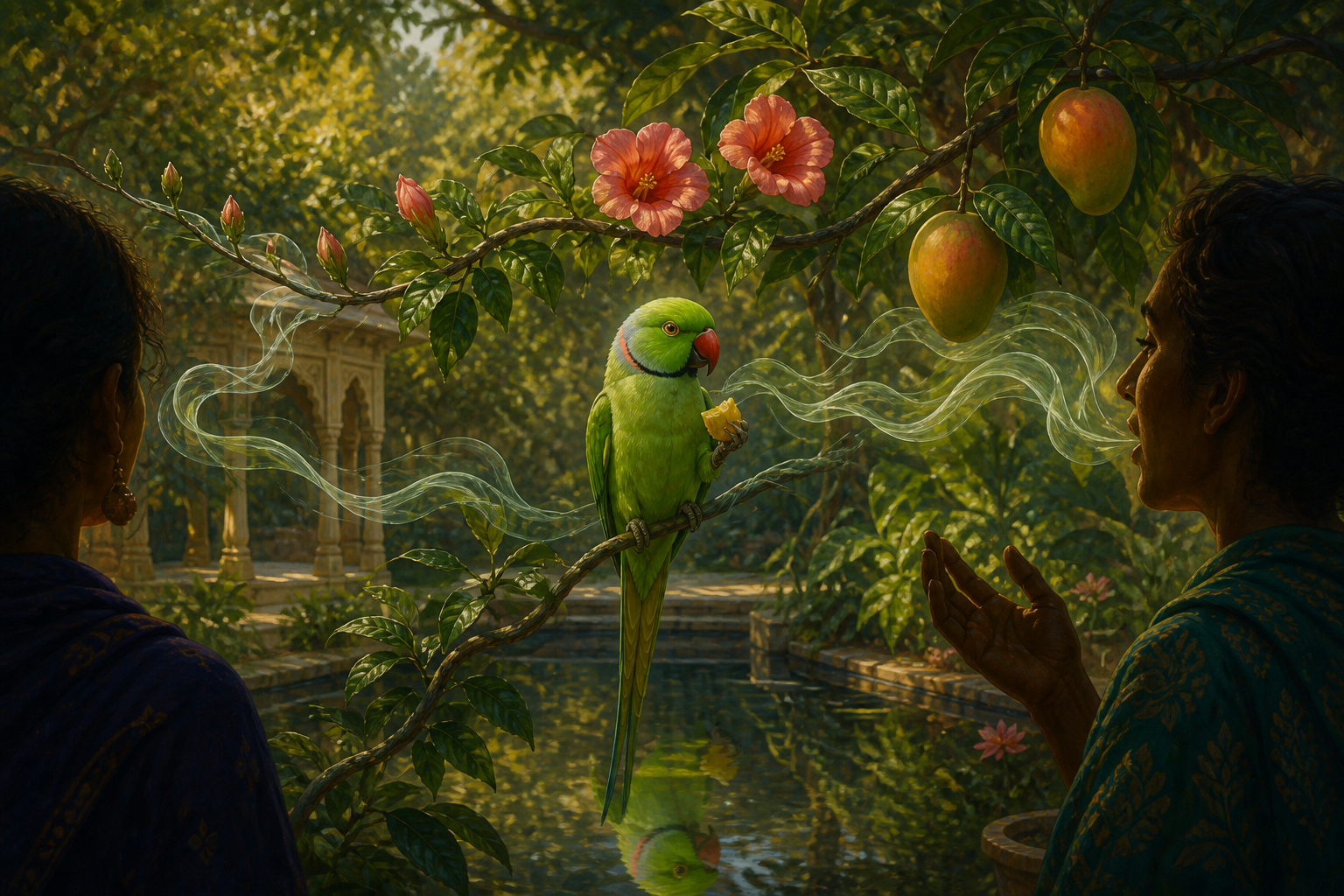
The parrot contributes several related meanings rather than one rigid definition. The first is speech. A parrot can reproduce human sounds, so it readily evokes the voiced and repeated word. This matters because desire rarely remains a silent sensation. It gains social power through praise, endearment, invitation, description and promise. What begins inwardly acquires wings when language carries it from one person to another.
That connection also explains why speech can intensify desire. Naming an attractive possibility makes it easier to imagine. Repeating it keeps it present. Hearing another person name it can awaken a want that had not previously occupied your mind. The parrot therefore represents more than romantic eloquence; it shows how words sustain attraction after the original sight or sensation has passed.
Mimicry introduces the symbol’s more searching side. A repeated sound is not necessarily an understood statement, and an echoed desire is not necessarily a considered choice. People learn what to admire from families, peers, stories, status systems and repeated images. Eventually, a borrowed preference can sound completely personal.
When you recognize the parrot as an echoing bird, the image gives you a practical test: is this something you have examined and chosen, or something you have heard so often that repetition now feels like conviction? The point is not to distrust every desire. It is to distinguish direct attraction from imitation before either becomes action.
Fruit and seed provide another symbolic register. A fruit is a possibility brought to maturity, while a seed holds the beginning of what may follow. Read through that pattern, kama is not a static feeling. It seeks form, fulfillment and continuation. Desire moves toward a result, and the result contains consequences beyond the first moment of pleasure.
This is why fruition is a better key than gratification alone. Gratification asks whether a want was satisfied. Fruition asks what the want produced. The second question is more demanding and more useful: did the desire mature into affection, beauty, creativity and relationship, or into fixation, deception and harm?
Kamadeva’s mind-born origin changes the reading
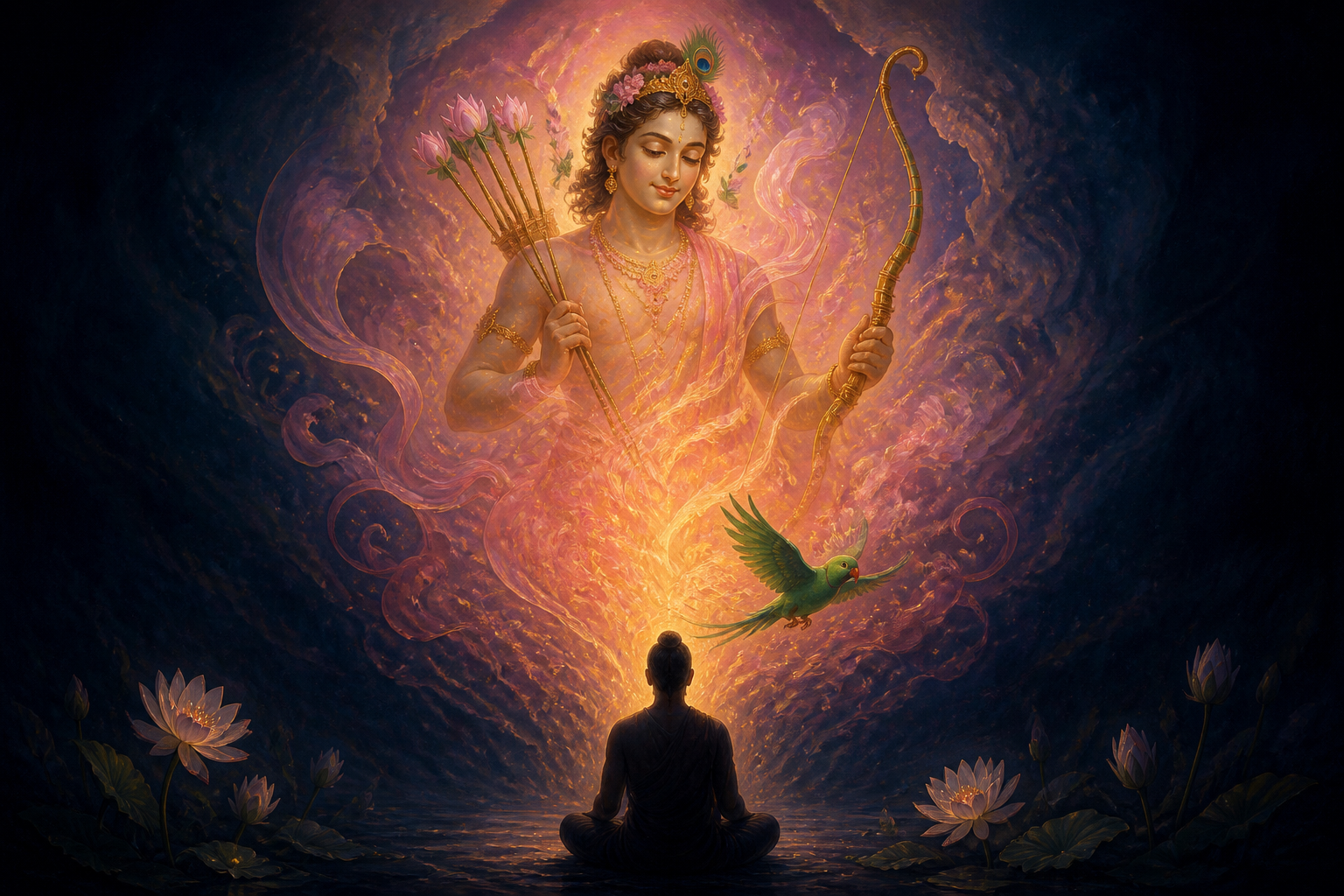
Puranic tradition remembers Kamadeva as one who arises from the mind of Brahma. That detail keeps the parrot’s symbolism from being reduced to biological fertility. Desire becomes active in the mental world before it becomes an outward deed. You imagine, compare, name, repeat and anticipate. Only then does the impulse settle into intention and conduct.
The parrot belongs naturally within this sequence. It is the voice that repeats the attractive image, the mental echo that keeps calling attention back to it and the movement that carries an inward possibility toward expression. Kamadeva’s vahana therefore links mind and manifestation: what consciousness entertains can become what a person pursues.
That does not make the first stirring of attraction a moral failure, nor does it make every desire a command. The crucial interval lies between noticing and carrying forward. If a desire troubles you, separate its stages: the initial attraction, the image you build around it, the words that reinforce it, the intention you form and the result you are willing to create. The parrot is especially relevant in the middle of that sequence, where repetition can turn a passing impulse into a durable attachment.
This is a Dharmic way to approach the symbol without either glorifying or condemning kama. Desire is a real power. Its ethical character becomes clearer through its direction, means and fruit. The image invites discernment at the point where mental attraction begins acquiring speech, momentum and consequence.
Four common misreadings obscure the parrot
The first misreading treats the bird as a merely erotic mascot. That narrows both Kamadeva and kama. The deity’s domain includes aesthetic delight and attraction broadly, so the parrot can illuminate poetry, beauty, affectionate communication and creative longing as well as romance.
The second turns the parrot into a simple emblem of uncontrolled lust. Mimicry can certainly warn against compulsive repetition, but the same vocal quality can represent communication and the ability of beauty to find expression. A layered symbol can disclose a power and caution you about its misuse at the same time.
The third assumes that every feature has one official dictionary meaning. Hindu iconography is rarely improved by that approach. Speech, echo, mental movement and fruition reinforce one another here; forcing the bird into a single-word definition discards the relationship among them.
The fourth mistake is to isolate the parrot from Kamadeva. A parrot appearing in another narrative or artistic setting need not carry this complete interpretation. Context governs meaning. Confirm the figure, setting and relationship before assigning the symbolism of Kamadeva’s vahana to every depicted parrot.
Key takeaways for reading Kamadeva’s parrot
- Begin with kama in its broad sense: desire, attraction and aesthetic delight, not sexual appetite alone.
- Read the parrot’s voice as the passage from inward attraction to spoken expression.
- Notice the ambiguity of mimicry: repetition can communicate love, but it can also make borrowed wants feel personal.
- Connect fruit and seed with fruition. Ask what a desire will produce, not only whether it can be satisfied.
- Keep Kamadeva’s mind-born origin in view. Imagination, naming and repetition help an impulse become an intention.
- Treat the vahana as a layered interpretive key, not as a mascot, omen or one-word cipher.
The next time you encounter Kamadeva’s parrot, pause before looking for a fixed label. Follow the movement the bird reveals: from attraction in the mind, through the echo of words, toward a fruit that will affect more than the moment. Then apply the image’s question to one desire of your own: whose voice is repeating it, and what will it bring into being if you give it wings?
References
