
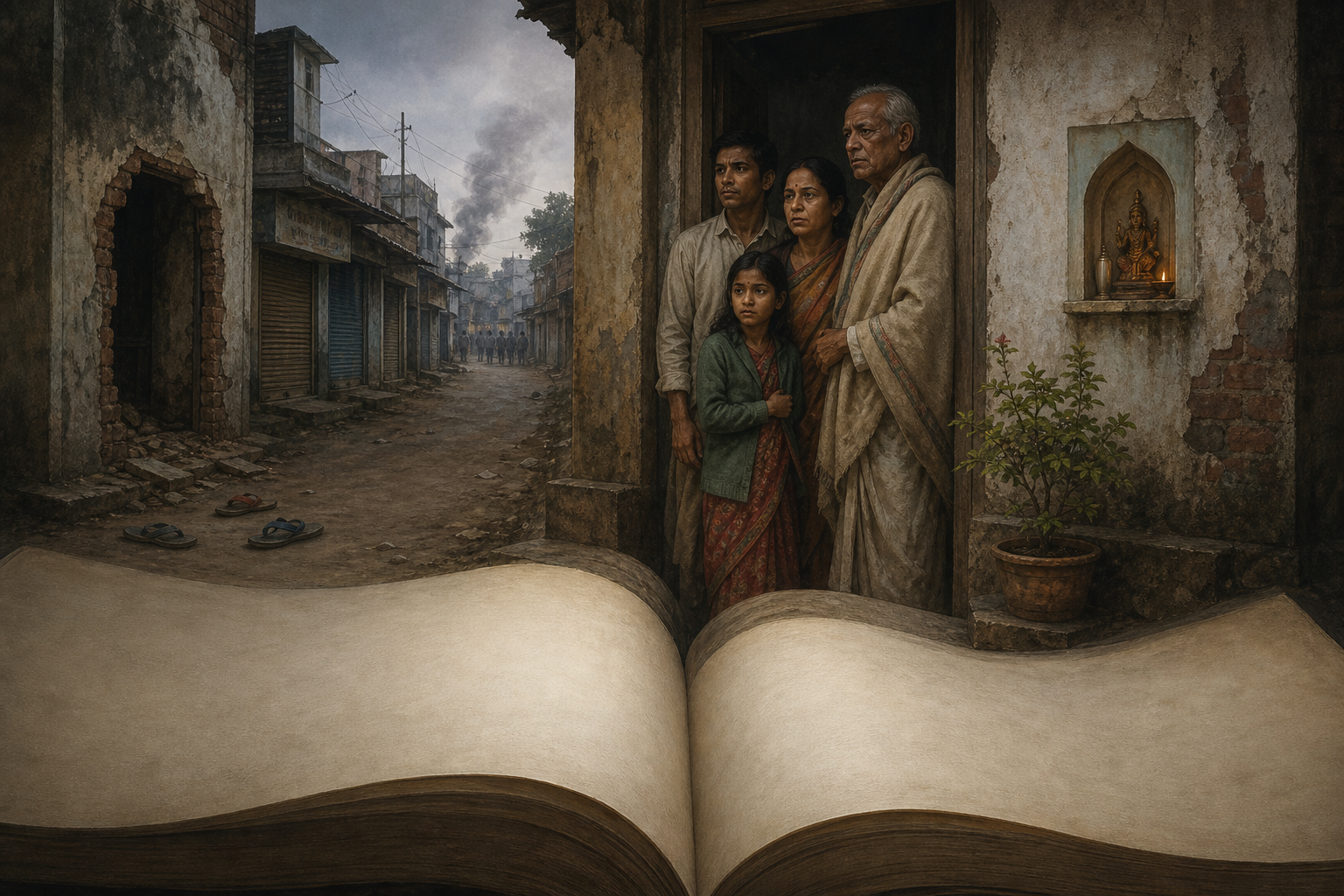
If you picked up Lajja to understand what happened to Bangladesh’s Hindus, you need to know what kind of truth it can give you. The Datta family is fictional, but the danger surrounding Sudhamoy, Kironmoyee, Suronjon, and Maya was framed in response to the anti-Hindu violence of December 1992.
Read it neither as a complete history nor as mere invention. Read it as a close study of how religious persecution works: a distant event becomes a pretext, neighbors are reduced to communal identities, ordinary life becomes unsafe, and institutions fail the people who most need protection. That reading gives you a disciplined way to discuss Hindu persecution without exaggeration, euphemism, or collective blame.
Begin with the family, then widen the frame
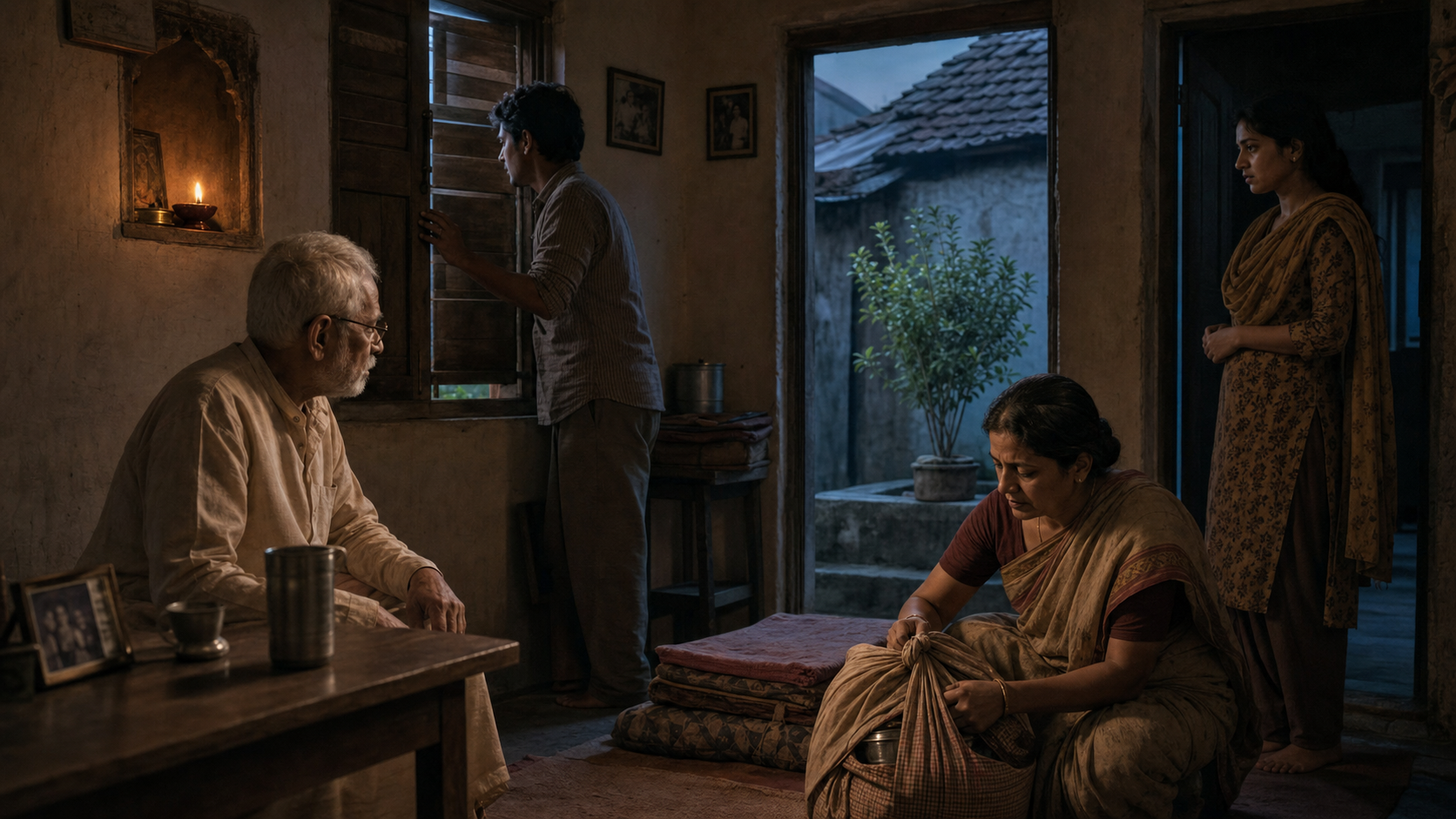
Large phrases such as “communal violence” can hide what persecution does inside a home. The Datta family restores that human scale. Public hatred enters private life as fear, uncertainty, loss of trust, and the realization that citizenship may not protect a minority once neighbors begin treating religious identity as guilt.
The violence surrounding the family is not confined to one kind of target. Temples were destroyed, homes and shops were attacked and looted, and Hindu women faced sexual violence. Notice the structure of that targeting. The temple represents the right to worship. The home represents physical belonging. The shop represents economic survival. Sexual violence attacks both the individual victim and a community’s sense of security. When all four domains are threatened, persecution reaches far beyond a disagreement over belief.
This gives you a practical way to read every episode. Ask four questions: What part of life has become unsafe? Was the victim selected because of religious identity? Who had the power to intervene? What choice remained available to the victim afterward? Those questions reveal more than a general label such as “tension” ever can.
Let humanity be the other name of religion.
Taslima Nasrin, Lajja
That dedication supplies the moral test for everything that follows. It is not an argument against religious life. It is an argument against using religion to strip innocent people of safety and dignity. Any religious claim that requires the punishment of an uninvolved neighbor has already abandoned dharma for adharma.
A trigger explains when, not why the minority was chosen
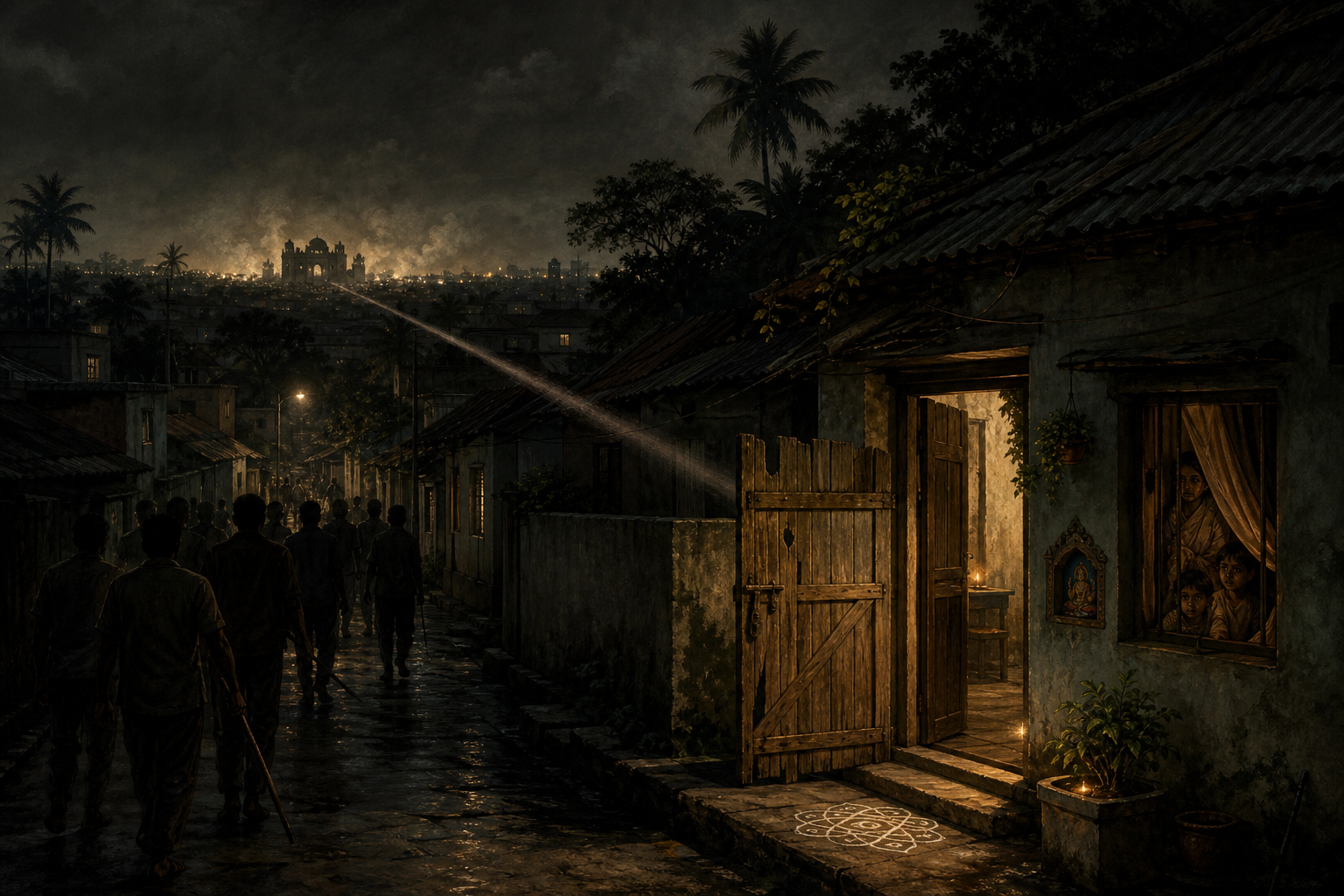
The demolition of the Babri Masjid in India preceded the December 1992 attacks in Bangladesh. Yet chronology alone does not explain responsibility. Bangladeshi Hindus were treated as substitutes for people and events across an international border. Their shared religious identity became the supposed connection, even though collective identity cannot establish individual guilt.
This is the distinction between a trigger and a pretext. A trigger helps explain why violence erupted at a particular moment. A pretext is the justification used to redirect anger toward an available target. Neither tells you why a society had already become willing to punish a minority, why particular properties could be attacked, or why perpetrators expected to act without effective restraint.
When you assess another episode of communal violence, separate three things. First identify the event invoked by the aggressors. Then identify how the victims were selected. Finally ask what institutions, political incentives, or failures made the attack possible. If you collapse those questions, the aggressor’s excuse begins to sound like an explanation. It is not.
No judgment about what happened at Ayodhya can make an uninvolved Hindu family in Bangladesh a legitimate target. Saying that plainly is not an attempt to avoid historical debate. It is the minimum principle required to reject collective punishment everywhere.
Use language that identifies persecution without overstating the evidence

Words shape what a reader thinks happened. “Communal tension” may describe hostility before violence, but it is inadequate once people and places are attacked because they are Hindu. “Riot” can imply that two sides engaged in comparable violence. If the known facts establish one-sided selection of Hindu temples, homes, businesses, and women, “anti-Hindu attacks” or “targeted communal violence” is more precise.
Precision also places limits on what you should claim. Repeated attacks can establish a recognizable pattern. They do not, by themselves, prove central coordination. State failure is not automatically the same as state direction. If available evidence shows that officials failed to protect citizens, say that. Do not claim that officials organized attacks unless independent evidence establishes it. The word “systematic” should likewise be reserved for evidence of an organized practice, policy, or sustained pattern, not used merely as an intensifier.
The Bangladesh government’s decision to ban Lajja within months belongs in this analysis. Nasrin also faced death threats and eventually lived in exile. The ban does not prove that the government directed the mob violence. It does establish a separate and serious fact: the state restricted a work that confronted fundamentalism, minority insecurity, and the failure of Bangladesh’s secular promise.
That promise matters because the persecution represented more than a sequence of damaged buildings. Bangladesh emerged from the 1971 Liberation War with a secular national aspiration. The vulnerability of Hindus in 1992 therefore appears as a betrayal of citizenship itself: a religious minority could be treated as less securely Bangladeshi when majoritarian anger rose.
Keep the literary and historical layers distinct when you speak or write. Say that the Datta family is fictional. Say that Nasrin placed them against the anti-Hindu violence of December 1992. Corroborate any additional date, location, casualty figure, or allegation before presenting it as historical fact. This distinction protects credibility without diminishing the moral reality conveyed through the family.
A pro-Hindu response must reject collective blame
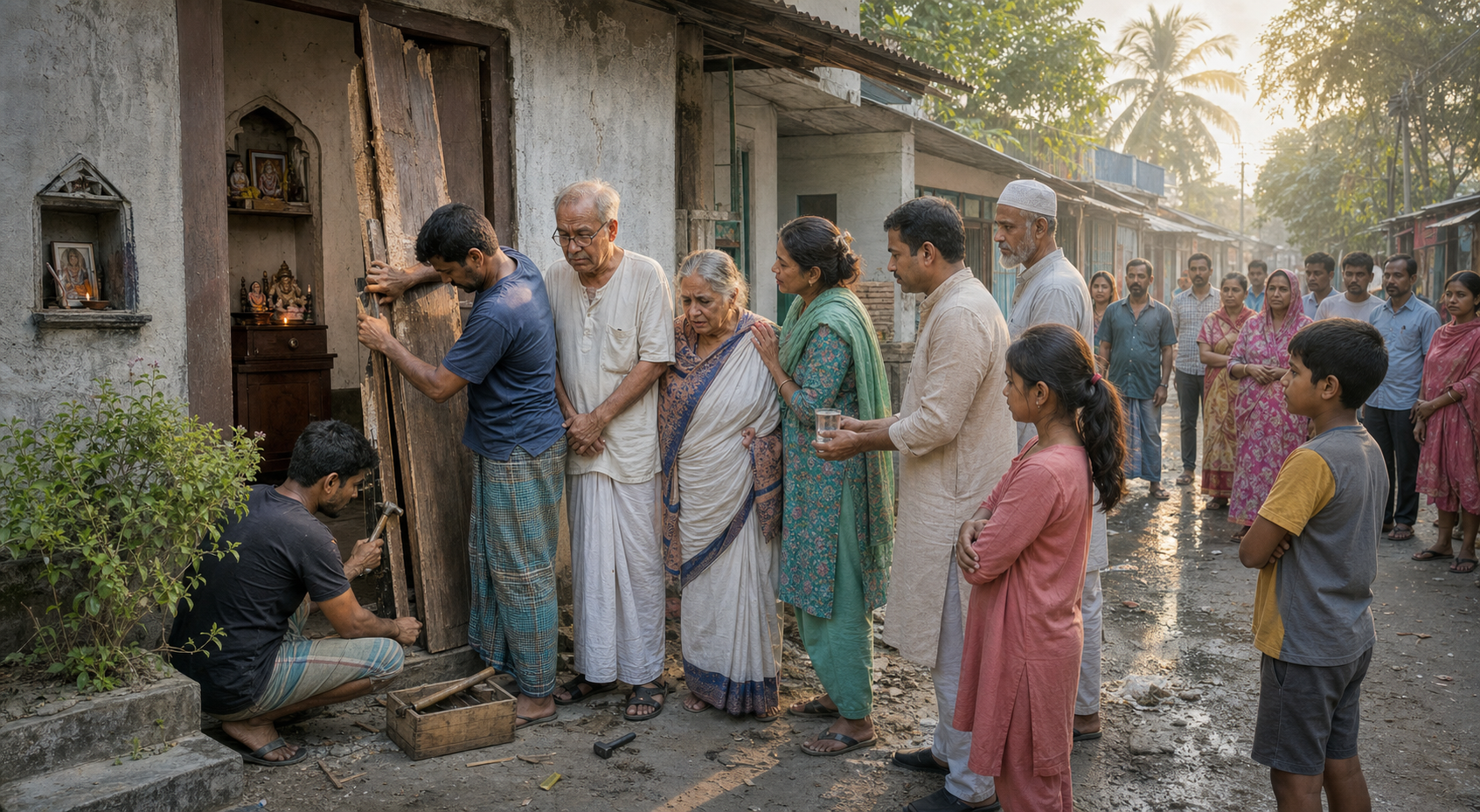
Defending persecuted Hindus does not require you to accuse every Muslim. In fact, turning “Muslim fundamentalists” into “Muslims” would reproduce the mechanism that made the Datta family vulnerable: treating an individual as responsible for everything associated with a religious category.
Name the perpetrators as specifically as the evidence permits. Name Hindu victims without disguising why they were selected. Name failures of protection and censorship where they are established. At the same time, refuse to assign inherited guilt to an entire population. Moral restraint is not a retreat from advocacy. It prevents the discussion from being diverted away from victims and toward a fresh contest of communal accusations.
Refusing collective blame also does not require false symmetry. You can acknowledge that an event in India preceded the attacks while insisting that it did not justify violence against Bangladeshi Hindus. You can oppose anti-Muslim hatred while accurately naming anti-Hindu persecution. These positions are not contradictory. Both follow from the principle that innocent people must not be punished for their religious identity.
This is where Lajja asks something difficult of a Dharmic reader. It invites righteous anger at cruelty, but its dedication sets a boundary around that anger. If your response erases the individuality of other human beings, you have surrendered the very moral ground on which the defense of persecuted Hindus stands.
Key takeaways for readers and advocates
- Lajja uses the fictional Datta family to give human scale to the anti-Hindu violence surrounding December 1992.
- A trigger explains the timing of violence; it does not explain or justify the selection of unrelated Hindu victims.
- Attacks across worship, home, livelihood, and bodily security reveal a pattern of identity-based persecution rather than an abstract religious dispute.
- Accurate advocacy distinguishes mob violence, state failure, censorship, and state direction instead of treating them as interchangeable claims.
- A credible pro-Hindu position names fundamentalism and anti-Hindu targeting while refusing to blame Muslims collectively.
If you plan to cite Lajja in an essay, community meeting, classroom, or public campaign, keep a simple claim record. For each factual assertion, note the date, place, target, alleged perpetrator, kind of harm, and corroborating link. Mark an unknown as unknown instead of filling the gap with assumption. Do not publish the identity or location of a vulnerable survivor without consent.
Ask three concrete questions of any institutional response: Were threatened people and places protected? Were attackers investigated? Could victims, witnesses, and writers speak without intimidation? These questions move the conversation from ceremonial concern to accountability.
Do not use a novel rooted in 1992 as proof of every claim about Bangladesh in the present. For current advocacy, verify dates, locations, official actions, and casualty claims through multiple independent records. Lajja can teach you what to notice; responsible documentation must establish what happened in each new case.
Read with four words beside you: trigger, target, institution, consequence. Then speak with equal discipline. Name the Hindu victims, identify the fundamentalism that endangered them, distinguish proven facts from inference, and refuse the logic of collective guilt. That is how remembrance becomes reliable witness rather than another instrument of communal anger.
References
