
You may have encountered the name Prabhupada House and wondered whether it describes a former residence, a memorial, a community building, or something else. Do not let the evocative name answer a historical question that still needs evidence.
The secure starting point is both narrower and more meaningful: Prabhupada House belongs to the Melbourne Hare Krishna setting, and that community identifies itself with the International Society for Krishna Consciousness, or ISKCON. Its significance must therefore be read in relation to A.C. Bhaktivedanta Swami Prabhupada, whom the community names as its Founder-Acharya. If you want to visit, study, or help preserve the house, the task is to hold devotional meaning and historical proof together without confusing them.
Place devotional meaning and historical proof side by side
A religious heritage place can matter in several ways. It may have a documented association with a teacher. It may preserve the memory of a founding generation. It may support a living community. It may also embody a lineage even when its architectural history is modest. These are different claims, and each requires a different kind of evidence.
Hare Krishna Melbourne places Prabhupada House within its ISKCON identity and names A.C. Bhaktivedanta Swami Prabhupada as Founder-Acharya. That establishes the institutional and devotional frame. It does not, on its own, establish when the property was acquired, whether Prabhupada stayed there, what activities occurred inside it, or when the present name came into use.
This distinction is especially important because a house named after a religious teacher is not necessarily that teacher’s former residence. It may commemorate him, continue his mission, preserve community memories, or serve a present-day purpose. Until the particular connection is documented, describe the association precisely rather than choosing the most dramatic interpretation.
- Ask what is documented. Look for dated photographs, correspondence, property records, contemporary notices, recorded talks, or other material tied to the place.
- Ask what is remembered. Identify who directly witnessed an event, who heard about it later, and when each recollection was recorded.
- Ask what the house does now. Its present function may be devotional, residential, educational, archival, administrative, or a combination. Do not infer the answer from its name.
- Ask what it means to the community. Devotional significance is evidence of living heritage, although it is not a substitute for evidence about dates, ownership, or physical changes.
Founder-Acharya is not merely an honorary label in this context. It locates Prabhupada at the formative point of ISKCON’s teaching lineage and institutional life. A place associated with his name can therefore carry heritage through teaching, remembrance, and community continuity, even when individual claims about the building still require verification.
Plan a visit without assuming the house is publicly accessible
Prabhupada House should not be treated as an ordinary tourist attraction unless the Melbourne community currently presents it that way. Access, use, and visitor arrangements can change. Before travelling, use the current contact details published by Hare Krishna Melbourne and ask direct questions.
- Confirm whether Prabhupada House presently receives visitors and whether an appointment is required.
- Request the current address from the community rather than relying on an old post, map entry, or unverified social-media caption.
- Ask which parts, if any, are accessible and whether the building has residential or other private areas.
- Check the expected protocol for footwear, photography, recording, dress, food, and participation in devotional activities.
- Ask whether someone familiar with the documented history can explain the site’s connection to Melbourne’s ISKCON community.
Do not assume that a temple timetable, if you find one elsewhere, also governs access to the house. Do not photograph residents, worshippers, records, private rooms, or sacred objects without permission. A heritage visit becomes more informative when the people caring for the place do not have to defend its boundaries.
If a knowledgeable community member is available, replace broad prompts such as “Tell me the history” with questions that produce usable answers:
- What is the earliest connection between this property and the Melbourne Hare Krishna community that can be independently dated?
- Was Prabhupada House always the name used for the property, or was the name adopted later?
- Which events associated with the house are supported by contemporary records?
- Which accounts survive primarily as oral history, and who remembers them firsthand?
- How has the building’s use changed?
- Which physical features are original, restored, reconstructed, or adapted?
These questions do not diminish devotion. They protect the difference between what is known, what is remembered, and what is interpreted. That difference is what allows a heritage account to remain trustworthy as it passes to another generation.
Read the house through lineage, community, and place
A useful visit is not a hunt for a single famous-event claim. Read Prabhupada House through three connected lenses and keep notes under each one.
Lineage: why Prabhupada’s name is attached
Notice how the community connects the house to Prabhupada’s role as Founder-Acharya. Ask whether that connection is expressed through teachings, practices, institutional memory, objects, stories, or a documented event. Record the answer in the community’s own terms, then identify what evidence supports any historical particulars.
Community: who carries the heritage now
Buildings do not preserve living religious heritage by themselves. People maintain them, remember their uses, welcome newcomers, transmit practices, and decide what should be retained. Ask who presently cares for the house, who uses it, and how decisions about it are made. A change of function is not necessarily a loss of authenticity; it is part of the history and should be documented accurately.
Place: what the physical fabric can and cannot prove
Look at the layout, materials, alterations, displays, and relationship between public and private space. Ask what has changed rather than guessing from appearance. An old-looking object is not automatically original to the house, while a renovated room may still be central to the community’s continuing life.
Use a simple note format: what you observed; how it was explained; what evidence could verify the explanation. For example, a displayed photograph is an observation, its community meaning is an explanation, and its date, photographer, caption, and chain of custody are verification questions. Keeping those layers separate prevents an assumption from quietly becoming a fact.
Key takeaways
- Understand Prabhupada House within Hare Krishna Melbourne, ISKCON, and the community’s recognition of A.C. Bhaktivedanta Swami Prabhupada as Founder-Acharya.
- Do not infer that Prabhupada resided in or visited the building merely because it bears his name.
- Confirm current access with Hare Krishna Melbourne before travelling; do not assume that the property operates as a public museum or temple.
- Separate documented history, firsthand memory, repeated tradition, present use, and devotional interpretation.
- Judge the house as living heritage through its lineage connection, community stewardship, and physical fabric rather than through one unsupported claim.
Preserve Melbourne’s ISKCON memory with usable records
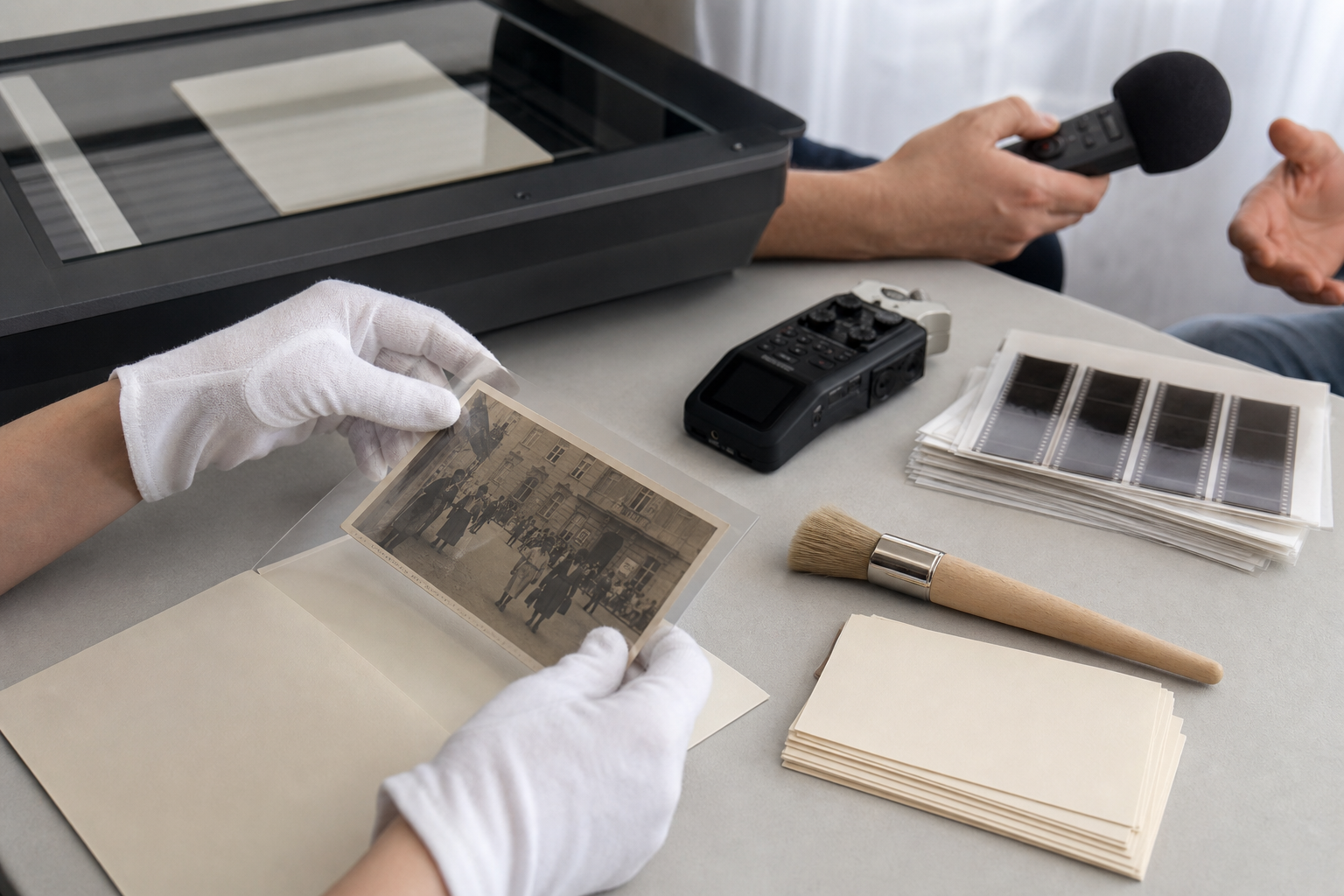
If you belong to the community or hold photographs, letters, recordings, programmes, or memories connected with Prabhupada House, the immediate danger is not a lack of affection. It is the loss of provenance: the names, dates, circumstances, and permissions that make an item intelligible after its original custodian is gone.
For every item, record the following while someone can still answer:
- A stable filename or catalogue identifier.
- Who created, owned, donated, or supplied it.
- The date, or an honestly labelled approximate period when the exact date is unknown.
- The people and place shown, including who made each identification.
- Whether the accompanying account is firsthand, heard from a named person, or repeated without a known origin.
- Any permission or restriction governing publication, quotation, copying, or public display.
- Where the original is held and where a preservation copy is stored.
Record oral histories with consent. Begin by asking the speaker to distinguish “I saw” from “I was told.” Preserve the original account even if later evidence corrects it; add the correction and supporting material separately. This keeps the human memory intact without presenting every remembered detail as settled history.
Aniruddha Dasa is the person named in the Prabhupada House introduction. That gives you a verified spelling to carry into further inquiry, but it does not establish a formal role or biographical detail beyond what the community itself confirms. Apply the same discipline to every name, title, date, and event.
If you are planning a visit, send your access and history questions before you travel. If you are helping preserve the heritage, catalogue one well-documented photograph or record one properly consented memory first. Small, verifiable acts will serve Prabhupada House better than a grand narrative whose details cannot be traced.
References
- Dandavats – Today’s Featured Video: In The Loop, Prabhupada House – Aniruddha Dasa
- Hare Krishna Melbourne – Official website
