
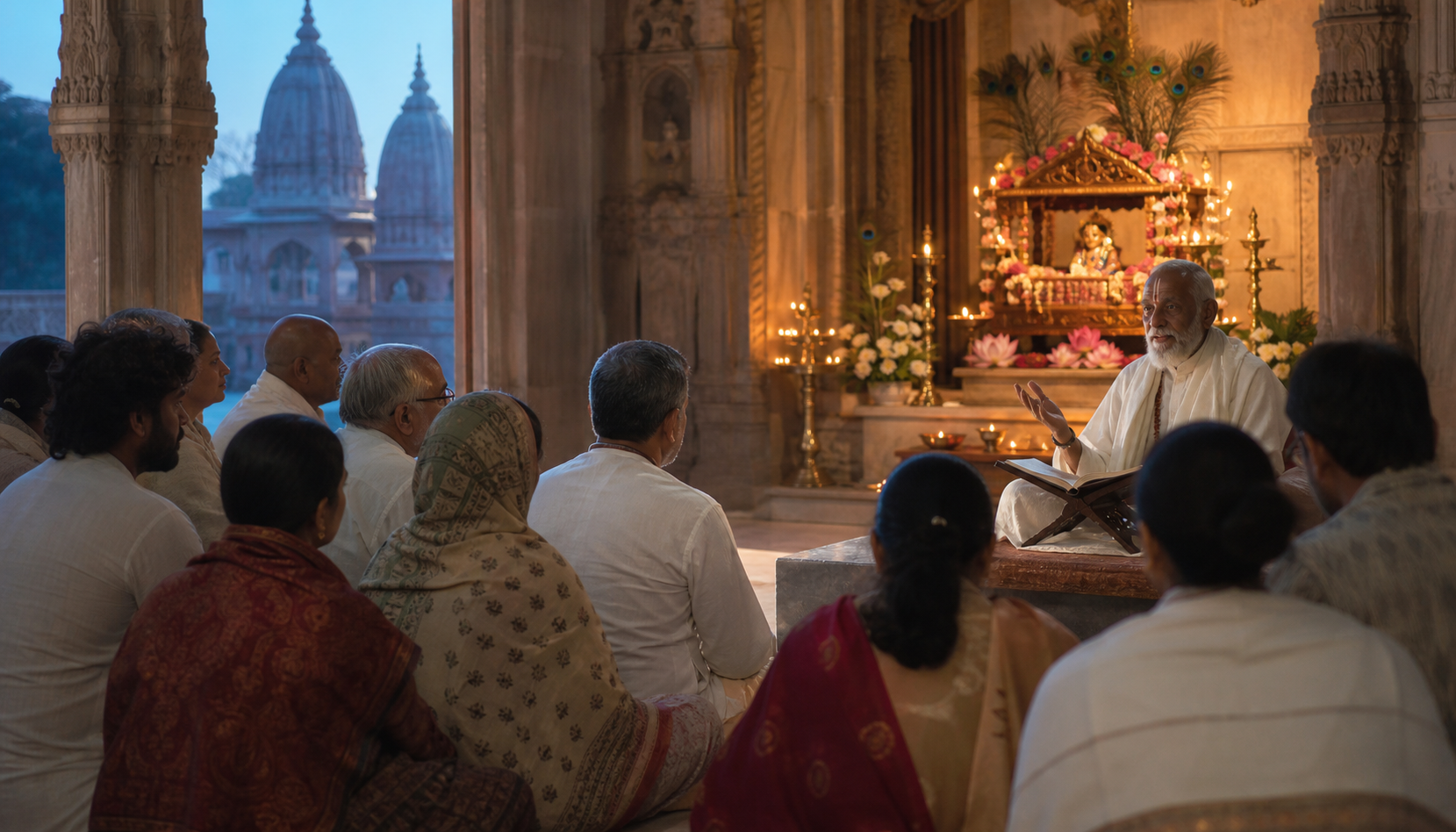
You may open a Janmashtami discourse wanting something deeper than festival atmosphere, yet finish with only a few stories, Sanskrit terms, or memorable phrases. The problem is usually not a lack of devotion. It is that no one has shown you how to listen to sacred discourse as a practice.
A Janmashtami-special morning Srimad Bhagavatam class by Guru Prasad Swami at ISKCON Delhi places scriptural hearing where it belongs: near the heart of the observance. Whether you attend such a class in a temple or hear a recording at home, a simple listening method can help you carry its teaching beyond the festival.
Hear Krishna’s appearance as revelation, not festival trivia
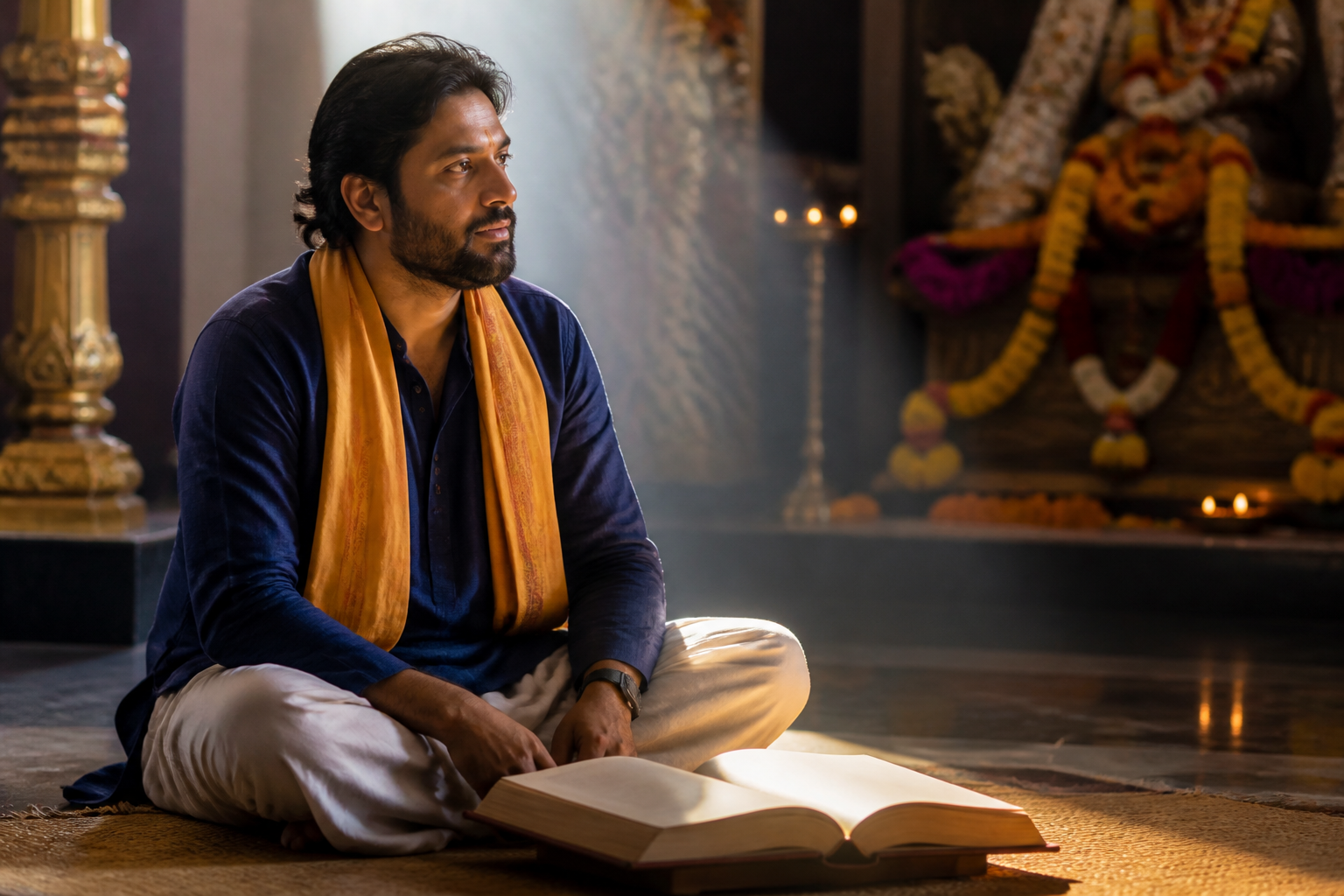
Janmashtami celebrates the divine appearance of Sri Krishna. A Bhagavatam discourse on this occasion is therefore not merely a chronology of remarkable events. It asks you to notice what Krishna’s appearance reveals about Bhagavan, how devotion responds to him, and what must change in the listener.
Begin with one question: What does this account ask me to recognize about Krishna that I normally forget? That question protects you from two common reductions. One treats the discourse as religious entertainment; the other turns it into abstract philosophy with no claim on your conduct.
Listen for relationship. Who tries to control events? Who depends upon divine protection? Who serves without making personal comfort the condition of service? What does the speaker identify as Krishna’s purpose, and what response does that understanding invite? These questions direct your attention from spectacle toward bhakti.
Keep the speaker’s lineage in view. Vaishnava traditions share reverence for Krishna and the Bhagavatam, but they do not always express every theological point in identical language. Receive a discourse within its stated sampradaya rather than silently converting each claim into your own preferred framework.
Prepare a page that separates scripture, teaching, and response

Do not begin by trying to record everything. A page crowded with disconnected sentences often preserves less than three clearly separated notes. Divide your page before the discourse begins:
- Scripture: Write the passage, episode, or scriptural phrase being explained. If the speaker does not identify an exact verse, do not invent one from memory.
- Teaching: State the central claim in one complete sentence. Use your own words unless you are certain that you captured a quotation exactly.
- Response: Record one implication for your worship, relationships, habits, or service. Make it concrete enough to perform.
Add a narrow margin for unfamiliar names and terms. Note the word as accurately as you can, along with the surrounding idea or the recording timestamp. Do not pause the central argument every time you hear an unfamiliar Sanskrit expression. Context first; spelling and definition can be checked afterward.
Your physical setup matters because divided attention produces divided hearing. At home, put away the other screen, stop message notifications, and listen at normal speed on the first pass. In a temple, settle before the class begins and keep your notebook ready. Multitasking may let the sound continue, but it prevents you from following how one teaching leads to the next.
Listen on the levels of lila, siddhanta, and sadhana

A strong Bhagavatam discourse often moves among sacred narrative, theological meaning, and spiritual practice. Confusion begins when you collapse those levels into one. Mark them separately:
- Lila: What occurs in the sacred account, and how do the participants respond? Follow the narrative before trying to turn every detail into a symbol.
- Siddhanta: What truth about Krishna, the jiva, devotion, grace, or divine action is being taught? Write the speaker’s actual claim, not the broader claim you assume must follow from it.
- Sadhana: What should a listener do differently? Look for a practice, disposition, restraint, or form of service rather than a vague instruction to become more spiritual.
This distinction also helps when a statement feels difficult. First ask whether you are uncertain about what happened in the narrative, what doctrine the speaker drew from it, or how the doctrine applies. A question aimed at the correct level is much easier to answer.
Before accepting or rejecting a difficult claim, write four short lines: what was said; what reason was given; what I inferred; what remains unclear. You may discover that your objection concerns an inference the speaker never made. If the disagreement remains, ask a qualified teacher which part is scriptural wording, which part is commentary, and which part is characteristic of the lineage.
Do not build a sweeping conclusion from an isolated clip. Sacred teaching has an argumentative shape: a question, context, explanation, qualification, and application may belong together. Revisit the surrounding passage before sharing a dramatic sentence online, and never present your paraphrase as the speaker’s exact words.
Carry one teaching through the rest of Janmashtami
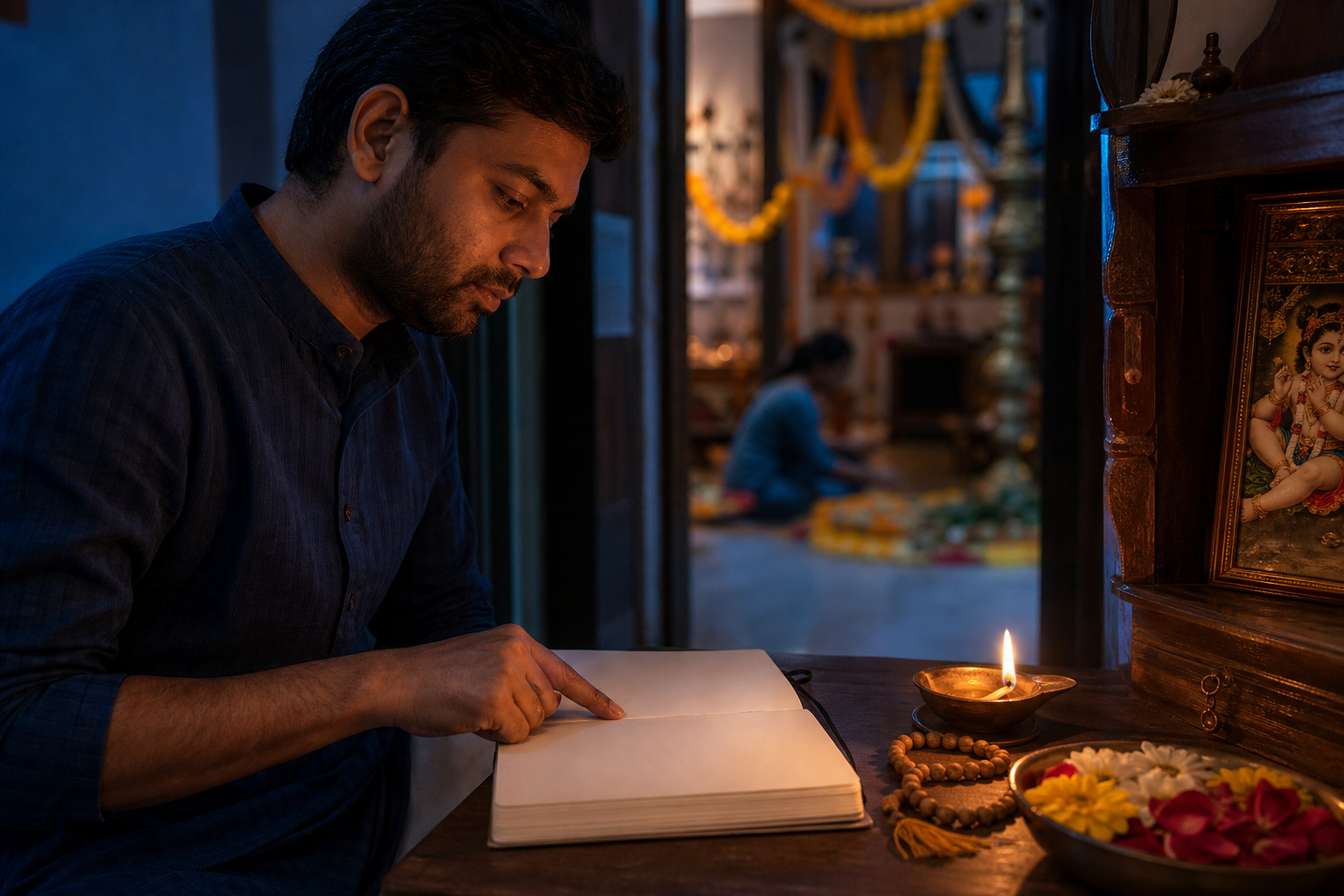
The practical measure of hearing is not how many notes you collected. It is whether one teaching receives an embodied response. Choose a single action small enough to complete with attention:
- Read the Bhagavatam passage discussed in the class and compare it with your notes.
- Give one period of Krishna-nama your undivided attention, using the discourse’s central teaching to steady the mind.
- Perform a needed act of temple, household, or community service without waiting to be noticed.
- Correct one behavior that contradicts the quality of devotion praised in the discourse.
- Explain one teaching to your family in plain language, clearly separating the scriptural account from your own reflection.
Use a one-sentence sankalpa: Because I heard _____, I will _____ before _____. Fill the final blank with a real occasion, such as the end of the festival observance or your next period of worship. A defined occasion prevents sincere intention from dissolving into an indefinite promise.
Return to the note after you have acted. Ask whether the practice helped you remember Krishna, loosen self-centeredness, or serve more attentively. If it did, continue it without turning a festival resolution into a performance. If it did not, refine the action rather than discarding the teaching.
Key takeaways
- Enter the discourse with one question about what Krishna’s appearance asks you to recognize or change.
- Separate your notes into scripture, teaching, and personal response.
- Track lila, siddhanta, and sadhana without confusing narrative details, doctrinal conclusions, and practical applications.
- Preserve lineage-specific teachings in their proper context instead of presenting every formulation as universal.
- Complete one concrete act of remembrance or service while the hearing is still fresh.
Before you begin your next Janmashtami Bhagavatam discourse, draw the three-part page and write your opening question. When the class ends, do not rush to another program. Stay long enough to name the one response that will make your hearing visible in the way you live.
References
