
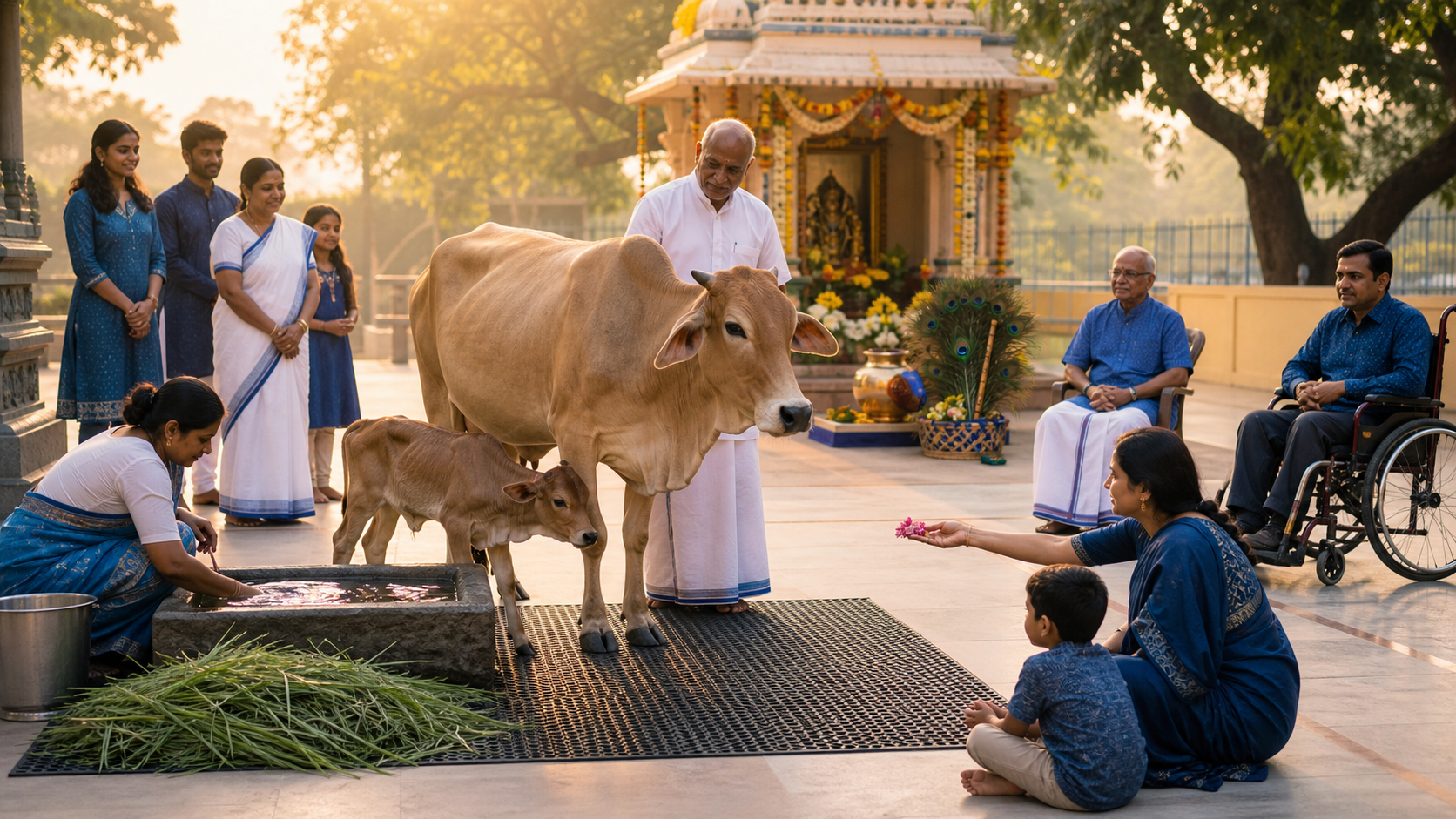
You may be planning Gokulashtami and wondering how gopuja can become more than a decorated cow, a brief offering and a photograph. The answer lies in joining reverence to responsibility: honour the cow, serve the living being before you, and welcome people as Krishna would.
Use one simple standard for every choice you make: does it protect the cow’s welfare, preserve each person’s dignity and deepen remembrance of Krishna? If an activity fails one of those tests, change it before the celebration begins.
Cow worship honours a relationship, not only a symbol
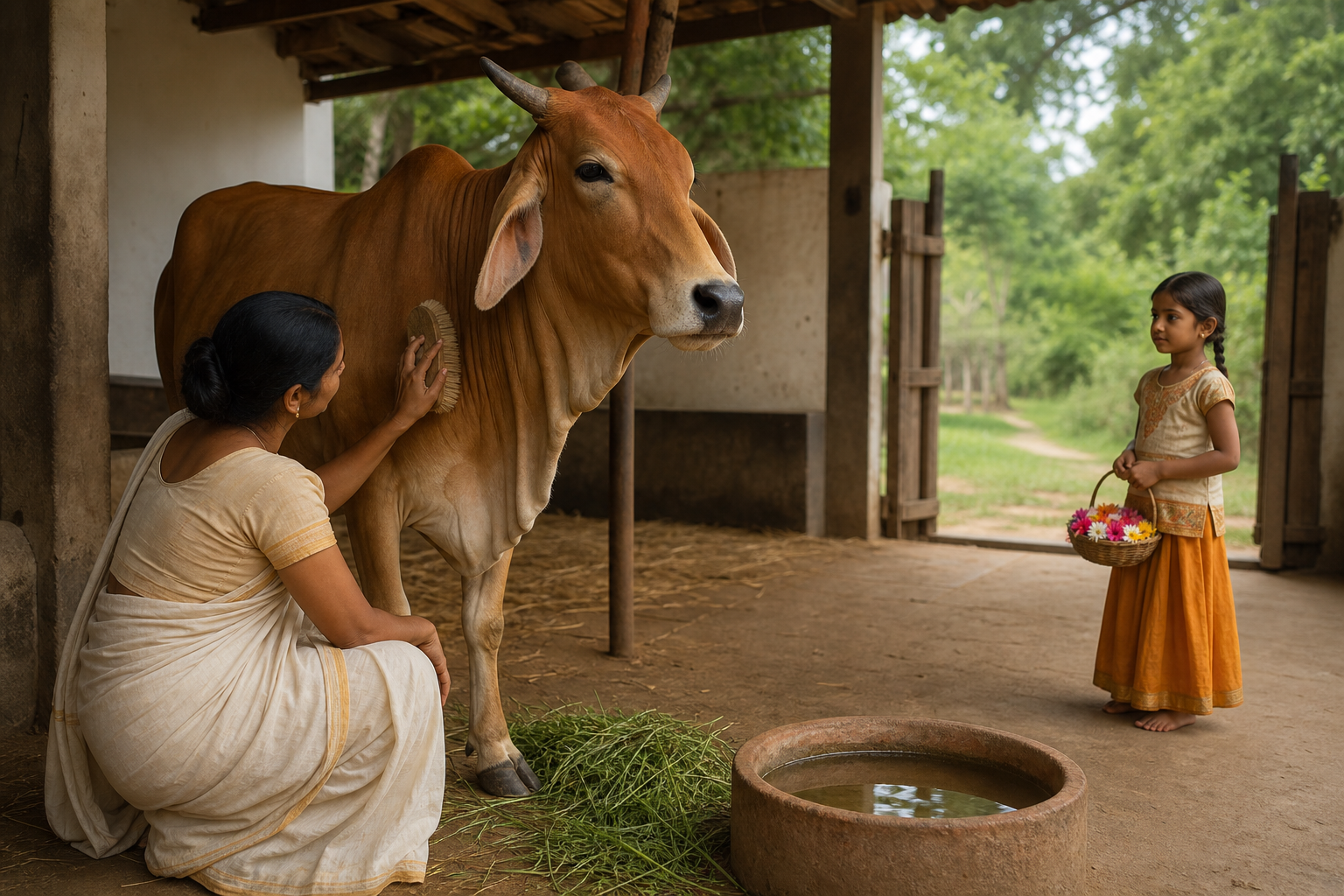
Krishna’s childhood in Gokula makes the cow inseparable from the devotional imagination of Gokulashtami. Yet a living cow cannot be treated merely as religious scenery. She must be approached with the restraint, care and gratitude owed to a being under human protection.
This is why puja, seva and samrakshana belong together. Puja expresses reverence. Seva turns reverence into work. Samrakshana gives that work continuity through protection and responsible care. A ceremony may contain beautiful offerings, but its ethical meaning remains incomplete if concern for the animal ends when the ritual does.
The connection is visible in TTD’s planned September 4, 2026 Gokulashtami observance at Sri Venkateswara Gosamrakshana Shala in Tirupati. The programme joins Krishna’s birth celebration to cow worship and service, with spiritual and cultural activities at a goshala arranged to evoke Gokulam. The pairing matters: the sacred setting directs attention toward an existing place of care rather than using a cow as a temporary festival prop.
You can apply the same principle on a smaller scale. If you visit a goshala, ask its caretakers what the animals actually need before purchasing feed or ceremonial items. If you cannot safely visit a cow, perform Krishna puja at home and support responsible cow care through a trusted institution. Devotion does not become lesser because it avoids an unnecessary encounter with a live animal.
Krishna’s inclusive dharma must shape the arrangements
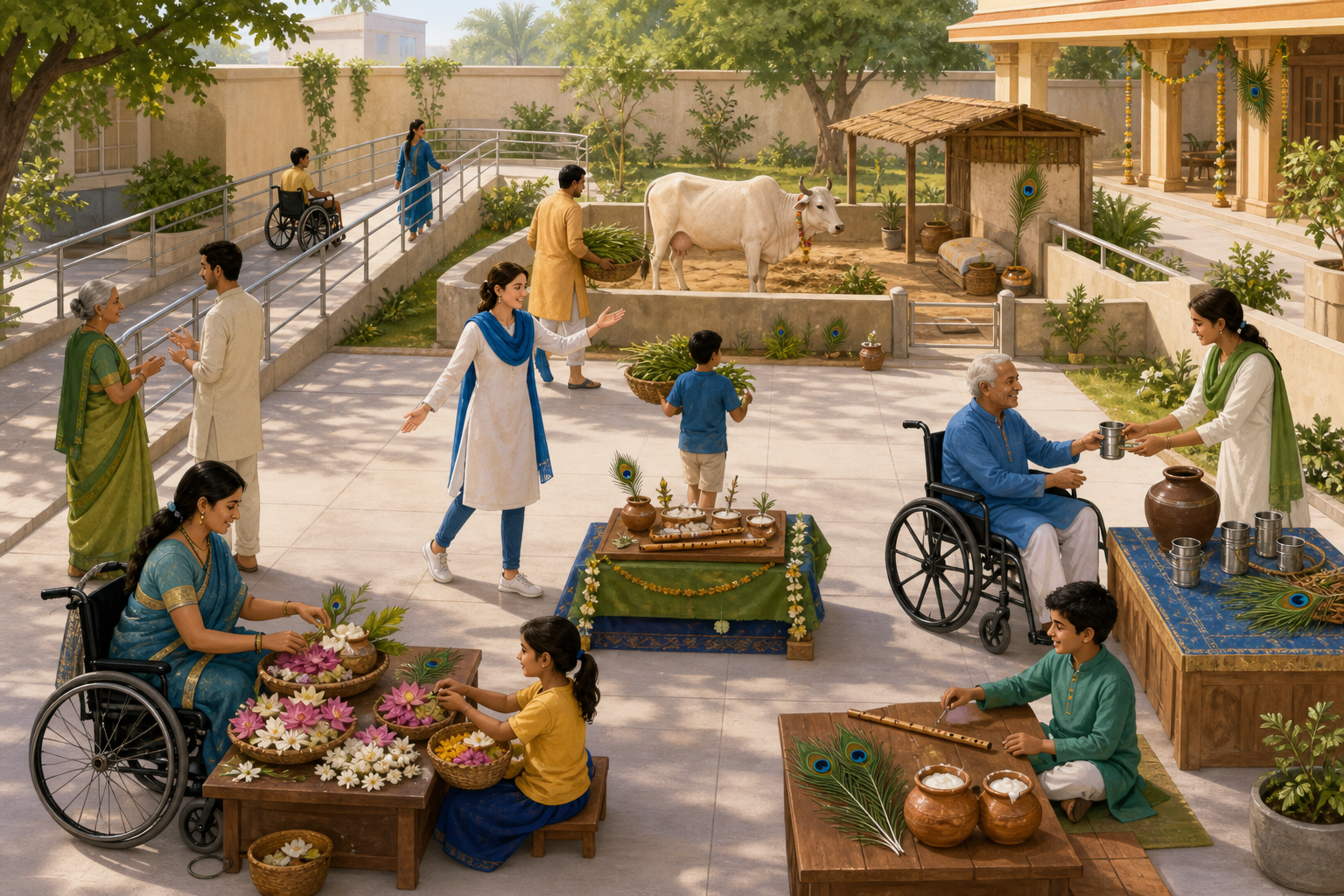
It is possible to praise Krishna’s universal compassion while organizing his festival in a way that humiliates or excludes people. That contradiction cannot be corrected by adding another mantra. It has to be corrected in the guest list, the distribution of work, the seating and the sharing of prasada.
A Krishna-centred understanding of Sanatana Dharma holds that people are to be regarded equally across caste, creed, community, gender and religion. It also refuses to measure human worth by rank or by whether someone performs a prestigious or humble form of service. For your celebration, that principle is not an abstract slogan. It is an operating rule.
- Invite without using social identity as a test of who is worthy to stand before Krishna.
- Make water, seating, darshan and prasada available without a degrading distinction between guests.
- Assign tasks by willingness, ability and safety rather than inherited ideas about who should perform humble work.
- Give the people cleaning, carrying, cooking and caring for animals the same courtesy given to donors or visible ritual participants.
- Explain unfamiliar practices without mocking a newcomer who does not know the expected gesture, mantra or sequence.
Equality does not require every sampradaya to abandon its liturgical form, nor does inclusion mean pretending that all roles are identical. It means that no role becomes an excuse to diminish a person’s worth. A traditional ritual can remain recognizably traditional while every participant is treated with dignity.
Build your Gokulashtami observance around six decisions
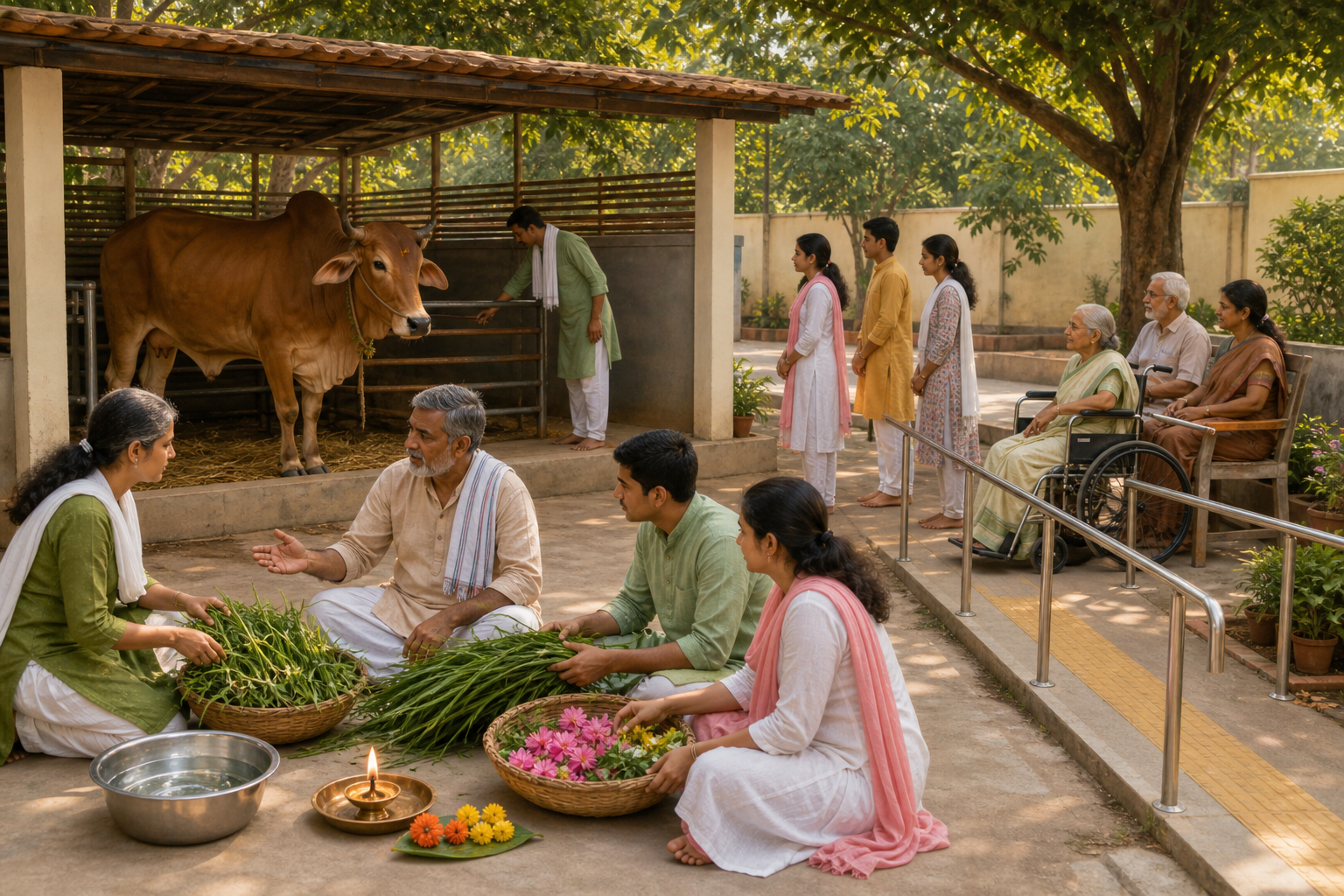
A meaningful observance does not need to be elaborate. It does need to be intentional. Make these decisions before buying decorations or announcing a programme.
- Name the purpose. Write one sentence that joins Krishna-sm remembrance, cow welfare and equal welcome. Use it to reject activities that are merely ornamental or socially divisive.
- Contact the caretaker first. If a goshala or temple is involved, ask what form of visit, donation, feed or volunteer work is appropriate. Follow its instructions around the animals; do not assume that a customary-looking offering is suitable for every cow.
- Keep worship and welfare in the same programme. Place gopuja beside a concrete act of service, such as contributing an item requested by the goshala, supporting ongoing care or helping with an approved task.
- Design the welcome deliberately. Check entrances, seating, drinking water, instructions and prasada distribution from the perspective of a newcomer, an older visitor and anyone with limited mobility. Fix the barrier before guests arrive.
- Protect the cow from festival pressure. Limit handling to what the responsible caretaker permits. Do not crowd, restrain or repeatedly reposition an animal for photographs. If the cow appears unsettled or the caretaker asks people to step back, the devotional response is to step back.
- Decide what continues afterward. Record one realistic follow-through commitment, who will carry it out and when it will be reviewed. A modest commitment that is fulfilled serves better than an impressive promise forgotten after Gokulashtami.
For the exact ritual sequence, use the practice of your family, temple or sampradaya. There is no need to invent a supposedly universal gopuja from fragments found elsewhere. The ethical framework is portable even when liturgical details differ: approach with reverence, follow competent guidance, avoid distress and connect the rite to continuing care.
Notice the contradictions that weaken the celebration
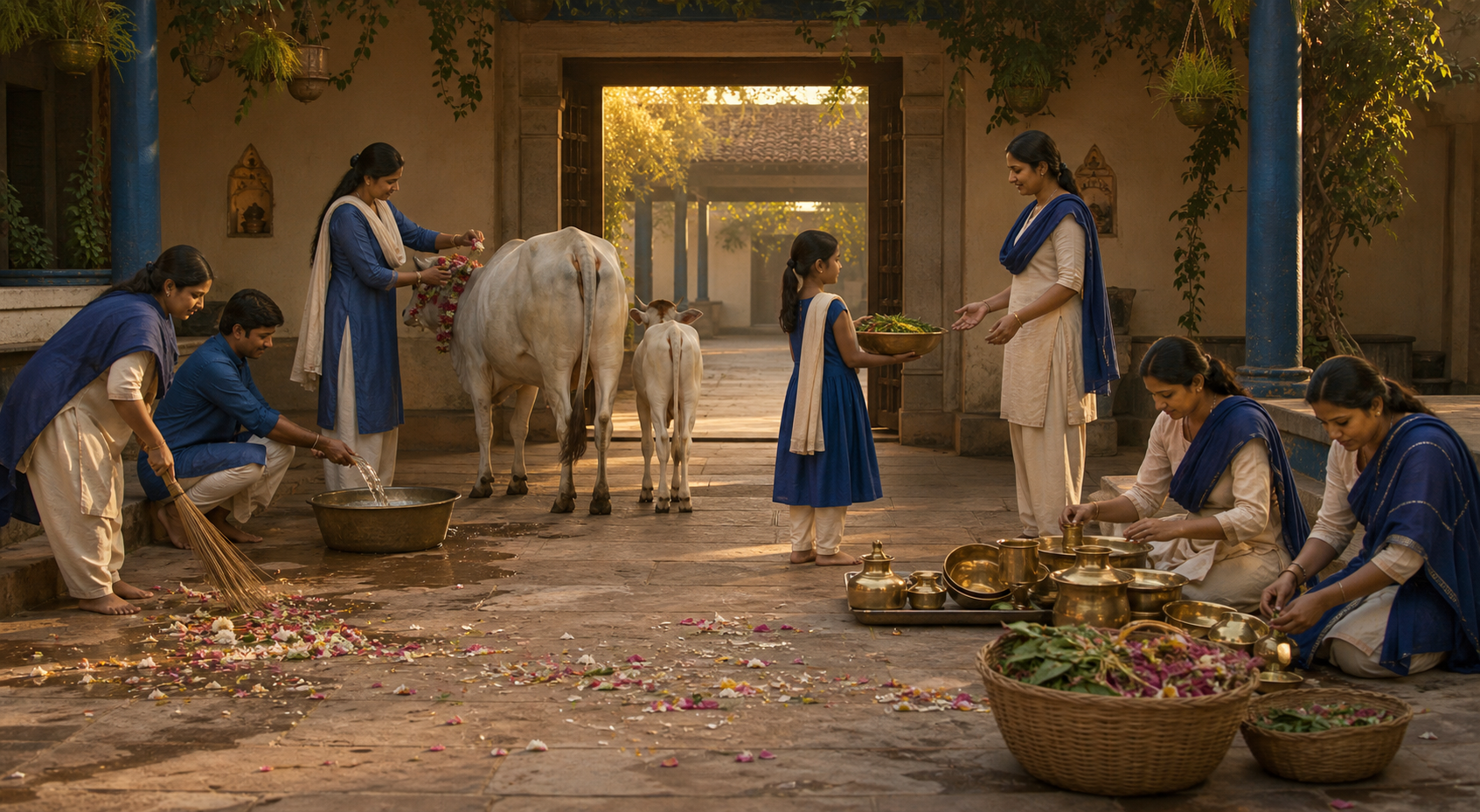
The clearest way to protect the meaning of Gokulashtami is to notice where conduct contradicts the devotion being expressed.
- Lavish decoration with no provision for care: reduce the ceremonial expense and direct something useful toward a goshala’s stated needs.
- Equality in speeches but hierarchy in hospitality: examine who waits longest, who sits separately, who receives prasada last and whose work goes unacknowledged. Change the arrangement, not merely the wording.
- A live cow treated as a photo opportunity: place the animal’s comfort under the caretaker’s authority. A photograph is optional; non-disturbance is part of seva.
- Humbling service imposed on people of lower status: invite volunteers openly, rotate ordinary tasks where practical and honour the work without turning service into a spectacle.
- Devotion used to shame those with limited access: do not suggest that a person without a nearby goshala, sufficient money or physical mobility has failed Krishna. Home worship, learning, responsible giving and kindness to people are meaningful ways to participate.
- Reverence turned into hostility: protecting a sacred value does not require contempt for another community. A celebration carried out through humiliation contradicts the equal regard associated with Krishna’s dharma.
These corrections are practical because they address what people and animals actually experience. The quality of a celebration is revealed less by its public claims than by how the least visible participant is treated.
Key takeaways
- Join gopuja to go-seva and continuing protection; do not let care end with the ceremony.
- Ask goshala caretakers what is safe and useful before bringing feed, offerings or groups near cows.
- Express Krishna’s inclusive dharma through equal dignity in invitations, service, seating and prasada.
- Keep inherited ritual forms where they belong, but never use a ritual role to rank human worth.
- Choose at least one realistic act of cow service that will continue after Gokulashtami.
Before this Gokulashtami, put three things into your plan: one conversation with a responsible cow caretaker, one barrier to equal participation that you will remove and one act of service that will outlast the festival. Then gopuja becomes what Krishna’s dharma asks it to be – reverence made visible through care and equal regard.
References
- Hindu Pad – Gopooja at TTD’s Sri Venkateshwara Goshala on Gokulashtami – 4 September 2026
- Hindu Pad – Sanatana Dharma is Janardhana Dharma
