
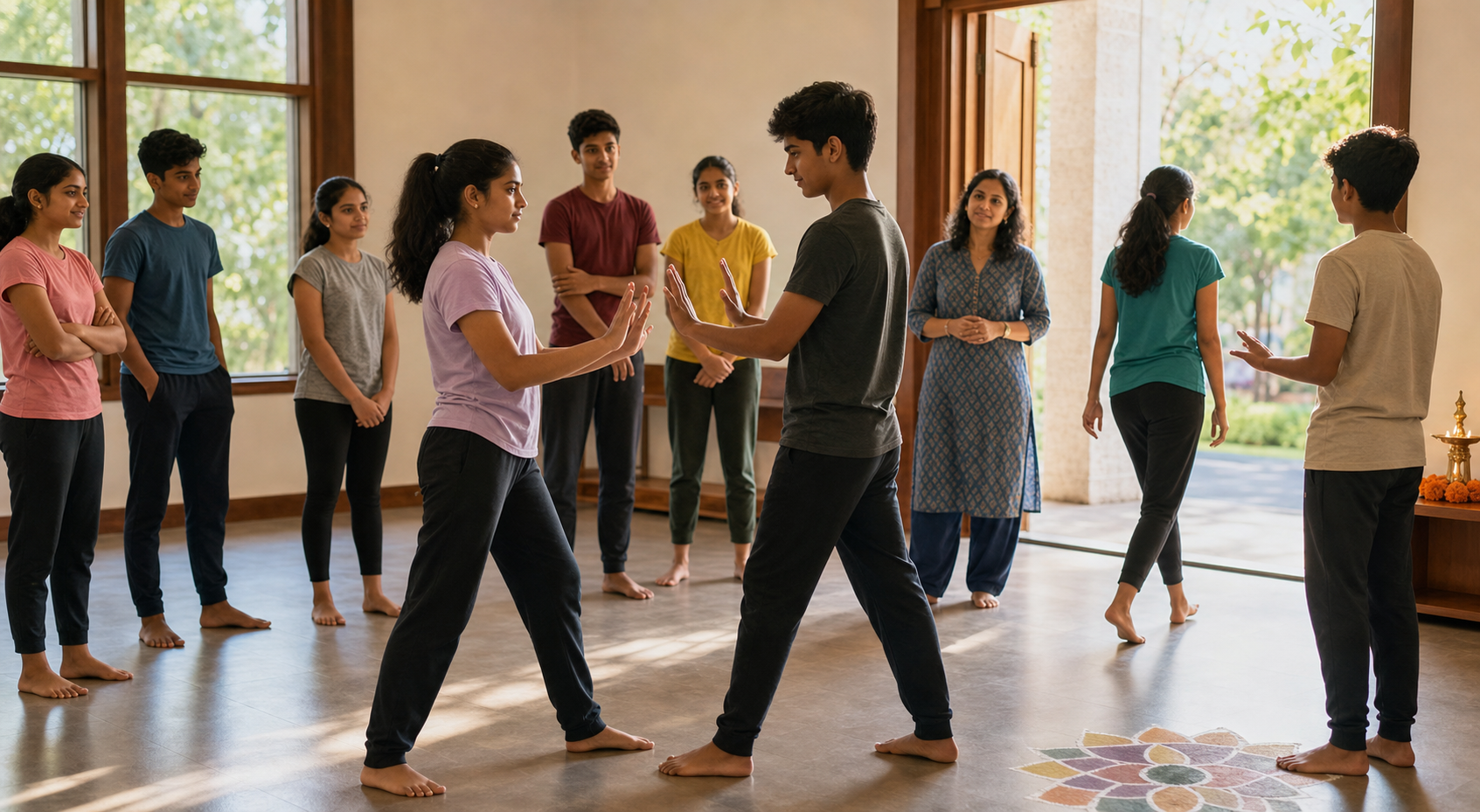
You may be trying to answer a practical question: how do we help Hindu teenagers become rooted, alert and capable without turning youth outreach into a sermon or a display of aggression? Start by connecting dharmic values to decisions they already make – when a confrontation begins, when a cruel message appears on a screen, when a friend is isolated, or when fear makes silence seem easier.
A useful programme should leave each participant with more than inspiration. A young person should know how to recognise an unsafe situation, create distance, seek help, set a digital boundary and take the next step into properly supervised training. That is where values become lived character.
Key takeaways
- Teach values as observable choices, not slogans that young people are expected to repeat.
- Frame self-defence as awareness, boundaries, escape and help-seeking before physical technique.
- Use qualified instructors, consent-based practice and a clear safeguarding process.
- Treat digital discipline as part of self-command and personal safety, not as a campaign to shame young people for owning phones.
- Judge outreach by what participants can do afterward and whether they enter safe, sustained training – not by applause or photographs.
Turn familiar values into choices under pressure
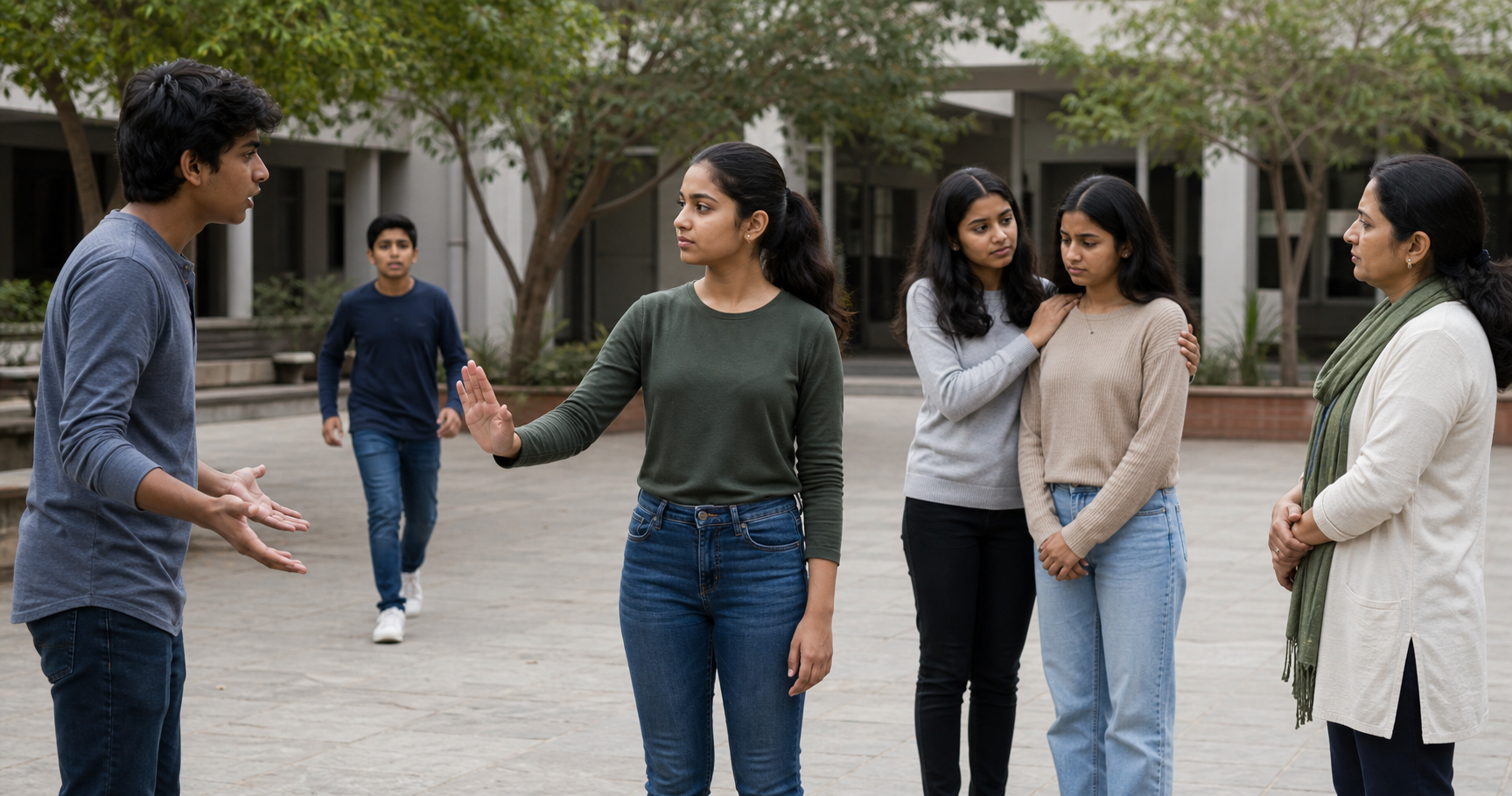
Words such as dharma, ahimsa, seva, courage and self-restraint can sound profound while remaining distant from a student’s day. The organiser’s job is to close that distance. Ask what each value requires when the choice is inconvenient, socially costly or frightening.
For youth outreach, you can translate familiar ideas into practical conduct:
- Dharma: Choose the responsible action even when the crowd rewards the reckless one. That can mean refusing to circulate a humiliating video, reporting a threat accurately or accompanying a frightened friend to a trusted adult.
- Ahimsa: Prefer prevention, distance and de-escalation. Ahimsa need not mean pretending danger is absent; it means refusing needless harm while taking safety seriously.
- Abhyasa: Practise useful habits before a crisis. A boundary phrase, an exit decision or a help-seeking plan becomes more available when it has been rehearsed calmly.
- Seva: Help in a way that improves safety. Do not film, gossip, provoke an aggressor or turn another person’s distress into content. Get appropriate assistance and remain with the affected person when it is safe to do so.
- Self-respect: Maintain boundaries without treating another person’s dignity as expendable. Hindu confidence does not require an enemy, and strength does not require humiliation.
This practical combination is already appearing in youth engagement. A college programme in Andheri, Mumbai, placed moral values, restraint in social-media use and free self-defence training within the same conversation. The combination matters because these are not separate problems. They all concern what governs your attention, choices and conduct when pressure rises.
Avoid reducing moral education to obedience. If the message is merely that respectable young people behave as elders expect, participants will learn performance rather than judgement. Give them situations with genuine tension: loyalty to a friend versus reporting danger, courage versus provocation, privacy versus asking for help, or group approval versus refusing cruelty. Let them explain what they would do and why.
The discussion should also make room for correction. A participant who chooses an unsafe response should not be mocked. Walk through the likely consequence, identify the safer decision point and let the participant try again. That method teaches accountability without making public embarrassment the price of learning.
Teach self-defence as prevention before physical response

Young people can easily mistake self-defence for winning a fight. Correct that assumption at the beginning. The aim is to get away from danger, protect life and reach appropriate help. Physical resistance may become necessary in an immediate threat, but it is not the first measure of courage and it cannot be made risk-free.
Give participants a safe decision sequence
- Notice: Pay attention to changes in tone, movement, crowd behaviour, available exits and nearby people who can help.
- Create distance: Move toward a safer or more public place when possible. Do not stay merely to prove confidence.
- Set a boundary: Use a clear voice and simple words. The purpose is communication, not trading insults.
- Leave: Disengage when a safe route is available. Do not chase, surround or return to continue an argument.
- Get help: Contact the appropriate trusted adult, venue authority, campus process or emergency service for the situation.
- Use physical skills only as required: Any technique should be taught and supervised by a qualified instructor who can adapt practice to the participant, setting and applicable law.
This sequence gives the student choices before a confrontation becomes physical. It also corrects a damaging idea: leaving is not cowardice when leaving is the safest available action. A successful escape is a successful act of self-defence.
Set safety conditions before anyone practises
A motivational speaker is not automatically a suitable self-defence instructor. Before inviting someone to teach, ask for relevant qualifications, experience with the intended age group, references, a description of the curriculum and an emergency plan. Confirm how the instructor handles physical contact, participant refusal, injuries, disability, religious clothing and previous experiences of violence.
- Tell participants what a drill involves before it begins and obtain active consent for physical contact.
- Provide a dignified way to observe or opt out. No student should have to disclose a private reason in front of the group.
- Do not use surprise grabs, pain, threats or public humiliation to make a demonstration appear realistic.
- Begin with awareness, posture, voice, movement and exit decisions before any contact exercise.
- Do not promise that a particular move will always work. Differences in size, footing, numbers, weapons and surroundings change the danger.
- Do not ask students to bring weapons or attempt improvised weapon-disarming demonstrations.
- Establish who will respond if a participant reports stalking, harassment, abuse or an immediate threat. Do not promise secrecy that the responsible safeguarding process may not permit.
- Check local law, institutional policy, insurance and consent requirements before offering physical training, especially when minors are involved.
Self-defence outreach should never recruit young people into vigilantism. Do not encourage patrols, retaliation, pursuit of suspected offenders or confrontation beyond a participant’s competence. Those actions can escalate danger, harm an innocent person and create legal exposure. If there is an immediate threat, the safer course is to move away when possible and use the locally appropriate emergency and reporting channels.
Make the programme inclusive as well. Do not frame girls as helpless people waiting to be protected, or boys as natural fighters who must never show fear. Every participant needs permission to set boundaries, leave danger and ask for help. Responsibility always remains with the person committing harassment or violence; training must never become a reason to blame someone who was harmed.
Make digital discipline a form of self-command

Warnings about social-media addiction often fail because they describe the phone as the enemy and the young person as weak. That framing invites defensiveness. Focus instead on observable behaviour: reflexive checking, interrupted study or prayer, late-night scrolling, angry replies, reckless forwarding and the feeling that every notification demands an immediate response.
Do not diagnose participants or use the word addiction as a casual label for any amount of phone use. Ask a more useful question: does this pattern repeatedly displace something the young person has already decided matters?
Give each participant a simple practice:
- Name the trigger: Identify when automatic checking usually begins – boredom, an argument, a notification or fear of missing a group conversation.
- Choose a boundary: Select a predictable activity during which the phone will remain out of reach, such as study, sadhana, a family meal or physical training.
- Change the setting: Turn off notifications that serve no necessary purpose and place the device somewhere that requires a deliberate choice to retrieve it.
- Choose a replacement: Decide in advance what to do when the urge arrives – return to the current task, take a short walk, speak to someone nearby or continue a planned practice.
- Review honestly: At the next meeting, ask what worked, what broke the boundary and what adjustment would make it more realistic.
This is not a purity test. The aim is to recover choice. A boundary that survives ordinary life is more valuable than a dramatic pledge abandoned as soon as the group leaves the room.
Digital self-defence also includes conduct during conflict. Teach participants not to answer an abusive message in the first rush of anger. They can preserve necessary evidence without redistributing humiliating material, use platform blocking or reporting controls, tighten privacy settings and involve a trusted adult or responsible authority when a threat appears credible. If there is immediate danger, online reporting alone is not enough; use the appropriate local emergency channel.
Protect privacy during the session itself. Do not require students to unlock their phones, display private messages, reveal screen-time records or install an application in front of the group. They can examine their own habits without surrendering personal information to an organiser.
Build outreach around trust, consent and follow-through
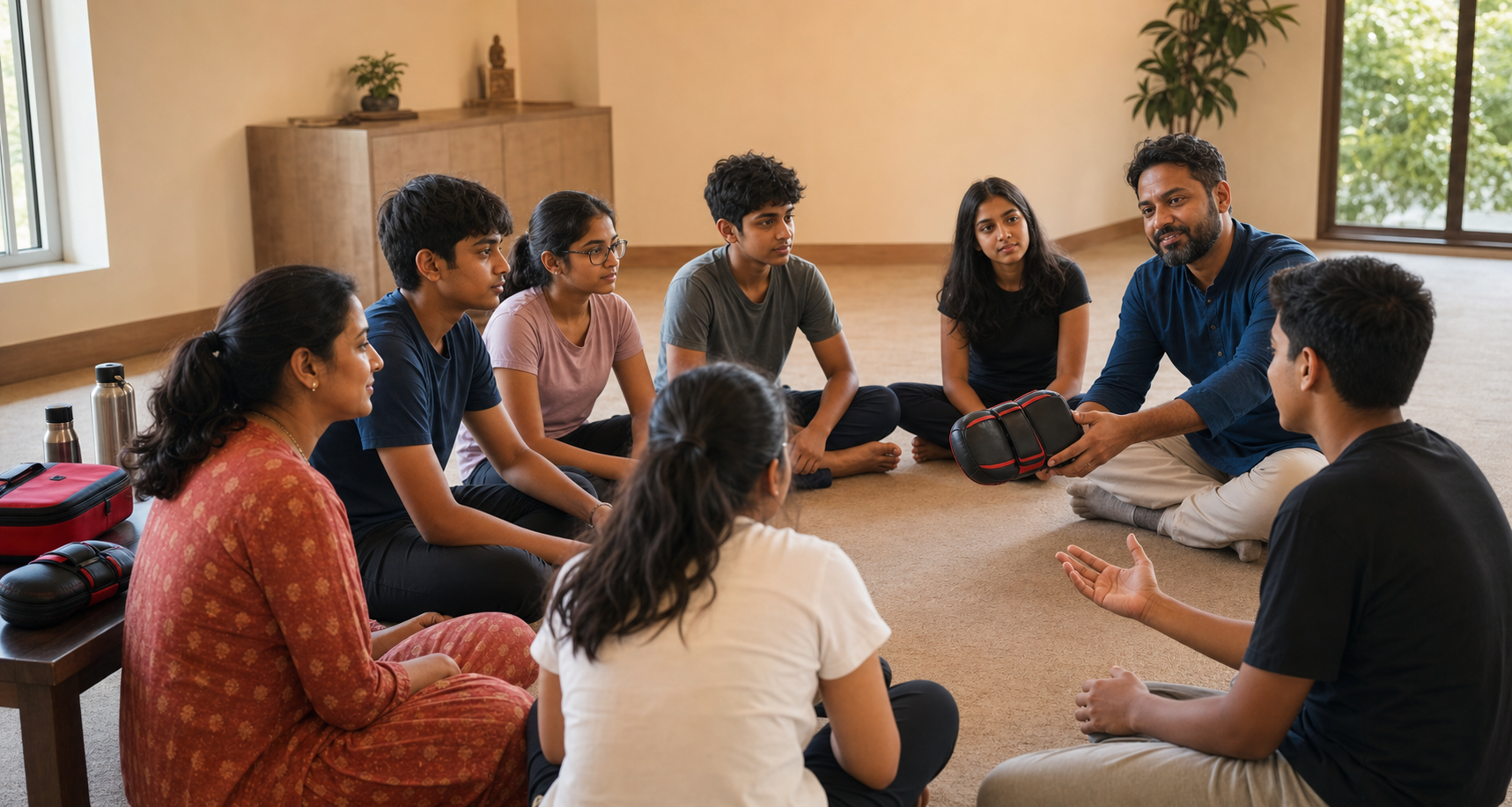
A strong event has a clear path from invitation to continued practice. A vague poster about awakening youth may attract attention, but it does not tell a parent or student whether the programme is safe, relevant or worth attending.
The invitation should state the intended age group, venue, accessibility information, session purpose, instructor identity, physical nature of any practice, cost, consent requirements, contact person and next training opportunity. If the training is free, say so plainly, but do not assume that removes every barrier. Travel, timing, clothing, accessibility and guardian permission can still prevent participation.
Before the event, assign responsibility for four distinct functions:
- Programme lead: Keeps the session focused on the promised outcomes.
- Qualified instructor: Controls the safety and suitability of physical instruction.
- Safeguarding contact: Receives concerns or disclosures privately and follows the applicable procedure.
- Follow-up contact: Gives participants accurate enrolment details and handles personal information with consent.
One person may fill more than one role in a small organisation, but the responsibilities should still be named. Otherwise, everyone assumes someone else will handle a problem.
A practical session can move through a simple arc: present a realistic scenario, let students identify the decision points, connect those choices to dharmic values, demonstrate prevention-first responses, allow consent-based practice, then provide a concrete route into further training. Keep speeches short enough that participants can think, ask and practise.
You can open with language such as: This is not a test of who is toughest. We are here to practise attention, boundaries and safe decisions. You may decline any physical exercise without explaining why. That statement sets the moral and safety expectations before peer pressure takes over.
Do not build Hindu identity through hostility toward another community. A pro-Hindu programme is strongest when it produces disciplined, service-minded young people who can protect dignity without surrendering judgement. Enemy-centred messaging may generate excitement, but it weakens the habits that genuine self-defence requires: observation, restraint, proportionality and clear action.
Photography deserves the same care as physical practice. Do not make participation in a group photograph a condition of attendance. Obtain appropriate consent before recording young people, and never publish a participant’s account of harassment, fear or family circumstances as promotional material without explicit, informed permission.
Measure capability rather than applause
An enthusiastic room can conceal a weak programme. Applause shows that a moment landed; it does not show that a young person can act safely later. Ask questions that test usable understanding without demanding private disclosures.
- Can the participant describe how to leave an escalating situation without treating departure as defeat?
- Can the participant name an appropriate person or channel for seeking help in the venue?
- Can the participant state a boundary clearly without adding a threat or insult?
- Can the participant identify a digital habit to change and the practical setting that will support that change?
- Does the participant know who the instructor is, what further training involves and how to enrol?
- Did anyone feel pressured, mocked, singled out or touched without clear consent?
Collect feedback privately and ask about both usefulness and safety. Do not invite sensitive disclosures on a public form or during a group show of hands. When feedback identifies coercion, reckless instruction or unclear reporting routes, treat that as a programme defect to correct, not as evidence that the participant lacked courage.
Follow-through is the real test. Publish the next training details before the awareness session ends. Make registration simple, explain what participants should expect and contact only those who consented to follow-up. Then compare stated interest with actual attendance and continued participation. If many students express interest but do not return, examine practical barriers before assuming indifference.
Your next move is to write four lines before announcing an event: the behaviour you want participants to practise, the safety rules that govern instruction, the person responsible for concerns and the exact next step after the session. If any line is still vague, the programme is not ready. Clarify it first, then invite young people into an outreach effort worthy of their trust.
References
