
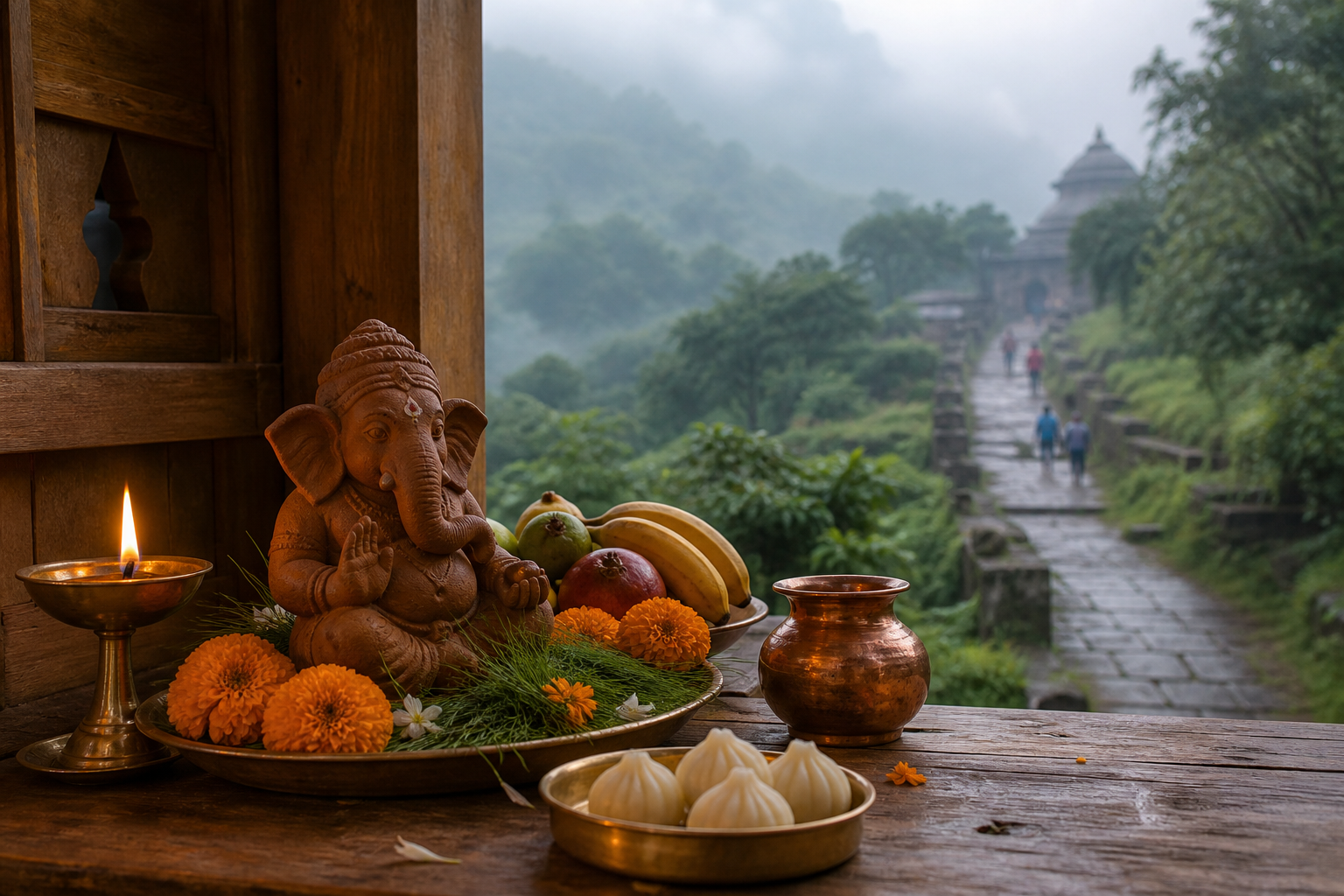
You want to honour Ganesh on Chaturthi, but the instructions in front of you may be longer than your confidence. One relative insists on a particular offering, another follows a different sequence, and a temple visit introduces its own questions. The result can be anxiety about getting everything right before worship has even begun.
Build one coherent observance instead: choose a clear intention, prepare a clean place, follow your family’s practice where you know it, and keep unfamiliar rituals within what you can perform attentively. If you make a pilgrimage, carry the same discipline from your home to the temple and back into daily conduct.
Decide what your Ganesh observance is for
Ganesh is worshipped at beginnings and at the points where progress meets obstruction. Before you buy decorations or collect a long list of materials, identify the beginning or obstacle you are actually bringing before him. It may concern work, study, family responsibility, spiritual discipline, or a habit that repeatedly defeats your better judgement.
This does not turn puja into a transaction. You are not bargaining for a result. You are placing an intention before Ganesh and accepting responsibility for the conduct that must accompany your prayer.
- Name the matter: Describe the beginning, duty, or obstruction in one honest sentence.
- Choose the form: Decide whether you are keeping a simple home puja, joining a family or community celebration, making a temple pilgrimage, or combining these.
- Choose your ritual authority: Where details matter, follow your inherited household custom, sampradaya, local temple, or trusted priest rather than mixing unrelated procedures.
- Set a manageable scope: Prepare only what you can offer, complete, distribute, and clean up with care.
The reliable foundation is cleanliness joined with dedication. Cleanliness is more than decoration: it includes your body, the worship space, the vessels, the offerings, and the way food is handled afterward. Dedication means giving the rite your attention and completing it respectfully rather than rushing through an impressive arrangement.
Write a short sankalpa before you begin. A plain formulation is enough: “With gratitude, I worship Sri Ganesh and seek steadiness in this responsibility.” Use your own language if that lets you pray more truthfully. The sentence should tell you what the observance asks of you after the flowers have been cleared away.
A simple home Chaturthi puja you can complete attentively
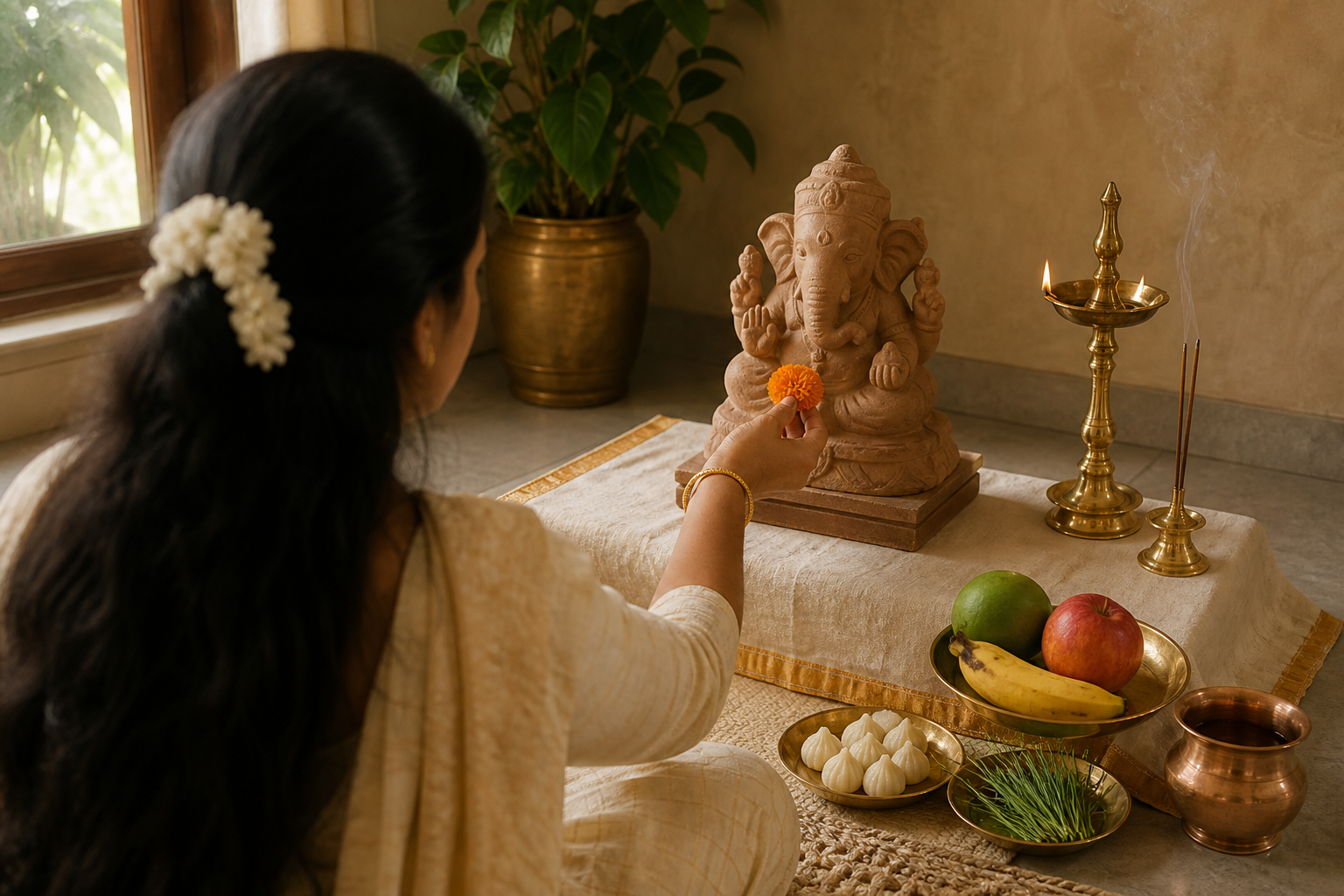
Puja procedures differ among families and lineages. The sequence below is therefore a practical framework for a modest household observance, not a replacement for a procedure entrusted to you by your family or guru. If your tradition prescribes particular mantras, offerings, fasting rules, or timings, let those instructions govern your worship.
- Decide which image you are worshipping. You may use an existing murti or picture, or a temporary festival murti where that is your custom. If the image is temporary, decide before the puja how its formal conclusion will be observed. Do not treat a permanent household image as though it were a temporary festival image.
- Prepare a clean, stable place. Set out the image, a clean vessel of water, an offering plate, and the flowers, fruit, sweet, or suitable home-cooked food you will actually use. A smaller complete arrangement is preferable to a large collection of items you do not understand.
- Prepare yourself. Bathe or wash as your circumstances and custom permit, wear clean clothing, silence avoidable distractions, and bring everyone participating to the worship space before beginning.
- State the sankalpa. Name Ganesh, the occasion, and the intention of the puja. You do not need ornate language to be sincere. If a formal sankalpa belongs to your tradition, use that received form.
- Invoke Ganesh. Offer namaskar and use the invocation, familiar name, mantra, or family prayer you have been taught. If “Om Gan Ganapataye Namah” belongs to your practice, repeat it steadily rather than racing through a large number of repetitions without attention.
- Make the offerings in an orderly way. Present each item with awareness. If your family uses water, flowers, leaves, incense, a lamp, food, or other upacharas, retain its customary order. Do not assume that every material named in a generic checklist is compulsory in every household.
- Pray, perform aarti, or sit in silence. Bring your stated intention back to mind. Ask for clarity, disciplined effort, and the ability to recognize the obstruction you may be creating yourself. If aarti is customary, perform it safely; otherwise, a concluding prayer and namaskar can preserve the simplicity of the observance.
- Conclude and care for what was offered. Share prasad respectfully, extinguish any flame, clean the space, and follow your tradition for the temporary murti. If visarjan is involved, settle the method and location in advance and comply with local arrangements rather than improvising at the last moment.
If you use a lamp or incense, place it on a stable surface and keep it attended. When a safe flame cannot be maintained, do not introduce one merely to imitate somebody else’s setup. The physical safety of people, clothing, children, animals, and the home is part of responsible worship.
Several avoidable mistakes make a home puja harder than it needs to be:
- Combining several elaborate procedures until their sequences contradict one another.
- Abandoning the puja because one optional material is unavailable.
- Preparing more food than the household can respectfully distribute or consume.
- Attempting formal consecration rites without understanding the continuing obligations attached to them.
- Giving decoration and photography more attention than mantra, prayer, or prasad.
When you are uncertain, preserve the elements you know and ask before adding the ones you do not. Sincerity does not make all procedures interchangeable; it gives you the humility to let tradition supply the proper form.
Let family tradition govern fasting, katha and conclusion
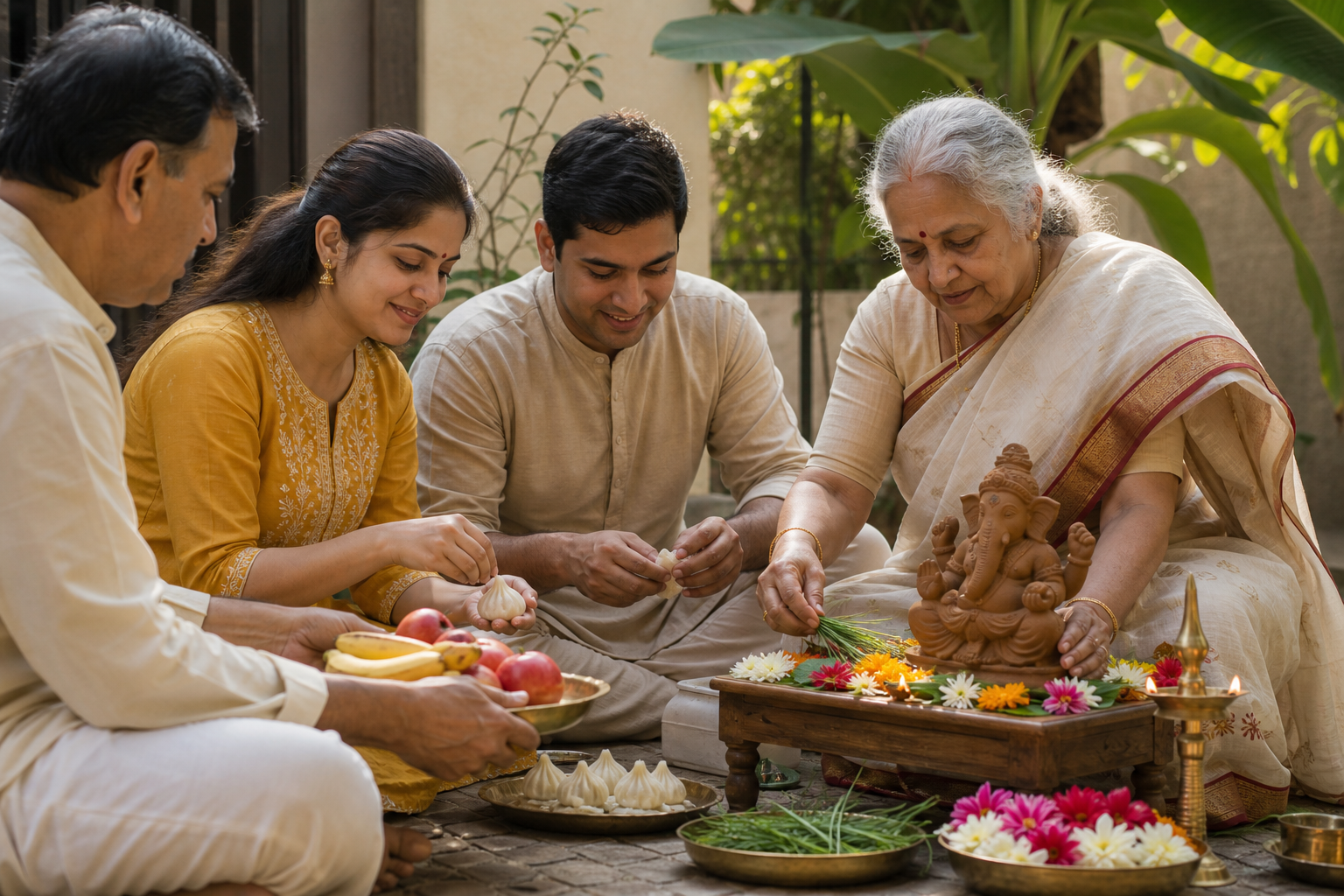
Two Hindu households can honour Ganesh faithfully while differing in food, mantra, sequence, duration, moon-related customs, or the manner of concluding the festival. Variation is not automatically carelessness. Bharat’s living traditions are carried through regions, languages, temples, sampradayas, and families, not through one universal festival checklist.
Before Chaturthi, ask the person who normally guides your household four concrete questions:
- Is fasting part of our observance, and what form does it take? Anyone with dietary or medical needs should follow appropriate health guidance rather than being pressured into a fast.
- Which offerings are customary in our family, and are any ingredients avoided?
- Which mantra, aarti, or katha do we use?
- How do we conclude the puja, distribute prasad, and handle a temporary murti?
Record the answers. A page in a family notebook is more valuable than trying to reconstruct the observance from memory every year. Include the names of prayers, the broad order, who taught it, and which details are firm family practice rather than personal preference.
Katha also deserves deliberate space. The Syamantaka Mani narrative has a remembered connection with Ganesh Chaturthi. If this katha belongs to your observance, let one person narrate a coherent version and give the family time to discuss it. Do not reduce the story to an anxious rule stripped of its moral setting.
You can make the listening active without turning it into a lecture. Ask what the story demands from speech, judgement, reputation, responsibility, or corrective action. Where your family observes a moon-related restriction or remedy, learn its exact scope from the tradition that handed it down. Do not frighten others with fragments or insist that every regional custom must be identical.
If you are a guest in another household, follow the host’s practice unless it conflicts with a serious personal need. Ask quietly before bringing offerings or initiating an unfamiliar chant. Respecting a living tradition sometimes means refraining from adding your preferred practice to somebody else’s puja.
Make pilgrimage an extension of sadhana, not sightseeing
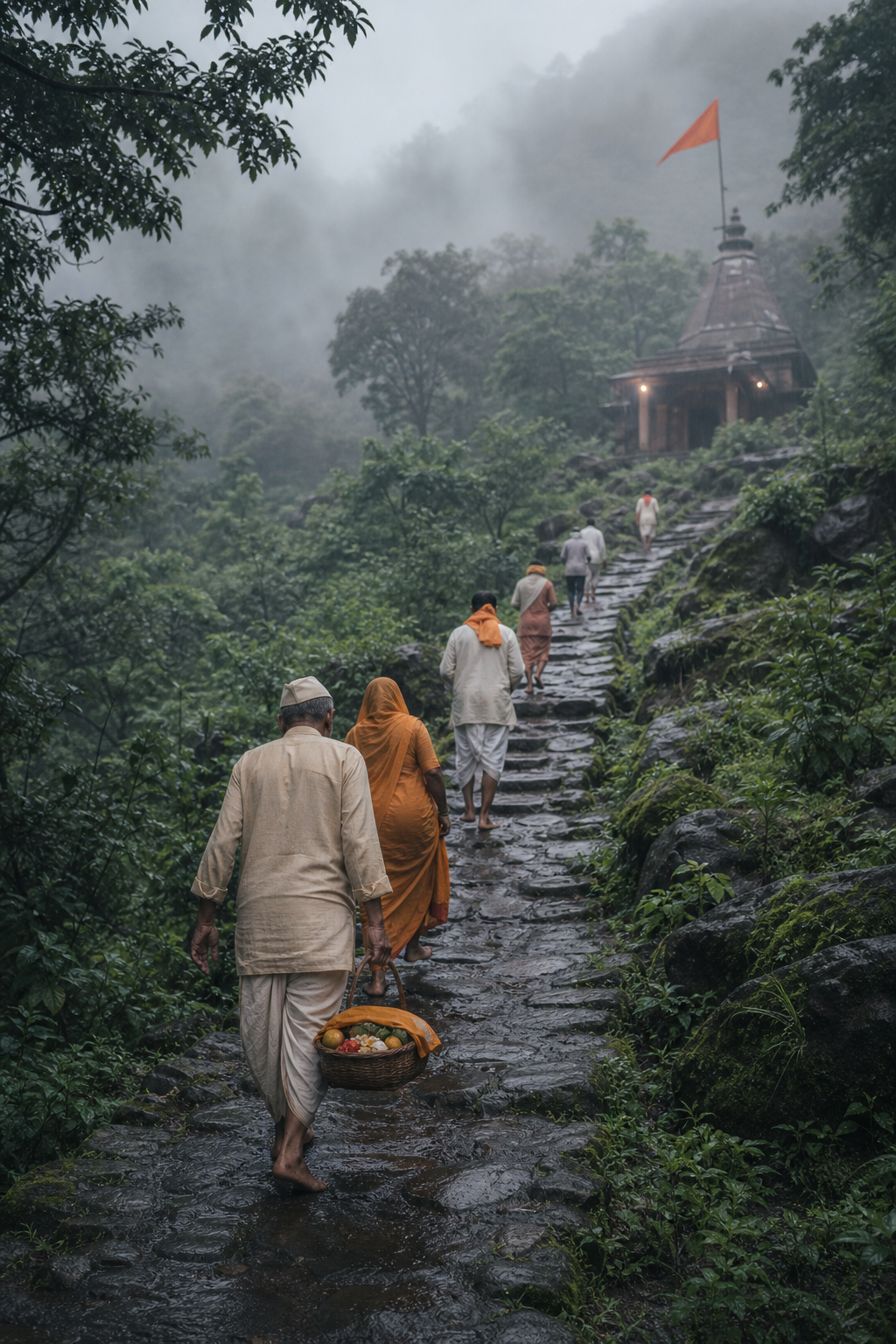
A temple pilgrimage changes the setting, but not the central discipline. You still need a purpose, orderly preparation, respect for the deity, and control over your own conduct. The queue, uncertainty, heat, travel, and other pilgrims are not interruptions to the pilgrimage; they are where patience and consideration become visible.
One pilgrimage option in Telangana is the Sri Siddhivinayaka Swamy Temple at Rejinthal in Medak district, located 13 kilometres from Zahirabad. The presiding form is Swayambhu Siddhi Vinayaka Swamy, described as self-originated, and the temple is managed by Kanchi Kamakoti. A swayambhu kshetra calls for reverence, but it does not exempt a visitor from the temple’s practical rules.
Temple timings, festival arrangements, queues, and permitted offerings can change. Before travelling, confirm the details directly with the temple rather than assuming an ordinary day’s routine will apply on Chaturthi.
- Confirm access: Check the opening period, special darshan arrangements, and whether festival crowds affect entry.
- Plan the complete journey: Settle the route to Zahirabad and onward to Rejinthal, as well as the return journey. Do not plan only the outward leg.
- Ask about temple rules: Confirm accepted offerings, dress expectations, photography restrictions, and any arrangements relevant to children, elders, or visitors with limited mobility.
- Carry only what you can manage: Keep valuables and unnecessary baggage to a minimum so your attention is not consumed by possessions.
- Set one devotional intention: Decide what you will place before Siddhi Vinayaka before entering the queue. This prevents darshan from becoming a hurried list of unrelated requests.
At the temple threshold, pause and recollect why you came. During darshan, look, offer namaskar, and pray without demanding an unusual sign or emotional experience. If the temple permits you to sit afterward, spend a little time in quiet attention instead of immediately turning to your phone or departure plans.
Complete the pilgrimage at home with one action. If you prayed for success in study, establish the study discipline you have been avoiding. If you prayed for harmony, correct the speech or behaviour that worsens conflict. If you sought the removal of an obstacle, distinguish the conditions outside your control from the habit you can change. Ganesh devotion becomes practical when prayer and effort stop contradicting each other.
If you cannot travel, do not treat home worship as spiritually inferior. A pilgrimage is a valuable form of devotion, not a measure of somebody’s worth. Prepare the home space carefully, remember the kshetra, and make the same commitment to disciplined action.
Key takeaways for your next observance
- Begin with a clear sankalpa: name the beginning, duty, or obstruction you are placing before Ganesh.
- Build home puja on cleanliness and dedication, then let your family tradition determine the detailed procedure.
- Use a simple sequence you can complete attentively; do not confuse an oversized materials list with deeper devotion.
- Give inherited katha, fasting customs, and the conclusion of a temporary murti deliberate attention before the festival begins.
- For pilgrimage, verify current temple arrangements directly and carry your prayer home as a specific change in conduct.
Your next step is small and immediate: write your one-sentence sankalpa, contact the relative or temple that can clarify the customs you do not know, and prepare a clean worship space. Let everything else grow from that foundation.
References
- Hindu Pad – Rejinthal Ganesh Temple | Siddhi Vinayaka Temple
- Hindu Pad – How to do Ganesh Chaturthi Puja | Ganesh Chaturthi Pooja Procedure
- Hindu Pad – Syamantaka Mani & Ganesh Chaturthi (Story)
