
If you encountered the Mazgaon incident through a short video or an angry social-media caption, your first task is to separate the documented sequence from the claims accumulating around it. A firm response begins with knowing what happened, what remains an allegation, and what will help the case rather than inflame the street.
Eggs thrown at a Ganesh procession cannot simply be waved away as harmless mischief. The act disrupted worship, affected devotees and created an immediate risk of disorder. Yet anger at that affront does not justify retaliation, collective blame or an online trial. Hindu interests are best served when the offender is identified through evidence, prosecuted under the law and denied the wider confrontation such conduct can provoke.
What happened during the Mazgaoncha Morya procession
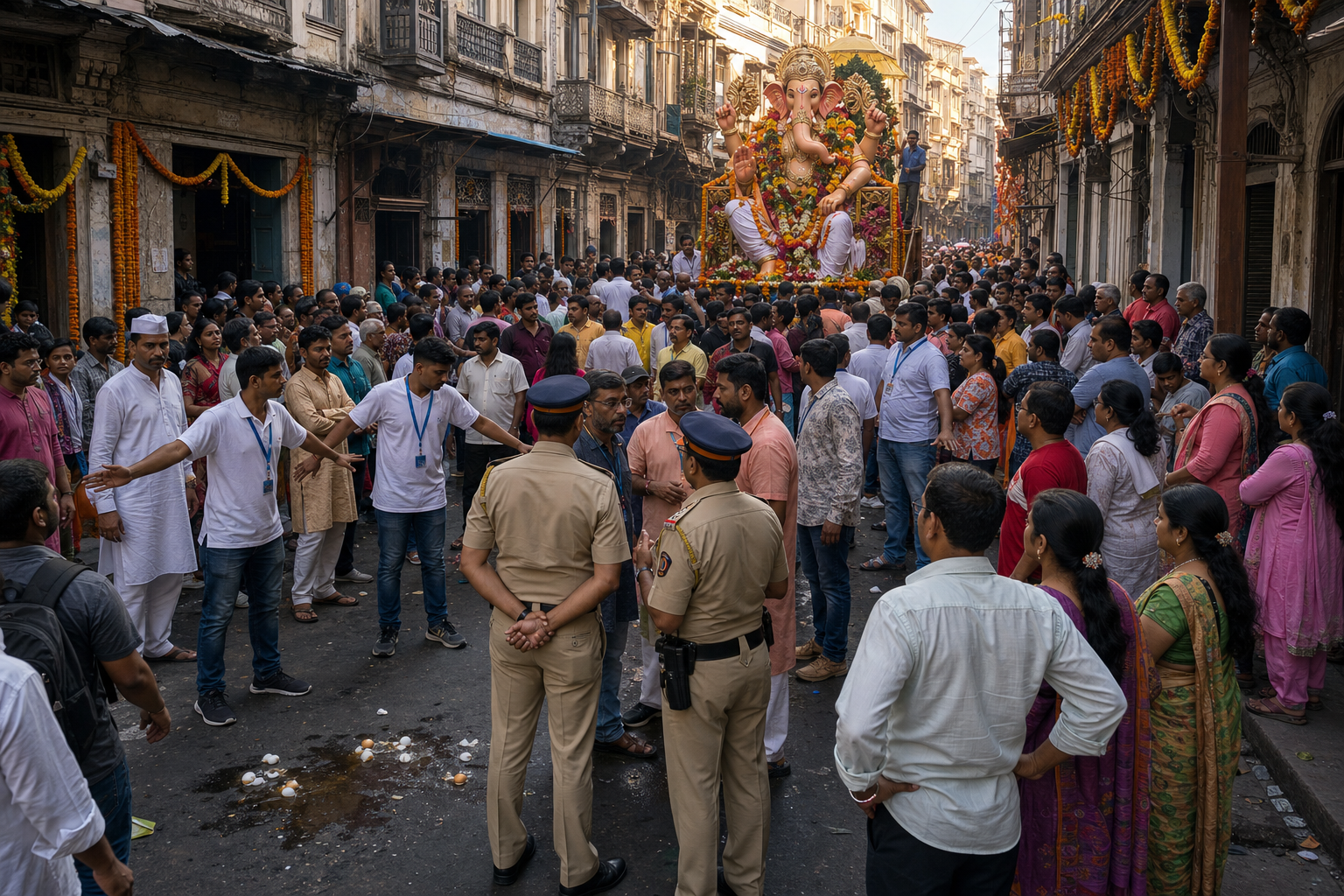
At approximately 9:40 p.m. on 23 August 2026, the Mazgaoncha Morya Ganpati Mandal was taking its Shri Ganesh Aagman Shobha Yatra through the narrow lanes of Mazgaon in South Mumbai. Traditional dhol-tasha accompanied hundreds of devotees as the procession moved through the neighbourhood.
Eggs were then reportedly thrown from an elevated position, believed to be a residential building overlooking the route. They landed on the road, the deity’s carriage and several devotees. The resulting commotion briefly halted the procession, while participants demanded police action.
Senior officers reached the location, calmed the crowd and increased the police presence. The procession was then able to continue. That sequence deserves attention: the religious journey was protected, the immediate confrontation was contained, and the demand for accountability was transferred from the crowd to the investigating authority.
Bhaykhala Police subsequently formed five investigation teams and used technical surveillance. A 22-year-old man, Danish Sher Khan, was arrested within 36 hours and reportedly confessed during questioning. The arrest and reported confession are important developments, but neither is a judicial finding of guilt.
Key takeaways
- The incident occurred during the Mazgaoncha Morya Ganesh arrival procession at about 9:40 p.m. on 23 August 2026.
- Eggs reportedly struck the procession route, the deity’s carriage and devotees, creating an immediate public-order risk.
- Police contained the situation, allowed the yatra to continue and arrested a suspect within 36 hours.
- The FIR treats the conduct as a possible religious and communal-harmony offence, not merely a nuisance or prank.
- An arrest is not a conviction, and an allegation against one person is not evidence against an entire community.
Why a restrained response is the stronger Hindu response
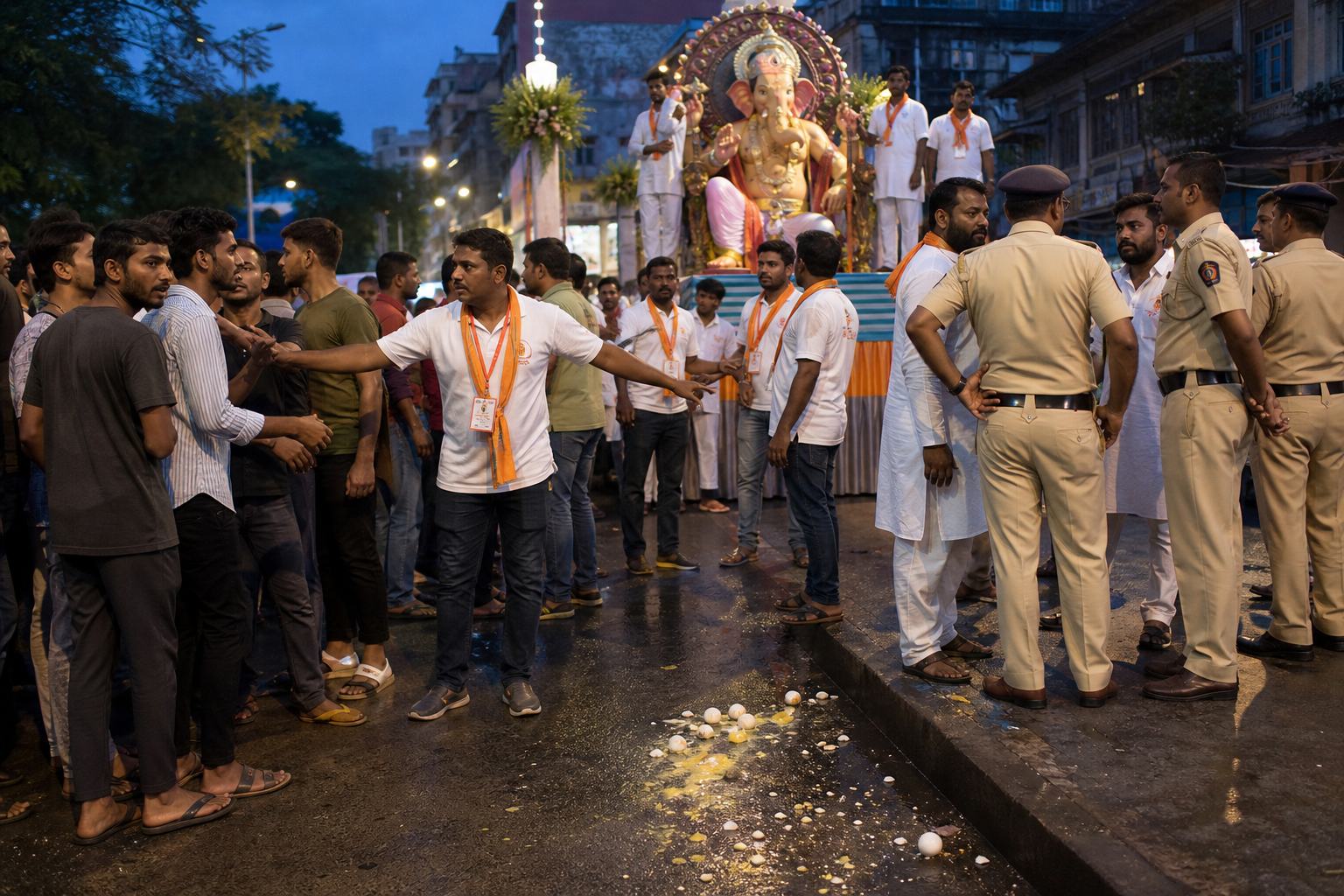
You do not have to choose between minimising the insult and surrendering to rage. Both reactions weaken accountability. Calling it a prank ignores the sacred setting and the danger created when objects are thrown into a dense religious procession. Retaliating against a building, its residents or unrelated people replaces a prosecutable allegation with fresh offences, injuries and competing claims.
If the purpose of the act was to provoke a wider clash, an uncontrolled response would multiply its effect. A disciplined procession does the opposite. It protects the murti and devotees, preserves witnesses, leaves the police with a clear incident to investigate and prevents the original conduct from being obscured by later violence.
Restraint here does not mean silence. It means drawing three precise boundaries. Do not accept trivialisation of the religious insult. Do not treat accusation as conviction. Do not transfer one person’s alleged conduct to a neighbourhood, faith or population without evidence. This combination is morally coherent and practically difficult to discredit.
For devotees, the useful test is simple: will this action help establish who threw the eggs, preserve proof of intent and secure lawful consequences? Supplying original footage passes that test. Attacking strangers, circulating an unverified address or adding communal claims that investigators have not established does not.
What Sections 299 and 196 of the BNS actually mean

Bhaykhala Police registered FIR No. 520/2026 under Sections 299 and 196 of the Bharatiya Nyaya Sanhita, 2023. The BNS replaced the Indian Penal Code on 1 July 2024. The provisions selected indicate that investigators are examining religious insult and the risk to harmony, rather than treating the event only as disorderly conduct.
- Section 299: This provision concerns deliberate and malicious acts intended to outrage the religious feelings of a class by insulting its religion or beliefs. It carries a maximum sentence of three years, a fine, or both.
- Section 196: This provision addresses the promotion of enmity between groups and conduct prejudicial to harmony. The stated maximum is three years, a fine, or both, with punishment extending to five years in the specified circumstances involving a place of worship or religious ceremonies.
Both offences were described in the case as cognisable and non-bailable. Cognisable classification generally permits police to investigate and, subject to the governing law, arrest without first obtaining a warrant. Non-bailable does not mean that bail is impossible; it means bail is not an automatic entitlement handled in the same way as a bailable offence and ordinarily requires judicial consideration.
The legal distinction that matters most is between the physical act and the required intent. A video may help show an object falling, its direction and the resulting disruption. It does not necessarily prove, by itself, who threw it or what that person intended. Identity, context, surrounding conduct, witness accounts and original recordings therefore matter. Investigators and the court must determine whether the evidence satisfies every element of the cited provisions.
The same caution applies to the reported confession. It can guide an investigation, but the public should not treat an interrogation claim as a substitute for admissible evidence and a judicial process. If you are directly involved as a complainant, witness or accused person, obtain advice from a qualified Indian advocate rather than relying on social-media explanations of the BNS.
What devotees, witnesses and mandals should do
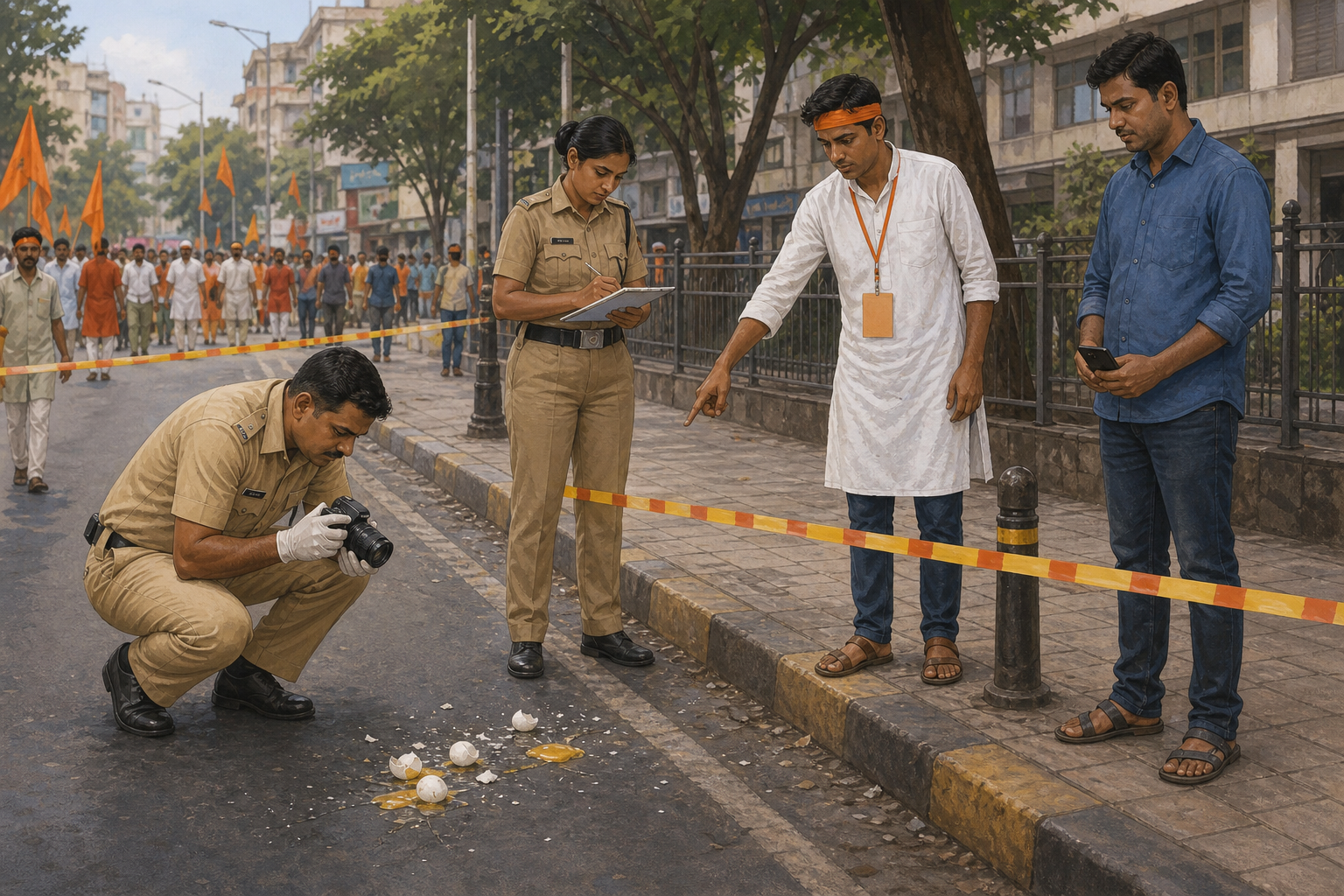
A procession committee needs a response protocol before the first object is thrown, not after rumours have already filled the information gap. The following sequence protects people, worship and evidence at the same time.
- Secure the procession first. Move devotees away from the apparent direction of danger, protect the deity’s carriage and follow police instructions. Do not rush the suspected building, enter private property or confront residents.
- Preserve original recordings. Keep the unedited photo or video file on the device that captured it. Record the exact time, route location, direction from which the object appeared and the names of people who directly saw the throw. A forwarded or repeatedly compressed clip is less useful than the original.
- Separate witnesses from commentators. Someone who saw an egg land is not necessarily someone who saw it being thrown. Write down exactly what each person observed without filling gaps collectively. Independent accounts are more valuable than a story harmonised in a crowd.
- Submit evidence through a traceable channel. Give original material to the investigating officer or police station, retain a copy and note when and to whom it was supplied. Ask for an acknowledgement where available. Posting first can expose bystanders, trigger harassment and make later verification harder.
- Appoint one mandal liaison. One authorised office-bearer should communicate with police, maintain the incident timeline and issue verified updates. This reduces contradictory claims while allowing other volunteers to manage devotees and the procession.
- Control public messaging. State the confirmed time, place, effect on the procession, FIR details and official police developments. Do not publish a suspected flat number, family details, communal rumours or names that police have not confirmed.
- Review the remaining route. Before the next yatra, identify overlooking terraces and balconies, available CCTV cameras, poorly lit stretches, police access points and safe places where the procession can pause. Assign stewards to observation, crowd movement, evidence collection and police contact so that no one improvises under pressure.
If you only possess a copied clip, do not present it as proof of identity or motive. Send investigators the details of the person who supplied it, if that person consents, so they can seek the original. If you witnessed nothing directly, the responsible contribution is to circulate verified case information and refuse to decorate it with speculation.
What credible accountability should look like now

The speed of the arrest matters because delayed action during a religious festival can deepen fear and invite street-level confrontation. Speed, however, must be followed by a complete investigation. The public interest is not served by a dramatic arrest followed by weak evidence, prolonged opacity or an avoidable collapse in court.
Devotees and mandal representatives can reasonably seek answers to concrete questions: Were original videos and nearby CCTV recordings secured? Were direct witnesses identified separately? Was the apparent throwing position examined? Has security along the remaining procession route been reassessed? Will official updates distinguish established facts from allegations?
Equal citizenship requires Hindu festivals to be protected from deliberate disruption. It also requires culpability to remain individual unless evidence establishes something wider. Fair investigation is not softness toward an anti-Hindu act; it is what turns justified outrage into a durable legal result.
If you have direct evidence from Mazgaon, preserve it, submit it and keep a record of the handover. If you are helping organise another Ganesh procession, appoint the police liaison and evidence custodian before departure. Firmness is most effective when it protects the yatra, strengthens the prosecution and leaves a provocateur no wider conflict to claim.
References
