
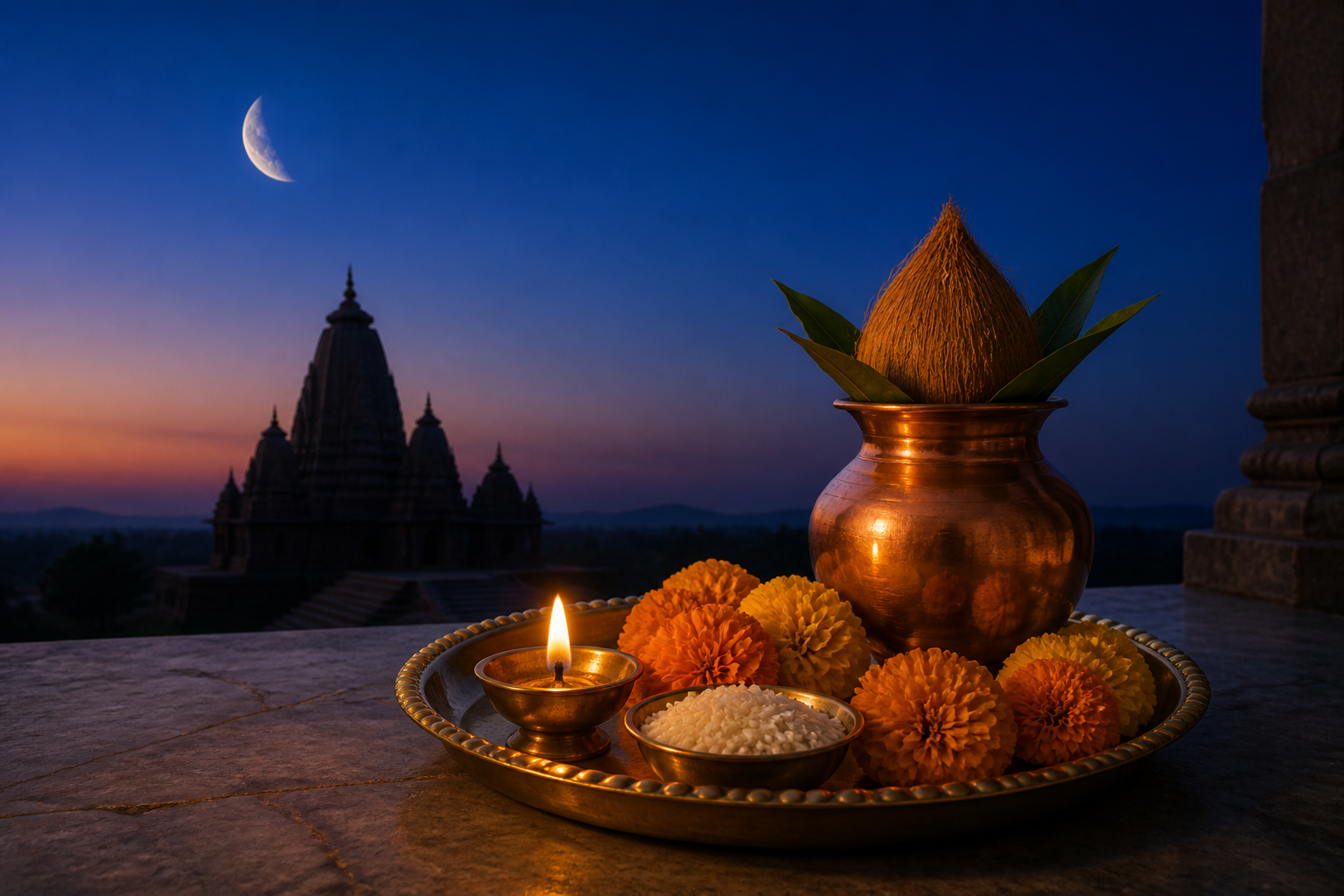
If you are planning puja, choosing the tithi for a sankalpa, or preparing for Ekadashi, the important detail on September 6 is the evening change of tithi. The civil date stays the same, but the lunar day does not.
On Sunday, September 6, 2026, Krishna Paksha Dashami continues until 6:19 PM, after which Krishna Paksha Ekadashi begins. Because this timing is given for most regions rather than for one named city, verify the exact local boundary before using it for a formal vrata or ceremony.
September 6 Panchang at a glance
| Calendar point | Details |
|---|---|
| Civil date | Sunday, September 6, 2026 |
| Lunar fortnight | Krishna Paksha, the waning phase of the Moon |
| Before 6:19 PM | Dashami, the tenth tithi |
| From 6:19 PM onward | Ekadashi, the eleventh tithi |
| Geographic scope | General timing for most regions; confirm against a city-specific Panchang when precision matters |
This means September 6 cannot be labelled only as Dashami or only as Ekadashi without also stating the time. For morning and daytime planning, Dashami is the relevant tithi. For activity after the stated evening transition, Ekadashi is the relevant tithi.
What changes at 6:19 PM, and what does not
A tithi is a lunar day determined by the changing relationship of the Sun and Moon. It is therefore not tied to midnight. A tithi can begin or end during the morning, afternoon, evening, or night, as Ekadashi does on this date.
At the stated transition, the Panchang designation changes from Dashami to Ekadashi. The civil date and weekday do not change: it remains Sunday, September 6. Keeping those two systems separate prevents a common planning error – treating the entire civil day as though it carried one tithi.
The 6:19 PM boundary is not automatically an auspicious muhurta. It also does not, by itself, establish when an Ekadashi fast should begin or which civil date your sampradaya will recognize for the vrata. Those decisions can depend on local tithi conditions, sunrise-based rules, and the observance method followed by your family, temple, or lineage.
Choose the tithi according to the time of your action
Use the following sequence when making plans for September 6:
- Identify whether the activity is tithi-dependent. If your regular daily worship has no special Dashami or Ekadashi requirement, the evening transition need not disrupt your routine.
- Write down the intended local time. A plan that merely says “September 6” is incomplete when the tithi changes at 6:19 PM.
- Use Dashami for activity before the transition. Morning worship and other tithi-specific acts performed before the stated change belong to Krishna Paksha Dashami.
- Use Ekadashi after the transition. Activity performed after the stated boundary belongs to Krishna Paksha Ekadashi, subject to confirmation of the local ending time.
- Ask which moment governs a ritual that crosses the boundary. If a ceremony begins during Dashami but continues into Ekadashi, do not choose the controlling tithi by guesswork. Confirm the convention with the officiating priest or the authority of your tradition.
For a sankalpa, the relevant tithi is generally the one present at the ritual’s applicable moment, not a label copied from an all-day calendar box. Give the priest your city and intended start time so the local Panchang can be checked precisely.
If your concern is the Ekadashi vrata, treat the evening transition as preparation information, not as a complete fasting instruction. The fact that Ekadashi begins after 6:19 PM does not alone prove that September 6 should be observed as the fasting day. A city-specific calendar following your sampradaya is needed for that determination.
Do not mistake a tithi listing for a complete muhurta
The traditional Panchang has five limbs: tithi, vara, nakshatra, yoga, and karana. This date gives you the weekday and the Dashami-to-Ekadashi sequence, but those facts alone are not enough to select an auspicious time for a rule-bound ceremony.
Do not infer the nakshatra, rashi, yoga, karana, or a so-called good-time window from the 6:19 PM change. They are separate calendar factors. If you need more than the tithi, consult a complete Panchang calculated for the place where the activity will occur.
Before committing to a formal time, check four items:
- The city or town where the worship or ceremony will take place.
- The local time zone used by the calendar.
- The exact planned start time, especially if it is close to 6:19 PM.
- The vrata or muhurta convention followed by your family, temple, or sampradaya.
This local check matters most near the boundary. A broad calendar can help you organize the day, but a small location-based difference could change which tithi applies to an activity scheduled close to the transition.
Key takeaways for September 6, 2026
- September 6, 2026 falls on a Sunday.
- Krishna Paksha Dashami lasts until 6:19 PM in the general timing provided for most regions.
- Krishna Paksha Ekadashi begins after the 6:19 PM transition.
- The evening transition changes the tithi, not the civil date or weekday.
- The transition time is not automatically an auspicious muhurta or the start of an Ekadashi fast.
- For a formal sankalpa, vrata, or ceremony, verify the timing with a Panchang for your city and tradition.
Put your city and intended ritual time beside September 6 in your calendar now. If the activity is anywhere near the evening change, confirm the local tithi before finalizing it; that one check is more useful than treating the entire date as a single lunar day.
References
