
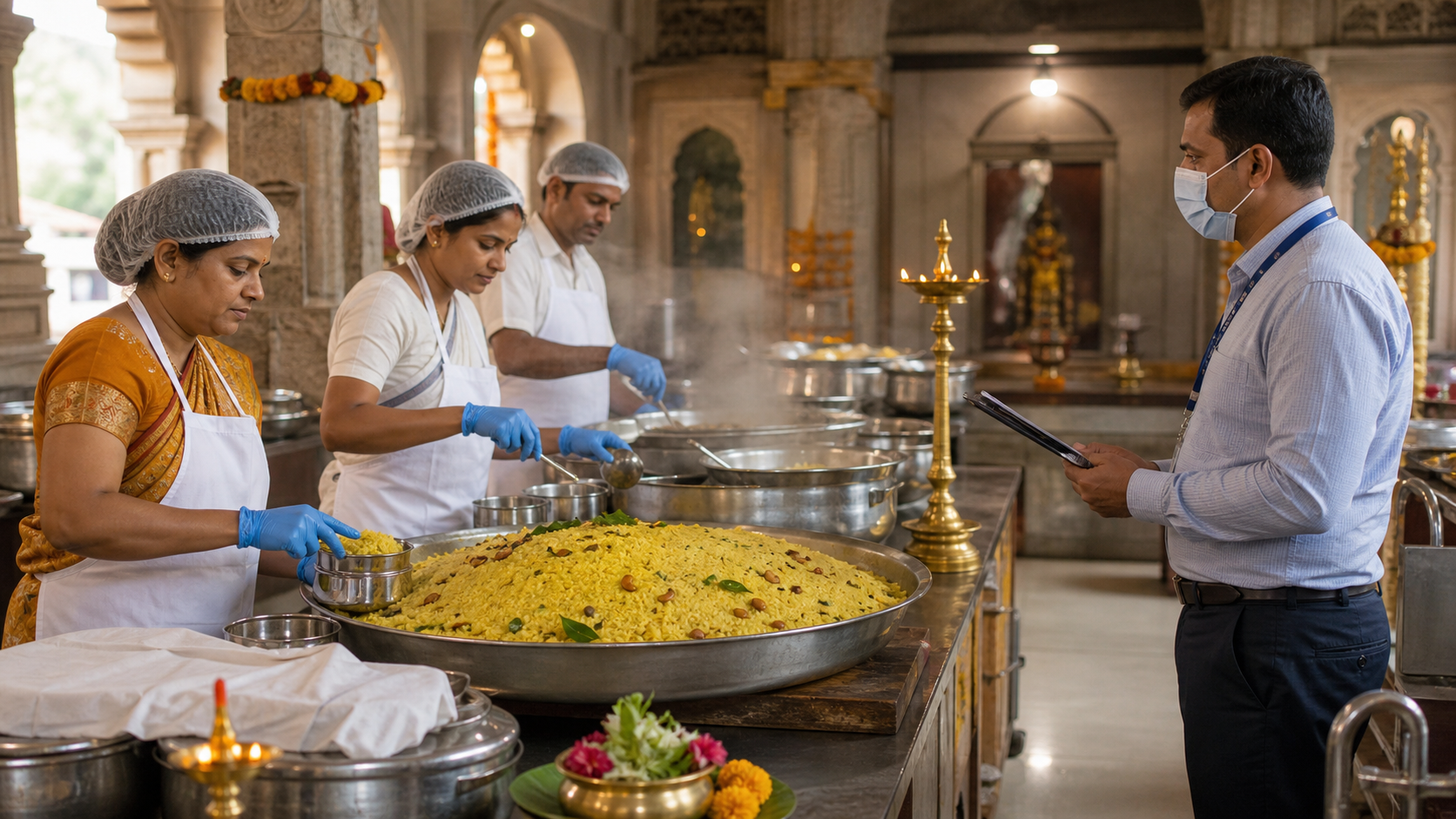
If your temple committee receives a special food-safety notice before a festival, you face two duties at once: protect devotees and decide whether Hindu institutions are being singled out. Treating either duty as a betrayal of the other is a mistake.
You do not have to choose between reverence for mahaprasad and rigorous hygiene. Nor should you accept a rule merely because it arrives under the language of public safety. The right response is to make the food demonstrably safe, preserve a written record, and test the administration against one clear principle: comparable risks must face comparable rules.
Safety and equal treatment are the same public duty
Mahaprasad and bhandara carry meanings that a secular inspection form cannot capture. Food may be prepared as seva, offered in worship, and received with gratitude rather than treated as an ordinary commercial purchase. That sacred character deserves respect. It does not make devotees less entitled to clean preparation, responsible storage, or prompt action when contamination is suspected.
The state has a legitimate reason to prevent foodborne illness wherever large numbers of people are fed. But public health loses credibility when the language, timing, or burden of enforcement appears to attach to one religious community rather than to an identifiable risk.
That concern arose in Maharashtra when a food-safety directive addressing mahaprasad and bhandara during Hindu festivals prompted an allegation of selective enforcement. The allegation matters, but it should be tested rather than treated as proven merely because a Hindu practice was named. A single directive can reveal unequal wording; establishing a double standard requires comparison with how similar food distribution is handled at other religious, civic, and government-run events.
Equality does not always mean the same number of inspections at every gathering. A larger event, a longer serving period, a more complex supply chain, or a documented complaint may reasonably attract closer scrutiny. The decisive question is whether those factors are written down and applied across communities. If the same conditions at a temple, gurdwara, monastery, mosque, church, or civic celebration produce different official treatment, the administration owes the public an explanation.
Use five tests before calling enforcement discriminatory

Selective enforcement is a serious charge. Make it with evidence that an official cannot dismiss as rhetoric. Ask for the relevant directive, checklist, notices, and publicly available enforcement records, then examine five points.
- Scope: Does the rule cover all comparable mass-feeding events, or does it identify Hindu practices without stating a neutral category such as attendance, duration, food type, preparation method, or complaint history?
- Trigger: Can the administration explain why this event was selected? A written risk factor is more credible than a vague claim that festivals require attention.
- Burden: Are organizers across communities asked for equivalent records, testing, volunteer controls, inspections, and corrective measures under comparable conditions?
- Consequence: Does a similar lapse produce the same response? Education, a warning, sampling, disposal, a penalty, or suspension should not depend on the religious identity of the organizer.
- Transparency: Will the authority publish enough information to show where inspections occurred, what triggered them, what was found, and what action followed?
Keep the comparison exact. A roadside stall is not automatically comparable to a large community kitchen. A one-hour distribution is not necessarily comparable to food held through a long day. An event with a complaint is not identical to one without a complaint. Weak comparisons allow an administration to avoid the real equality question.
Also separate three different situations. A rule can be neutral on its face but unevenly enforced. A notice can use religion-specific language while imposing no additional burden. Or a targeted campaign can be justified by documented risk but communicated so poorly that it reasonably creates suspicion. Each problem calls for a different remedy: enforcement data, revised wording, or a public explanation of the risk criteria.
If you cannot obtain comparable records, say precisely that. “The administration has not disclosed whether equivalent events receive equivalent scrutiny” is a stronger and more defensible claim than asserting discrimination without the missing evidence. It identifies the transparency failure and tells officials how to answer it.
Make your own festival kitchen difficult to fault
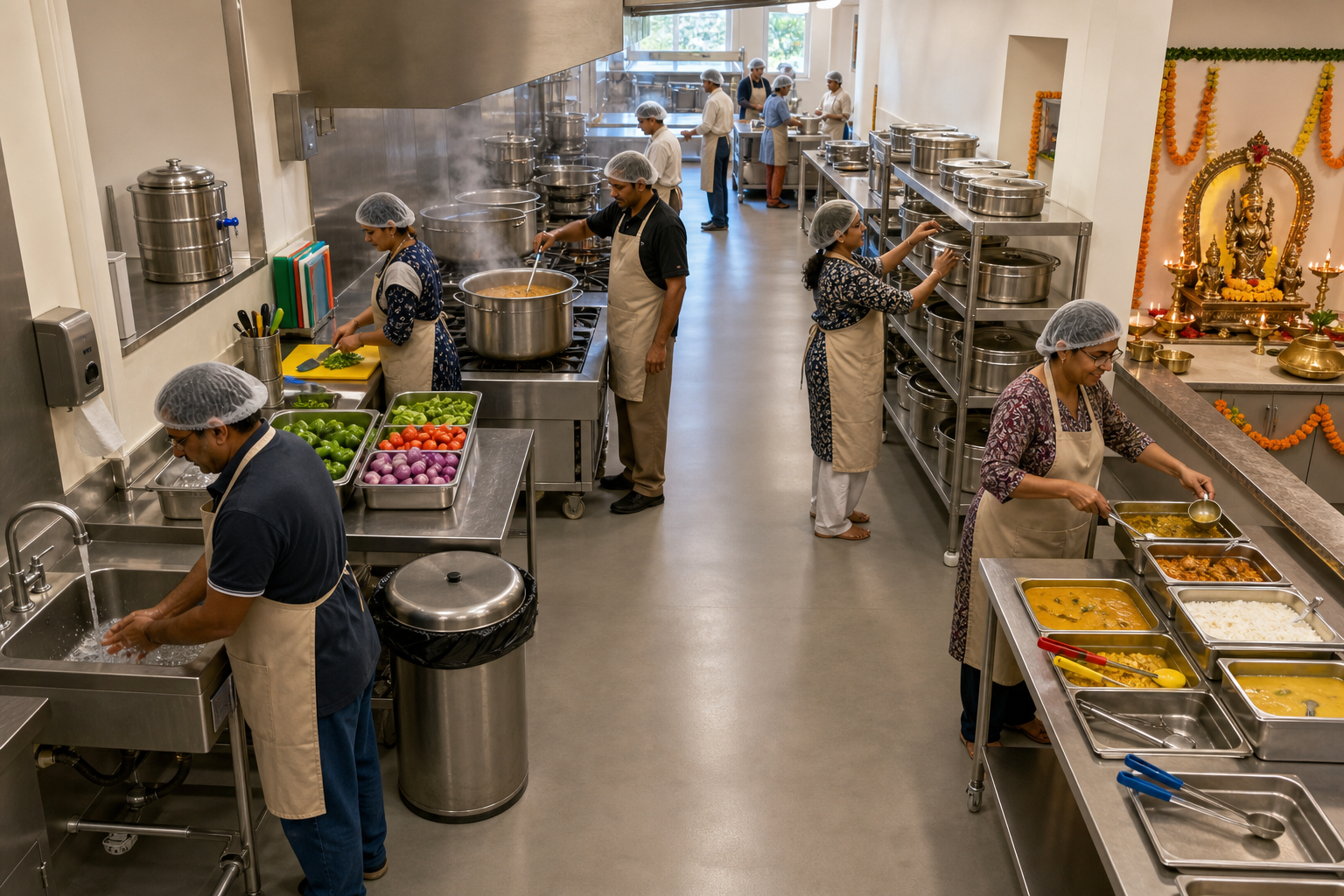
A temple committee should not wait for an inspector before building a reliable process. Good records protect devotees first, but they also prevent a legitimate equality complaint from being diverted into an argument about avoidable kitchen lapses.
- Name one responsible coordinator. Give that person authority to pause preparation or service when something looks unsafe. Avoid a system in which everyone is helping but no one can make the final safety decision.
- Map the full food journey. Review procurement, transport, storage, washing, preparation, offering, serving, and the handling of leftovers. A clean serving counter cannot correct a failure that occurred earlier.
- Set visible hygiene checkpoints. Provide handwashing, clean water, clean utensils, covered containers, protection from dust and pests, and separation between raw ingredients and food ready to serve. Assign people to verify these conditions during the event, not only before it begins.
- Control time and handling. Prepare quantities that match realistic service capacity. Use designated utensils and serving teams so queues do not turn into uncontrolled contact with food. Do not keep distributing a batch whose condition is in doubt merely to avoid waste or embarrassment.
- Keep a simple event log. Record ingredient suppliers, receipt dates, preparation batches, serving periods, volunteer responsibilities, observed problems, and corrective actions. The purpose is traceability, not bureaucracy for its own sake.
- Create an incident rule before the crowd arrives. If contamination or illness is suspected, stop serving the relevant batch, prevent further exposure, preserve identifying information such as packaging and batch records when it is safe to do so, and contact the appropriate local food-safety and medical services. Do not allow an argument over discriminatory treatment to delay an immediate health response.
When an inspection occurs, cooperate with legitimate safety steps and ask for documentation. Request the officer’s identification, the written basis for the inspection, the checklist being used, details of any sample taken, a receipt for material removed, the finding, the corrective action expected, and the available review process. Keep your questions calm and contemporaneous.
Do not obstruct sampling, conceal a suspected problem, or encourage devotees to consume food under dispute. Those actions can endanger people and weaken any later challenge to unequal treatment. If a notice threatens a penalty, closure, or another serious legal consequence, obtain advice from a lawyer qualified in the relevant jurisdiction rather than relying on informal interpretations.
This disciplined approach is not submission. It puts the committee in the strongest position to say: our safety process is documented; now show us that your enforcement process is equally disciplined.
Ask the administration for a religion-neutral protocol

Complaints about bias should end in a concrete institutional demand. “Do not inspect Hindu festivals” is the wrong demand because it leaves devotees exposed and allows genuine hazards to go unchecked. Ask instead for a protocol that any organizer can read and any citizen can audit.
- Define inspection triggers through neutral factors such as scale, duration, preparation conditions, prior violations, or complaints.
- Use one core checklist for comparable food distribution, with additional requirements tied to documented risk rather than religious identity.
- Send preventive guidance to all relevant organizers early enough for volunteers to correct problems before an event.
- Train inspectors to distinguish respectful handling of sacred food from exemption from safety controls.
- Give written reasons for sampling, findings, corrective orders, and penalties.
- Provide a usable process for correcting factual errors and challenging inconsistent treatment.
- Publish aggregated inspection and enforcement information by event type, trigger, finding, and outcome so that equal application can be assessed without exposing personal medical details.
- Review government-run kitchens and canteens under the same commitment to food safety and public accountability.
The Maharashtra objection also called for action on allegedly substandard food in government canteens. That demand raises a valid accountability question: the state should not scrutinize community kitchens while neglecting food served under its own control. But “fix government canteens first” cannot justify postponing action against an immediate hazard at a festival. Equal responsibility means addressing both, not using one failure to excuse another.
Language matters as well. Officials may need to name mahaprasad or bhandara when communicating directly with Hindu organizers. Naming a practice is not by itself proof of hostility. The concern becomes stronger when religion-specific language carries a special burden, when equivalent practices are absent from enforcement, or when officials cannot identify a neutral reason for the distinction.
A credible policy therefore has two layers: universal standards and context-sensitive communication. Universal standards establish equality. Context-sensitive communication helps each community apply those standards without erasing the sacred meaning of its practice.
Key takeaways
- Protecting devotees and resisting selective enforcement are compatible duties.
- One Hindu-specific directive can justify scrutiny, but a double standard is established through comparison with similar events.
- Compare scope, triggers, burdens, consequences, and transparency rather than relying on broad accusations.
- Document procurement, preparation, service, incidents, and inspections so that preventable safety failures do not obscure the equality issue.
- Demand risk-based rules that apply across religions, civic events, and government-run food services.
- Never delay an immediate safety response while contesting the fairness of enforcement.
Your next representation to an authority should be specific: identify the unequal wording or burden, name the genuinely comparable events, request the missing records, and propose a neutral protocol. That converts a grievance into a standard the administration can adopt, the public can verify, and every community can invoke.
References
