
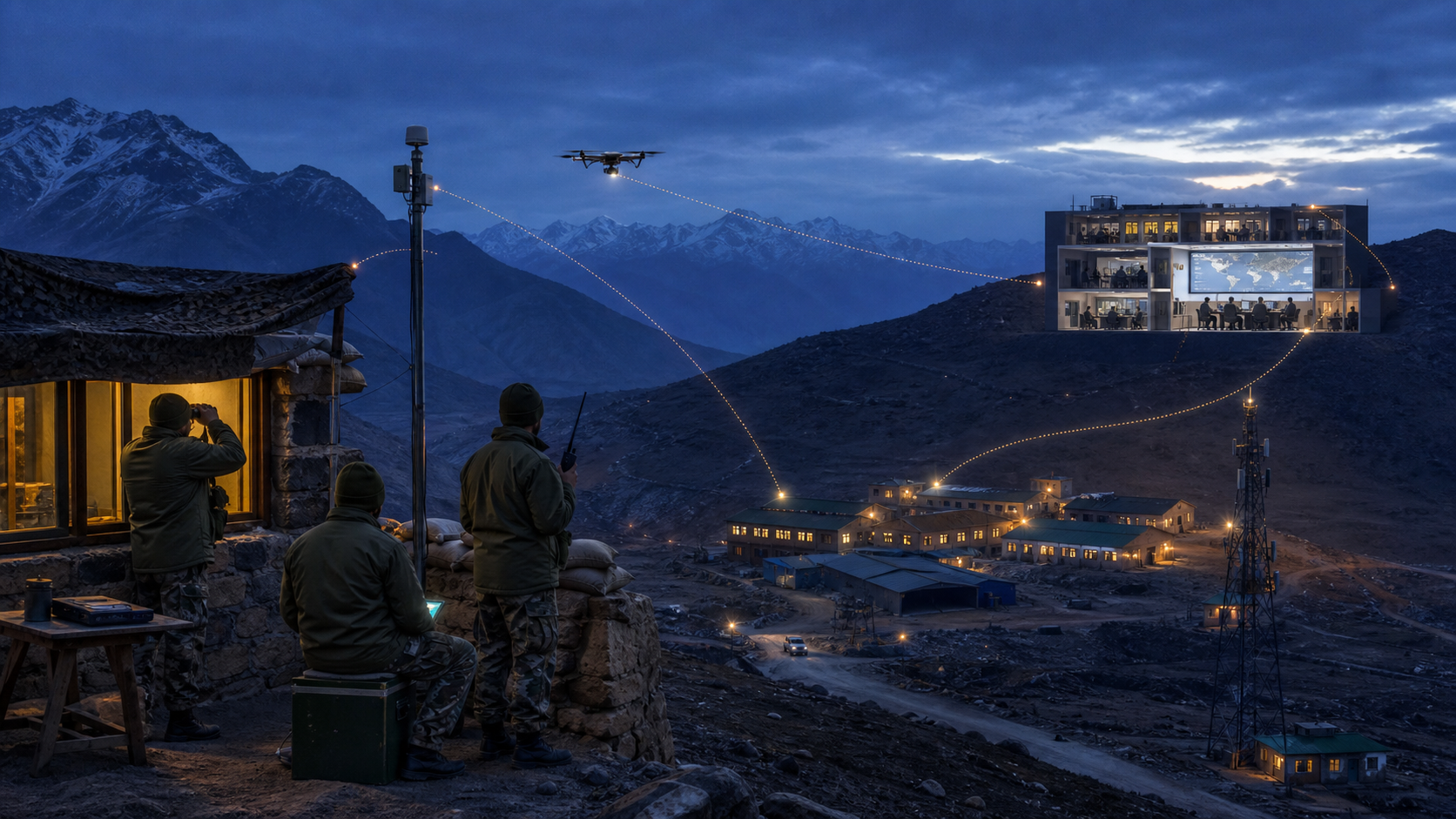
If you saw the phrase “border command grid” and wondered whether it means a better-defended frontier or merely a larger control room in New Delhi, you are asking the right question. Sensors, screens and communication links matter only when they help a border unit recognise a threat sooner, make a lawful decision faster and preserve enough evidence to prevent the next intrusion.
As of late August 2026, the Ministry of Home Affairs was developing a system that would connect forward operating bases through field headquarters to a central command in New Delhi. An India-Pakistan border pilot was due to begin first, driven by drone-borne narcotics and weapons smuggling. The ambition deserves support, but a pro-Bharat assessment must be based on operational results rather than the amount of technology purchased.
The grid’s real job is to close the response loop

A surveillance device detects or observes something. A command grid does a different job: it moves the resulting information to the people who must interpret it, combine it with other intelligence, authorise a response and learn from the incident. Confusing those functions is how a government can accumulate impressive equipment without producing a coherent border picture.
The planned chain runs from the forward base to the field headquarters and then to New Delhi. That arrangement could give commanders a shared view across sectors instead of leaving each post to understand an event in isolation. It must not, however, make a time-sensitive local response wait for a distant desk. Central visibility and local usability have to coexist.
To be operationally useful, the grid needs to close five connected stages:
- Detection: register a possible intrusion without burying personnel under routine noise.
- Classification: distinguish a likely hostile drone from an authorised aircraft, an innocent signal or a false alarm.
- Decision: deliver a clear alert to an officer who has both the authority and the context to act.
- Response: coordinate the authorised countermeasure while protecting friendly communications and legitimate activity.
- Learning: preserve the incident record, examine recovered material and feed the findings back into future surveillance.
A failure at any handoff weakens the whole chain. A detection that arrives too late is of little use. A fast alert with poor classification wastes attention. A successful interception that produces no preserved evidence stops one vehicle but may teach nothing about the network behind it.
This is also why the intended shift from manpower-heavy patrolling toward intelligence-led surveillance should not be misread as replacing jawans with machines. Technology can widen awareness and focus human attention. Personnel still have to interpret ambiguity, apply rules, secure recovered material and operate when a link or sensor fails. The useful question is not whether the border will be human or technological. It is whether each makes the other more effective.
Why the Pakistan-border pilot is a demanding first test
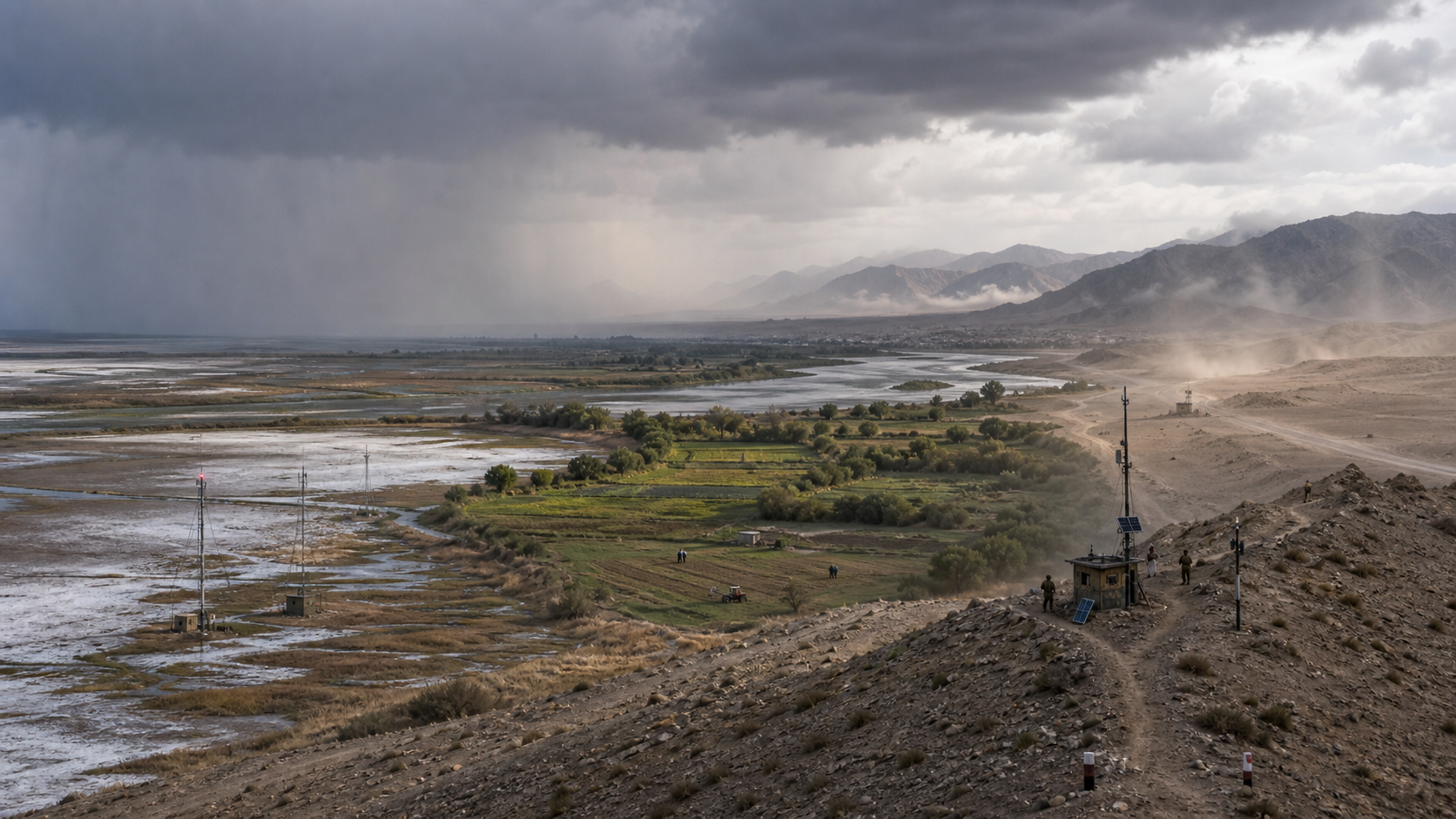
The pilot is aimed at an active operational problem rather than a hypothetical future threat. Government data placed before the Lok Sabha showed that the Border Security Force seized 294 drones in Punjab during 2024 alone. That figure establishes the scale of recovered machines, but it does not reveal the total number of attempted crossings or the percentage that escaped detection. Seizures are therefore a warning signal, not a complete measure of border control.
The reported anti-drone capability has different detection ranges for different aircraft: 500 metres for nano-UAVs and three kilometres for fixed-wing drones. That distinction matters. There is no single protective radius that applies to every drone. A small, low-observable vehicle may give an operator a much shorter window than a larger fixed-wing craft.
The reported electronic countermeasure covers frequencies from 20 MHz to 8 GHz, with the stated ability to disrupt a drone’s GPS within five seconds and force it down within ten. Those numbers describe a claimed operating capability, not a completed field result from the forthcoming pilot. Real evaluation must establish whether the performance remains dependable amid clutter, multiple simultaneous alerts, varied flight profiles and the communications already being used by friendly units.
Speed must be measured across the entire response, not only inside the jammer. A device may act within seconds after receiving a valid target, while the total chain still loses time during detection, classification, escalation or authorisation. When results are eventually released, look for the interval from first detection to effective action. A hardware response time by itself does not tell you whether the border responded in time.
Recovery should also begin an intelligence process rather than end an interception. State officials have requested additional forensic drone laboratories to reconstruct flight paths and identify launch points across the border. The command grid will be more valuable if field records, recovered devices and forensic findings can be associated with one incident. Repeated routes, components or operating patterns can then become actionable intelligence instead of remaining separate case files.
Key takeaways: five tests that matter more than hardware counts
- End-to-end speed: measure from initial detection to an effective, authorised response, not merely the reaction time of one device.
- Signal quality: determine how many alerts are confirmed threats, how many are false alarms and whether operators receive enough context to tell the difference.
- Field usability: verify that forward personnel receive a clear priority and recommended next action, rather than an unfiltered stream of centralised data.
- Evidence continuity: ensure that sensor records, response decisions, recovered material and forensic conclusions can be traced through one auditable incident record.
- Resilience: test whether the grid continues to provide useful local capability when a sensor, power supply or communication link becomes unavailable.
Some detailed figures may properly remain classified. That does not remove the need for accountability. Independent security oversight can examine sensitive performance data, while public reporting can disclose aggregate measures without publishing exploitable locations or tactics. Citizens do not need a map of detection gaps to learn whether response times improved, false alarms became manageable and recoveries generated usable investigations.
One practical distinction will prevent many misleading claims: deployment is not the same as effectiveness. Equipment can be installed, connected and displayed on a central screen while personnel still struggle with poor alerts, incompatible records or uncertain authority. Each stage requires its own acceptance test.
The unanswered design questions are not footnotes

Most programme details remain undisclosed, including the budget, technical architecture and timetable for nationwide rollout. That uncertainty should limit confident claims about what the grid will cover or how it will operate. It should also focus attention on the decisions that will determine whether the pilot can scale.
- Interoperability: can existing and future equipment exchange alerts and incident records without trapping the government inside one vendor’s closed system?
- Command authority: which decisions remain with the forward unit, which move to field headquarters and which genuinely require central involvement?
- Cybersecurity: how are identities, access privileges, software changes and remote connections controlled across a network linking sensitive sites?
- Continuity: what useful capability remains at a post when central connectivity is interrupted?
- Data discipline: which records must be preserved for operations, forensics and accountability, and who may retrieve or alter them?
- Field support: can faults be diagnosed, components maintained and operators retrained without leaving long gaps in coverage?
- Independent validation: who confirms that claimed detection and response performance appears under realistic field conditions rather than only in a demonstration?
These questions are connected. A central network expands visibility, but it also creates more accounts, connections and software that must be protected. Common data formats can simplify coordination, but only if field units follow consistent incident procedures. Advanced sensors can reduce blind spots, but persistent false alarms can train an operator to distrust the system. Architecture is therefore not an obscure procurement concern; it determines the quality of every decision made through the grid.
The deadline also needs a clear definition. Home Minister Amit Shah directed that the broader security grid be finalised within eighteen months, placing the target around late 2027. “Finalised” could refer to an approved design, an accepted pilot, a functioning command layer or a much wider deployment. Those milestones are not interchangeable. Progress reporting should name the one that has actually been completed.
What you should watch through the late-2027 deadline
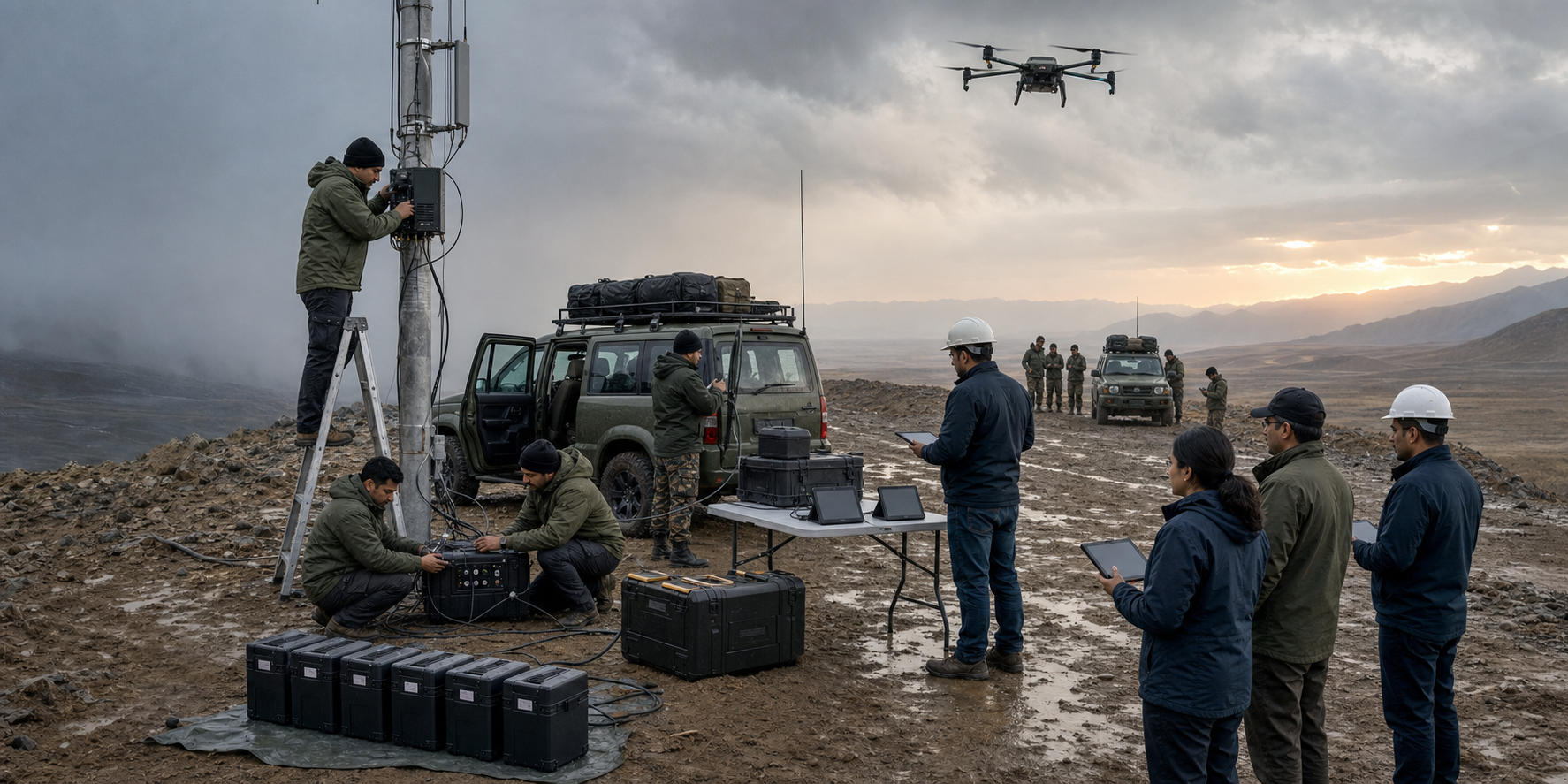
The first meaningful sign of progress will not be a photograph of the national command centre. It will be evidence that the Pakistan-border pilot completed a full operational cycle: a threat was detected, classified, passed to the right authority, countered where authorised, documented and examined for intelligence value.
Watch for four kinds of evidence as the programme advances:
- A defined baseline. Without a starting measure for detection, response, false alarms and system availability, later claims of improvement cannot be tested.
- Field acceptance. Operators at forward bases should be able to show that the grid improves decisions during ordinary duty, not only during a prepared demonstration.
- Forensic follow-through. Recoveries should generate traceable findings that can refine surveillance and expose repeated methods or routes.
- A scale decision tied to results. Expansion should follow demonstrated operational value, with architecture and training corrected before weaknesses are reproduced across more sectors.
Bharat needs a border grid that helps the jawan at the frontier and the commander seeing patterns across the frontier. When the next update arrives, ask what moved faster, what became clearer and what was learned after interception. If those answers are measurable, the grid is becoming a security capability. If the update offers only equipment totals and a new control room, keep the verdict open.
References
