
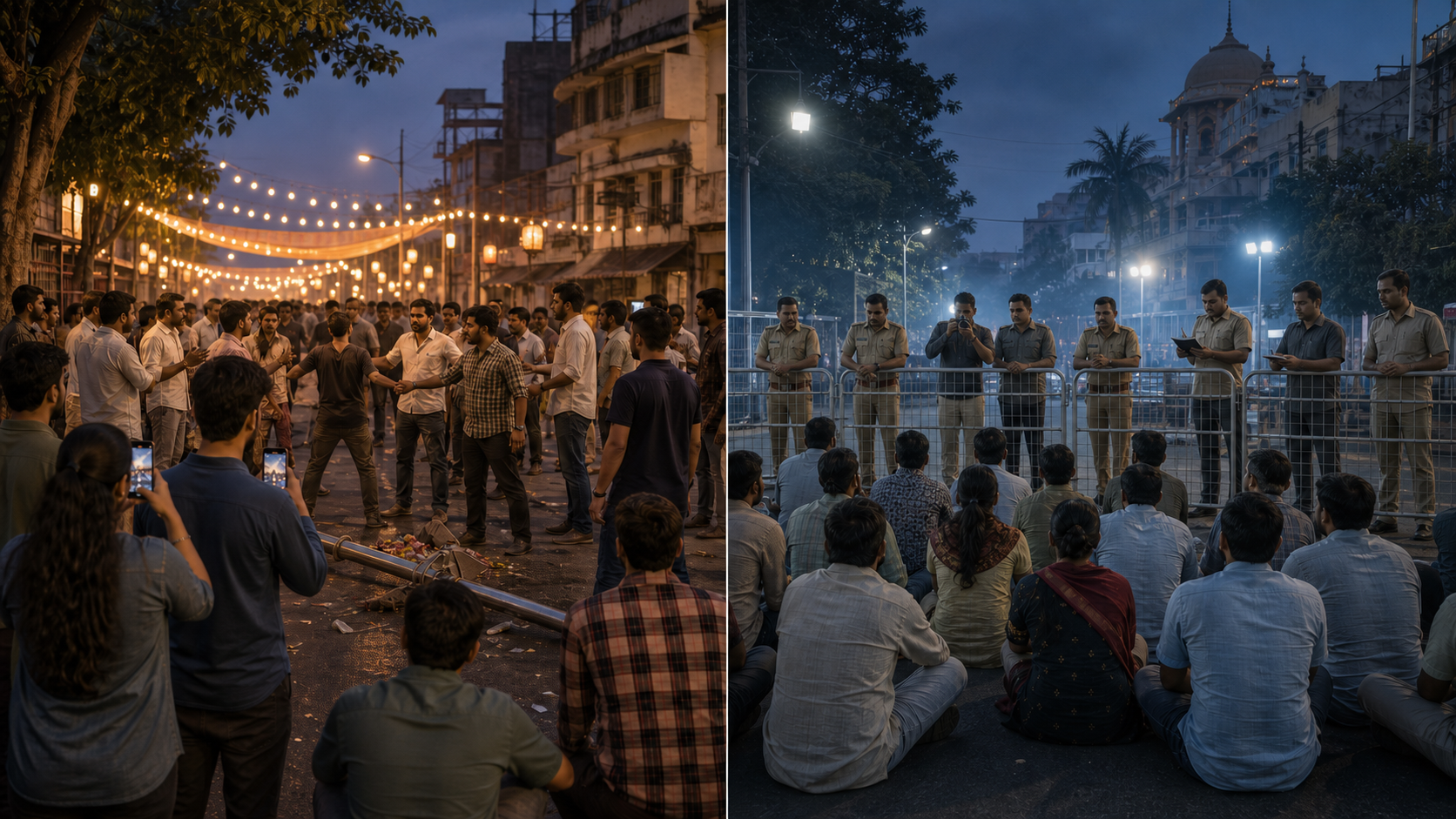
If you saw the rod-assault footage and then heard that Puneeth Kerehalli and other Hindu activists had been booked, your immediate question was probably simple: did the police act against people who protested an attack while failing to act against the attackers?
The responsible answer requires two things at once. The alleged assault on a Hindu activist must be investigated without dilution, and the later protest must be assessed on its own evidence. Neither event cancels the other. Keeping them separate is how you can demand equal justice without overstating what the available facts prove.
The sequence contains two incidents, not one
The case becomes easier to understand when you separate the physical confrontation from the protest that followed it.
- The reported assault: During an Eid-Milad procession on N.R. Road in Bengaluru’s Basavanagudi area, Rashtraraksana Pade activist Murali was reportedly struck on the head with a rod after a confrontation. Circulating footage appears to show a physical attack, but a clip’s appearance is still something investigators must authenticate and place in its full sequence.
- The subsequent protest: Puneeth Kerehalli and others assembled at the location to protest the alleged assault. Tension reportedly increased, and additional police personnel were deployed.
- The first legal track: An FIR alleging promotion of communal enmity reportedly named Puneeth Kerehalli, Gopi Gowda, Puneeth Gowda, Vinod Nayak and others. Reports also associate the case with obstruction allegations. Kerehalli, Gopi Gowda and Vinod Nayak were arrested.
- The second legal track: After Hindu organisations issued a strong warning, police reportedly registered another FIR against alleged participants in the assault under provisions concerning attempted murder and the SC/ST (Prevention of Atrocities) Act. Three accused were arrested and were reported to be minors.
This chronology creates a legitimate question about priority and delay: why did visible action against the protesters apparently precede the second FIR concerning the alleged rod attack? It does not, by itself, establish why the police acted in that order. The complaint times, full FIRs, station records, arrest grounds and later court filings would be needed to answer that.
There is also an important factual distinction hidden by the shorthand that a victim was turned into an accused. Murali is identified as the person reportedly struck with the rod; Kerehalli is identified as a leader of the later protest. On the disclosed facts, you should not write as though the police necessarily arrested the same person who sustained the reported head injury. Victims and protesters may stand on the same side of a dispute, but their identities and alleged conduct are not interchangeable.
An FIR is not a verdict in either direction

An FIR records allegations that trigger a criminal investigation. It is not a judicial finding that the named people committed the alleged offences. An arrest is serious state action, but it is not proof of guilt. That distinction applies equally to Hindu activists named in the first FIR and to the people accused under the second FIR.
Two FIRs arising from one period of unrest do not neutralise one another. The law may have to examine several distinct questions: who used the rod, who else joined the assault, what happened immediately before it, what each protester later said or did, whether anyone obstructed lawful police work, and whether any alleged speech or conduct actually satisfies the offences invoked. Evidence against one person cannot be transferred to another merely because they belong to the same crowd or community.
This gives you a clear standard for discussing the case:
- Say that Murali was reportedly struck with a rod unless a court finding establishes the act and offender.
- Say that Puneeth Kerehalli and the other named activists were booked or arrested in connection with allegations arising from the protest. Do not describe them as convicted.
- Describe the people booked in the second FIR as accused of the assault-related offences. Do not declare them guilty before adjudication.
- Do not attribute an individual’s alleged conduct to all Muslims, all procession participants, all Hindus or all Hindu organisations.
- Do not circulate the names or recognisable images of people reported to be minors merely to intensify an online campaign. Focus on the conduct, evidence and institutional response.
This language is not timidity. Precision protects the credibility of the demand for justice. If the evidence establishes a rod attack, the responsible case for prosecution will be stronger when advocates have not polluted the public record with exaggeration, collective blame or premature declarations of guilt.
How to test the footage and the police response
Video can be powerful evidence because it may preserve actions that competing narratives omit. It can show a raised rod, a blow, the positions of people nearby and part of the sequence surrounding the attack. But a circulating clip does not automatically establish every legally relevant fact. It may begin after the confrontation started, omit activity outside the frame, lose quality through repeated uploads or leave individual identities uncertain.
Before you treat a clip as conclusive, test it with these questions:
- Provenance: Who recorded or first uploaded it, and can the original file be preserved?
- Location and time: What visible details connect it to N.R. Road, Basavanagudi and the procession in question?
- Continuity: Is there longer footage showing what happened before and after the excerpt circulating online?
- Identification: Can investigators reliably connect each visible person to a name, rather than relying on social-media guesses?
- Specific conduct: Who held or used the rod? Who restrained, encouraged, pursued or withdrew? A crowd label cannot answer these individual questions.
- Corroboration: Do injury records, witness accounts, other camera angles or nearby CCTV support the visible sequence?
- Integrity: Has the clip been cropped, slowed, captioned or edited in a way that changes how a viewer interprets it?
If you possess original footage, preserve the original file and work from a duplicate. Record where and when you received it, retain the uploader’s details and avoid adding captions or edits to the evidentiary copy. If you are an injured person, a witness or someone named in either case, consult a Karnataka criminal lawyer before making a detailed public statement or surrendering your only copy. A lawyer can advise on your circumstances; a social-media campaign cannot substitute for individual legal advice.
The police response deserves the same evidence-based scrutiny. Ask whether the person apparently wielding the rod was identified, whether the complete recording was collected, whether Murali’s reported injury was documented, and whether every alleged offence in the protest FIR is tied to a particular person’s words or actions. A vague assertion that a crowd created tension is not a substitute for individualised evidence.
Also ask for a reliable chronology: when was each complaint made, when was each FIR registered, when did arrests occur, and what evidence was available at each point? The reported progression from the protest case to the later assault-related FIR matters, but only dated official records can show whether there was an unjustified delay or a procedurally explainable sequence.
Selective policing is a claim to prove, not merely repeat
The reported order of events gives Hindu organisations a sound reason to demand answers. A Hindu activist allegedly suffered a potentially grave head injury; protesters seeking action were then booked; and an assault-related FIR reportedly followed pressure from those organisations. That sequence can create the appearance that police treated the demand for action as the immediate problem while responding more slowly to the violence that prompted it.
Appearance, however, is not yet proof of political motive. The allegation that Karnataka’s Congress government pursued appeasement or targeted Hindu activists should be evaluated through records and patterns, not assumed solely from the existence of two FIRs. The state government is politically accountable for the policing environment, but connecting a particular operational decision to partisan intent requires more than anger at the outcome.
You can test the selective-policing claim against five concrete indicators:
- Speed: Did police record and investigate the alleged rod assault as promptly as the protest allegations?
- Specificity: Are the allegations against protesters linked to identifiable acts, words and people, or are broad offences being applied to a group?
- Symmetry: Were comparable acts treated by comparable investigative standards, regardless of the accused person’s religious or organisational affiliation?
- Completeness: Did investigators seek the full video sequence, medical evidence, independent witnesses and all available camera angles?
- Transparency: Have police explained the separate grounds for each FIR and arrest without prejudging either case?
A serious pro-Hindu response should insist on answers to all five. If the record shows that clear assault evidence was ignored until political pressure became unavoidable, criticism of police bias gains factual weight. If the record shows prompt but initially undisclosed investigative steps, the claim must be adjusted. Evidence should decide which conclusion survives.
The same discipline applies to the word “Islamist.” It should describe an evidenced ideological role, not function as a substitute for identifying who allegedly did what. In reporting the physical incident, “alleged assailants in the procession” is more precise than language that implicates an entire religious community. Hindu civil rights are defended more effectively by demanding individual accountability than by reproducing collective accusation.
Key takeaways: what you should demand now
- Keep the two events separate. The alleged rod assault and the later protest require independent findings about individual conduct.
- Do not confuse arrest with guilt. That rule protects the Hindu activists in the first FIR and also governs how the accused in the second FIR must be described.
- Demand the complete evidentiary sequence. A viral excerpt is a lead; the original file, longer footage, reliable identification and corroboration determine its real weight.
- Examine chronology before alleging motive. Complaint times, FIR registration times, arrest grounds and investigative steps can reveal whether police acted selectively.
- Protect reported minors from online exposure. Challenge the alleged conduct and official response without turning unverified identities into campaign material.
- Reject collective blame. Equal justice means investigating every identifiable assailant and every separately alleged protest offence, regardless of community.
If you plan to share this case, prepare a short factual note before posting: identify the location, describe Murali’s reported injury, distinguish Kerehalli’s later protest and arrest, mention the separate assault-related FIR, and list what remains unverified. Link to the fullest available footage rather than a captioned fragment. That gives readers something they can check instead of asking them to adopt a conclusion on trust.
As further records emerge, watch for three milestones: the precise allegations and arrest grounds in each legal track, the authenticated evidence concerning the rod attack, and any judicial findings on the accused individuals. Until those are available, insist on a simple standard: investigate the assault fully, justify every charge individually, and grant no exemption or presumption of guilt on the basis of religious identity. That is the demand most likely to protect the injured, preserve legitimate protest and expose unequal policing if it occurred.
References
