
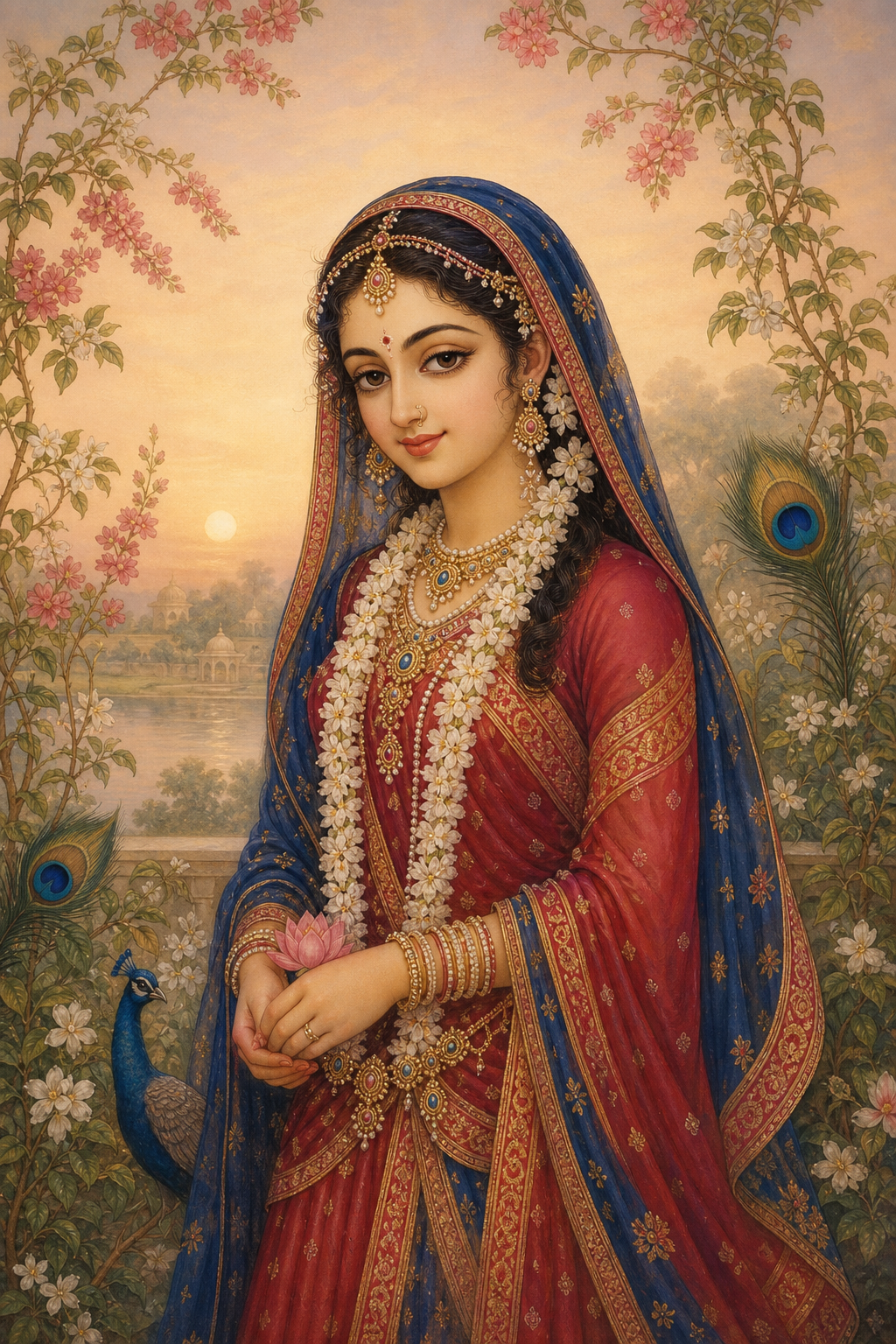
You may have encountered a devotional discourse that lingers over Sri Radha’s eyebrows and wondered whether this is profound bhakti or merely poetic excess. The distinction matters. A sacred feature becomes spiritually useful when it leads you from looking to remembrance, from remembrance to loving attention, and from attention to seva.
You do not need to force an elevated emotion or invent a hidden meaning. You need a disciplined way of seeing: begin with Sri Radha as a whole person, receive the expression of her face, and let that encounter correct the quality of your own devotion.
Why one small feature can deepen remembrance
An abstraction has no eyebrows. A person does. Bhakti becomes personal when the beloved is remembered in particularity rather than reduced to a general idea such as beauty, divinity, or love.
The eyebrows matter because they participate in expression. Their curve affects how you receive the eyes and the direction of the glance. A slight alteration can make the same face appear reserved, playful, concerned, intent, or gently corrective. The brows therefore help make silent feeling perceptible, but they never do so independently of the rest of the face.
That is the devotional logic behind receiving Sri Radha’s eyebrows as a stimulation for ecstatic love. The visible feature is not the final object of attention. It becomes an occasion for remembering her presence, her disposition, and the loving relationship at the heart of Radha-Krishna bhakti.
A stimulation is not a mechanical switch. Looking at a sacred image does not oblige your mind to produce ecstasy, nor does an intense bodily reaction prove spiritual attainment. Tears, stillness, delight, distraction, or the absence of any marked feeling cannot by themselves certify or invalidate devotion. The more dependable question is directional: did your attention become less self-centered and more ready for service?
This protects the practice from performance. Ecstatic devotion is not excitement manufactured for your own consumption. Its center is the beloved. If contemplation leaves you quieter, more careful in worship, and more willing to serve without recognition, it has already moved in a sound direction.
Read the eyebrows with the whole face
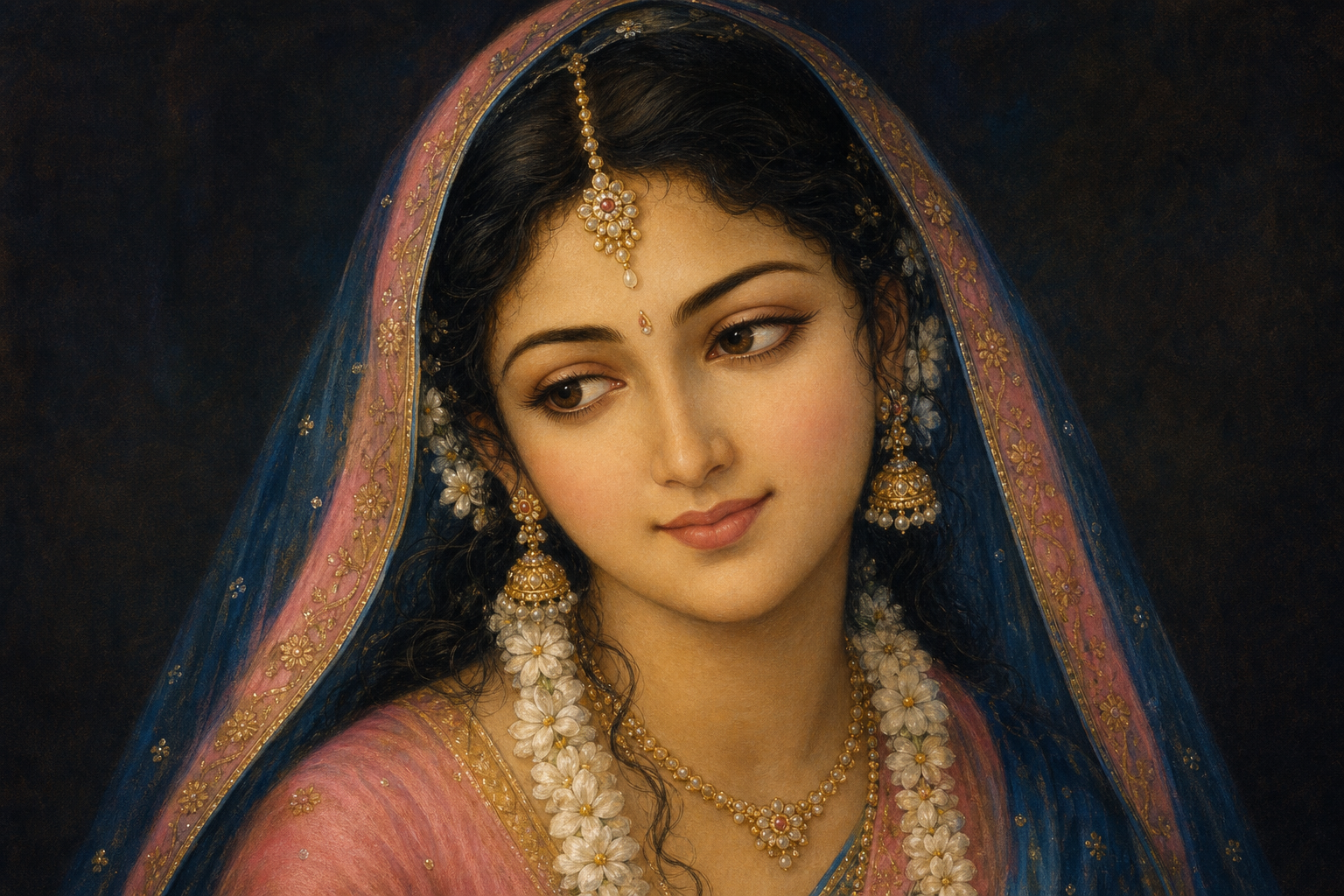
Devotional darshan is not visual inspection. You are not dissecting an artwork or collecting attractive features. You are approaching sacred presence with receptivity. That difference should govern how you look.
Begin with the whole form. Let your attention move to the face and only then to the eyebrows. When you reverse that order and begin with an isolated feature, you risk treating Sri Radha as an aesthetic object. When you begin with her personhood, the detail remains relational.
Use four kinds of context before assigning any meaning:
- The eyes: Notice where the glance appears to move and whether it seems open, lowered, direct, or turned aside.
- The mouth: A similar arch of the eyebrows may feel different beside a smile, a composed mouth, or an expression of concern.
- The posture: The position of the head and body can make an expression appear welcoming, playful, attentive, or restrained.
- The devotional setting: If the image belongs to a known lila or established temple tradition, receive the expression within that context. If you do not know the context, do not invent one.
There is no universal decoder in which one curve must always mean one emotion. Sacred artists and temple traditions do not all depict Sri Radha identically. Even within one image, the expression can yield more than one devotional impression. You may receive tenderness on one occasion and dignified reserve on another without needing to declare either impression an objective fact.
Conditional language is a valuable discipline. Say inwardly that the expression seems compassionate, may suggest loving concern, or invites greater attentiveness. Do not jump from a personal impression to a claim about exactly what Sri Radha is thinking. Humility does not weaken contemplation; it keeps contemplation from hardening into fantasy.
If your guru, sampradaya, temple tradition, or an established devotional text gives a specific explanation of the image, let that teaching guide you. A private response may enrich your prayer, but it should not be presented to others as inherited doctrine merely because it felt powerful.
A practical contemplation for your next darshan
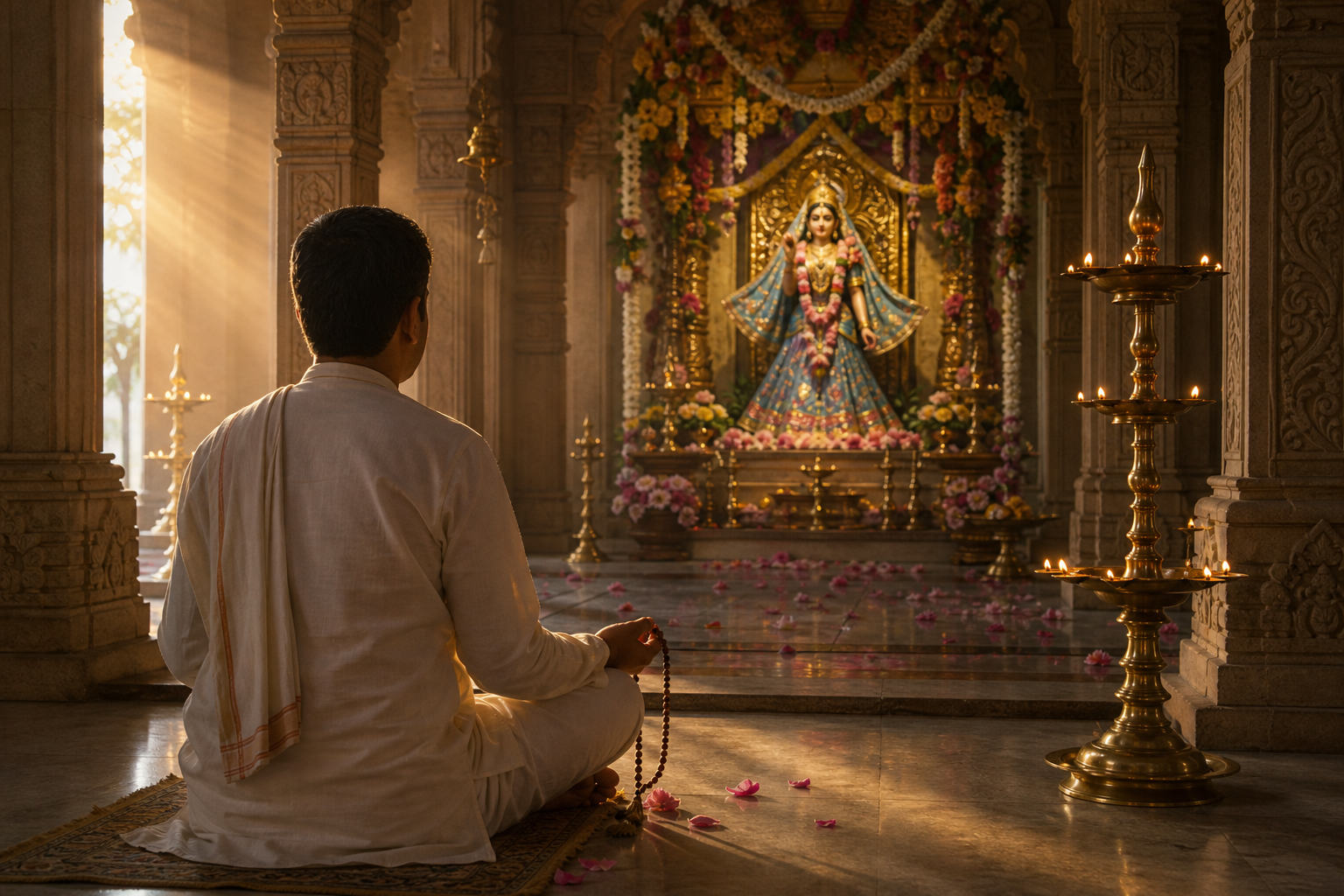
This practice can accompany your ordinary worship without replacing japa, kirtan, study, or prescribed seva. Keep it simple enough that it serves remembrance instead of becoming another technique to master.
- Choose an image already connected to your worship. Use a murti or sacred image you approach reverently rather than an isolated crop selected only for visual appeal. If you use a screen, remove notifications and display the complete face or form.
- Settle into your established practice. Begin with the prayer or mantra given in your tradition. Do not invent a special mantra for the eyebrows. If you have no prescribed formula, ask in your own words for clean attention and freedom from self-serving imagination.
- Remember whom you are approaching. Before noticing any feature, bring Sri Radha’s personhood and her loving relationship with Krishna to mind. This prevents the exercise from becoming an impersonal study of facial beauty.
- Receive the entire expression. Look gently at the face without staring or straining. Notice the eyes, mouth, head, and posture. Then allow the eyebrows to come into focus as one part of that living expression.
- Name only a possible mood. Use one modest phrase such as tender attention, playful reserve, compassionate concern, or dignified seriousness. Choose only what the whole expression plausibly evokes, and hold the impression lightly.
- Turn the mood into a response. Ask what this encounter calls for from you now. Tenderness may call you to chant less mechanically. Concern may expose a neglected duty. Loving correction may require an apology. Reserve may teach you to wait rather than demand spiritual consolation.
- Return to the whole form. Do not end with the isolated feature. Offer respect to Sri Radha as a whole person, resume your ordinary worship, and carry one concrete response into the next duty of your day.
The sixth step is where contemplation becomes useful. Without it, you can accumulate refined impressions while remaining unchanged. With it, beauty becomes instruction. The curve of the brow leads to the glance, the glance awakens relationship, and relationship asks something of your conduct.
Do not repeat the exercise merely to reproduce yesterday’s mood. Familiar images disclose different aspects under different conditions, and some days your attention will be ordinary. On such a day, offer the ordinary attention honestly. Steady remembrance is more serviceable than emotional pressure.
Protect the practice from projection and sentimentality
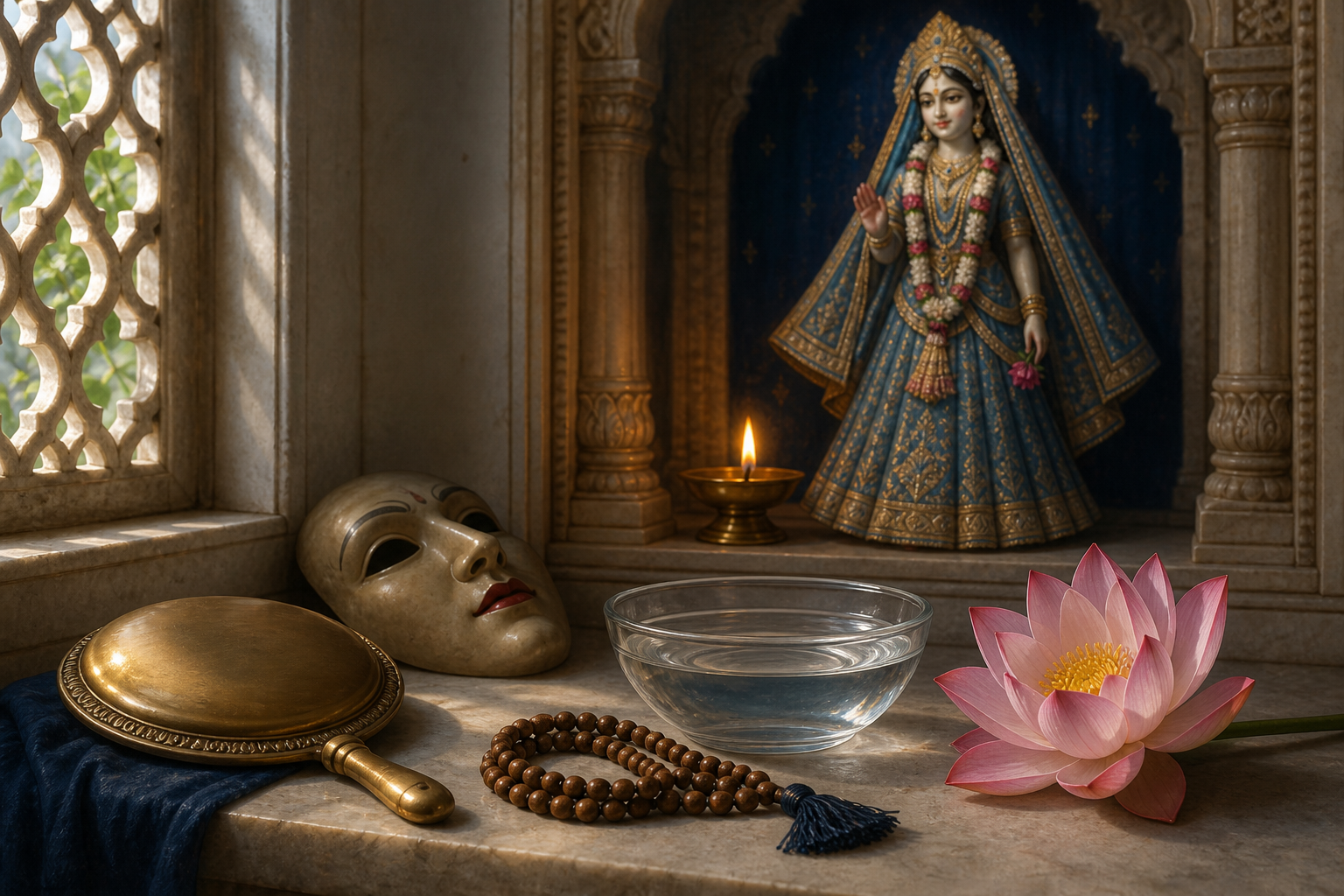
The most common error is not a lack of imagination. It is imagination without accountability. Because facial expression is subtle, a devotee can easily mistake a preferred feeling for a message received from Sri Radha.
You can test the direction of your contemplation through several contrasts:
- Devotional attention remains teachable; projection insists that a private impression must be correct.
- Devotional attention remembers the whole person; projection collects attractive features for private enjoyment.
- Devotional attention seeks seva; sentimentality seeks an unusual feeling and becomes disappointed when the feeling does not appear.
- Devotional attention accepts the boundaries of lineage; projection uses poetic language to bypass guidance and correction.
- Devotional attention affects conduct; fantasy ends when the image is no longer in view.
The intimate beauty of Radha-Krishna devotion requires particular care. Prudishness can flatten sacred beauty into lifeless respectability, but sensual appropriation is equally distorting. Receive intimate imagery through the devotional vocabulary and disciplines of your tradition. Do not turn Sri Radha into an object of detached aesthetic consumption or private fantasy.
Three questions offer a useful check after contemplation. Did this make you more reverent toward Sri Radha rather than more fascinated with your own experience? Did it make your next act of worship or service more attentive? Would you be willing to revise your interpretation if a trustworthy teacher corrected it? A sound practice can answer all three without defensiveness.
If the contemplation repeatedly produces agitation, vanity, or a desire to advertise supposed spiritual experiences, simplify it. Return to the whole form, your received mantra, and an ordinary act of seva. The remedy for self-absorption is not a more elaborate image; it is a more serviceful orientation.
Key takeaways
- Sri Radha’s eyebrows are a doorway into personal remembrance, not an isolated object of fascination.
- Read the brows together with the eyes, mouth, posture, and devotional setting; no single curve supplies a universal code.
- Treat the mood you perceive as a humble devotional possibility unless your tradition supplies a definite interpretation.
- Do not measure the practice by emotional intensity. Measure its direction through remembrance, humility, and readiness for seva.
- Complete contemplation by changing one concrete action: your chanting, attention to duty, treatment of another person, or care in worship.
At your next darshan, begin with Sri Radha’s whole form, notice how the eyebrows participate in her expression, and ask what attentive love requires from your very next duty. Then perform that duty carefully. That movement from sacred beauty to service is where contemplation becomes bhakti.
References
