
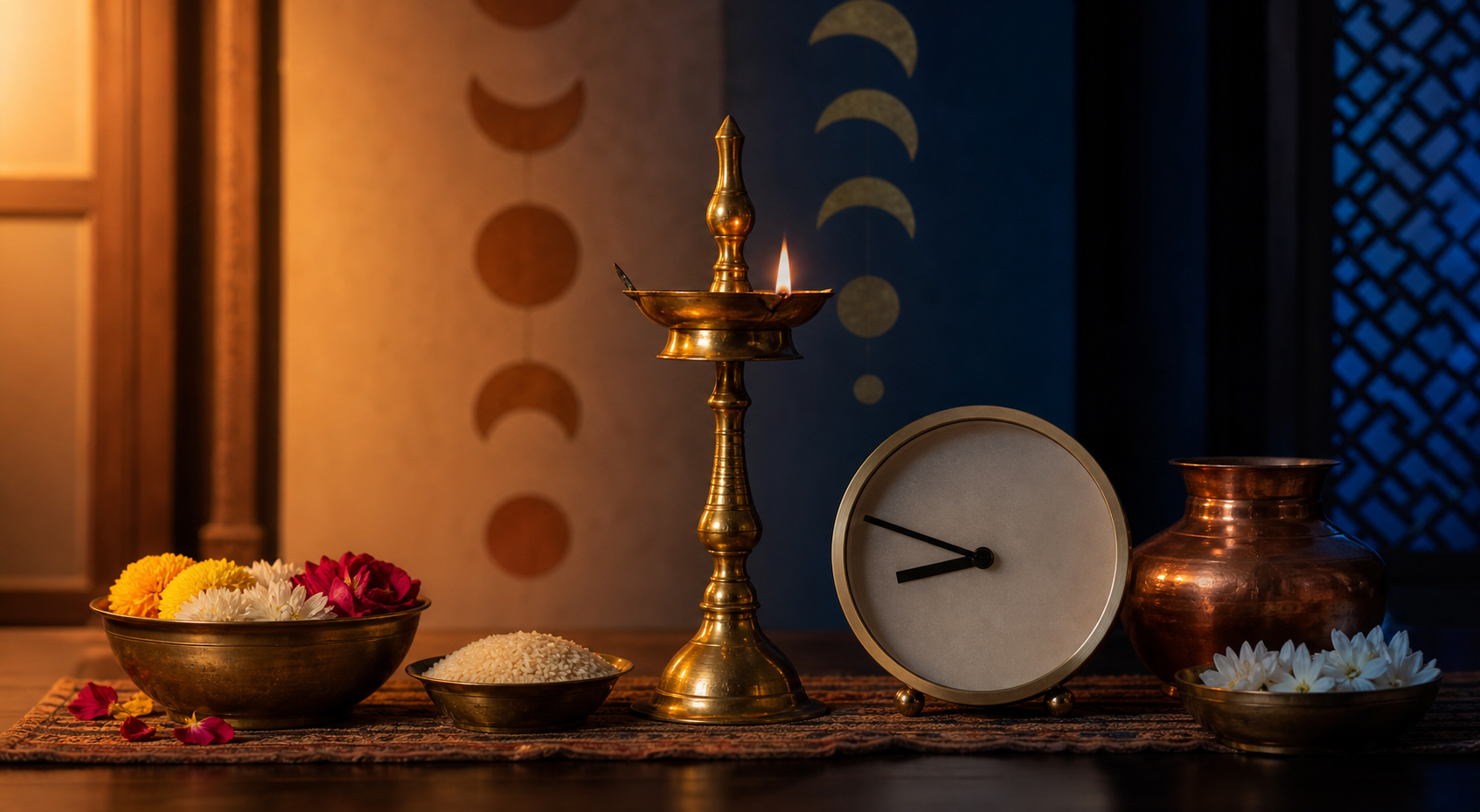
If you are arranging a puja, vrata, sankalpa or family observance for Saturday, September 5, 2026, do not assign one tithi to the entire civil date. The lunar date changes during the evening.
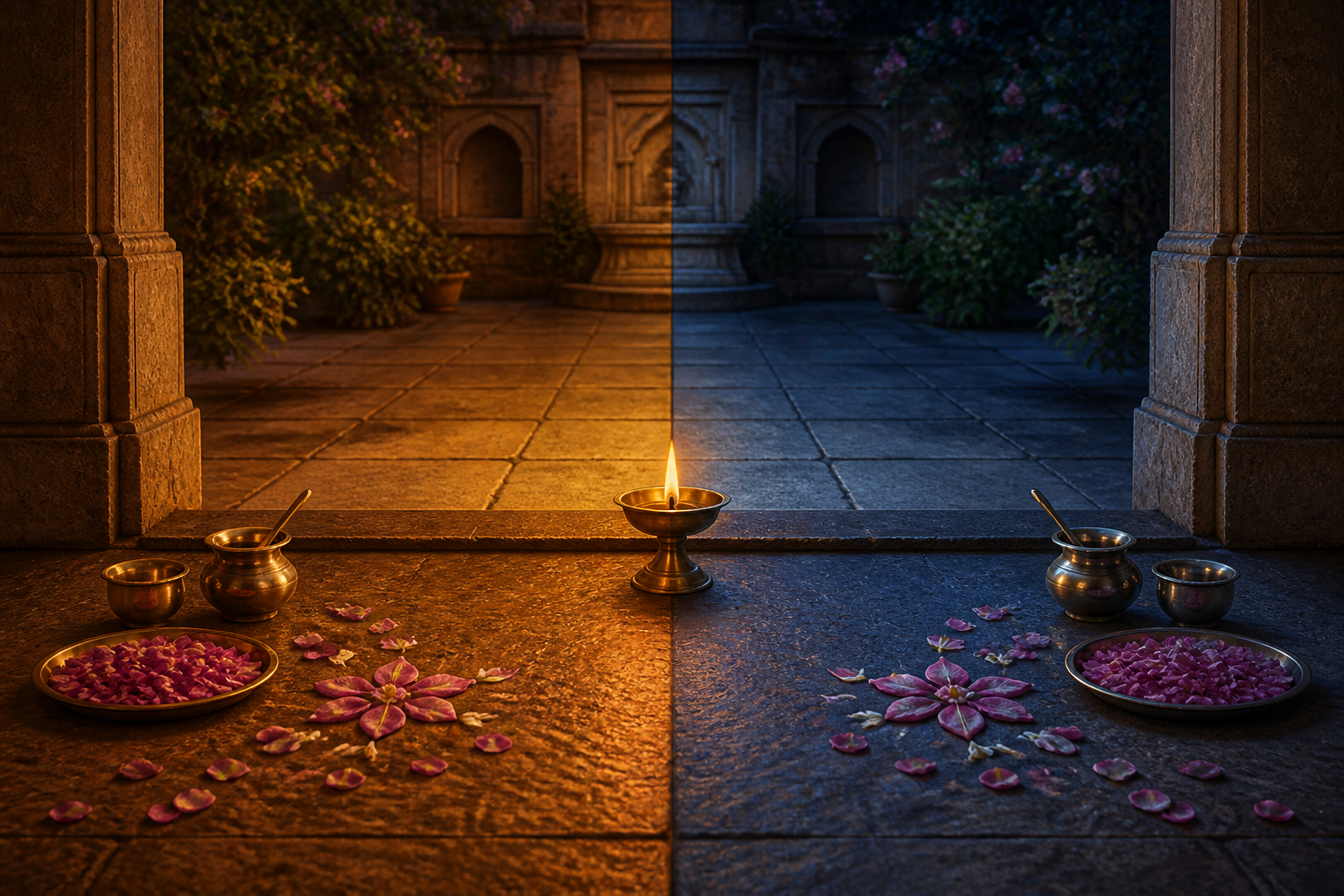
The practical boundary is 8:47 PM: Krishna Paksha Navami lasts until 8:47 PM, after which Krishna Paksha Dashami begins. That distinction should guide how you identify the tithi, but any location-dependent ritual timing still needs to be checked against a Panchang calculated for your city.
Key takeaways for September 5
- September 5, 2026 falls on a Saturday.
- Krishna Paksha Navami, the ninth tithi of the waning lunar fortnight, continues until 8:47 PM.
- Krishna Paksha Dashami, the tenth tithi of the waning fortnight, begins after 8:47 PM.
- For an evening observance, check whether it falls before, after or across the tithi transition.
- Do not treat 8:47 PM as a universal local time without confirming the location and time-zone convention behind your Panchang.
- A tithi by itself does not establish an auspicious muhurta.
Read the date as two tithis, not one
| Part of September 5, 2026 | Applicable tithi | What it means for your planning |
|---|---|---|
| Before 8:47 PM | Krishna Paksha Navami | Use Navami when identifying the prevailing tithi, subject to the rules of your observance and your local Panchang. |
| After 8:47 PM | Krishna Paksha Dashami | Use Dashami when identifying the prevailing tithi, again subject to local calculation and ritual rules. |
This is why a civil date and a Hindu lunar date cannot always be matched one-to-one. Saturday remains Saturday from midnight to midnight on the civil calendar, but the tithi can change within that interval. Seeing both Navami and Dashami listed for September 5 is therefore not a contradiction.
Krishna Paksha is the waning or dark half of the lunar cycle. Navami is its ninth tithi, and Dashami is its tenth. The change at 8:47 PM is a transition in lunar reckoning; it is not merely a label added to the following civil day.
Plan an evening observance around the 8:47 PM boundary
The evening is where a casual reading can cause an avoidable mistake. A daytime activity lies comfortably within Navami, while an activity held after the stated transition falls under Dashami. If your practice specifically requires one of those tithis, the start time cannot be chosen from the civil date alone.
- Write down whether your observance requires Navami, Dashami or simply the date of September 5.
- Note whether the relevant act occurs before or after 8:47 PM. For a puja, that may be the sankalpa, a principal offering or another rite specified by your tradition.
- If the observance crosses the transition, do not invent a start-time or end-time rule. Follow the rule given by your sampradaya, temple or family paddhati.
- If a priest is conducting the rite, send the city, date and intended time when asking for confirmation. The city matters because Panchang calculations are location-sensitive.
Vratas and festival observances do not all use the same method for selecting a day. Some depend on the tithi prevailing at sunrise; others depend on whether a tithi is present during a prescribed part of the day. The evening transition tells you when Navami gives way to Dashami, but it does not replace the rule governing a particular observance.
Verify the clock time for your location
A Panchang is astronomical and local. Sunrise, sunset and the displayed ending times of lunar factors are tied to place and time-zone conventions. A clock time copied into another city can therefore give you the wrong local boundary even when the underlying lunar sequence remains the same.
Use 8:47 PM as the published reference for this September 5 entry, then make one additional check if the timing affects a ritual decision: open a trusted Panchang configured for the city where the observance will actually occur. This check is especially important when you are outside the region for which the calendar was prepared, are travelling, or are coordinating a ceremony across time zones.
Do not convert 8:47 PM merely by comparing time-zone offsets unless you know the location and calculation convention behind the original time. The safer method is to generate or consult the Panchang for the destination city itself.
Do not mistake the tithi for a complete muhurta
Navami or Dashami answers one question: which lunar tithi prevails? It does not, by itself, answer whether a proposed time is auspicious for marriage, griha pravesh, a major purchase, travel, a new undertaking or another samskara.
A complete Panchang assessment considers additional factors such as the weekday, nakshatra, yoga and karana, along with the requirements of the intended act. Tradition-specific prohibitions and the individual considerations used for major samskaras may also matter. You cannot infer those factors from the Navami-to-Dashami transition.
For ordinary devotional practice, this tithi information may be all you need to record the day correctly. For a ceremony whose validity or customary timing depends on muhurta, use it as the first checkpoint and obtain the remaining local details before fixing the hour.
Place the 8:47 PM boundary beside any September 5 evening plan now. If the tithi determines whether that plan proceeds, confirm the local-city calculation and the governing ritual rule before invitations or arrangements are finalized.

References
