
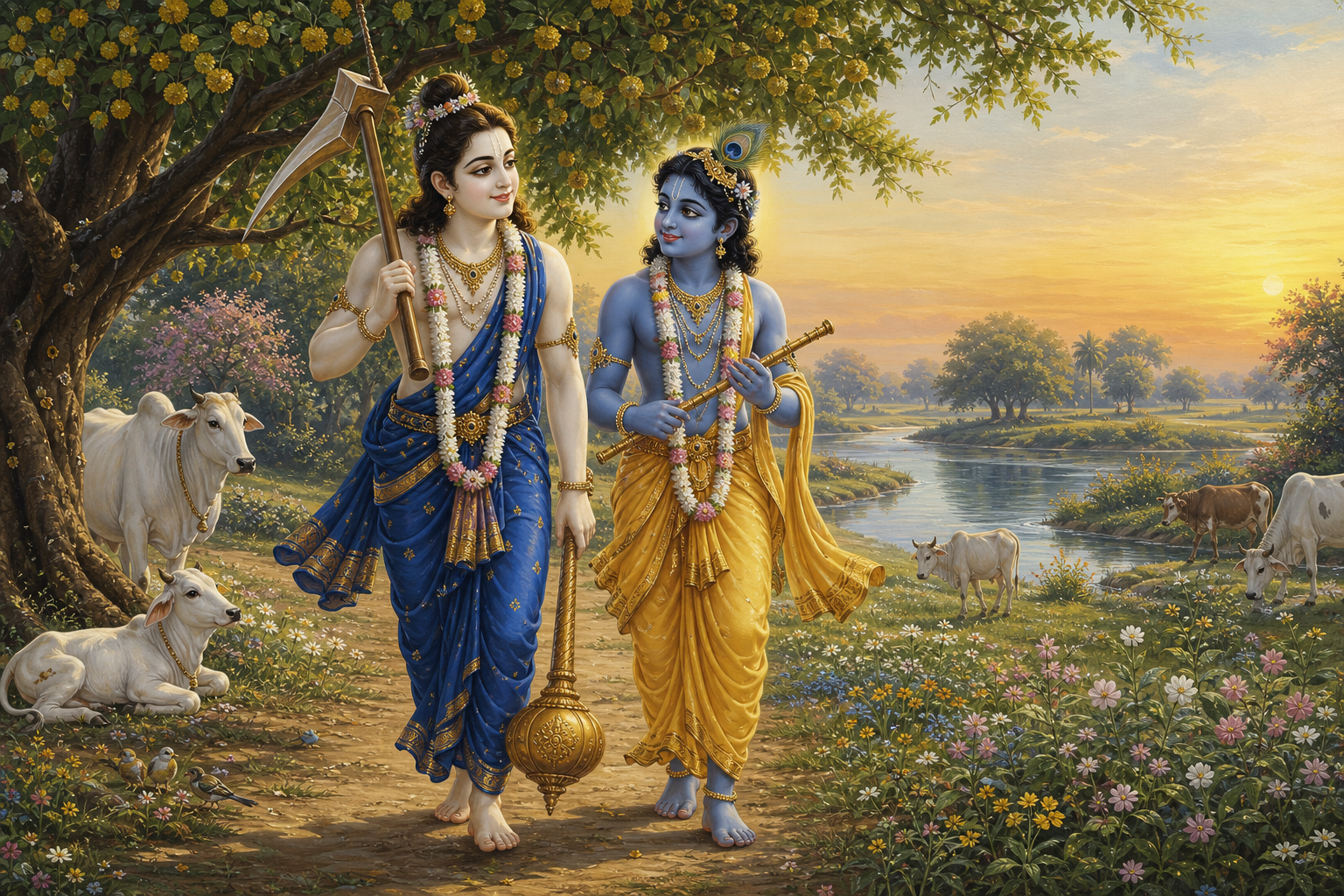
If you know Lord Balarama only as the strong, fair-complexioned figure standing beside Krishna, you may be unsure what you are meant to see. Is he Krishna’s elder brother, an avatara, Sankarshana, Adi Sesha, the bearer of the plough, or the original spiritual master?
These identities are not interchangeable labels, but neither are they rivals. Each reveals a different dimension of Balarama’s place in Vaishnava theology and devotion. Once you keep relationship, divinity and service together, his apparently varied pastimes form a coherent portrait. Contemporary Vaishnava teaching therefore continues to join the glorification of Lord Balarama to careful reflection on who he is.
Brother, divine expansion and sacred servant
Within Krishna’s earthly pastimes, Balarama is his elder brother. That relationship is not decorative background. It gives Balarama’s strength its direction. He accompanies, protects, advises and serves Krishna while sharing the familiar intimacy of family life. You miss the heart of his character if you notice only his physical power.
Calling Balarama an avatara is common and broadly intelligible, but particular Vaishnava traditions use more exact language. Gaudiya Vaishnava theology describes him as Krishna’s first plenary expansion: fully divine, one with Krishna in spiritual nature and power, yet appearing in a distinct form and relationship. Difference allows loving exchange. Unity establishes that Balarama’s service is divine activity, not the submission of an inferior being.
This distinction protects you from two opposite mistakes. Balarama should not be reduced to a powerful human companion, but he should not be merged into Krishna so completely that his elder-brotherly personality disappears. Vaishnava theology preserves both truths: divine unity and relational distinction.
Balarama is also associated with Sankarshana and Ananta, or Adi Sesha. You will sometimes hear the shorthand that Balarama is an incarnation of Adi Sesha. That formulation depends on the theological framework being used. Gaudiya theology ordinarily describes the direction differently: Ananta Sesha manifests from Balarama and extends his mood of service. This matters because it places service, support and spiritual strength at the center of Balarama’s identity.
The same logic explains why Gaudiya Vaishnavas honor Balarama as the original spiritual master. A genuine guru does not make the disciple dependent on the guru’s personality; the guru supplies knowledge, discipline and spiritual strength for service to Bhagavan. Balarama embodies that enabling function. His strength is not merely the ability to overcome an enemy. It is the power by which divine service can be carried, protected and completed.
His names and symbols tell you how to read him

Balarama and Baladeva direct attention to strength. In devotional interpretation, however, bala is larger than muscular force. It includes steadiness, spiritual capacity and the ability to bear responsibility. When you encounter a display of Balarama’s power, ask what relationship or duty that power is serving. That question usually reveals more than the spectacle itself.
Sankarshana carries the sense of drawing together or drawing away. The Bhagavata Purana places this name within the sacred account of the unborn child being transferred from Devaki to Rohini. Vaishnava theology also gives the name a cosmic dimension through Balarama’s identity as Sankarshana. The narrative and theological meanings belong to different levels, so neither should be used to erase the other.
Haladhara and Halayudha identify him as the bearer of the plough. A plough is not an ornamental weapon. It prepares soil, opens a field and makes nourishment possible. It can also uproot what resists cultivation. That combination makes it a fitting emblem of Balarama: his strength establishes the conditions in which life, order and devotion can grow.
Balabhadra joins strength to auspicious or noble purpose. Rama, when used for Balarama, conveys delight and should be understood from context rather than confused automatically with Sri Ramachandra. Learning these names is practical. A name often tells you which aspect of Balarama a prayer, image or narration is emphasizing.
Balarama is commonly represented with a light or white complexion and with a plough and mace. The plough evokes cultivation, provision and the correction of disorder. The mace evokes disciplined force and protection. Iconography varies by region and lineage, so do not treat one modern image as the universal standard. Look first for the attributes, the accompanying deities and the local temple’s own identification.
The pastimes reveal the direction of divine strength

Balarama’s pastimes are often remembered for decisive acts of power. Their devotional value becomes clearer when you follow the whole movement of each narrative: a relationship or shared good is threatened, an obstruction appears, Balarama responds, and order is restored. The point is not simply that he can defeat an opponent. The point is what his strength protects.
At Talavana, the demon Dhenuka prevents the cowherd community from enjoying the forest’s fruit. Balarama removes the danger and makes the place accessible again. You can read the episode as protection of common life rather than as an isolated feat. Hoarded abundance is released, fear loses its hold, and the community can return to what should have been available to it.
Pralamba enters the cowherd boys’ play in disguise and attempts to carry Balarama away. The danger initially resembles companionship. Balarama’s response therefore joins power to discernment. The episode invites you to notice that a threat does not always announce itself as hostility; it can enter through a trusted form. That is an interpretive observation, not permission to treat ordinary suspicion as spiritual insight. Discernment must remain accountable to truth and dharma.
The plough becomes especially striking in the pastime involving the Yamuna. Balarama commands the river to come near and draws her with his plough when she does not comply. This is divine lila expressing cosmic sovereignty within a sacred narrative. It is not a behavioral model for anger, environmental abuse or coercion. Whenever a divine act exceeds ordinary human authority, description must not be turned into imitation.
The episode of Romaharshana requires the same care. Its severity should not be hidden, and a single dramatic moment should not be detached from the sages’ response, Balarama’s engagement with their concern and the subsequent act of atonement through pilgrimage. The complete sequence raises difficult questions about honor, authority, accountability and the responsibility attached to power. A serious reader stays with those questions instead of extracting a convenient slogan from the confrontation.
Balarama’s conduct around the Kurukshetra war reveals another form of strength. Though connected to people on opposing sides, he does not become a combatant and undertakes pilgrimage. When he later encounters the concluding mace duel, he attempts to restrain a destructive course that the fighters will not abandon. The episode prevents us from equating strength with constant intervention. Sometimes power acts; sometimes it refuses enlistment in a conflict whose terms it cannot endorse.
These pastimes should not be flattened into generic moral tales. Balarama is not merely a symbol invented to represent courage, agriculture or brotherhood. For devotees, he is a divine person whose acts have theological meaning. Ethical reflection follows from the lila, but it does not replace devotion to the person at its center.
How to approach Balarama without reducing him
Begin by identifying the theological frame you are hearing. If a Gaudiya Vaishnava teacher calls Balarama Krishna’s first expansion and the original guru, receive those terms within Gaudiya theology. If another Vaishnava setting emphasizes avatara language or his association with Adi Sesha, note that framework as well. You do not gain clarity by forcing every school’s vocabulary into a single formula.
Next, hear one complete Balarama-katha rather than collecting detached incidents. Before you begin, write down one question: Whom or what does Balarama’s strength serve here? During the narration, notice the relationship, the obstruction, the response and the restored order. Afterward, state the lesson in one sentence without turning it into a claim that you possess divine authority.
Pay attention to the name used in the narration. Baladeva may foreground divine strength. Sankarshana may open a theological or cosmic dimension. Haladhara directs your attention to the plough. A name is often an interpretive key, especially when the same divine person appears in several relationships and functions.
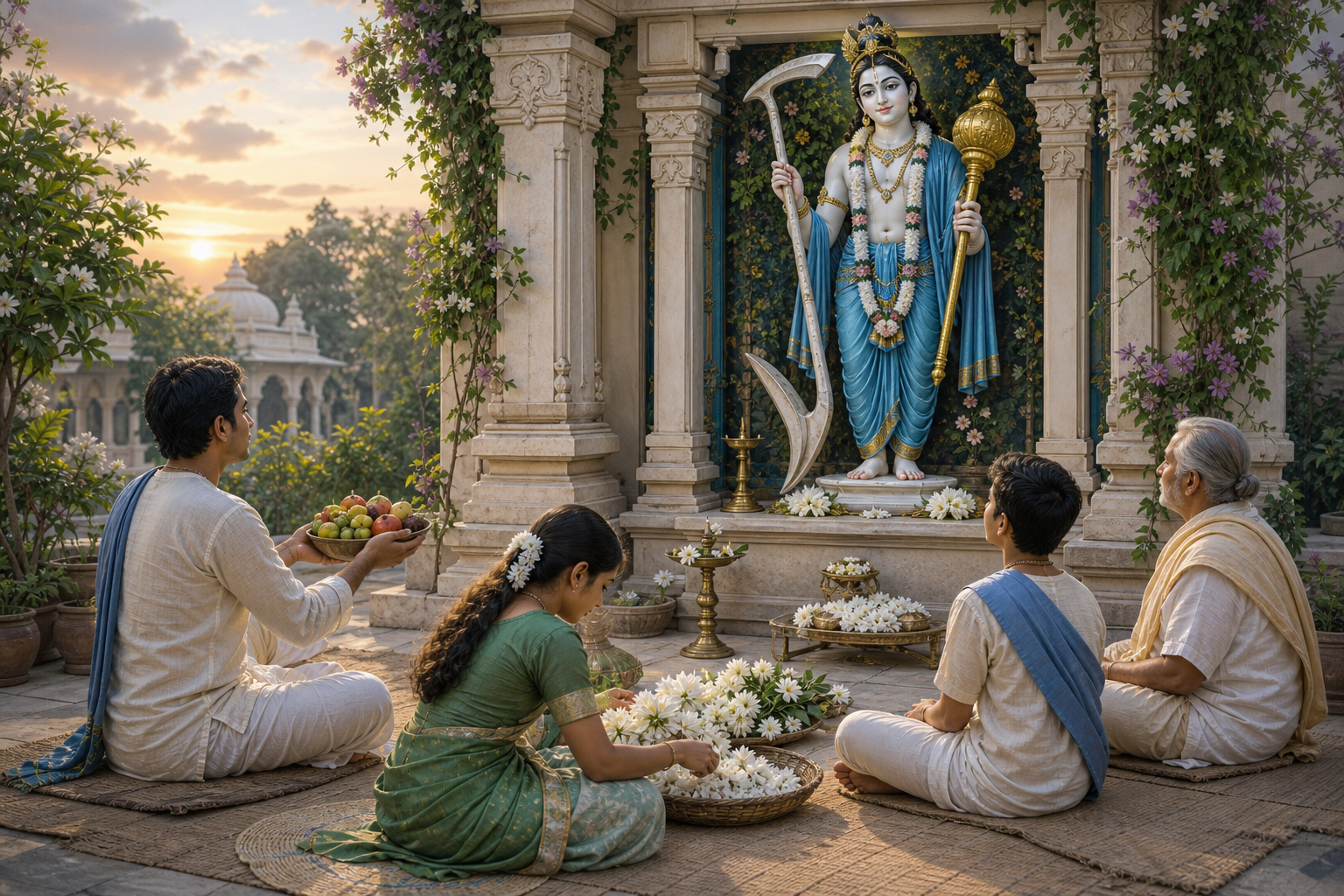
For personal practice, you can address him simply as Balarama or Baladeva and pray for strength to serve truthfully, keep a duty, protect someone entrusted to you, or remove an obstruction in your own conduct. Do not invent an esoteric mantra or initiation for yourself. If you belong to a lineage, follow its authorized mantra, ritual form and guidance. If you are visiting a temple, follow the temple’s customary worship rather than importing practices from an unrelated tradition.
You can also make the symbolism concrete. Choose one neglected responsibility that requires steady effort rather than display. Complete it without seeking recognition. This is not a substitute for formal sadhana, but it helps you understand why Balarama’s strength is inseparable from service. The plough prepares the field before anyone celebrates the harvest.
Key takeaways
- Balarama is Krishna’s elder brother within the lila and a fully divine manifestation within Vaishnava theology; one truth should not be used to erase the other.
- Gaudiya Vaishnavism describes him more precisely as Krishna’s first plenary expansion and the original spiritual master, while other Vaishnava frameworks may use different formulations.
- His association with Sankarshana and Adi Sesha must be explained from a stated theological standpoint rather than compressed into a supposedly universal formula.
- The plough and mace represent strength directed toward cultivation, protection, correction and service, not domination for its own sake.
- Read a complete pastime, including its consequences and restoration, before drawing an ethical lesson from its most dramatic act.
- The most practical prayer to Balarama is for the strength to carry dharma and serve without making yourself the center.
The next time you stand before Balarama or hear his name, do not ask only what he can uproot. Ask what rightful responsibility you have lacked the strength to carry. Then take up one part of it steadily. That is a small but honest way to let Balarama’s sacred identity change how you understand power.
References
- Dandavats – Glorification of Lord Balarama || His Holiness Bhakti Dhira Damodara Swami Maharaj || 28-08-2026
- Dandavats – Balarama-katha | HH Candramauli Swami | ISKCON Ljubljana Live
