
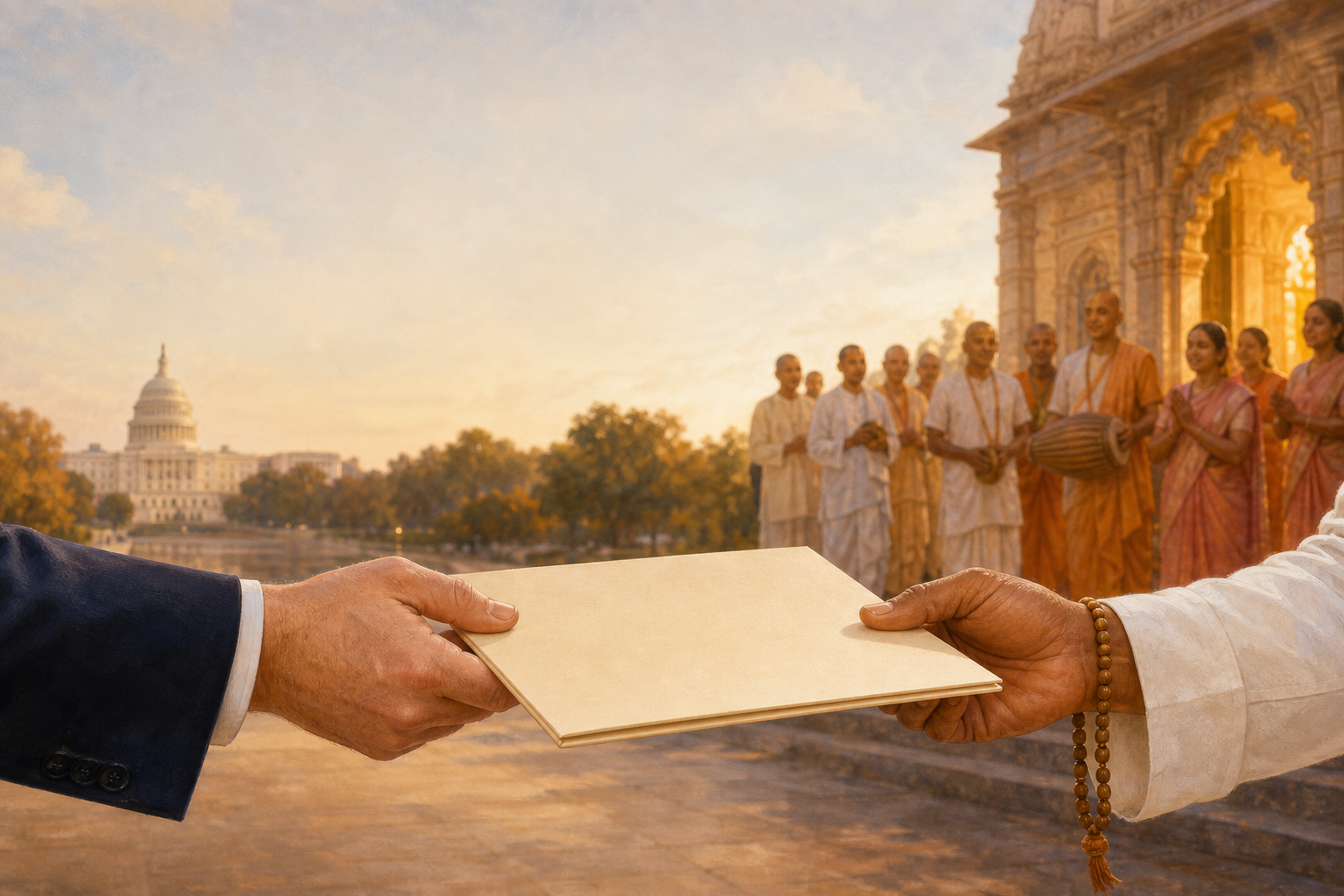
If you saw ISKCON’s 60th-anniversary greeting described as congressional recognition, you may be wondering whether Congress passed a formal measure. That distinction matters. Overstating the event would weaken a genuine moment of civic recognition for the Hare Krishna movement.
The accurate account is both narrower and more useful: a sitting U.S. representative congratulated ISKCON, identified its six-decade milestone, and connected the occasion to a temple he knew in Detroit. Here is what you can safely say about the greeting, why its local character matters, and how devotees and temples can build on it without turning it into something it was not.
Key takeaways
- U.S. Representative Shri Thanedar, who represents Michigan’s 13th District, publicly congratulated ISKCON on its 60th anniversary.
- Thanedar also recalled his association with the ISKCON temple in Detroit, giving the message a specific local and personal context.
- A greeting from a member of Congress is meaningful congressional recognition, but it is not automatically an act adopted by the House of Representatives or Congress as a whole.
- The safest wording is that Congressman Shri Thanedar congratulated ISKCON. Do not substitute claims about a congressional resolution unless such a measure is separately documented.
- Temples can use the occasion to deepen nonpartisan civic relationships, preserve their local history, and explain Krishna bhakti to a wider public.
Use the precise claim: a congressman recognized the milestone

The central fact is straightforward: U.S. Representative Shri Thanedar of Michigan’s 13th District congratulated ISKCON on its 60th anniversary and recalled his association with its Detroit temple.
That is recognition from a member of Congress. His elected office gives the message public and civic significance. It shows that an American federal legislator considered the anniversary worthy of acknowledgment.
It does not, by itself, establish that the House of Representatives voted on a resolution, that both chambers acted, or that the federal government formally endorsed ISKCON. A member’s greeting and an institutional act of Congress are different things. Unless you can produce a separately documented congressional measure, keep those claims separate.
A reliable sentence for a temple newsletter, social post, event introduction, or community archive is: U.S. Congressman Shri Thanedar congratulated ISKCON on its 60th anniversary and recalled his association with the ISKCON temple in Detroit. That wording communicates the full significance of the event without inflating it.
Be especially careful with headlines. “Congressman recognizes ISKCON anniversary” accurately identifies the speaker. “Congress recognizes ISKCON” implies action by the institution and requires additional proof. One word changes the constitutional and civic meaning of the claim.
The Detroit connection gives the greeting its real weight
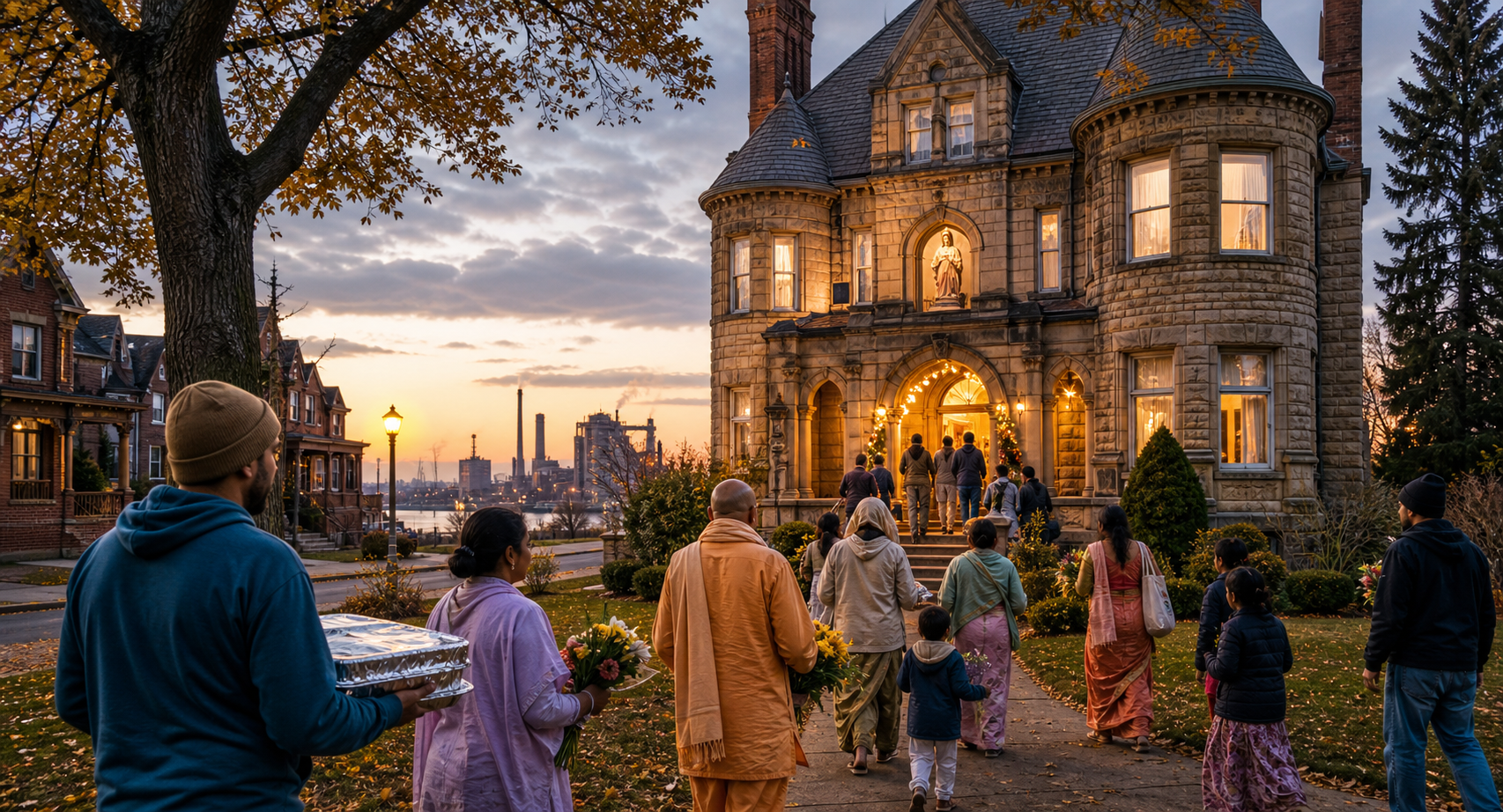
The most consequential part of Thanedar’s message is not his title alone. It is his recollection of an association with the Detroit temple. That detail moves the greeting beyond a generic anniversary formula and places ISKCON within the civic memory of an American city.
This is how a global Dharmic movement becomes publicly intelligible: through a particular mandir, congregation, festival, kirtan, class, or relationship that a neighbour can identify. ISKCON may be international, but most people encounter it locally. The temple is where an unfamiliar Sanskrit name becomes a known community presence.
For devotees, this offers a practical measure of successful cultural outreach. Do not count only how many prominent people send greetings. Notice whether a public representative can name the temple, connect it to a place, and recall an actual association with it. Specific recognition usually rests on a relationship; generic recognition may disappear as soon as the anniversary ends.
The lesson is not that temples should chase political approval. Krishna bhakti does not acquire spiritual authority from an elected official. The civic value lies elsewhere: a representative’s familiarity signals that the temple is visible enough to enter public conversation as a durable religious institution.
What a 60th-anniversary greeting can and cannot signify
Six decades are long enough for an institution to be encountered by more than one generation. A public anniversary greeting can therefore mark continuity, social presence, and the endurance of the mission associated with A.C. Bhaktivedanta Swami Prabhupada. For devotees, that naturally carries a deeper devotional meaning connected with guru, Krishna, sankirtana, and the transmission of bhakti.
The public meaning is more limited. Thanedar’s greeting does not amount to a governmental judgment on ISKCON’s theology, internal history, leadership, or every action taken in its name. Nor should it be treated as federal validation of Hinduism or Gaudiya Vaishnavism. An anniversary message acknowledges a milestone; it does not settle every question about the organization being congratulated.
Keeping those levels distinct protects both sides. The congressman can recognize a religious community’s presence without becoming its theological spokesman. ISKCON can welcome civic respect without implying that bhakti depends on state approval. That is a healthier relationship between religious life and public office than either exaggeration or suspicion.
For a Dharmic audience, the right response is neither to dismiss the greeting as merely symbolic nor to treat it as a national political breakthrough. Symbolic recognition matters when it records a real relationship. Its value grows when the community converts that relationship into clearer public understanding and steady civic conduct.
Turn the greeting into durable, nonpartisan civic work

If you serve a temple, congregation, youth group, cultural association, or communications team, the anniversary gives you several concrete next steps.
- Preserve the exact record. Save the public link, the speaker’s name, his office, his district, the anniversary being marked, and the Detroit reference. Future community histories become unreliable when a congratulatory message is remembered only through embellished social-media captions.
- Separate fact from interpretation. State first that Thanedar congratulated ISKCON and recalled the Detroit temple. You may then explain why you regard that as evidence of civic visibility, but do not turn your interpretation into a claim that Congress passed a measure.
- Tell the local story. When sharing the greeting, explain why the Detroit temple matters to the community. Use documented names, events, dates, and service activities available in your own records. A local account gives readers something more substantial than a politician’s title.
- Keep the relationship nonpartisan. Thank an official for respectful recognition without making the temple an electoral vehicle. Offer the same basic hospitality and clear information to public representatives across party lines.
- Make the next encounter educational. Be ready to explain that ISKCON is rooted in Krishna bhakti, that the temple is a place of worship, and that practices such as kirtan belong to a living devotional tradition. Use plain language before specialized vocabulary.
- Measure what follows. The useful question is not how widely the greeting circulates for one week. Ask whether it leads to a temple visit, a better-informed civic contact, a preserved oral history, or a clearer public explanation of the tradition.
You can also apply a quick accuracy test before publishing any caption: Does it say “Congressman Shri Thanedar” rather than “Congress”? Does it identify the 60th anniversary? Does it retain the Detroit connection? Does it call the message a greeting or congratulations rather than a resolution? If all four answers are yes, the reader will understand the event without being misled.
Share the recognition with gratitude and precision. Then use it as an opening: preserve the local history, welcome civic visitors without partisanship, and explain Krishna bhakti clearly. That work will give the 60th-anniversary greeting a life beyond the congratulatory moment.
References
- Dandavats – US Congressman Shri Thanedar congratulates ISKCON on the 60th Anniverrsary
- Dandavats – US Congressman greets ISKCON on its 60th Anniversary
