

If you are planning a Ganesha pilgrimage in Maharashtra, the hardest decision is not which shrine to visit first. It is deciding what kind of darshan you seek: Ganesha encountered in distinct temple murtis, through a festival sequence of forms, or through a saint whose life is understood as an expression of Ganesha’s presence.
These paths belong together, but they are not interchangeable. A coherent journey gives each its proper discipline: careful attention at the Ashtavinayak temples, continuity during nine-form festival worship, and reverence for Sant Gajanan Maharaj at Shegaon. Once you understand those differences, you can plan a yatra that is spiritually purposeful rather than merely crowded with destinations.
Three ways of approaching Ganesha in Maharashtra
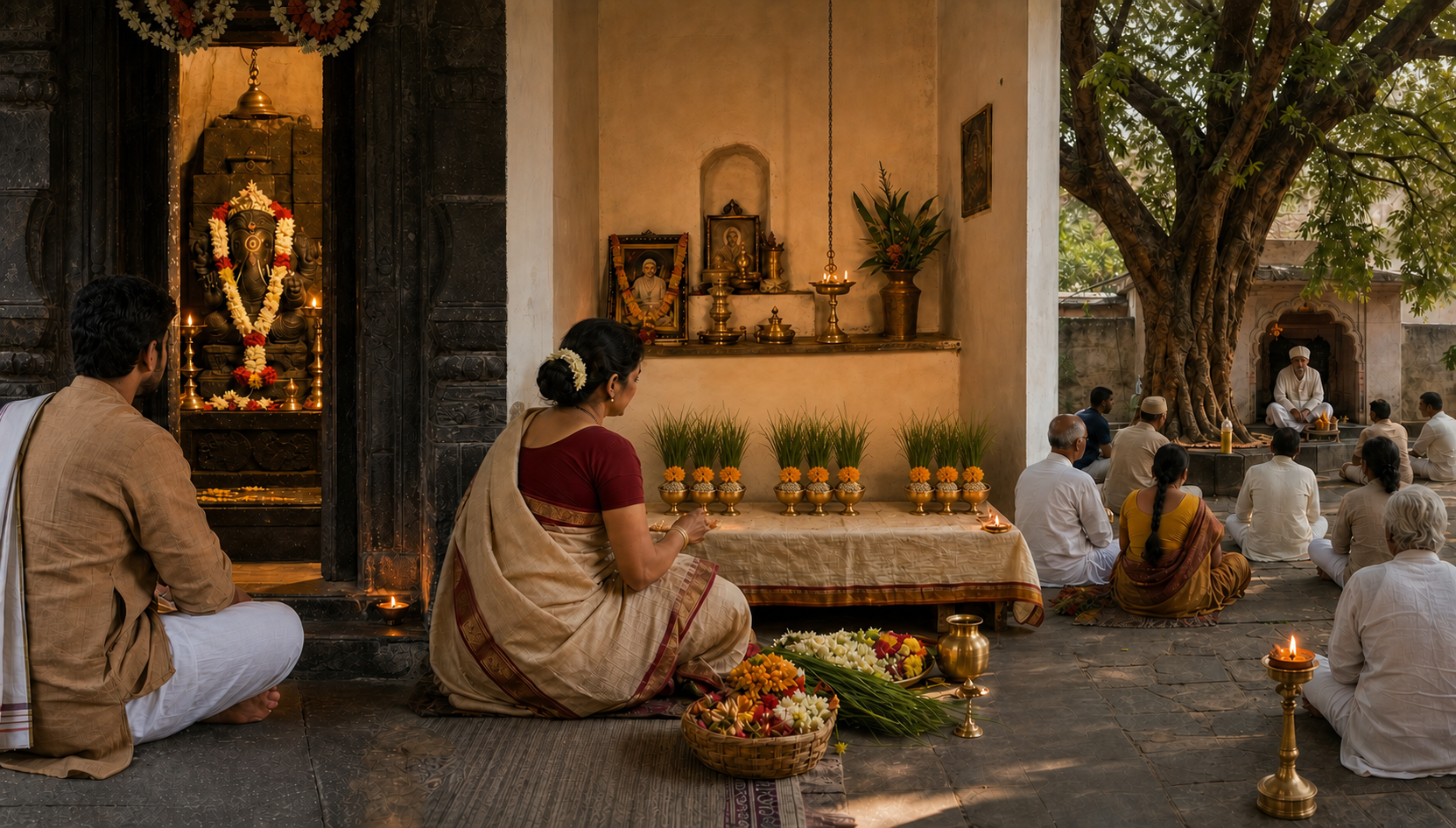
Hindu worship does not require one form of the divine to cancel another. Form focuses attention. A particular murti, a sequence of festival forms, and a saintly life can each reveal a different dimension of devotion. Your first planning task is therefore to identify which devotional frame belongs to each part of the journey.
| Devotional frame | Where or when you encounter it | What it asks you to do |
|---|---|---|
| Temple forms | The Ashtavinayak pilgrimage joins eight ancient Ganapati temples in and around Pune, each associated with a distinct idol form. | Complete the sacred geography while giving unhurried attention to the form at each temple. |
| Festival forms | One Ganesh Chaturthi Navaratri practice worships nine forms of Ganesha over nine days. | Follow one coherent daily sequence rather than treating the nine forms as another travel checklist. |
| Saintly presence | Sant Gajanan Maharaj is associated with Shegaon and is regarded as an incarnation of Lord Ganesha. | Approach Shegaon through the saint’s life, remembrance, and living tradition rather than counting it as an additional Ashtavinayak shrine. |
The practical rule is simple: do not rank these three frames against one another. The eight temples form a sacred landscape. The nine forms provide a rhythm of worship. Gajanan Maharaj belongs to a saint tradition rooted in Shegaon. Asking which one is the only “real” encounter with Ganesha misses the work that each form performs in the devotee.
Let each Ashtavinayak form change the way you look
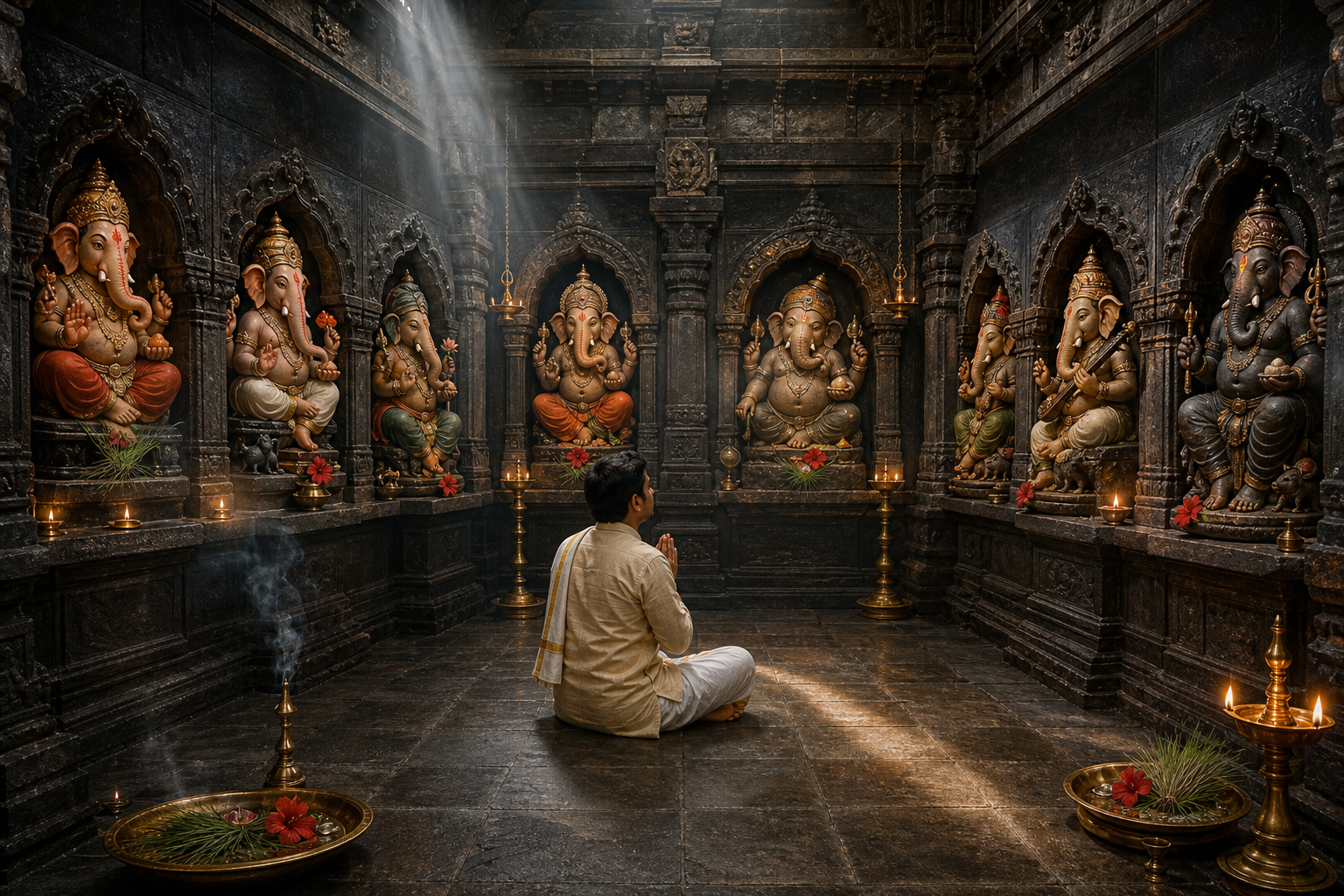
Ashtavinayak means “eight Ganeshas,” but the number alone is not the point. The temples preserve eight distinct forms, with differences that include the form of the trunk. Those differences train the eye to stop treating every Ganesha murti as a generic image.
At each temple, use the same five-part discipline:
- Pause before comparing the murti with one you have already seen. Let this form make its own first impression.
- Notice one concrete feature, beginning with the trunk and any other distinction clearly visible to you.
- Learn the form’s name and meaning from the temple’s own tradition. Do not impose a symbolism gathered from an unattributed list.
- Recall the sankalpa with which you began the yatra. Ask how this darshan changes your understanding of the obstacle, duty, or transition before you.
- After leaving the immediate darshan area, write one sentence about what you noticed. Keep interpretation separate from simple observation.
That final distinction matters. “The trunk appeared in this form” is an observation. “Therefore every murti with this trunk must have the same meaning” is an interpretation, and it may ignore local theology. Do not build a universal hierarchy from trunk direction or another visual feature alone. Ask what the form means in that shrine.
An eight-row notebook is enough for the whole circuit. Give each row four fields: the temple or local form, the first feature you noticed, the teaching you received, and the sankalpa you carried forward. By the eighth visit, you will have a record of inner movement rather than a collection of repeated photographs.
Use the nine-day sequence as sadhana, not a second itinerary
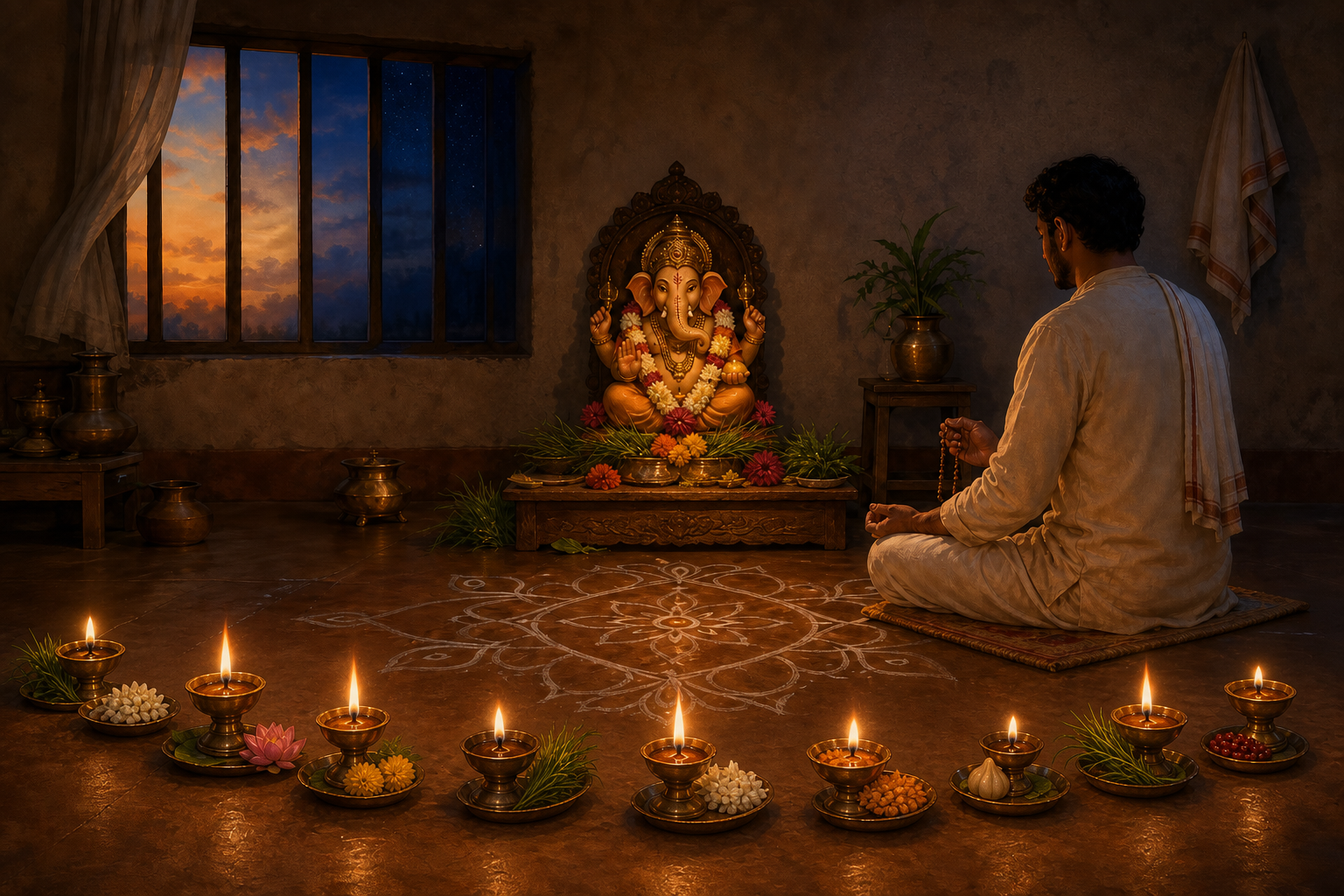
The nine forms belong to a different devotional grammar. Their worship unfolds over nine days of Ganesh Chaturthi Navaratri, with the practice associated with the Ganesha Purana, Mudgala Purana, and Matsya Purana. The value lies in sustained attention: you return each day, encounter a form, and allow the sequence to shape the whole observance.
If your family, guru, or temple gives you a paddhati, let that instruction govern the sequence. Avoid combining names, mantras, and ritual directions from several unrelated lists merely to fill nine slots. A consistent practice received from one trusted tradition is more useful than an elaborate compilation whose lineage you cannot identify.
You can prepare the observance without inventing ritual details:
- Obtain the complete nine-day sequence from the family or temple tradition you intend to follow before the observance begins.
- Set aside one notebook page for each day and write the prescribed form’s name at the top.
- Keep a stable time and place for daily worship as far as your circumstances permit.
- After the prescribed worship, note one quality or teaching you are carrying into that day’s conduct.
- On the ninth day, read all nine entries together and identify the one change that should continue after the festival.
This keeps the nine forms from becoming a memory exercise. Their purpose in your practice is not satisfied by being able to recite a list. The sequence should alter how you meet work, family duty, uncertainty, and obstruction across the nine days.
Plan Ashtavinayak as one vow across eight temples
The phrase Ashtavinayak Yatra refers to pilgrimage to the eight holy Ganapati temples in and around Pune. That gives the journey a built-in integrity: all eight temples matter. If your available time permits only some of them, describe what you are doing honestly as a visit to selected Ashtavinayak temples, then return for the full yatra when you can honour the complete circuit.
Plan the journey in this order:
- Write a one-sentence sankalpa before drawing the route. A journey organised around an intention is less likely to become a race between stops.
- List all eight temples on a trip sheet. Keep this logistical sheet separate from the devotional notebook you will use during darshan.
- Verify current darshan hours, festival changes, access conditions, transport, lodging, and any needs of elders or children close to departure. Operational details can change; devotional enthusiasm does not replace current information.
- Build enough margin into the route for worship, meals, rest, and delays. If the schedule requires you to rush every darshan, revise the schedule rather than treating prayer as the expendable part.
- At each temple, repeat the same observation practice. Consistency will make the distinct forms easier to notice.
- After the eighth temple, give the yatra a deliberate ending: read your eight notes, return to the original sankalpa, and choose one practice to carry home.
This distinction between trip sheet and yatra notebook is more useful than it may sound. The trip sheet answers where you must be and when. The notebook answers why you came. Mixing them tends to leave you with pages of timings and no record of the darshan itself.
Place Shegaon in the journey without turning a saint into a stop
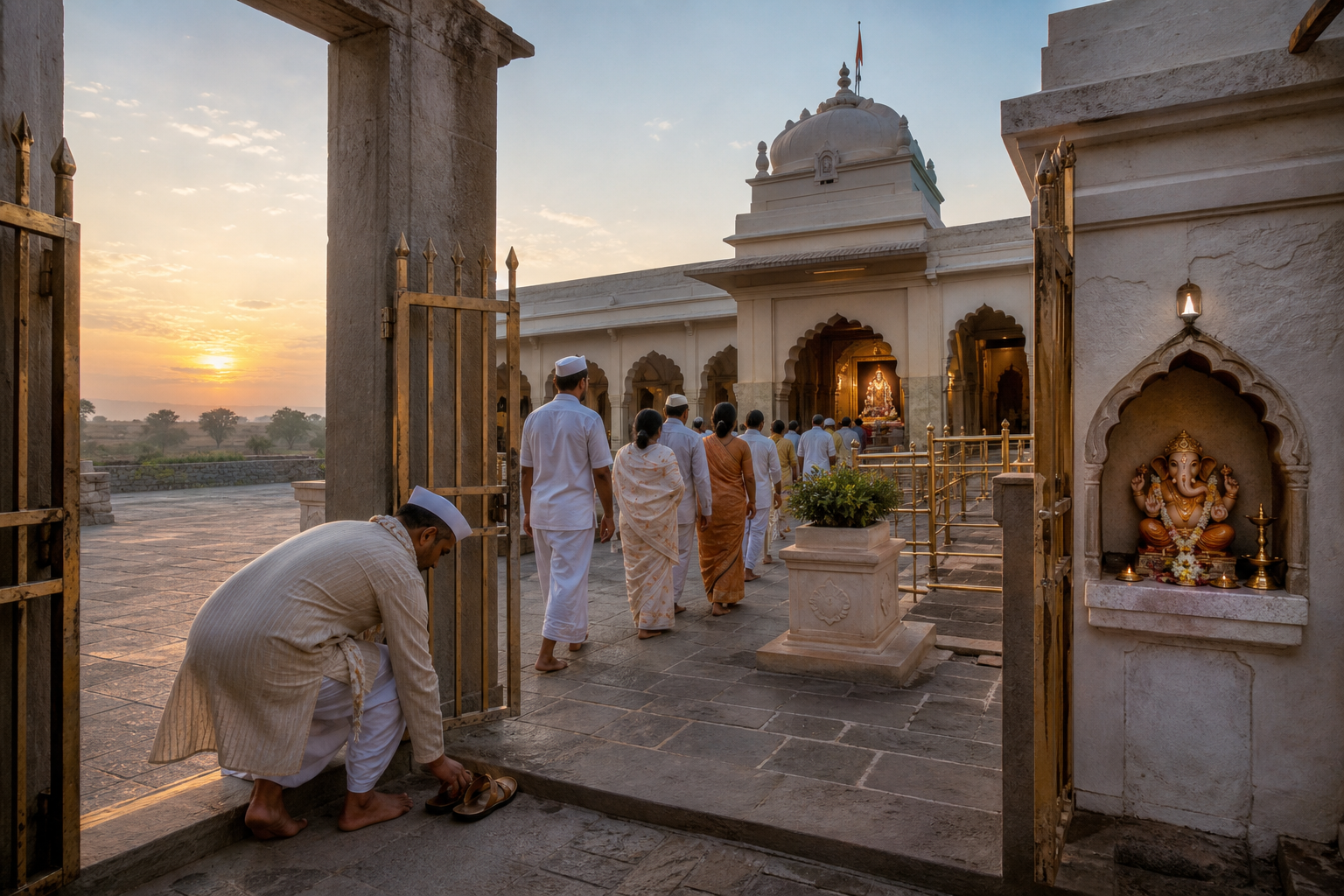
Gajanan Maharaj should not be counted as a ninth member of the Ashtavinayak circuit. His place in this wider Ganesha journey comes through a different relationship: the Maharashtrian saint first appeared at Shegaon in the form of a young man and came to be regarded as an incarnation of Lord Ganesha. Shegaon therefore extends your understanding of Ganesha devotion from sacred murtis and geography into the remembrance of a guru.
Decide whether to include Shegaon by asking what you want the journey to hold:
- Add Shegaon to a broader Maharashtra pilgrimage if you want to contemplate how devotion moves between temple form, disciplined practice, and reverence for a saint.
- Make Shegaon a separate pilgrimage if Gajanan Maharaj’s life and tradition are your main focus. This gives the saint more than the hurried attention left over after a demanding circuit.
- Centre the visit on the commemorative observance if that is your specific sankalpa. Gajanan Maharaj Punyatithi falls on September 15 in 2026; verify the local programme and access arrangements before travelling.
At Shegaon, replace the eight-temple observation grid with three questions: What aspect of the saint’s life draws devotees to recognise Ganesha in him? How is his presence remembered in local worship? What discipline, teaching, or devotional attitude will you take home? You do not need to force the answers before arriving. The questions simply keep the visit oriented toward the saint rather than toward completing another entry on an itinerary.
Key takeaways for your Maharashtra yatra
- Treat the Ashtavinayak temples, the nine festival forms, and Gajanan Maharaj as related but distinct modes of Ganesha devotion.
- Approach Ashtavinayak as one pilgrimage across eight ancient temples, not as eight interchangeable photo stops.
- Notice each murti’s distinct form, including the trunk, but learn its meaning from the local temple tradition instead of imposing a universal ranking.
- Follow the nine forms as a continuous nine-day sadhana using one trusted paddhati.
- Keep Shegaon within the saint tradition. Do not relabel Gajanan Maharaj as another Ashtavinayak form.
- For a 2026 Punyatithi visit, plan around September 15 and confirm current local arrangements before departure.
Before you reserve transport, finish one sentence: “This yatra is for…” Let that answer determine whether you begin with the eight-temple circuit, a nine-day observance, Shegaon, or a carefully paced combination. The pilgrimage begins when your intention starts governing the route.
References
- Hindu Pad — Ashtavinayak Temples near Pune: Eight Holy Ganesh Temples in Maharashtra
- Hindu Pad — 9 Days of Ganesh Chaturthi Navaratri: 9 Forms of Ganesha Pooja
- Hindu Pad — Gajanan Maharaj Punya Tithi 2026
