
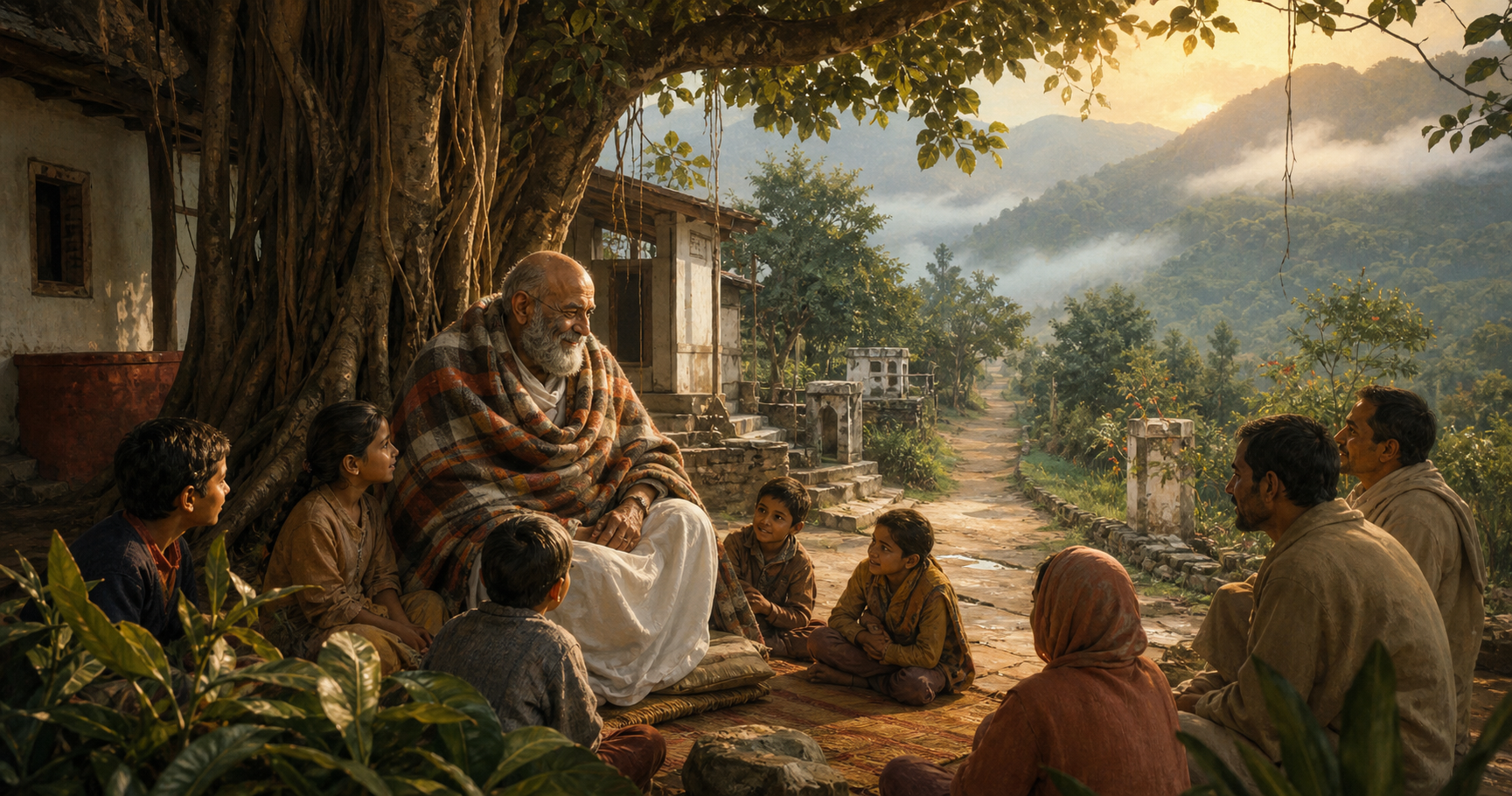
If you are deciding whether Hanuman Ansh is worth watching, the answer depends on what you want a saint’s biography to do. Watch it if you want a sincere, contemplative portrait shaped by bhakti. If you want a detached investigation, competing testimonies, or a complete historical chronology, its chosen mode is unlikely to satisfy you.
Directed by Vishal Chaturvedi, the film follows Neem Karoli Baba from a young boy who leaves home seeking Sri Rama to a revered, simple-hearted saint. That movement supplies the biography, but the continuity beneath it supplies the meaning: outwardly, the seeker becomes a figure loved by countless devotees; inwardly, devotion remains the governing center.
Key takeaways
- Hanuman Ansh is a devotional biography of Neem Karoli Baba, not a mythological action film about Hanuman.
- Its central question is not how a man acquired prominence, but how a life directed toward Sri Rama became recognizable as saintly.
- A conversation between a devotee and questioning children turns the biography into an act of intergenerational transmission.
- Natural landscapes, village dwellings, lakes, and music create a quiet emotional register suited to the subject.
- Devotees, families, and viewers interested in bhakti will find the clearest point of entry; anyone seeking exhaustive documentary history should treat it as a doorway rather than a final record.
The film judges a life by the direction of its love
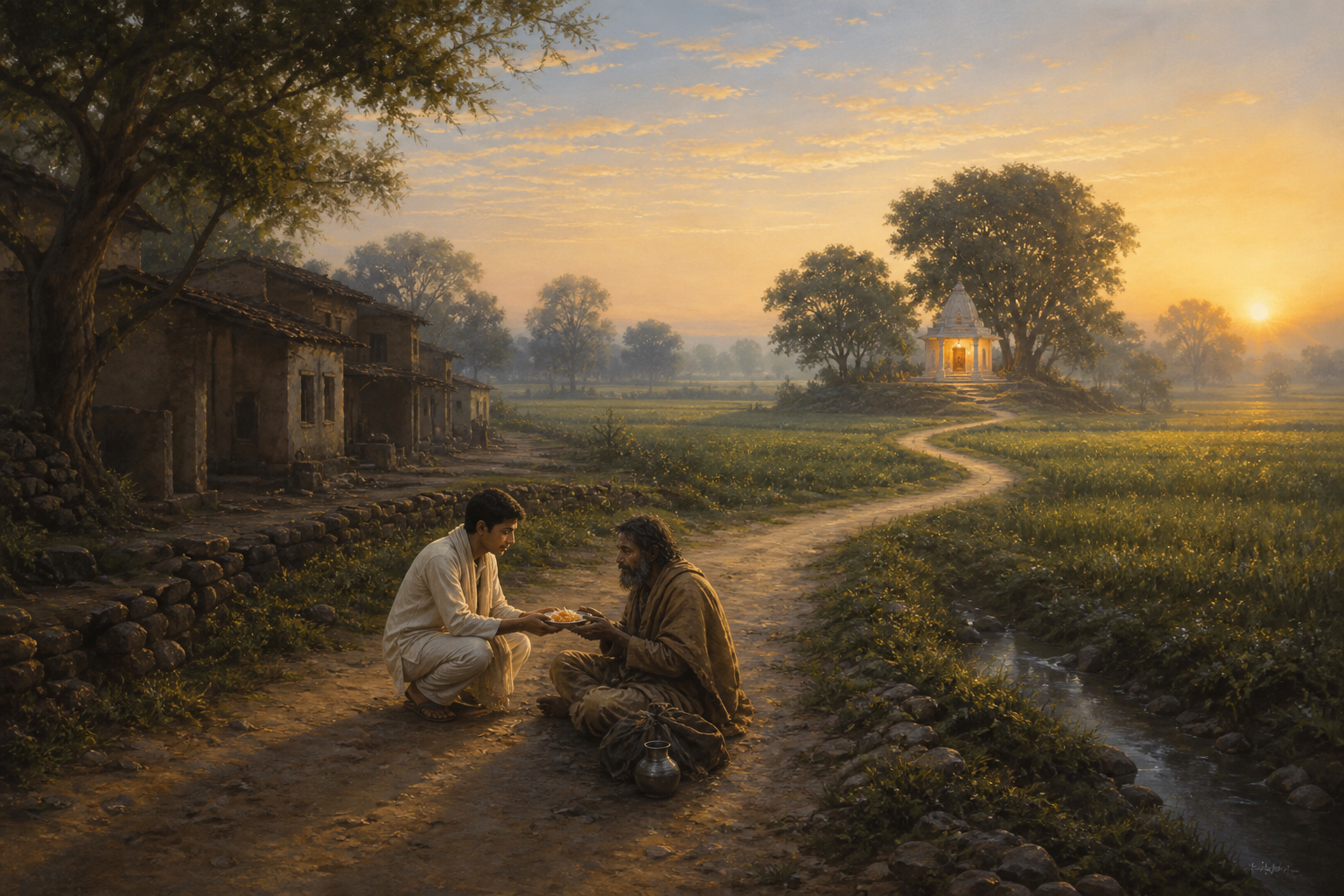
The Narada Bhakti Sutra 1.2 describes bhakti as supreme love directed toward Bhagavan. That definition provides a useful way to understand what Hanuman Ansh is trying to show. The decisive fact in Baba’s early life is not merely that he leaves home. It is that he leaves in search of Sri Rama. The destination gives the departure its spiritual character.
This distinction matters because saintly biographies can easily become catalogues of exceptional incidents. A viewer is shown extraordinary events and expected to infer holiness from them. Hanuman Ansh takes a more coherent route: it places the seeker’s orientation toward Rama at the beginning and asks you to understand the later saint through that original direction of love.
As you watch, compare what changes with what remains. The young seeker eventually becomes a revered Baba, yet simplicity continues to define him. Public recognition is therefore not presented as the culmination of the life. It is almost a test of the inner disposition established earlier: can a person become precious to many without making himself the center?
That is also why the word “devotional” should not be used as faint praise. It identifies the film’s contract with you. The narrative accepts Baba as a saintly presence and tries to make the bhava surrounding him intelligible. It does not stand outside that devotion and cross-examine it. Within that chosen register, sincerity is more important than dramatic suspicion.
This is a strength, but also a boundary. A remembrance-centered film should not be mistaken for an exhaustive historical record. If your questions concern precise chronology, institutional development, or conflicting recollections, you will need material constructed for those purposes. The right critical question here is narrower: does the film help you understand why this life carries spiritual meaning for devotees? Its biographical arc gives that question a clear and persuasive answer.
The conversation with children is the film’s real structure
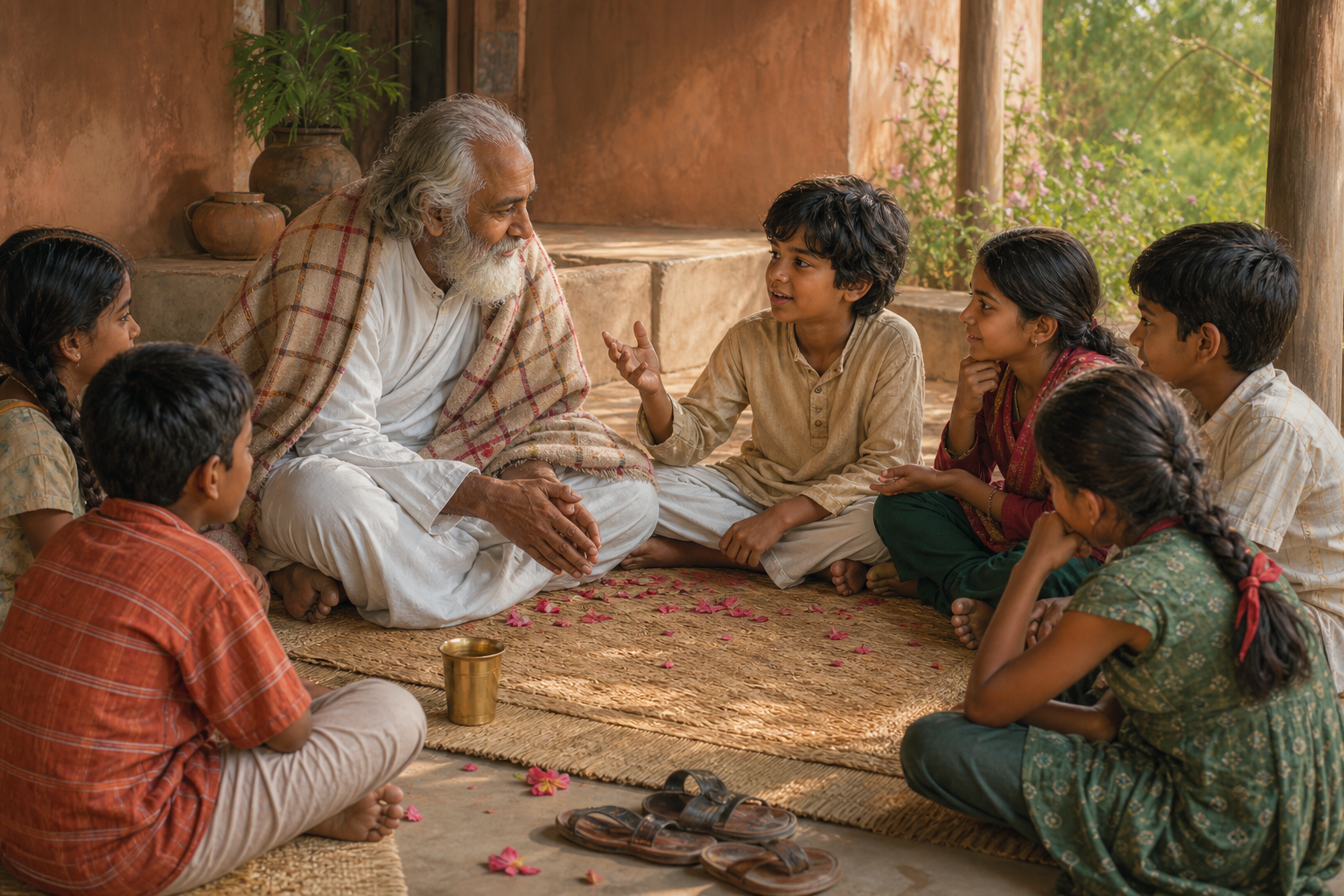
The life story unfolds through a conversation between a devotee and children full of questions about Baba. This is more than a convenient way to deliver information. It places the viewer inside one of the central problems facing every living tradition: how does spiritual memory cross from one generation to the next without becoming a dead recital?
The children matter because they do not begin with the devotee’s assumptions. Their questions create the opening through which the story must pass. The devotee, meanwhile, represents memory shaped by affection and shraddha. You sit between those positions: able to receive the remembrance, but also invited to ask what makes it worthy of being carried forward.
This framing suits a Dharmic account of a saint particularly well. Parampara is not maintained merely by preserving names and dates. It survives when one generation can communicate the meaning of a life to another. Facts establish who lived; bhava helps explain why the life still matters. Hanuman Ansh makes that transmission part of the drama rather than leaving it outside the screen.
If you watch with younger members of your family, resist the urge to explain everything before the film begins. Let the children’s questions in the narrative do their work. Afterward, use three questions to turn viewing into reflection:
- What is the difference between leaving something behind and leaving in search of Sri Rama?
- What might simplicity require from a person after others begin to revere him?
- Which stories of saints have reached our family, and what would be lost if we did not pass them on?
Those questions keep the discussion anchored in choices, not in vague admiration. They also reveal whether the film has done its deeper work. A saint’s story has entered tradition fully when it helps the listener examine the direction of his or her own life.
Landscape and music keep the spirituality human-scaled
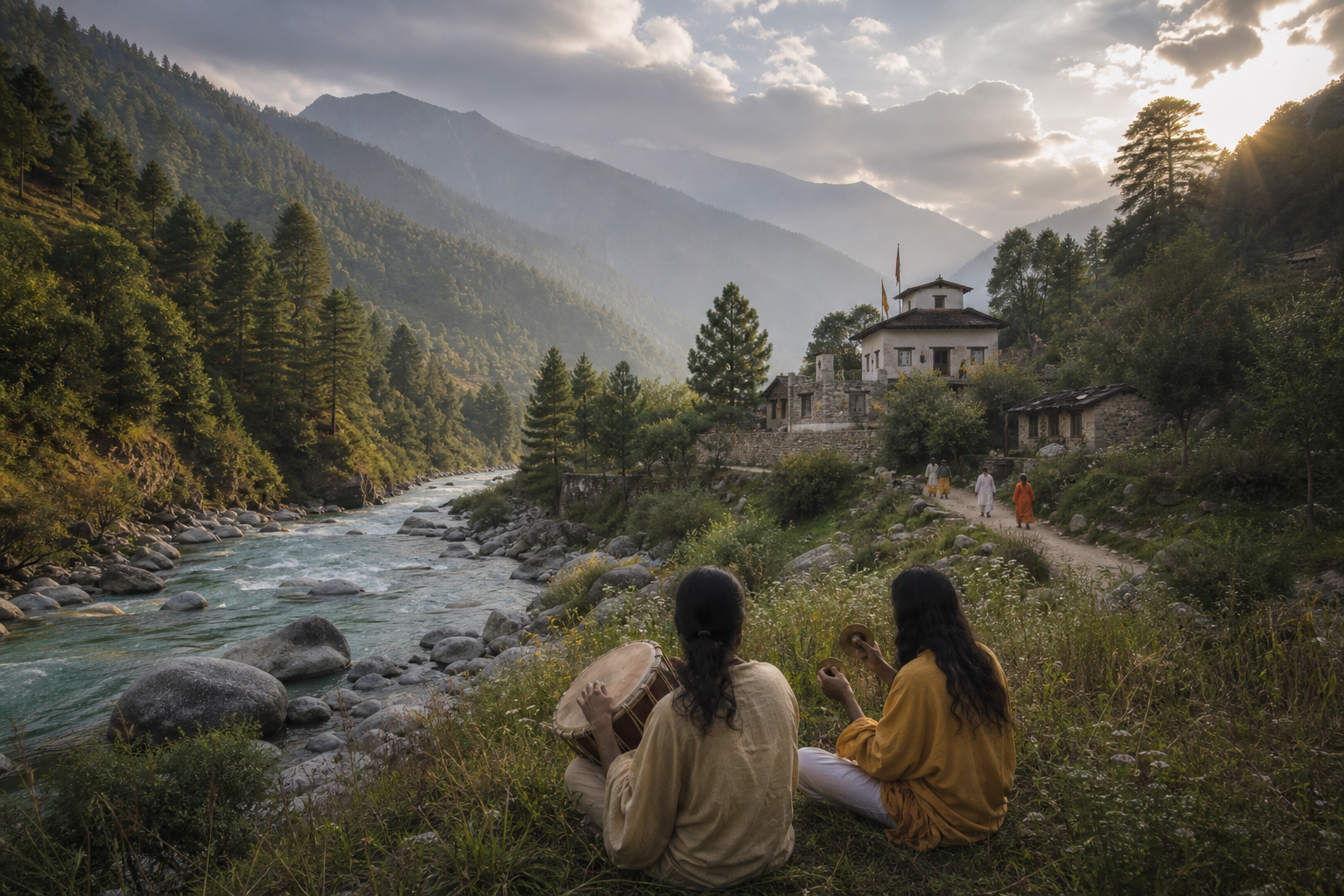
The title Hanuman Ansh may lead some viewers to expect mythological spectacle, combat, or visual effects. That is the wrong expectation. The film centers on Neem Karoli Baba, and its visual world is built from green surroundings, calm lakes, modest village homes, and an emotionally elevating musical score.
Those choices keep the spiritual scale intimate. A humble dwelling can say more about simplicity than an ornate speech. A quiet landscape gives the viewer time to receive a moment instead of rushing toward the next plot point. The natural environment also prevents reverence from becoming grandiosity: Baba’s significance is felt within ordinary places rather than manufactured through visual excess.
The music performs a related task. Devotional cinema does not communicate through propositions alone; rhythm, silence, melody, and image help establish bhava. The score therefore belongs to the film’s spiritual argument. It encourages you to experience the biography as remembrance, not just process it as information.
You can still watch this element critically. Notice when music deepens a moment already earned by the story and when it seems to instruct you what to feel. That is a fairer test than asking whether a devotional film uses emotion at all. Emotion is part of its language; the issue is whether the feeling grows from the life being depicted. Here, the restrained settings and the saint’s simple-hearted characterization give the score an appropriate foundation.
Who should watch Hanuman Ansh
Hanuman Ansh earns a recommendation within its clearly chosen spiritual register. Whether it belongs on your watchlist can be decided by the kind of encounter you are seeking:
- If you are a devotee: expect a portrait that treats bhakti as the organizing truth of Baba’s life. Watch for the connection between seeking Rama, remaining simple, and becoming dear to others.
- If you are new to Neem Karoli Baba: use the film as an introduction to the spiritual shape of his life. Do not expect one devotional narrative to answer every historical question.
- If you are watching with family: the conversation with children offers a natural opening for discussion. That narrative device is not an age rating, so check any formal content guidance separately before choosing it for younger viewers.
- If you study Dharmic culture: pay attention to how the film represents transmission itself. The devotee does not merely recount a biography; he accepts responsibility for carrying spiritual memory forward.
- If you prefer critical documentaries: enter with the right genre expectations. Evaluate whether the film renders devotion truthfully and coherently, while reserving archival and historiographical questions for works designed to investigate them.
The film’s most worthwhile idea is also its simplest: sainthood is not adequately explained by fame, and devotion is not adequately explained by emotion. Both must be read through the steady direction of a life. Hanuman Ansh traces that direction from a boy’s search for Sri Rama to the quiet gravity of a saint remembered with love.
If that is the film you are looking for, watch it without expecting spectacle and leave time for conversation afterward. Carry one question beyond the credits: what would it mean for love of the Divine to become the organizing center of an ordinary life?
References
