
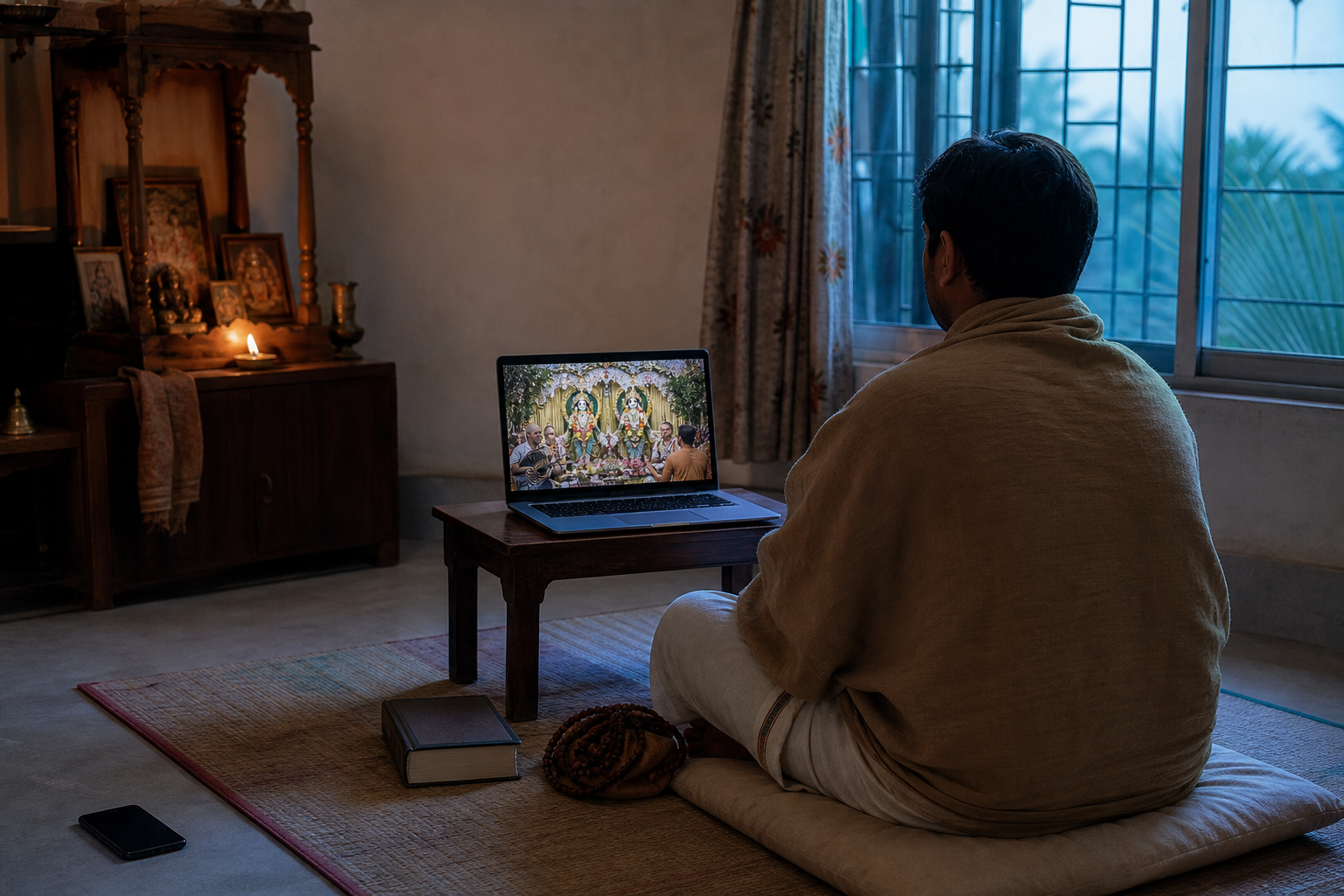
You may open an ISKCON morning broadcast with a sincere intention and still end up half-watching while messages arrive and the day begins. That is not mainly a problem of access. A screen is built for consumption, while worship asks for undivided attention.
On 26 August 2026, you can use a concrete pairing: begin with live darshan and kirtan from Sri Sri Krishna Balaram Mandir in ISKCON Vrindavan, and then turn to the morning SB lecture by Sruta Kirti prabhu. For home participation, that order gives your attention a useful arc: devotional seeing, responsive hearing and singing, and then careful reflection on scripture.
Give each part its proper kind of attention
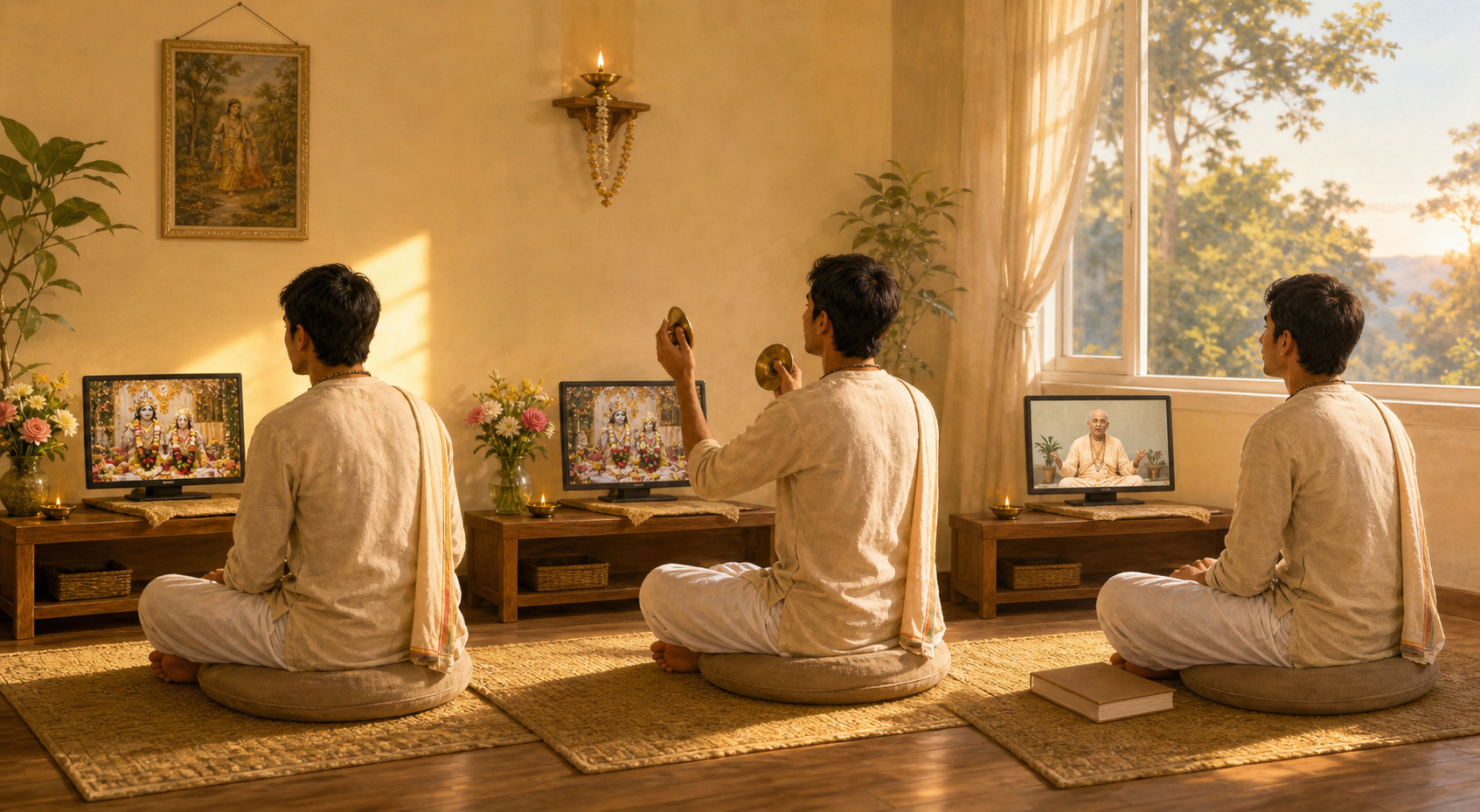
Darshan, kirtan and scriptural discourse can belong within the same devotional morning, but they are not interchangeable forms of content. Each asks something different from you. If you approach all three with the same passive gaze, the broadcast may continue while the practice itself never really begins.
- During darshan: let the Deities remain the center of your attention. Do not turn the camera view into a visual tour or spend the whole period inspecting production details. Sit steadily, look deliberately and allow silence where silence comes naturally.
- During kirtan: let the sound lead. Follow a familiar response aloud or quietly when your surroundings permit. If the response is unfamiliar, listen until its pattern becomes clear instead of filling the space with distracted imitation.
- During the discourse: shift from participation to inquiry. The speaker is no longer background audio. Listen for the main teaching, how it is supported and what it asks you to reconsider.
- At each transition: change your posture of attention. Put down anything you were using during kirtan, open your notebook only when the discourse begins, and notice that a new kind of engagement is being asked of you.
This distinction matters because devotional practice is not improved merely by extending screen time. Darshan can be lost in visual browsing, kirtan in ambient listening and discourse in indiscriminate note-taking. Naming the mode before you begin helps you notice when your attention has slipped into something else.
Set up the room before attention has to negotiate

The decisive part of an online morning often happens before you press play. If alerts remain active, unrelated tabs remain open and ordinary tasks are still competing for your hands, you will have to renegotiate your intention every few moments. Remove those decisions in advance.
- Open the darshan and discourse links before the session starts, then close unrelated pages.
- Place the screen where you can sit comfortably without holding the device. A hand-held phone makes every notification and habitual swipe immediately available.
- Silence alerts rather than trusting yourself to ignore them. Even an unanswered alert has already redirected attention.
- Keep paper and a pen nearby for the discourse. Using the same device for worship, messaging and notes makes it too easy to move between them without noticing.
- Complete small practical tasks first. Water, device power and seating should not become reasons to wander away once you have begun.
Keep the arrangement modest. A home setting does not become devotional through complexity, and you do not need to imitate temple gestures you have not been taught. If your household, guru or devotional community has established instructions, follow them. Otherwise, cleanliness, steadiness and attention are a sound beginning.
An interruption calls for an honest choice. If you are watching a replay, pause it and return when you can listen. If you are participating live, attend to the unavoidable duty and re-enter at the next clear transition. Letting sacred sound continue in an empty room may preserve technical continuity, but it does not preserve your attention.
Hear the discourse in layers, not as a stream of slogans
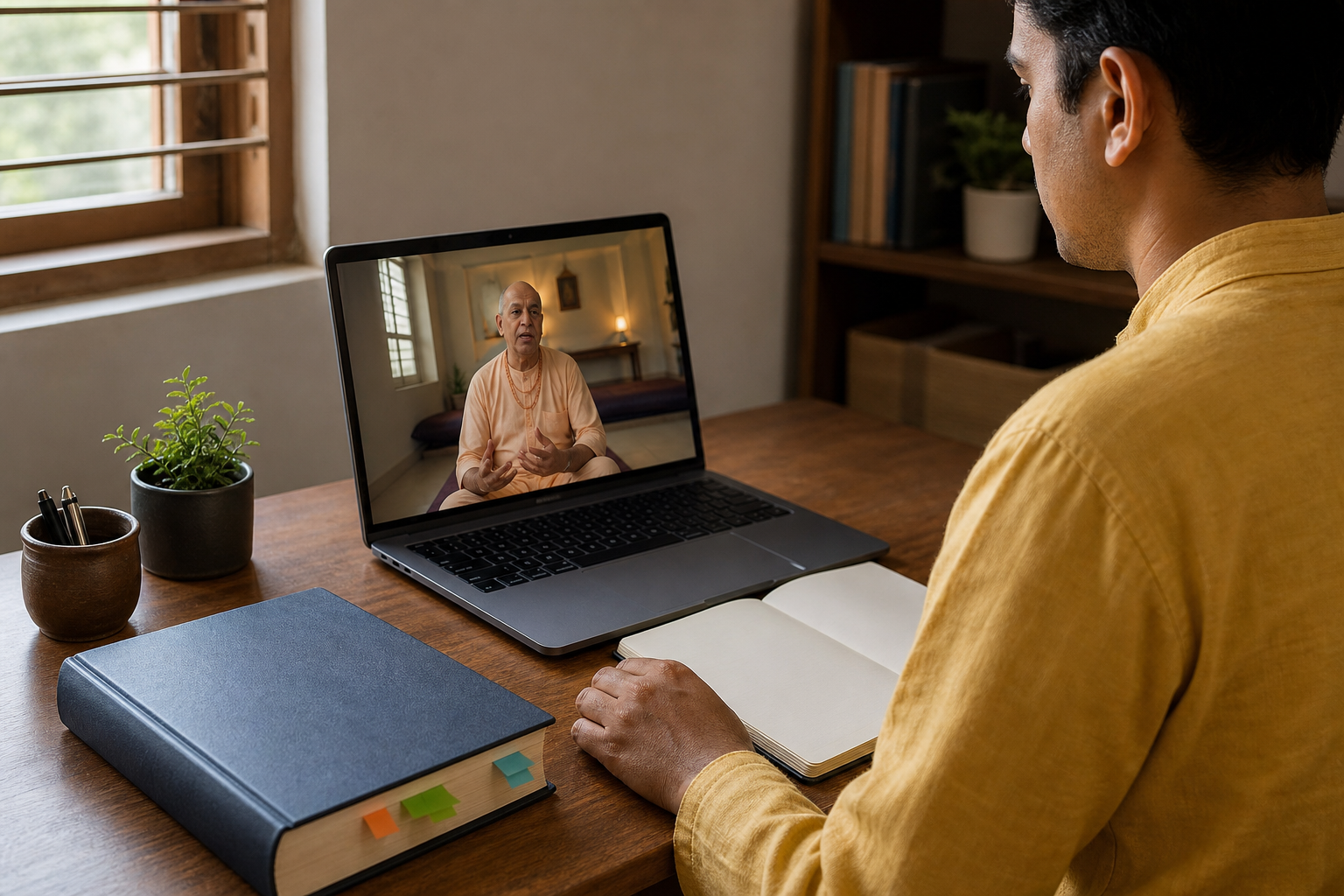
The value of a scripture-focused lecture is not measured by the number of sentences you copy. Notes become useful when they preserve the movement from text to teaching and from teaching to conduct. Use the following structure while hearing the morning SB discourse.
- Passage or theme: identify what is being explained. If you miss a reference, leave a blank or a question mark rather than guessing.
- Main claim: write the central spiritual point in your own plain words. If you cannot state it briefly, keep listening before adding more notes.
- Support: record the reason, example or distinction that carries the claim. This prevents a memorable phrase from being detached from the argument around it.
- Personal resistance: notice what you are tempted to dismiss, soften or apply only to other people. That reaction may reveal where the discourse is actually touching your habits.
- Practical expression: choose an action under your control that can embody the teaching during the day.
Separate what you heard from what you inferred. On the page, label the speaker’s actual point as Heard, your connection as Reflected, and anything that still needs clarification as Unresolved. This small distinction protects you from attributing your own association to the speaker or treating an unfinished thought as settled doctrine.
Do not interrupt the lecture to chase every unfamiliar term. Mark the term, keep listening and return to it afterward. Leaving the line of reasoning to conduct a side search often costs more understanding than the search provides.
Your final application should be observable. A broad intention such as becoming more attentive is difficult to carry into the day. A clearer form is: Today, when [situation] arises, I will [action] because [teaching]. You might pause before a tense reply, complete a neglected act of service or carry an unresolved question into later reading. The point is not to manufacture a dramatic resolution. It is to give the discourse somewhere concrete to live.
Protect the practice from three common distortions
Aesthetic browsing
Temple beauty can command attention, but online viewing easily turns beauty into browsing. You start comparing camera views, flowers, clothing or sound quality, and the object of attention quietly changes. When you notice this happening, return to the devotional act in front of you. See rather than inspect; hear rather than evaluate.
Background devotion
Background listening may have a place during ordinary work, but it should not be confused with a session you deliberately set aside for worship and discourse. The danger is not that your hands moved once. It is that the continuing audio creates the impression of participation after your attention has left. If you have chosen a focused morning session, protect it as such.
Equating access with physical attendance
A camera can give you visual and auditory access, but it cannot reproduce physical presence, shared responses, local etiquette or participation in a temple community. Do not deny that difference, and do not use it as an excuse for casualness. Treat the stream as a doorway to disciplined attention. If you later visit a mandir, observe the community and ask how to participate rather than assuming that the camera taught you everything happening beyond its frame.
Quick answers for joining the morning online
Do I need to know every response in the kirtan?
No. Listen closely until a response becomes familiar, then join as you are able. Participation should grow from attention. Not knowing a melody is not a reason to disengage, and singing over uncertainty is not a substitute for listening.
Is joining live better than watching a replay?
Choose the form in which you can protect your attention. A live broadcast gives you a fixed appointment; a replay gives you control over pauses and interruptions. If replay means indefinite postponement, keep the live appointment. If the live time conflicts with an unavoidable duty, use the replay rather than dividing your attention between both.
What should I do if I miss the beginning?
Begin with the practice currently underway. Settle your body, identify whether you are in darshan, kirtan or discourse, and adopt the corresponding kind of attention. If a recorded version is available, you can return later for a missed part of the teaching. Do not lose the present portion by mentally arguing with the part you missed.
The next time you open the morning broadcast, make one decision before playback: this is worship, not ambient media. Move through darshan, kirtan and discourse with distinct attention, and leave with one action you can carry into the day. That is enough structure to turn online access into a serious morning practice.
References
- Dandavats – Today’s Featured Video: Live Darshan & Kirtan || 26-08-2026
- Dandavats – 26 Aug – Morning SB lecture Sruta Kirti prabhu
