
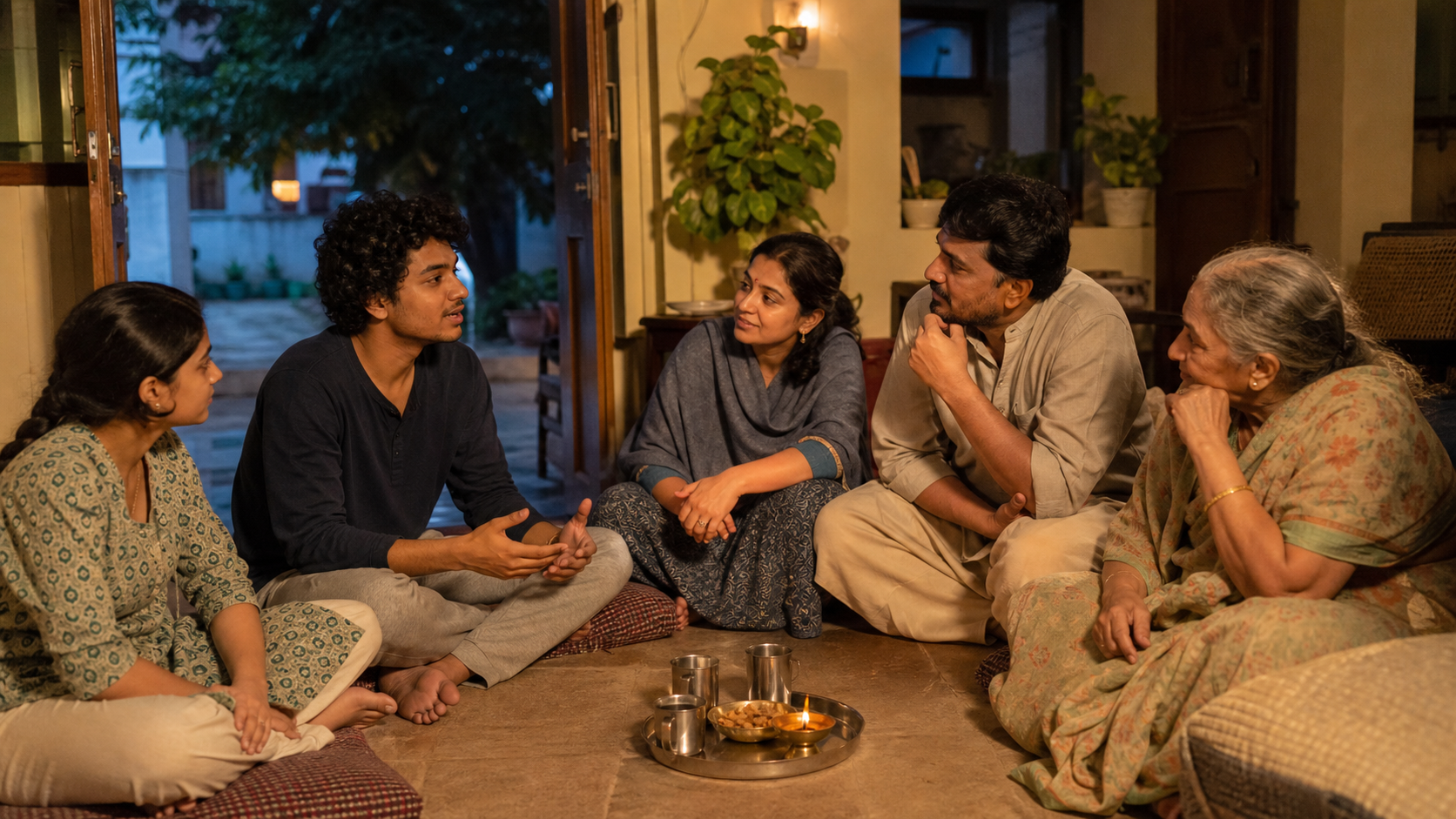
If conversations with your son, daughter, sibling, or younger relative keep collapsing into silence, sarcasm, or a lecture, your first task is not to win back a generation. It is to make the next honest conversation possible.
The practical frame is samvad and kutumb prabodhan. Samvad is dialogue that seeks clarity without sacrificing the relationship. In this context, kutumb prabodhan means the family consciously renewing its understanding and practice of dharma. Used together, they move culture out of the lecture and into lived family life.
Begin with the relationship, not a generational label
Gen Z may be a convenient public label, but it is a poor opening line inside a family. It cannot tell you why a particular young person questions a ritual, avoids the mother tongue, distrusts an institution, or resents a household rule. If you approach that person with a verdict about an entire generation, an ordinary question quickly becomes a loyalty test.
A more useful Dharmic starting point is to see Bharat’s younger people as inheritors of a living civilization rather than a consumer category. Inheritance does not require automatic agreement. It means they deserve access to the reasons, memories, practices, responsibilities, and internal debates that make an inheritance intelligible.
Before raising a difficult subject, replace your diagnosis of the young person with a description of the event. Use this opening sequence:
- Name what happened without assigning a motive. Say that the young person left while an elder was speaking, not that the departure proves a lack of values.
- Ask a focused question. Ask what made the person want to leave, rather than demanding an explanation for everything you dislike.
- Let the answer finish. Do not interrupt at the first word you can rebut.
- Reflect the answer in language the young person accepts. If they correct your summary, try again before defending your position.
The same method works when the disagreement concerns a custom. Instead of declaring that the young person rejects everything Indian, ask which part is difficult: the stated reason, the way the family practices it, the social pressure surrounding it, or the expectation of participation. Those are different problems. Each calls for a different response.
Set rules for disagreement before discussing the most sensitive issue. No one mocks another person’s intelligence, faith, accent, education, or generation. No one shouts over an unfinished answer. Reasons can be requested from elders as well as youth. If the rules break down, pause and agree when the conversation will resume. A pause without a return can feel like avoidance; a scheduled return protects trust.
Respect does not mean that every household boundary disappears. It means that the person remains worth hearing even when the boundary remains. State expectations plainly, explain their purpose, and separate disagreement from contempt.
Make dharma visible before trying to make it persuasive

Kutumb prabodhan is not achieved by increasing the volume or frequency of moral instruction. A household cannot transmit values that appear only in speeches. Young people need to see what a principle changes in the way adults speak, spend, serve, apologize, welcome guests, treat workers, care for elders, and handle conflict.
This is where many families can make an immediate correction. When a young person asks why a practice exists, distinguish among these possible answers:
- It is a teaching found in the family’s scripture or accepted doctrine.
- It is a discipline associated with a particular lineage, sect, or community.
- It is a regional or family custom that carries memory and belonging.
- It is a personal preference held by an elder.
Do not promote a personal preference into an eternal command merely because you fear losing authority. If you do not know which category applies, say that you do not know and undertake to find out. An honest gap in knowledge is easier to repair than a theological explanation invented under pressure.
Hindu, Buddhist, Jain, and Sikh families do not share an identical set of practices, and households within each tradition also differ. The aim is not artificial uniformity. The aim is to help a young person understand what the family does, why it does it, which parts are essential, and which parts can change without abandoning dharma.
A useful way to explain a household practice is: our family follows this because of the value or memory it preserves; this is the part expected while we live together; this is the part open to discussion; and this is what we still need to understand better. Then ask what specifically troubles the young person. That wording combines conviction with intellectual honesty.
Build a recurring family rhythm instead of waiting for a crisis. Depending on your tradition and household, that rhythm might include a shared prayer, meditation, seva, a meal without devices, preparation for a celebration, a visit to a temple, gurdwara, derasar, or vihara, or a conversation with an elder about family history. Keep it modest enough to repeat. Ask what the practice is meant to cultivate, not merely whether everyone performed it correctly.
Connect observance to conduct. If the household speaks of ahimsa but humiliates people, praises self-control but cannot tolerate a question, or venerates truth while concealing its own uncertainty, the contradiction deserves attention. Do not demand that youth ignore it. Correct what should be corrected, and explain why the correction itself is Dharmic.
Use a repeatable samvad process when disagreement begins

Good intentions are not enough when a conversation has an established pattern of escalation. Use a process that every family member can recognize. The goal is not to make every discussion formal. It is to stop anxiety from turning a narrow disagreement into a judgment on the person’s entire character.
- Ask what the exact question or claim is. Do not answer a broader accusation that the young person did not make.
- Ask what kind of response is wanted: listening, an explanation, help making a decision, or a discussion of evidence.
- Let the person explain the issue in full. Questions that sound hostile sometimes contain several concerns that need to be separated.
- Restate the concern. Continue only when the person says your summary is fair.
- Separate the layers: factual claim, moral principle, emotional injury, family expectation, and practical inconvenience.
- Answer the layer that is actually in dispute. Give the strongest reason you genuinely hold, not every argument available to you.
- Name uncertainty and agree on follow-through. You may need to consult a primary text, ask a competent teacher, reconsider a family habit, or return after everyone has calmed down.
Do not bundle theology, politics, grades, screen use, clothing, language, and respect for elders into the same exchange. When several grievances are smuggled into a conversation, the young person cannot answer any of them without appearing to admit all of them. Choose the issue that triggered the discussion and finish that issue first.
If an online video or message sparked the dispute, examine the exact claim together. Ask what evidence supports it, what evidence might change either person’s mind, and whether the creator has relevant knowledge. Apply the same standard to material you share. Samvad becomes propaganda when scrutiny is demanded from only one side.
Suppose a younger relative refuses to join a celebration. Begin by asking whether the objection concerns meaning, fairness, time, a previous hurt, or family pressure. If participation is still expected, state the expectation and its reason. If the real reason is fear of social embarrassment, be honest about that too. Do not disguise social anxiety as a sacred command.
Dialogue does not require false equivalence or endless negotiation. Some convictions and household duties may remain non-negotiable. Say so without pretending that the outcome was open when it was not. The conversation can still clarify the reason for a boundary, the manner in which it will be applied, and the dignity owed to the person who disagrees.
A successful exchange need not end in agreement. It should end with something definite: a disagreement accurately stated, a fact to verify, a practice to reconsider, an apology to make, or a boundary everyone understands. That gives the relationship somewhere to go next.
Let responsibility turn inheritance into belonging

Listening is incomplete if young people remain permanent spectators. Treat them as contributors to family and community life. Give them work that matters and enough discretion to make a real contribution.
- Invite them to record and organize family history. Let them ask an elder why a journey, language, observance, place, teacher, or turning point mattered.
- Give them ownership of part of a celebration or community visit, such as scheduling, accessibility, music, food coordination, invitations, documentation, or explaining the occasion to children.
- Ask them to help choose and carry out a form of seva. Discuss whom it serves, what respectful service requires, and what the family learned afterward.
- Let them bring a difficult question to a competent teacher and report back, including any uncertainty or disagreement they encountered.
- Create an exchange across generations: the younger person can teach a digital skill while learning a family recipe, verse, song, craft, language form, or local history.
Define the desired outcome and any genuine boundaries, then let the young person choose much of the method. Do not seize the task back merely because their style differs from yours. Review the result afterward, ask what they would change, and credit their contribution within the family. Responsibility without discretion feels like unpaid obedience; discretion without responsibility does not build stewardship.
When a question exceeds the family’s knowledge, introduce a trustworthy teacher or elder rooted in the relevant tradition. Before making that introduction, find out whether the person welcomes sincere questions and distinguishes scripture, interpretation, lineage discipline, and local custom. Be cautious of anyone who demands secrecy, isolation from family, unquestioning allegiance, or money as proof of sincerity. A mentor should deepen discernment, not replace it.
Do not measure reconnection by instant compliance. Notice whether the young person now brings questions instead of hiding them, can explain the family’s reasoning fairly even while disagreeing, volunteers for a responsibility, returns to a practice without being chased, or feels able to correct an elder respectfully. Notice the elders too. Their willingness to admit error and retire an unsupported habit is also evidence that samvad is real.
Disagreement can coexist with reconnection. The more useful test is whether affection, intellectual honesty, duty, and civilizational memory can remain present while the disagreement is examined.
Key takeaways
- Speak about an exact behavior or question, not a supposedly defective generation.
- Make dharma visible in ordinary conduct before asking a young person to accept an explanation of it.
- Distinguish scripture and doctrine from lineage practice, family custom, and personal preference.
- Use samvad to clarify the real issue, restate it fairly, answer proportionately, and agree on follow-through.
- Give young people meaningful responsibility so that civilizational inheritance becomes something they help carry.
At the next tense exchange, make the smallest useful repair. State what you noticed without an insult. Ask what it means to the young person. Listen until you can restate the concern fairly. Offer the reason you actually hold, admit what you do not know, and agree on what happens next. Do not wait for a grand family summit. A civilization remains living when its questions can be asked at home and its responsibilities can be taken up with understanding.
References
