
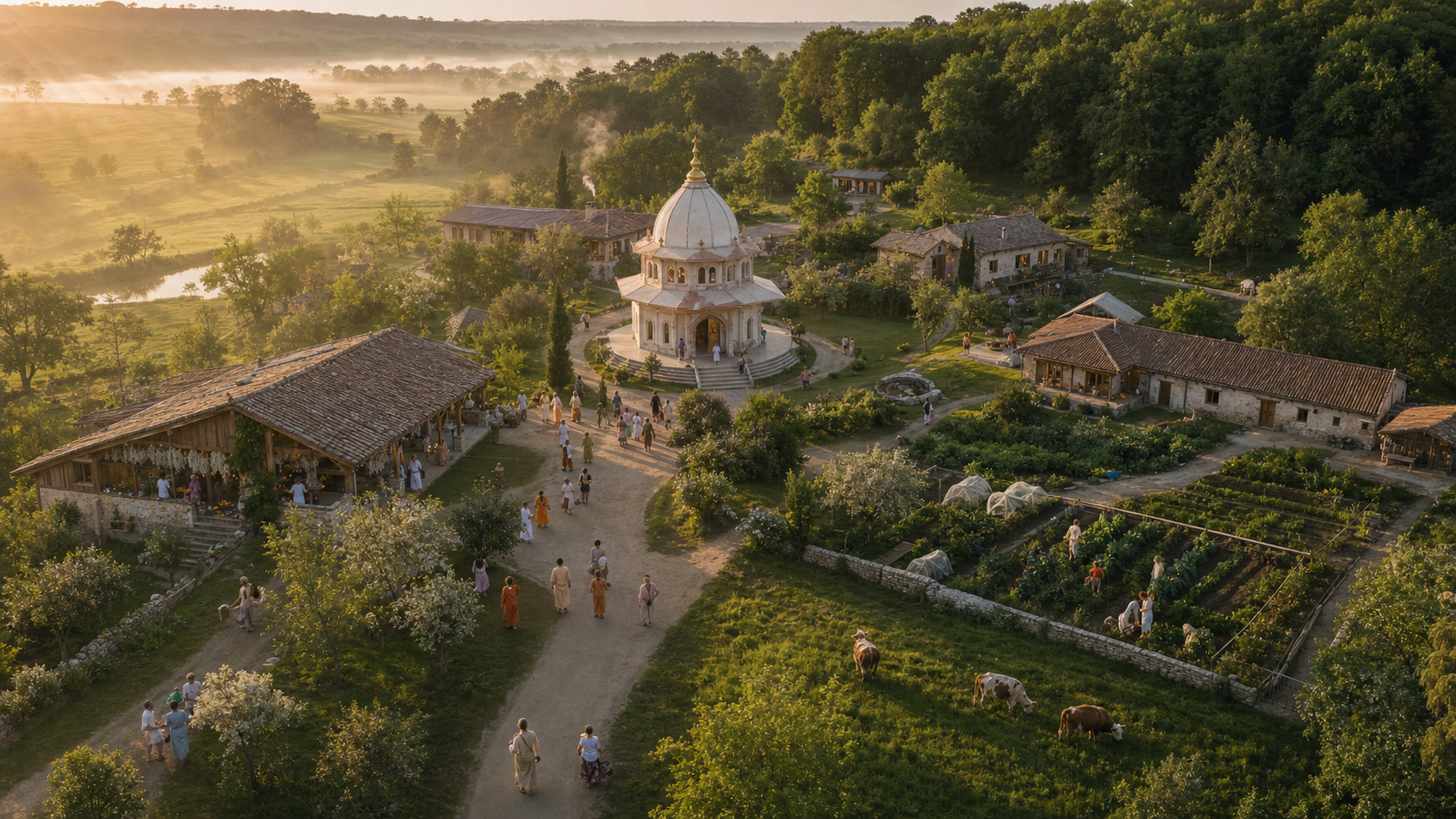
If you are deciding whether to support Sridham New Mayapur with your time, money, skills, or prayers, do not begin with the size of the proposed development. Begin with the life it is meant to make possible. A sacred community succeeds when an ordinary day makes sadhana, seva, learning, hospitality, and responsible family life easier to sustain.
The vision for developing Sridham New Mayapur gives devotees an opportunity to think beyond individual buildings. The real question is whether the temple, residents, land, visitors, and institutions can develop as one coherent dharmic ecosystem. You can use the tests below to judge proposals, improve discussions, and decide where your own service will have lasting value.
Development must protect the purpose of the dhama
Calling a place Sridham sets a demanding standard. Development cannot be treated as ordinary property expansion with devotional decoration added afterward. Roads, housing, kitchens, guest facilities, classrooms, gardens, utilities, and public spaces should all support remembrance of Krishna and service to the Vaishnavas.
This changes how you evaluate a plan. A visually impressive building may still weaken community life if it is expensive to maintain, separated from the daily flow of worship, inaccessible to older devotees, or dependent on a small group of already overburdened volunteers. A modest intervention may be more valuable if it removes a recurring obstacle to sadhana or seva.
Take each proposed feature and trace an ordinary day through it. Ask who opens it, who uses it, who cleans it, who pays for its operation, what happens when a key volunteer is absent, and how it serves the spiritual purpose of the community. This simple exercise exposes the difference between a concept and a functioning institution.
The resident and pilgrim perspectives also need to be separated. A pilgrim may experience the temple, prasada, accommodation, and a few hours of association. A resident encounters water systems, repairs, child-rearing, livelihood, conflict, winter or seasonal conditions, transport, and the repetition of daily service. A development that delights visitors but exhausts residents will eventually undermine its own hospitality.
Before endorsing a major component, look for clear answers to these questions:
- Which spiritual or community need does it meet?
- Who is responsible for it after construction or launch?
- What recurring work and expenditure will it create?
- Can children, elders, residents, guests, and full-time servants use it appropriately?
- What sacred, quiet, agricultural, or ecologically sensitive space must remain untouched?
- How will the community know whether it is actually helping?
If those answers are missing, the idea may still be worthwhile, but it is not ready to be treated as a commitment. Devotional enthusiasm should deepen scrutiny because the offering matters; it should not replace scrutiny.
Four systems have to mature together
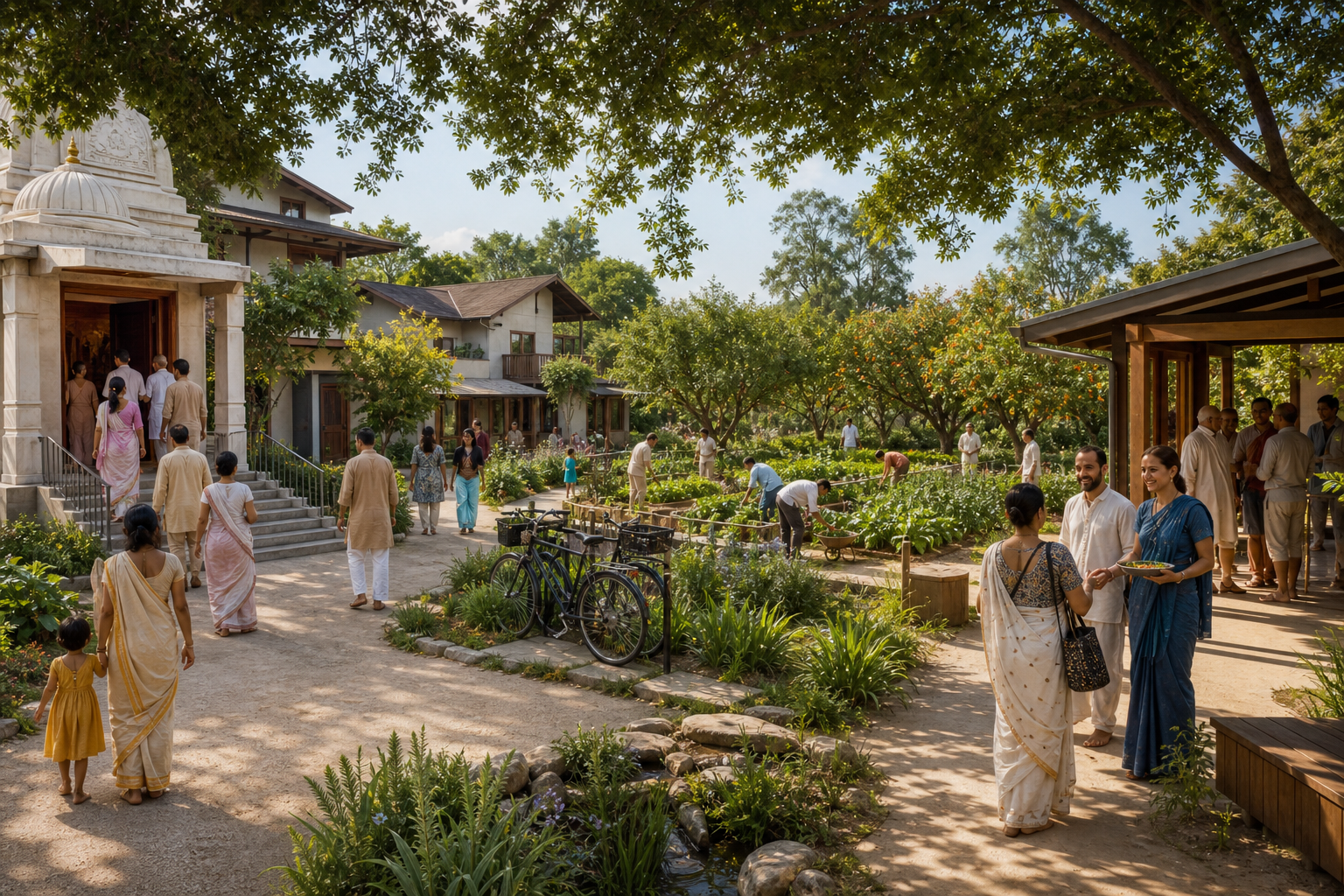
A sacred settlement is not one project. It is several interdependent systems. Expanding one while neglecting the others simply moves the pressure elsewhere. Four deserve attention in every phase of New Mayapur’s development.
1. Spiritual rhythm
The daily spiritual program is the organizing principle, not one activity among many. Housing, pathways, transport, meal times, service rosters, educational programs, and visitor arrangements should make participation realistic. If the design assumes that everyone has unlimited time, mobility, or access to a car, the built environment will quietly divide the community.
Ask planners to map movement during a quiet weekday as well as a festival day. Where do residents, children, older devotees, kitchen teams, pujari teams, delivery vehicles, and first-time guests cross paths? Which routes need silence, accessibility, lighting, shelter, or separation from service traffic? These details determine whether the spiritual center is genuinely central in daily life.
2. Resident life and intergenerational continuity
A community cannot rely indefinitely on heroic sacrifice by a shrinking core. Residents need intelligible service roles, habitable homes, education for children, meaningful engagement for young adults, care for elders, and a way to meet ordinary material responsibilities without abandoning the spiritual purpose that brought them there.
For every residential proposal, request three simple resident journeys: one for a household with children, one for a full-time temple servant, and one for an older devotee. Follow each journey from arrival through several years of life. Where will that person serve, learn, obtain necessities, receive help, and participate in decisions? If a plan works only for an idealized resident with no dependants, health limitations, or financial needs, it is incomplete.
Intergenerational continuity also requires real responsibility for younger devotees. Inviting them to events is not the same as entrusting them with service, training, budgets, land-based work, teaching, communications, or technical operations. A credible vision should show how knowledge and authority will pass from one generation to the next.
3. Land, infrastructure, and maintenance
Dharmic stewardship becomes visible in unglamorous systems: water, sanitation, drainage, energy, waste, food production, access, fire safety, repairs, and protection of the landscape. These are not secondary to spiritual life. When they fail, the burden falls on residents, worship, hospitality, and the land itself.
Words such as sustainable, ecological, or self-sufficient should therefore be treated as questions, not conclusions. What resource is being conserved? Who measures it? Which system can be repaired locally? What happens during a failure? Who funds replacement at the end of its useful life? A technology that looks green but requires unavailable expertise or neglected maintenance can create a new dependency.
Before new construction begins, create a maintenance register for what already exists. Record the asset, its condition, the responsible person, the recurring task, the likely failure point, and the source of operating funds. If the existing maintenance backlog is unknown, expansion costs are also unknown.
4. Governance, finance, and trust
Devotional authority and practical accountability should reinforce each other. People need to know who decides, who executes, who supervises expenditure, how residents are consulted, how conflicts are handled, and where concerns can be raised without personal retaliation. Ambiguity may feel manageable while a project is small, but it becomes expensive and divisive as land, buildings, donations, and responsibilities grow.
Every phase should have a named decision-making body, a responsible project lead, a defined scope, an approved budget basis, and a reporting rhythm. Financial updates should distinguish construction money from operating money. Completing a building without funding its utilities, staffing, insurance, repair, and eventual renewal is not completion; it is the transfer of an unfunded obligation to the community.
If you are considering a substantial donation, ask which legal entity receives it, what precise purpose it is restricted to, whether the necessary ownership and approvals are in place, how changes in scope will be handled, and how progress will be reported. Do not assume that a devotional preference expressed informally will control the eventual use of funds. If these matters are unclear, support a smaller, clearly bounded need or wait for the documentation.
Move from vision to construction in accountable phases
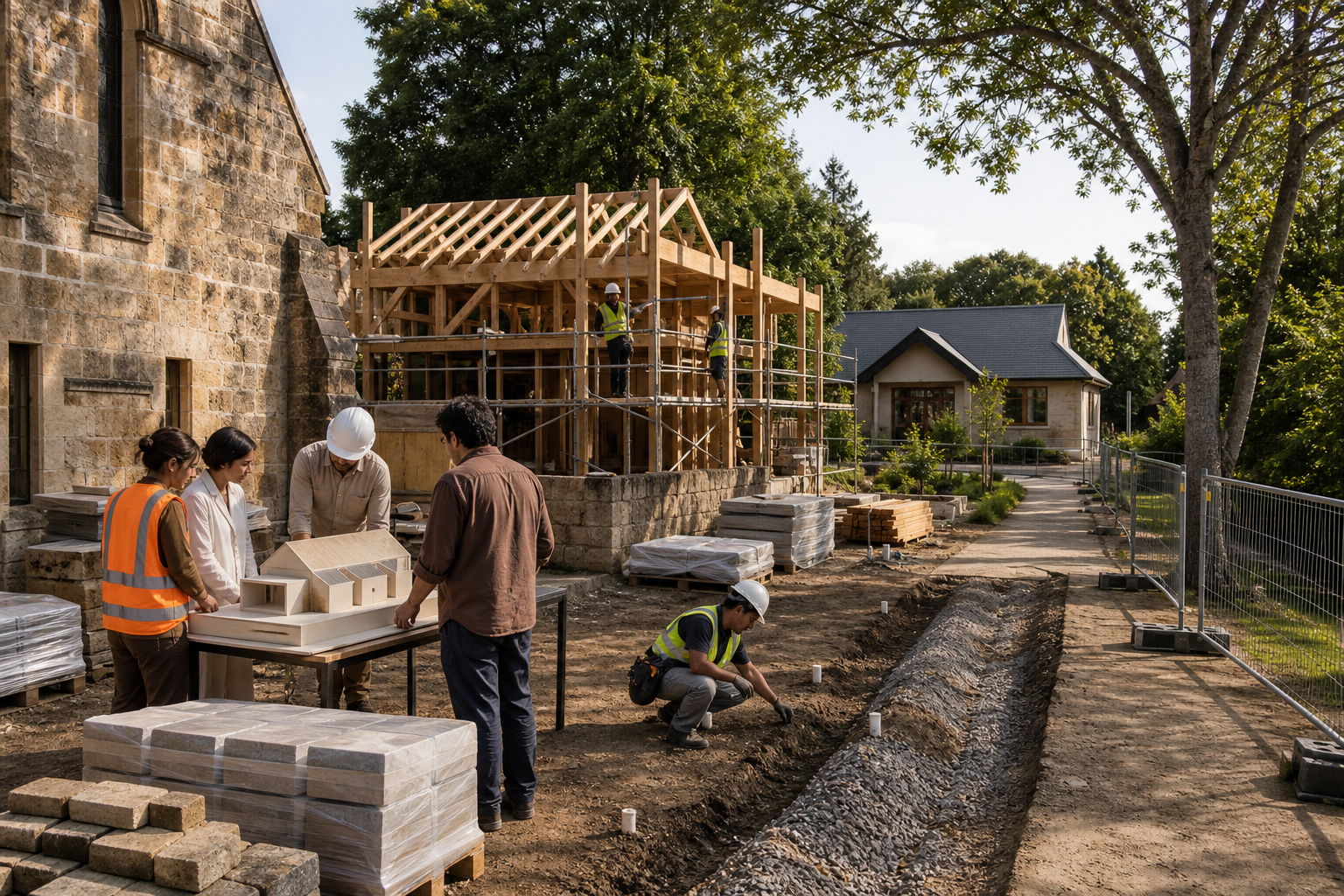
A master vision gives direction, but it should not become permission to start everything at once. The safer path is to divide development into phases that produce usable improvements, reveal hidden constraints, and can be evaluated before the next commitment is made.
- State the non-negotiable purpose. Write one paragraph explaining the spiritual life New Mayapur is meant to cultivate. Use it to test every later proposal.
- Document the present reality. Map existing buildings, land uses, utilities, service teams, maintenance obligations, resident needs, visitor flows, and known bottlenecks. A plan without a baseline cannot show what it has improved.
- Choose the constraint that harms daily life most. Give priority to a recurring obstacle affecting worship, prasada, sanitation, safety, access, education, housing maintenance, or essential seva. Visibility should not determine priority.
- Run one bounded phase. Define what will be delivered, who owns each task, how operating costs will be met, what approvals are required, and what conditions must be satisfied before work is accepted.
- Observe the completed phase in use. Measure service reliability, maintenance workload, resident participation, volunteer pressure, guest experience, and unintended effects on the land or temple routine.
- Publish the result before requesting the next commitment. Report what was completed, what changed, what remains unresolved, what was spent, and what the community learned. Then make a documented go, revise, or stop decision.
This sequence makes room for correction without treating correction as failure. Sacred development will involve incomplete information and competing needs. The danger lies not in revising a plan, but in becoming financially or institutionally unable to revise it.
Public communication should follow the same discipline. Renderings can help people imagine a future, but they should be accompanied by phase boundaries, dependencies, decision status, funding status, and operating responsibility. Devotees should be able to distinguish an aspiration from an approved project, an approved project from a funded one, and construction funding from long-term viability.
There is also a useful role for supporters who cannot donate large sums. Architects, farmers, educators, accountants, craftspeople, engineers, administrators, cooks, carers, communicators, and younger devotees can review specific systems. Their service becomes effective when they receive a bounded question, access to the relevant facts, a responsible contact, and a clear decision path. An open invitation to help, without that structure, usually produces ideas that nobody can implement.
Key takeaways for devotees and supporters
- Judge development by the daily spiritual life it enables, not by the scale or appearance of construction.
- Test every proposal from both resident and pilgrim perspectives; their needs overlap, but they are not identical.
- Develop spiritual rhythm, resident life, infrastructure, and governance together. Neglect in one system will weaken the others.
- Require a responsible owner and an operating plan for every new asset before treating its construction budget as complete.
- Ask for legal, financial, approval, and reporting clarity before making a substantial restricted donation.
- Support phased work that can be used, observed, corrected, and reported before the next expansion begins.
If you participate in the next discussion about Sridham New Mayapur, ask for a one-page charter for the next phase: its spiritual purpose, defined scope, responsible people, dependencies, operating burden, funding status, and completion test. That single page will not replace a master plan, but it will show whether the vision is beginning to take institutional form. The most faithful development will be the one that allows future generations to inherit not merely more property, but a stronger way of living and serving together.
References
