
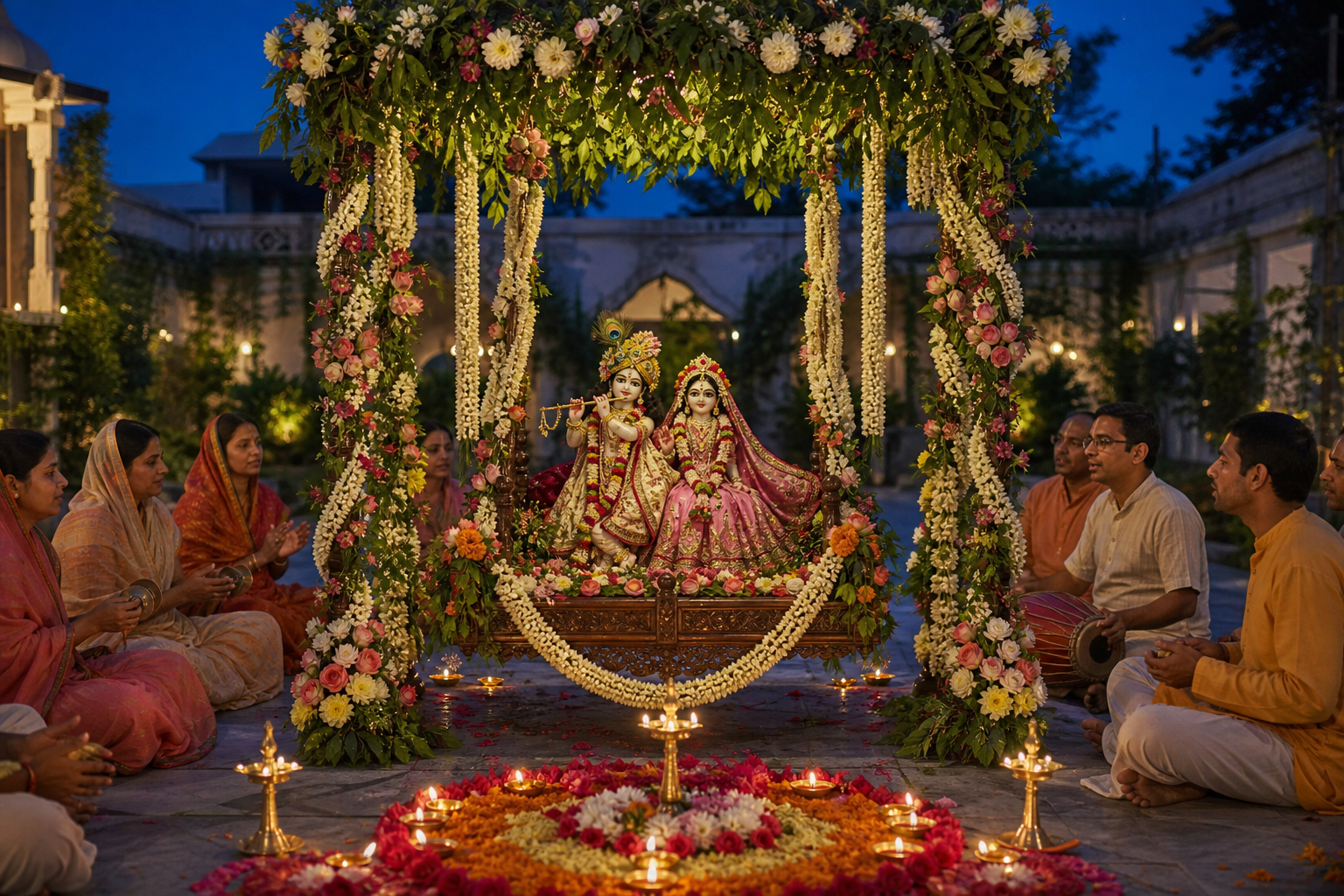
If you are drawn to Jhulan Yatra but worry that you do not know the full ritual, you do not need to imitate a large temple celebration. You need a form of worship that is reverent, manageable, and faithful to the maryada you actually follow.
Jhulan Yatra is the devotional swing celebration of Radha and Krishna. Its flowers, music, and decorated jhula give bhakti a festive form, but the center is seva. You prepare a place, turn your attention toward the Divine Couple through nama and kirtan, offer the swing where appropriate, and receive prasada with gratitude.
Treat decoration as support, not as the test
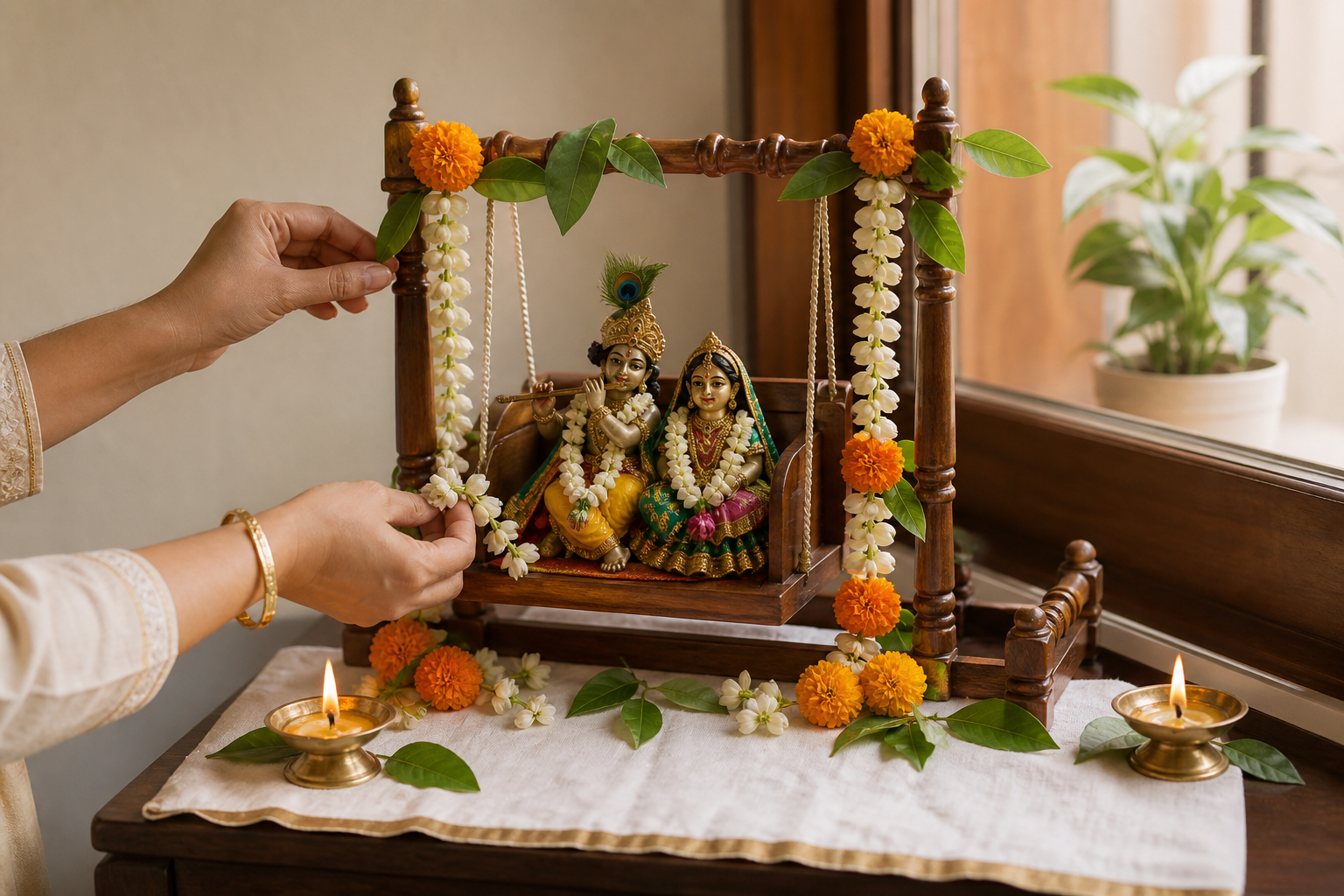
The visible beauty of Jhulan Yatra matters because it can focus the mind and express loving care. It becomes a distraction when arranging flowers, clothing, lights, or photographs occupies more attention than worship. Before adding an element, ask one practical question: will this help you remember and serve Radha and Krishna? If it will not, leave it out.
Give the observance one clear devotional center. That may be darshan at a temple, gently serving the jhula, singing one familiar bhajan, or preparing an appropriate offering. The invocation Jaya Radha Jaya Krishna captures the directness that works well here: address Radha and Krishna, remain attentive, and allow repetition to deepen remembrance. One song you can sing sincerely is more useful than a long collection you are struggling to follow.
Do not treat murtis as decorative objects. If your household does not already maintain deities and a customary way of serving them, use a clean devotional picture instead. Formal installation and deity care are not festival crafts to improvise. A picture, flowers, kirtan, and a respectful offering can support a coherent home observance without pretending to practices you have not received.
Choose a temple or home observance deliberately
A temple celebration lets you receive darshan, learn the local form of worship, join congregational kirtan, and serve under guidance. A home observance is useful when travel is difficult, when the temple schedule does not fit, or when you want to involve family members in a quieter setting. Neither choice requires you to reproduce the other.
If you plan to attend a temple, check its own announcement or contact its office before leaving. Jhulan customs differ among temples and sampradayas. Ask questions that affect what you should bring and when you should arrive:
- When do darshan, kirtan, arati, and any public jhula seva begin?
- May visitors gently pull or touch the swing, or is that service reserved for designated sevakas?
- Are flowers, garlands, fruit, or prepared food accepted, and are there specific rules for them?
- What are the temple’s expectations concerning dress, footwear, photography, and recording?
- Are volunteers needed for flower preparation, cleaning, crowd guidance, or prasada distribution?
Do not assume that a practice permitted at one mandir will be permitted at another. Local maryada governs the altar, the swing, and offerings. Asking in advance is not a sign that you know too little; it is how you avoid turning enthusiasm into inconvenience for the people responsible for worship.
Use this simple order for worship at home
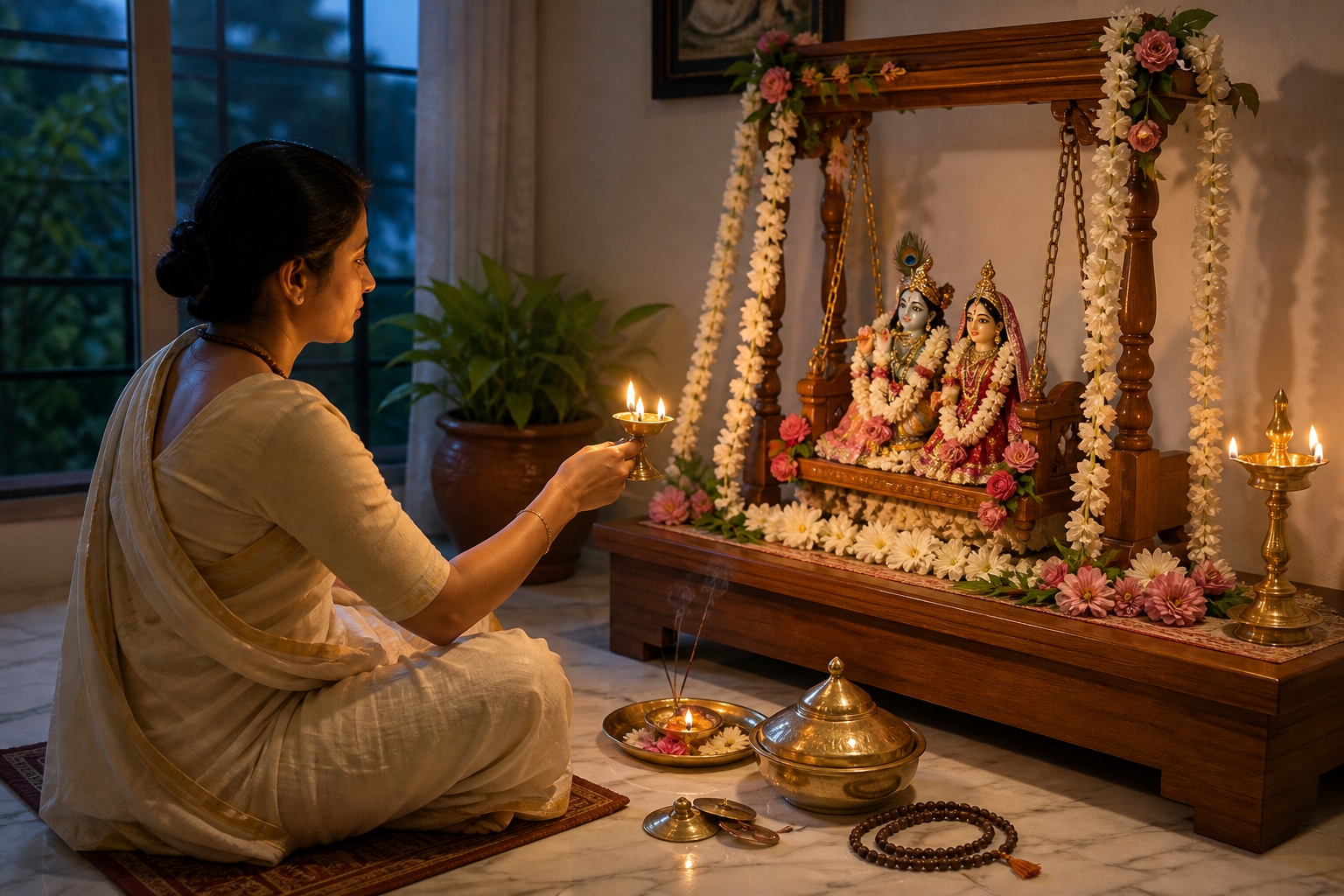
A home celebration needs a sequence more than it needs scale. Decide who will prepare the space, who will lead the singing, and who will handle the offering before you begin. That prevents people from moving objects, searching for songs, or discussing arrangements in the middle of worship.
- Clean the worship area and settle the room. Wash your hands, silence unnecessary devices, and place everything you will use within easy reach.
- Establish a devotional focal point. Use the Radha-Krishna picture you normally honor or murtis already served according to your household practice. Do not improvise a formal installation for the occasion.
- Decorate without creating instability. Flowers and clean cloth are sufficient. If you use a physical swing, place it on a firm surface and confirm that its seat, cords, and frame will not tip, loosen, or catch on clothing.
- State the intention of the observance. You can offer a short prayer in your own words, asking that the service be accepted and that your attention remain fixed on Radha and Krishna.
- Sing the nama or bhajan your tradition already uses. Choose a comfortable pitch and a refrain everyone can follow. Repetition is preferable to interrupting the kirtan repeatedly to teach new lyrics.
- Offer the swing only when it is appropriate and safe. Move it slowly and gently. If a picture or murti shifts, the structure strains, or several hands begin pulling in different directions, stop and stabilize it. If you have no suitable jhula, continue the kirtan without one.
- Present the food or water prepared according to your household’s devotional discipline. If you are unsure about ingredients or procedure, choose something simple that your tradition already accepts rather than inventing rules during the celebration.
- Close in your customary way. This may include arati where you already know the practice, pranama, a concluding prayer, and distribution of prasada. Extinguish lamps safely, clear the area, and handle offerings according to your local custom.
A lamp or incense is optional, not a measure of devotion. If children, pets, limited ventilation, or a crowded room make flame or smoke unsafe, omit it. Likewise, do not suspend a makeshift swing above valuable murtis or rely on temporary knots that have not been checked. The jhula should serve worship, not introduce anxiety or risk.
Participate at the temple without obstructing seva
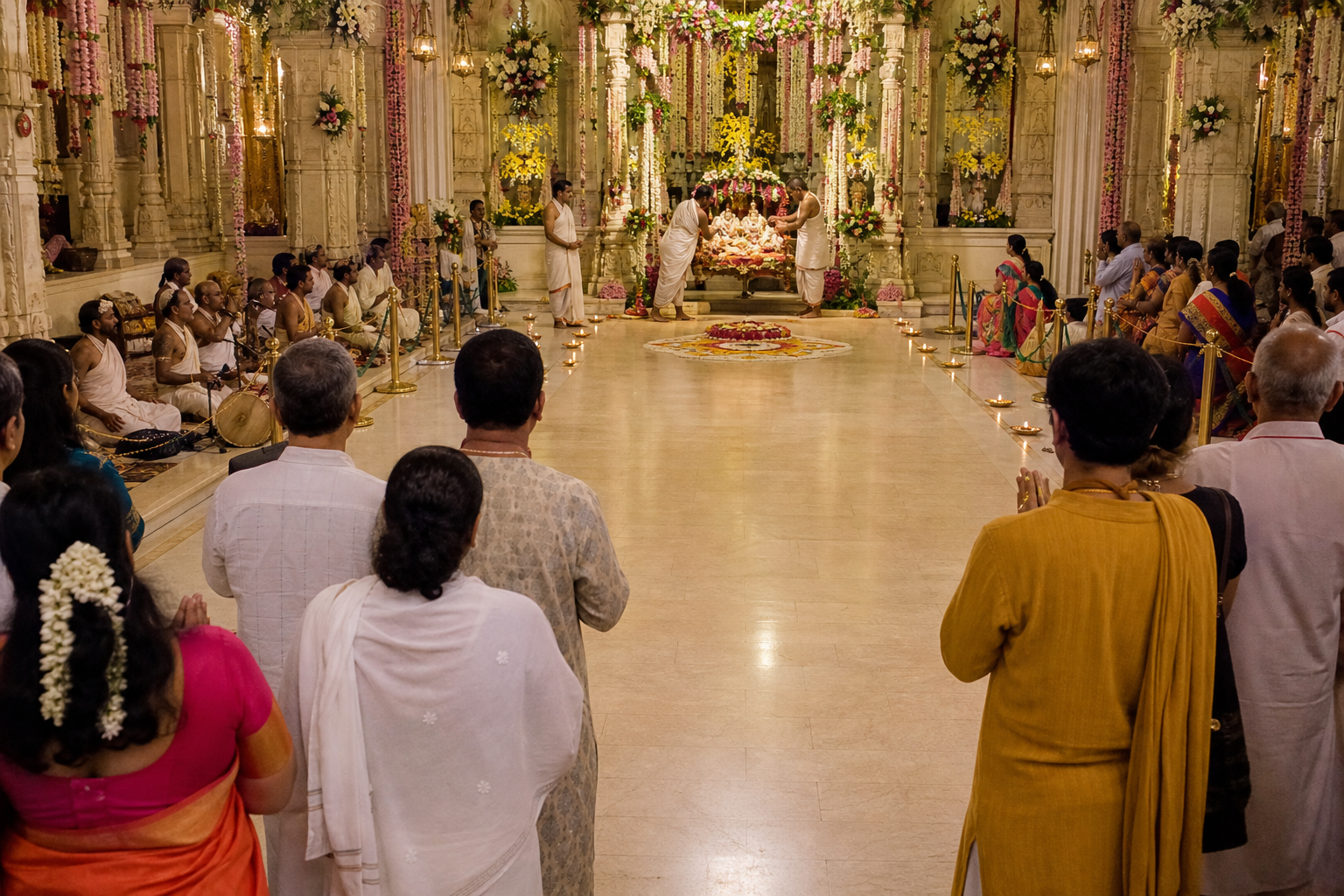
At a busy celebration, good intentions can still block darshan or make altar service harder. Watch how the temple organizes movement and follow the directions of pujaris and sevakas. If there is a queue for the jhula, prepare before you reach the front so that you are not deciding on photographs, offerings, or family positions beside the swing.
- Wait for an explicit invitation before touching the jhula, its ropes, altar objects, murtis, or decorations.
- Offer only what the temple has said it can receive. Hand it to the designated sevaka rather than placing it directly on the altar.
- Keep the darshan path open. Step aside after your turn instead of remaining in front to arrange photographs or continue a private prayer.
- If photography is permitted, take the picture without blocking others or using intrusive light. If it is not permitted, put the phone away.
- In congregational kirtan, listen to the lead singer and respond with the group. The aim is shared remembrance, not competing volume or tempo.
- Give children one clear responsibility, such as carrying approved flowers or helping an adult distribute prasada. Explain before entering that the swing and altar are approached only as the temple directs.
- If you volunteer, take the assigned task even when it is less visible than decorating or singing. Cleaning, preparing the space, guiding a queue, and restoring order afterward are also seva.
Restraint is part of participation. You do not lose a devotional opportunity by waiting, making room for another person, or accepting that a particular service is restricted. In a temple, cooperation protects both the sanctity of worship and every visitor’s chance for darshan.
Key takeaways for your Jhulan Yatra observance
- Let remembrance of Radha and Krishna determine the form and scale of the celebration.
- Follow the temple’s maryada rather than importing assumptions from another community.
- Use a devotional picture if you do not already have an established practice of caring for murtis.
- Choose one familiar kirtan or bhajan that everyone can sing attentively.
- Use a physical swing only when it is stable, handled gently, and permitted by the relevant household or temple custom.
- Plan the offering, participant roles, fire safety, and cleanup before worship begins.
- Regard quiet, practical work before and after the public celebration as genuine seva.
Make one decision now: will you observe at home or at a temple? If you are going to a mandir, confirm its schedule and seva rules. If you are staying home, choose one devotional image, one song, one appropriate offering, and one safe place for worship. That is enough planning for a simple observance in which celebration supports devotion rather than competing with it.
References
