

You may open Hindu scripture looking for a clear teaching about liberation, only to meet several kinds of sacred speech at once: an account of divine manifestation, a dialogue about righteous conduct, a demand for devotion, or an inquiry into the nature of the self. If you treat these as unrelated subjects, the path becomes harder to see.
The practical question is not merely, “Was this divinely revealed?” It is also, “What must change in me so that this revelation becomes liberating?” That second question turns scripture from information you possess into a discipline that works upon your perception, conduct, and understanding.
Revelation changes the seer as well as disclosing the Divine

A narrow model of revelation imagines a message delivered in words: the Divine speaks, the listener receives the statement, and the work is complete. Hindu sacred traditions often require a wider frame. Words matter, but so does the fitness of the person hearing them. A truth may be present without being recognized, just as a teaching may be memorized without being understood.
This becomes especially clear in the devotional teaching that the Lord’s incarnations have no limit and are perceived by devotees. The point is not simply that divine manifestation exceeds a closed catalogue. It is also that recognition depends upon the condition of the perceiver.
That does not make revelation a matter of private preference. “I feel that this is divine” is not, by itself, reliable discernment. Devotional perception must be formed by humility, ethical restraint, sustained attention, and fidelity to dharma. Otherwise, desire can dress itself in sacred language and call the result revelation.
When you encounter a passage about the Divine, ask three questions instead of stopping at literal assent:
- What is being disclosed? Identify the claim without adding assumptions: a divine quality, an incarnation, a relation between the Lord and the devotee, or a truth about human bondage.
- What prevents recognition? Look for pride, attachment, distraction, self-interest, fear, or ahankara rather than assuming that intellectual uncertainty is the only obstacle.
- What kind of person could perceive this properly? Notice whether the passage calls for devotion, discrimination, surrender, disciplined action, contemplation, or some combination of them.
This approach protects you from two opposite errors. You need not reduce every divine manifestation to a symbol, but you also need not accept every extraordinary claim as sacred. Unlimited divine possibility does not abolish discernment. It makes disciplined discernment more necessary.
Righteous living is part of the movement toward liberation
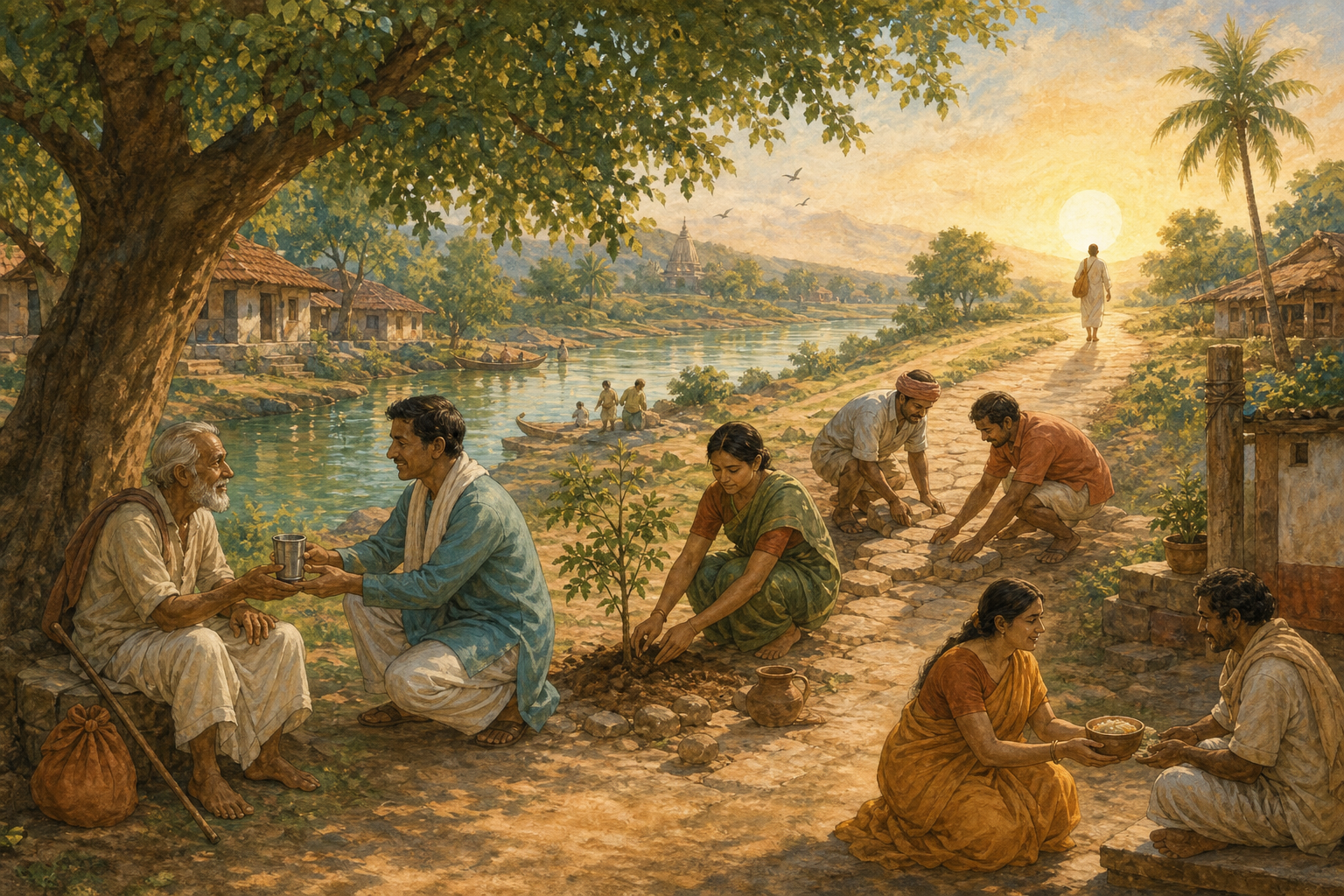
Liberation can become an abstraction when it is treated only as a final state beyond ordinary life. You may then discuss moksha while leaving your speech, obligations, resentments, and use of power untouched. Hindu scripture repeatedly places the highest questions inside the difficulties of living, where your understanding can be tested.
The Parasara Gita makes that connection concrete by joining righteous living to spiritual liberation through the dialogue of the sage Parashara and the philosopher-king Janaka. The presence of a ruler matters. Responsibility, judgment, and action are not distractions accidentally placed beside spiritual teaching; they form the setting in which wisdom must become operative.
Righteous conduct should not be mistaken for a transaction in which enough good deeds mechanically purchase freedom. Its deeper role is corrective. Conduct exposes what still governs you. A person may speak persuasively about detachment yet become furious when status is threatened. Another may praise compassion while treating dependants as inconveniences. In each case, daily action reveals bondage more accurately than spiritual vocabulary does.
Use that fact as a diagnostic. When a teaching about liberation feels remote, bring it into the nearest unresolved duty:
- What obligation are you trying to rename as a spiritual obstacle?
- Where does your conduct contradict the truth you say you accept?
- Which attachment becomes visible when you are corrected, delayed, or denied recognition?
- What is the next dharmic action available to you, even if your motives are not yet pure?
The last question is especially important. Waiting for perfect inward clarity can become another form of avoidance. Right action cannot replace liberating knowledge or devotion, but it can prepare the mind, reveal self-deception, and stop you from using philosophy to protect adharma.
Use a disciplined reading practice instead of collecting quotations

A memorable line can inspire you, but isolated quotations are easy to bend around an existing opinion. A liberating reading must recover the movement of the teaching: the listener’s predicament, the truth disclosed, the obstruction identified, and the discipline prescribed.
Apply the following sequence to one manageable passage rather than rushing through a large amount of material:
- Establish the setting. Identify who speaks, who listens, what problem has arisen, and whether you are reading dialogue, instruction, praise, narrative, or philosophical inquiry. The same sentence can function differently in a prayer and in a debate.
- State the disclosure plainly. Write one sentence beginning, “This passage asks me to recognize…” Remove decorative spiritual language until the actual claim is visible.
- Name the bondage. Decide what obstructs that recognition: ignorance, attachment, pride, harmful action, divided loyalty, or lack of devotional attention. Do not use “ego” as a vague answer when a more precise attachment can be named.
- Identify the demanded discipline. Does the passage call for reflection, remembrance, devotion, restraint, service, truthful conduct, surrender, or discrimination? A teaching becomes actionable when its verb is clear.
- Choose one bounded practice. Keep a neglected promise, restrain a harmful impulse, repair an injury you caused, or give undistracted attention to remembrance. The practice should be concrete enough that you can tell whether you actually did it.
- Examine the fruit honestly. Ask whether the reading has made you more truthful, attentive, humble, and responsible. If it produces vanity, contempt, passivity, or fascination with your own spiritual status, revisit your interpretation.
This repeated application is abhyasa. It does not mean mindless repetition. You return to the teaching because fresh circumstances expose attachments that were previously hidden. The words may remain unchanged while your capacity to hear them deepens.
A qualified teacher or established interpretive lineage can be crucial here, especially when a passage appears to conflict with dharma or when you are using it to justify a consequential decision. Guidance should make the text’s reasoning and demands clearer. It should not require you to switch off moral attention or treat a human interpreter as beyond examination.
Avoid four shortcuts that distort revelation and moksha

Several common shortcuts make Hindu scripture sound simpler while making it less useful. Each removes a tension that the seeker actually needs to face.
“Every claim of divine manifestation deserves acceptance”
The possibility of innumerable incarnations does not authenticate every person, vision, or movement presented as divine. Possibility and proof are different questions. Test whether the claim directs attention toward the Divine or toward a claimant’s appetite for control, wealth, immunity, or adulation. Devotion is receptive, but it is not credulous.
“Liberation means escaping every worldly obligation”
A dialogue involving Janaka does not permit such an easy equation. A ruler’s setting brings spiritual inquiry into contact with duty and consequence. Different forms of renunciation have their legitimate places, but neglect, irresponsibility, and indifference should not be renamed detachment merely because they feel like withdrawal.
“Good conduct by itself is the whole of liberation”
Ethical conduct matters, yet respectable behaviour alone does not settle the deepest questions of ignorance, identity, attachment, or relation to the Lord. Dharma prepares, expresses, and tests spiritual understanding. It should not be used to reduce moksha to social approval or rule-following.
“Every Hindu school means the same thing by liberation”
Hindu traditions do not speak in one flattened voice. Some emphasize awakening to the deepest truth of the self. Devotional traditions may emphasize loving recognition of and relation with the personal Lord. Their disciplines, theological language, and descriptions of freedom are not interchangeable.
You do not honour unity by erasing these differences. First ask what liberation means within the lineage and passage you are reading. Then consider what different traditions share at the level of practice, such as the overcoming of ignorance, selfish attachment, or ahankara. Begin with accuracy; seek synthesis only after each position has been allowed to speak in its own terms.
Key takeaways
- Divine revelation is not only a statement to believe; it can also demand a transformation in the capacity to perceive.
- The teaching that divine incarnations are without limit does not remove the need for discernment. Devotional receptivity must be joined to humility and dharmic judgment.
- Righteous living and liberation should not be separated. Daily conduct reveals attachments that abstract spiritual discussion can conceal.
- Read a passage in context, state what it discloses, name the bondage it confronts, identify its discipline, and apply that discipline concretely.
- Do not force distinct Hindu understandings of moksha into a single formula. Interpret each teaching within its own theological and practical setting.
At your next reading, choose one passage and write four short lines: what it reveals, what blocks recognition, what discipline it requires, and what you will do differently. If the passage changes neither attention, conduct, nor understanding, your reading may have begun, but it has not yet reached its liberating work.
References
- Dandavats — There is No Limit to the Lord’s Incarnations, but They Can Be Perceived Only by Devotees
- Hindu Blog — Parasara Gita Chapter 8 – Content, Teachings And Importance
