
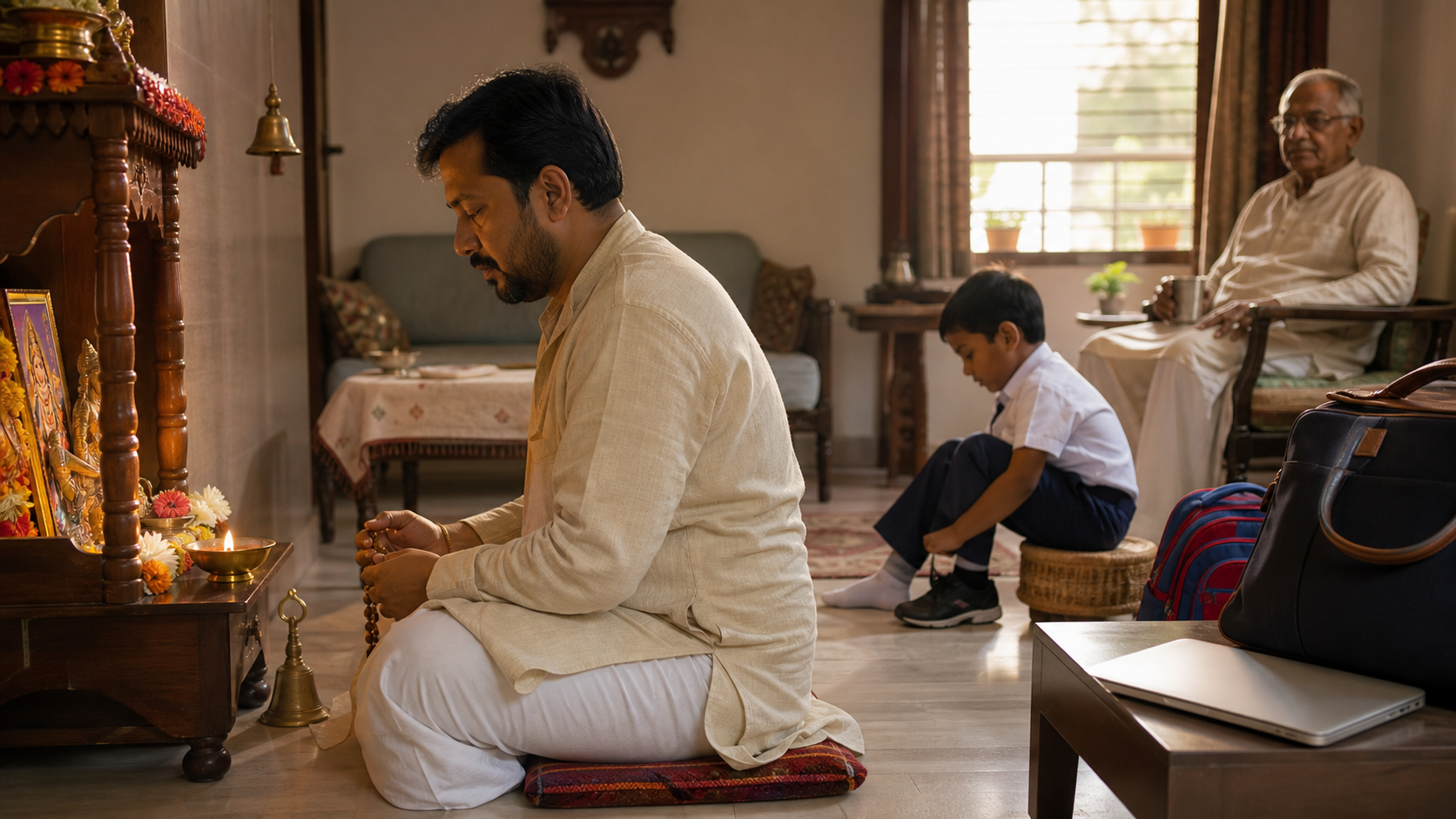
You intended to finish your morning practice before opening your messages. Then a child woke early, work called, an elder needed help, or the day simply outran you. By evening, the unfinished mala, unread passage, or shortened prayer can feel like evidence that ordinary life and spiritual life are pulling in opposite directions.
They do compete when the day has no order. But the practical problem of balance in duties with devotional service is not solved by giving devotion and responsibility equal hours. It is solved by identifying what must remain sacred, arranging the day around it, and refusing to make other people pay for spiritual ambitions you have not planned responsibly.
Define balance as right order, not equal time

A balanced day may contain a short period of concentrated worship and many hours of family care, study, employment, or community responsibility. The clock alone cannot tell you whether that day was spiritually ordered. Ask instead whether devotion governed the manner in which you performed your duties and whether those duties left a protected place for direct practice.
Begin by separating three things that are often mixed together:
- Received commitments: practices given through your sampradaya, initiation, vrata, or a teacher whose discipline you have accepted.
- Real duties: care of dependants, honest livelihood, education, health, household work, and promises that others reasonably rely on you to keep.
- Optional additions: extra reading, additional observances, more gatherings, longer rituals, online spiritual content, or voluntary service beyond your present capacity.
When pressure rises, optional additions should normally be examined before either received commitments or real duties are sacrificed. A person who neglects a dependant to attend one more programme has not necessarily chosen devotion over worldliness. The neglected duty may itself be the place where dharma is asking for fidelity.
Use a simple test before adding a new observance: What existing responsibility will supply the time? Can you sustain it during an ordinary working week? Does anyone else need to cooperate? Will it depend on repeated sleep loss, concealed resentment, or unfinished work? If those questions have no honest answer, the observance needs a smaller form, a different place in the day, or a later beginning.
A formal vow is different from a self-designed routine. Do not quietly reduce a vowed practice because a general productivity framework tells you to choose a smaller minimum. If a received commitment has become genuinely unmanageable, speak to the teacher or responsible spiritual authority connected with it.
Build a practice that survives three kinds of day

Many routines fail because they describe only the spacious day. The practitioner imagines uninterrupted worship, study, and contemplation, then has no rule for the morning when care, illness in the household, travel, or urgent work changes the conditions. Once the ideal plan collapses, the whole day is treated as spiritually lost.
For practices that are not governed by a fixed vow, write three versions of the same devotional rhythm:
<!– wp:list {