
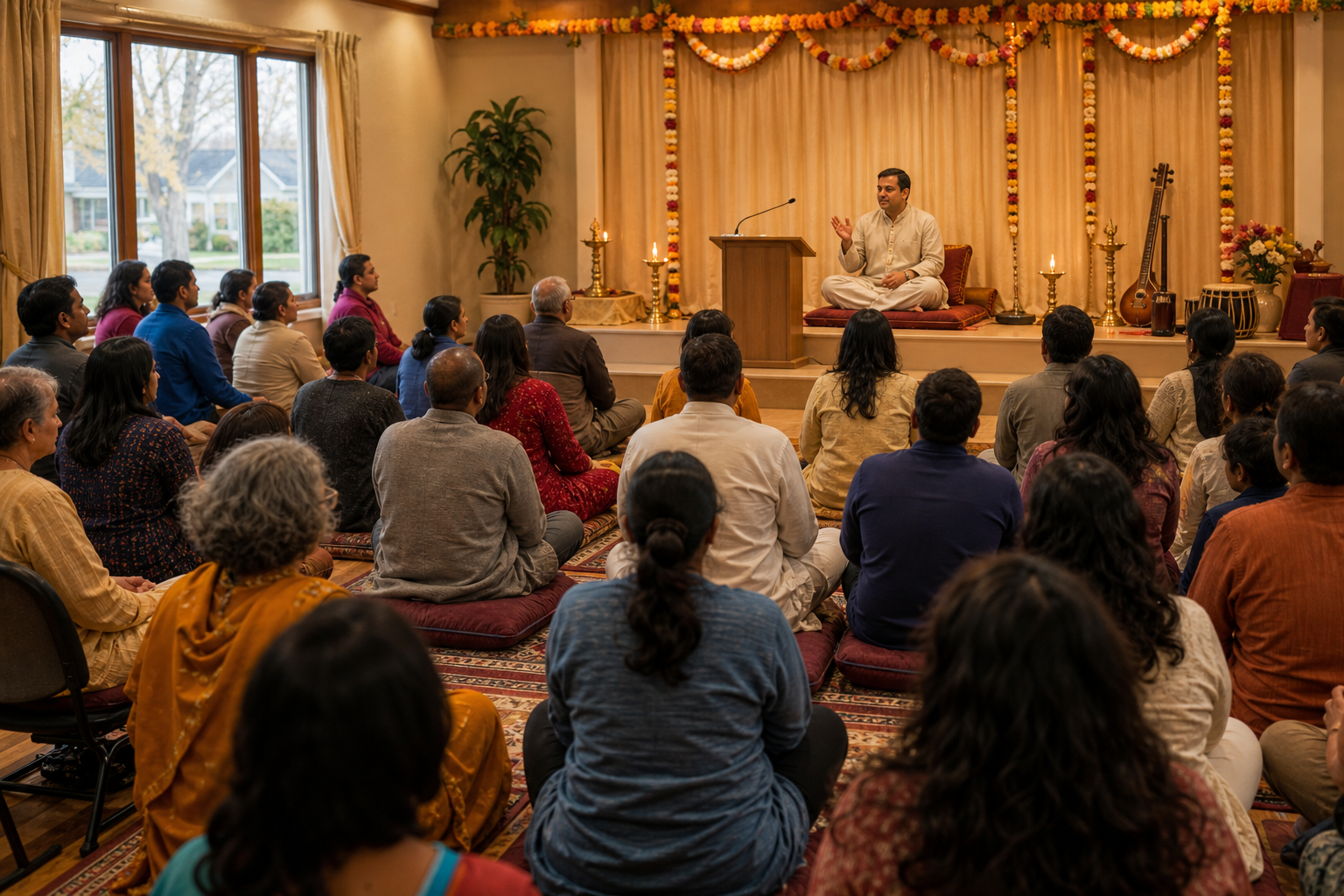
You may have opened the ISKCON Farmington Hills Sunday Feast class looking for a quick statement of its message. The honest answer is narrower: HG Gauranga Prabhuji leads this Sunday Feast class at ISKCON Farmington Hills, but no theme or scriptural passage is named alongside that identification. Assigning one before listening would be speculation.
You can still approach the discourse with purpose. Bring a real question, distinguish what is taught from what you infer, and leave with a practice you can actually carry into the week. That turns the class from another piece of devotional media into disciplined hearing.
Start with a live question, not a guessed theme
Before you press play, write a sentence beginning, “I need clarity about…” The question should come from your present conduct, not from curiosity alone. You might be struggling to perform a duty consistently, to stay attentive during devotional practice, or to translate a conviction into daily behavior.
A useful question identifies both the principle and the friction. “How can I become more spiritual?” is too broad to guide your listening. “Why do I postpone a devotional responsibility that I already consider important?” gives you something definite to notice.
- What instruction do you already accept but resist in practice?
- Where are you relying on devotional intention without corresponding action?
- What recurring situation exposes a gap between your values and your conduct?
- What uncertainty prevents you from taking the next responsible step?
Keep the question at the top of your notes, but do not force the discourse to answer it. If HG Gauranga Prabhuji addresses something different, change your heading. Listening faithfully means following the teaching that is actually given, not bending every sentence around the concern you brought with you.
Separate the teaching, its support, and its application
Devotional listening becomes muddled when a teaching, an illustration, and your personal reaction all enter the notebook as if they carried the same meaning. Keep them distinct while you listen.
- Teaching: State the central claim in plain language. Preserve any conditions or qualifications instead of reducing it to a slogan.
- Support: Note how the claim is explained. Is the speaker using scriptural reasoning, an analogy, a narrative, a contrast, or a practical observation?
- Application: Record the change in attention, conduct, relationship, or devotional practice that follows from the claim.
- Inference: Mark conclusions that you have drawn but that the speaker did not explicitly state.
This distinction protects you from a common error: upgrading an illustration into a universal rule. An example may illuminate a principle without defining every situation in which that principle applies. Likewise, your emotional response may reveal that a point matters to you, but intensity alone does not prove that your interpretation is correct.
When a passage or statement is quoted, record enough surrounding context to remember how it was used. When you paraphrase HG Gauranga Prabhuji, label the words as your paraphrase. That small act of intellectual honesty makes later discussion far more productive.
Take notes that remain useful after the video ends

A complete transcript can preserve every sentence while leaving your understanding untouched. Use a compact note structure that makes vague listening visible.
- Central claim: What does the speaker want the listener to understand?
- Necessary qualifier: What condition would be lost if you shortened the claim carelessly?
- Reason: Why is the claim presented as true or important?
- Practice: What would change if you accepted it seriously?
- Resistance: What habit, fear, preference, or assumption in you pushes back?
- Open question: What still requires clarification from a knowledgeable practitioner?
Add a timestamp when a point deserves replay or clarification. Do not pause after every sentence. Pause when you need to preserve a distinction, test your paraphrase, or capture the context of a difficult statement.
After listening, try to express the central claim without using vague phrases such as “something about devotion” or “a lesson about being better.” If you cannot do it, return to the transition where the speaker moves from explanation to application. That is often where the practical force of a discourse becomes clearest.
Carry the class from hearing into practice

Choose an observable act
Do not end with “I should remember this.” Memory is not yet practice. Translate the point into behavior that you can notice. If the relevant instruction concerns attention, identify a distraction you will remove before beginning your practice. If it concerns responsibility, name the accepted duty you will complete before taking on another. If it concerns speech, identify the recurring situation in which you will pause before responding.
The action should be modest enough to repeat and definite enough to evaluate. Avoid manufacturing an impressive vow that the discourse did not ask you to make. A dramatic commitment can become a way of admiring the teaching without patiently living it.
Attach the action to an existing cue in your day. Decide what will remind you, what normally interrupts you, and how you will resume after a lapse. This makes the difference between a devotional intention and a workable discipline.
Check your interpretation in community
If a point remains unclear, begin with comprehension rather than debate. A precise question sounds like this: “I understood the point to mean this, for this reason. Is that a faithful reading, or have I extended it too far?” That gives another practitioner something concrete to correct.
If you attend ISKCON Farmington Hills, take the question into an appropriate conversation within the temple community. If you are listening from elsewhere, ask a knowledgeable practitioner whom you trust. Include the relevant context and timestamp. A clipped sentence invites reactions; a complete line of reasoning invites understanding.
Disagreement also benefits from this discipline. Restate the claim as strongly and fairly as you can before objecting. Then identify whether your concern is about the teaching itself, the reasoning used to support it, or the way you think it applies. Those are different questions and may require different answers.
Key takeaways
- The established context is a Sunday Feast class delivered by HG Gauranga Prabhuji at ISKCON Farmington Hills; let the class itself establish its theme.
- Bring a real question to your listening, but do not force the discourse to answer a question it does not address.
- Separate the central teaching, its support, its application, and your own inference.
- Use notes that capture qualifications, resistance, and unresolved questions rather than trying to transcribe everything.
- Translate the point you understood into an observable practice and check uncertain interpretations with a knowledgeable practitioner.
Open the class with your live question above a blank page. When it ends, close the video before opening anything else. Write the practice you will carry and the question you still owe the community. That pause is where listening stops being consumption and begins to shape devotional life.
References
