

If you have stood before a Panchamukha Shivalinga and wondered why its eastern face matters, Tatpurusha gives you a demanding answer: become awake before you act. Its symbolism is useful when you face a decision, begin a duty, enter a difficult conversation, or notice that habit is choosing for you.
Tatpurusha is associated with dawn and clarity, but also with concealment. That is not a flaw in the symbolism. It is the central tension you are meant to contemplate: the light is present, yet your perception can still be veiled.
Why the face of awakening is also the face of concealment
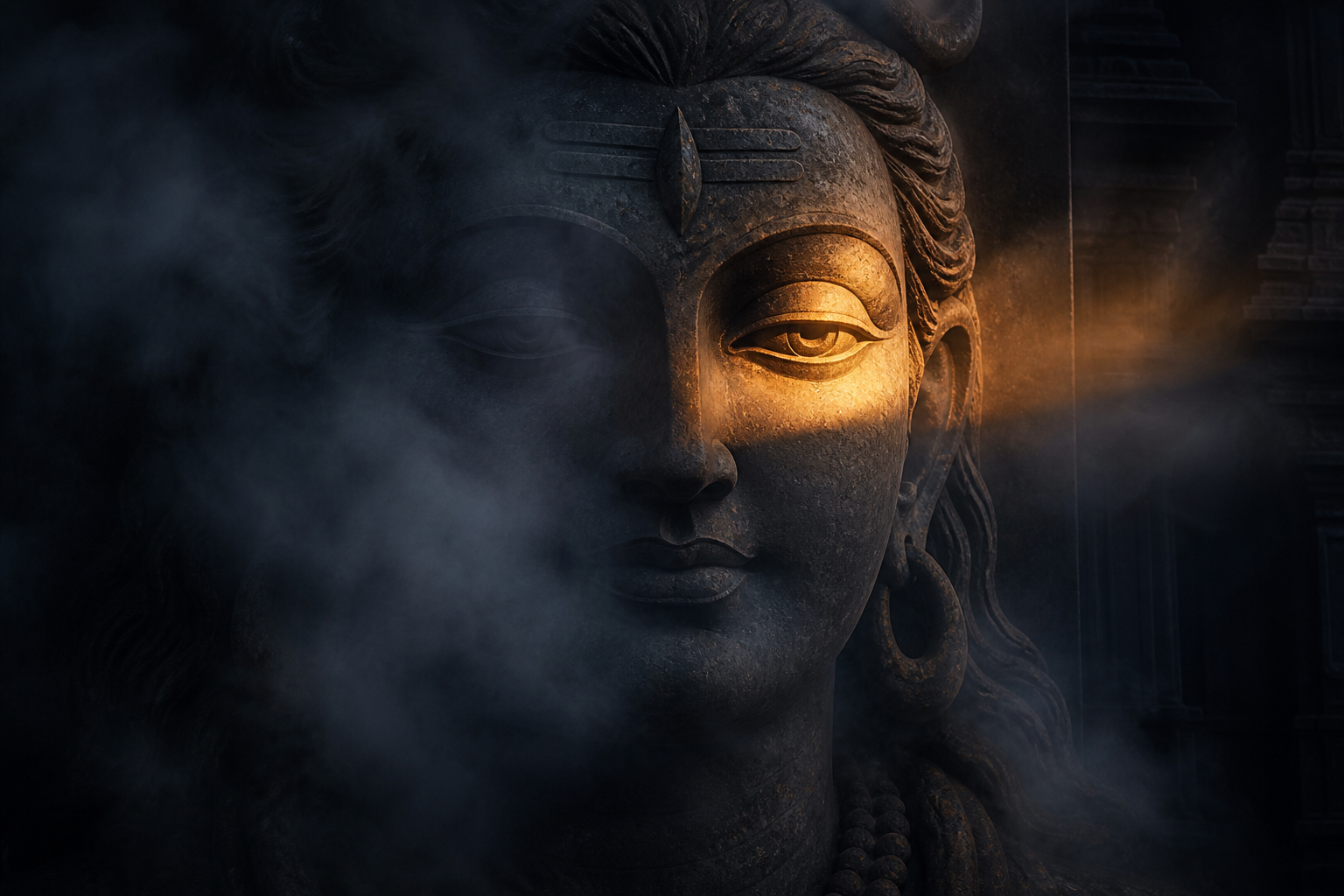
Tatpurusha can be understood as “That Person,” pointing beyond the limited personality toward the transcendent Purusha underlying individual experience. Interpretations differ among Shaiva lineages, but the practical movement is consistent: you turn from automatic identification with passing reactions toward a more disciplined awareness of what is actually happening.
The eastern direction reinforces that movement. Sunrise signifies an auspicious beginning, increasing visibility, and the possibility of renewed attention. Facing east before the Shivalinga therefore need not be treated as decorative orientation. It places your body inside a reminder: begin by seeing clearly.
Yet Tatpurusha is also linked with tirodhana, the concealing or veiling function. Ultimate reality is present, but it is not ordinarily recognized without disciplined practice. Dawn offers a helpful way to hold the apparent paradox. First light does not manufacture the landscape; it allows what was already there to become visible. In the same way, sadhana does not manufacture Shiva. It works upon the conditions under which recognition remains obscured.
Do not turn concealment into a grand explanation for every mistake. Start with what you can examine. Before acting, ask three plain questions: What do I directly know? What am I adding through fear, desire, or assumption? What response would remain ethical even if my preferred interpretation proves wrong? This is Tatpurusha translated from metaphysics into conduct.
Tatpurusha makes sense only within the five faces

Panchamukha Shiva does not present five competing deities. The five faces distinguish five movements of one Sadashiva: manifestation, preservation, dissolution, concealment, and grace. Tatpurusha trains alert perception, but perception alone is incomplete. Clear seeing must eventually tell you whether to preserve, end, create, or release your demand for control.
Key takeaways
- Tatpurusha faces east and joins awakening with disciplined awareness.
- Its association with concealment explains why clarity requires sadhana rather than mere intellectual agreement.
- The five faces express one Shiva through distinguishable cosmic functions, not five independent powers.
- The value of the symbolism appears in your next response: clearer judgment, steadier duty, compassionate restraint, necessary release, or receptivity to grace.
| Face and direction | Symbolic emphasis | Question for practice |
|---|---|---|
| Tatpurusha, east | Awareness and concealment | What must I see without projection? |
| Aghora, south | Dissolution and transformation | What has completed its purpose and must pass? |
| Vamadeva, north | Preservation, compassion, and harmony | What deserves patient protection? |
| Sadyojata, west | Manifestation and creativity | What worthy possibility needs concrete form? |
| Ishana, upward | Revelation and grace | What lies beyond my power to force? |
The placement of Ishana is especially important. In some mukhalinga forms, four faces appear around the shaft while Ishana occupies the summit; Pashupatinath is a prominent example. The upward face is not merely another point on a compass. It prevents the four horizontal functions from becoming a closed system in which you imagine that everything can be categorized and controlled.
Read the surrounding emblems with the same care. Matted locks, the crescent moon, and Ganga show sacred force held in order. The third eye directs awareness toward discernment rather than suspicion. Ash recalls impermanence, while the tiger skin signifies mastery over primal impulse. Abhaya and varada mudras join fearlessness to benevolence; Nandi joins devotion to ethical steadiness. Together, these symbols stop Tatpurusha’s alertness from becoming restless vigilance, cold analysis, or spiritualized self-importance.
A dawn practice that keeps symbol, mantra, and conduct together

Dawn is a natural time to contemplate Tatpurusha because the eastern orientation and the day’s beginning support the same intention. Temple procedures and Agamic customs vary, so follow the established practice of your temple or lineage where one is available. For a simple household contemplation, you can use the following sequence without pretending it replaces formal ritual instruction.
- Choose the threshold consciously. Sit or stand facing east at dawn when practical. Let the direction remind you that the first task is attention, not immediate activity.
- Let the breath become gentle. Notice several natural breaths without forcing a rhythm or demanding an unusual state. The purpose is to collect attention before mantra.
- Use one mantra deliberately. You may recite the Rudra Gayatri: “Om Tatpurushaya Vidmahe Mahadevaya Dhimahi Tanno Rudrah Prachodayat.” Hold its movement as a request for guidance and clarified understanding.
- Alternatively, use a five-breath cycle. Accompany five attentive breaths with Na-Ma-Shi-Va-Ya, one syllable for each breath. Across the cycle, notice emergence, continuity, release, receptive stillness, and grace. Do not force each correspondence into a rigid formula unless your lineage specifically teaches one.
- End with one observable commitment. Name an action you can perform that day: listen fully before replying, finish a neglected duty, preserve a needed boundary without cruelty, release a grievance, or begin a worthy task.
The final step matters because a devotional practice can feel complete while leaving conduct unchanged. Judge the morning by what follows it. Are you less governed by the first impulse? Can you distinguish a fact from an assumption? Does greater alertness make you more responsible and compassionate? These are more useful measures than waiting for a dramatic inner experience.
Practitioners may describe steadier attention or greater emotional balance, but such testimony should remain within its devotional setting. Mantra and breath contemplation are not guaranteed therapeutic interventions. Their immediate purpose here is spiritual recollection and disciplined conduct.
Use the five faces before a consequential response

Tatpurusha is most useful at the instant when perception is about to harden into reaction. Give it the first question, then let the other faces test the answer. This prevents awareness from becoming endless self-observation with no dharmic action.
- Tatpurusha: What can I see directly, and what am I projecting?
- Vamadeva: What person, duty, relationship, or value should be preserved with compassion?
- Aghora: What habit, attachment, false assumption, or completed pattern must end?
- Sadyojata: What clear request, boundary, repair, or new effort now needs form?
- Ishana: What responsible action is mine, and which outcome must I stop trying to control?
Suppose you are about to send a sharp reply. Tatpurusha separates the words you actually received from the motive you inferred. Vamadeva asks whether the relationship, your dignity, or a legitimate obligation deserves protection. Aghora asks whether the grievance or a harmful pattern should end; it does not ask you to treat the other person as disposable. Sadyojata turns insight into a clear boundary or constructive request. Ishana permits you to communicate responsibly without claiming power over the response.
This sequence also corrects a common misunderstanding of mastery. Shiva’s symbols do not praise domination by impulse, status, or force. Mastery means that power is ordered by discernment, mortality is remembered, compassion limits action, and the result is not confused with personal ownership.
Avoid the shortcuts that empty Tatpurusha of meaning
Do not reduce the east to positive thinking
Tatpurusha does not promise that every beginning will feel bright or end as you wish. Dawn signifies the duty to see. Sometimes clearer perception reveals that a plan is unwise, a habit has become binding, or a necessary conversation cannot be postponed. The eastern face calls for readiness, not optimism detached from truth.
Do not make concealment an excuse for confusion
Tirodhana gives confusion a theological context, but it does not sanctify carelessness. If you know that desire is distorting a decision, the response is disciplined attention and ethical restraint. Calling the distortion “mystery” while continuing to indulge it reverses the symbol’s purpose.
Do not force every group of five into one diagram
The five faces can be contemplated alongside the five great elements, five senses, and five sheaths. These correspondences can direct attention from the visible icon toward embodiment, perception, thought, discernment, and awareness. They become less useful when treated as a compulsory one-to-one chart that must work identically in every Shaiva setting. Regional, artistic, and Agamic variations are part of the living tradition, not defects to be erased.
Do not confuse Dharmic resonance with sameness
Hindu, Buddhist, Jain, and Sikh disciplines can resonate through attention, restraint, non-harm, truthful conduct, remembrance, or service. That does not make their theologies or practices interchangeable. Let Tatpurusha deepen your understanding of a Shaiva symbol while allowing other Dharmic paths to speak in their own categories.
At your next dawn practice, choose one real situation before beginning. When the mantra ends, complete two sentences: “The veil here is ___. The dharmic action available to me is ___.” Then take the smallest honest action before the day’s momentum takes over. That is how the eastern direction becomes a discipline rather than a decoration.
References
- DharmaRenaissance Blog — Panchamukha Shiva: A Fivefold Discipline for Daily Life
- DharmaRenaissance Blog — Discover Tatpurusha: The Complete Guide to Shiva’s Eastern Face on the Shivalinga
