

You may be able to watch your thoughts while sitting quietly, yet lose that clarity as soon as someone criticises you, a prayer goes unanswered, or an important plan begins to fail. The mind closes around one story, the body prepares to react, and the calm observer seems to disappear.
The observer did not disappear. Attention became absorbed in what was being observed. Learning to recognise that difference is the practical heart of witness consciousness. It can change how you meet fear, desire, grief, conflict, and duty without asking you to withdraw from life.
Begin with the distinction that changes the whole practice

Anything you can notice is an object of awareness. A pain is noticed. Anger is noticed. A plan, memory, self-image, or spiritual insight is noticed. Even the mental sentence “I am the witness” is something you can notice.
Advaita Vedanta gives the changeless basis of this knowing a precise name: Kutastha, the awareness that illuminates changing experience without becoming one of its changes. The body changes, moods alternate, thoughts contradict one another, and social roles come and go. Awareness is not another role standing behind them. It is the fact that they are known.
This distinction is easy to turn into a new identity. The ego says, “I am the calm observer, unlike these reactive people.” But that superior observer is another thought, complete with a role, a judgement, and something to defend. Genuine sakshi-bhava, the disposition of witnessing, is quieter. It does not need to announce itself.
You can test the distinction immediately. Notice each of the following without trying to change it:
- A bodily sensation, such as pressure, warmth, or restlessness.
- An emotion and the name the mind gives it.
- A thought about what should have happened.
- An urge to speak, withdraw, control, or prove something.
- The commentary claiming that your observation is going well or badly.
All of these are present to knowing. Do not rush to define that knowing. The moment you give it a shape, location, personality, or achievement, examine that description too. It has also become something known.
This is where the language of inner divinity becomes useful, provided it is handled carefully. It does not mean that every preference of the individual is divine, that the ego can command reality, or that you secretly control other people and events. It points to a sacred depth that is not created by success and not destroyed by disappointment. Faith can move from demanding a particular outcome to trusting your capacity for presence, compassion, and right action.
Disidentification also does not make the body, mind, or relationships disposable. A sensation may not be your complete identity, but it can still require care. A thought may not be the Self, but repeated thoughts can still shape conduct. A social role may be temporary, but its duties remain real within daily life. The witness clarifies participation; it does not cancel responsibility.
Shared contemplative ground does not erase real differences
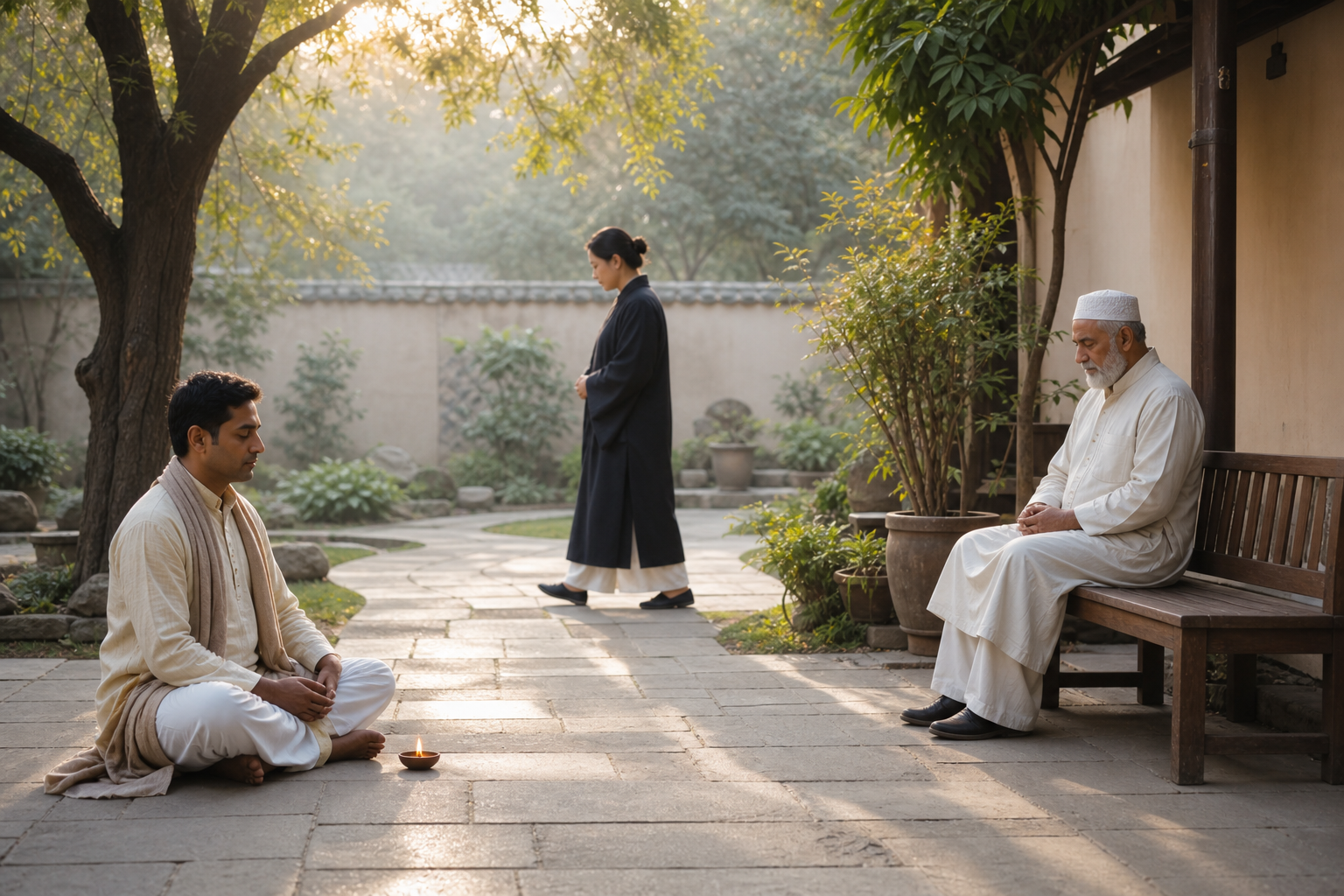
Hindu, Buddhist, Jain, and Sikh paths all train practitioners to loosen compulsive identification, but they do not make an identical metaphysical claim. Treating their vocabulary as interchangeable can make practice shallower rather than more universal. Unity is strongest when difference is understood, not blurred.
| Dharmic path | What practice exposes | Characteristic discipline | Language of freedom |
|---|---|---|---|
| Advaita Vedanta | The error of taking the changing body-mind and reflected consciousness to be the changeless Self | Neti-neti, inquiry into waking, dream, and deep sleep, and abiding as sakshi | Moksha or jivan-mukti through knowledge of Atman |
| Buddhist traditions | Clinging, delusion, and the tendency to construct a permanent identity from changing experience | Mindful presence, insight, non-clinging, and karuna | Nirvana through the ending of clinging and delusion |
| Jain tradition | The pure jiva obscured by karmic accretions and binding attachment | Ahimsa, aparigraha, ethical restraint, and purification | Kevala jnana and release from bondage |
| Sikh tradition | The ego’s claim to separateness, control, and self-importance | Naam-simran, living in hukam, humility, and seva | Inner freedom expressed as dying before bodily death |
A Buddhist practitioner need not adopt an eternal Witness to cultivate clear observation. An Advaitin need not reduce Atman to a temporary attentional state. Jain liberation preserves the reality of jiva rather than dissolving every distinction into Advaitic non-duality. Sikh remembrance remains God-centred and inseparable from hukam and service.
The practical kinship lies elsewhere. Grasping loosens. Reactive identity loses authority. Attention becomes steadier. Compassion and non-harm move closer to the centre of conduct. Egoic compulsion is allowed to die while the person remains fully engaged in life.
If you are rooted in one lineage, use its primary vocabulary and disciplines rather than assembling attractive terms from every path. Let the other traditions sharpen your respect and understanding. They do not need to be collapsed into your own doctrine before their contemplative achievements can be honoured.
Use a witnessing practice that ends in dharmic action

Witness consciousness becomes useful when you practise with a live difficulty, not only with the idea of awareness. Begin with something emotionally real but manageable. The aim is neither to solve the entire situation during meditation nor to manufacture a blank mind. You are learning to see what is happening without immediately becoming its servant.
- Establish contact with the body. Sit in a stable posture and feel the natural breath where it is clearest. Do not force it into a special rhythm. Notice the support beneath the body and let attention become less scattered.
- Bring one difficulty to mind. Choose the unanswered message, uncertain decision, disappointment, conflict, or fear that is actually occupying you. Avoid constructing an imaginary spiritual problem when a real one is already present.
- Separate sensation, thought, and urge. Name them plainly: “tightness in the chest,” “the thought that I will fail,” and “the urge to escape.” This prevents one undivided feeling of crisis from controlling the field.
- Notice that each element is known. Ask silently, “What knows this?” Do not answer with a theory, an image of a witness, or your name. Rest with the immediate fact of knowing.
- Apply neti-neti without rejection. The sensation is known and changes; it cannot exhaust what you are. The thought is known and changes; it cannot exhaust what you are. The role under threat is known and changes; it cannot exhaust what you are. “Not this” means “not my whole identity,” not “unworthy of care.”
- Return through Dharma. Ask what truthful, non-harming, responsible action is available now. It may be listening, apologising, setting a boundary, completing neglected work, requesting help, or declining to retaliate. Take that action without requiring the practice to guarantee its outcome.
If self-inquiry only generates more internal debate, use a simpler anchor. Mantra-japa or Naam-simran can gather attention until the need to analyse subsides. Breath awareness can expose an impulse before it becomes speech. Seva can break the closed circuit of self-concern. These are not competing accessories; they train attention, humility, and conduct from different directions.
Advaita also examines waking, dream, and deep sleep to distinguish awareness from any one state. The claim is specific to its philosophical framework: the Witness illuminates the presence and absence of particular mental worlds while remaining unaffected. Use the inquiry to loosen your assumption that the current waking story is the whole of you. Do not turn it into a forced conclusion that practitioners of every other tradition must accept.
When prayer meets silence
Write down what you asked life or the Divine to provide. Then write what has actually happened. Keep those statements separate. The gap between them often reveals not only grief, but the mind’s contract with reality: “If I am sincere, this result must follow.”
Now ask a different question: “Given what is here, what remains mine to do?” Continue prayer if devotion is genuine, but let prayer include listening, surrender, discernment, and courage. Take the practical steps the situation requires. Inner faith is not a reason to wait passively for rescue.
When anger is about to become speech
Do not begin with a metaphysical claim such as “anger is unreal.” Begin with observable data. What was said? What sensation appeared? What story did the mind add? What action is the body preparing to take?
A useful internal sequence is: “This is the fact. This is the reaction. This is the urge. What response serves truth without unnecessary harm?” Witnessing creates room between urge and action. Dharma tells you what to do with that room. Sometimes the right response is firm. Non-attachment does not require vagueness, submission, or avoidance.
When an outcome matters deeply
Divide the situation into what is yours to govern and what is not fully yours. Preparation, effort, honesty, attention, and repair belong to your side. Other people’s approval, the exact timing of events, and the final result do not belong to you alone.
Then place effort where agency is real. This is non-attachment in working form. It does not mean wanting nothing or performing carelessly. It means refusing to make inner stability conditional on an outcome that no individual can completely command.
Why the practice should lead to seva
An inward path can quietly become self-absorption. Counter that tendency with one useful action for which you do not need recognition. Help with an ordinary task. Give someone your full attention. Correct a mistake that would otherwise burden another person. Serve where the work is needed, not merely where it supports a spiritual self-image.
Seva tests whether witnessing has reduced self-importance. If awareness makes you more available to others, practice is entering conduct. If it merely gives you a refined identity and new language for judging people, ahankara has changed clothes.
Liberation while living must be visible in how you live
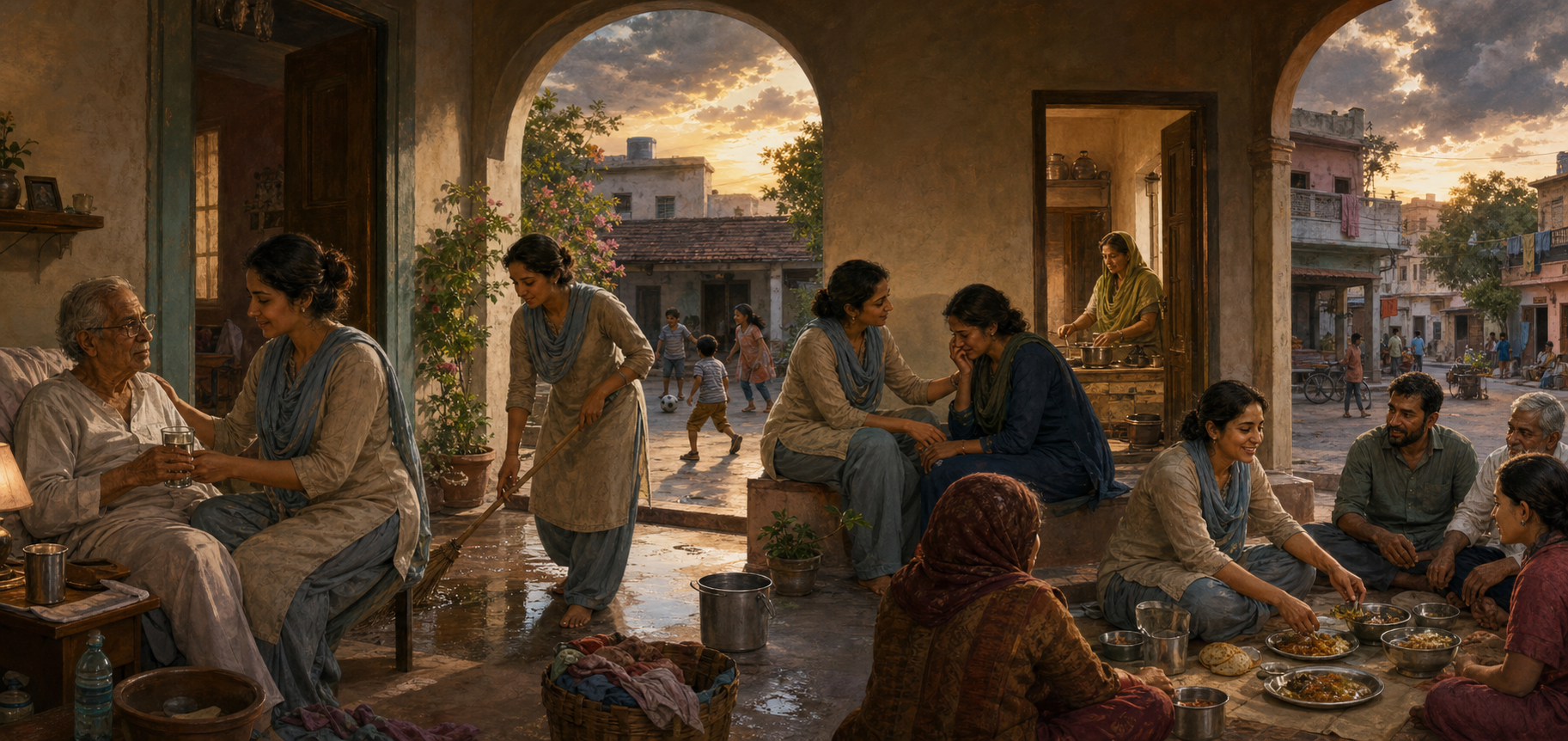
The language of being “dead while alive” refers to the death of compulsive ego, not the destruction of the body or a refusal of worldly responsibility. Jivan-mukti likewise points to freedom while life continues. Family duties, work, uncertainty, bodily limitations, and public obligations remain, but they are no longer organised entirely around defending a fixed self.
In Advaita, moksha is knowledge rather than a modification of the Self, because Atman is held to be already complete and free. Practice does not manufacture Kutastha. It removes confusion and helps the mind assimilate what has been recognised. This is why an extraordinary meditative state is not the final measure: every state begins, changes, and ends.
Look instead for ordinary behavioural evidence:
- An emotion can be felt without being obeyed immediately.
- Criticism can be examined before it is rejected or returned as injury.
- Speech becomes more truthful without becoming needlessly cruel.
- Work can be done carefully without a guarantee of praise or success.
- An apology no longer feels like the annihilation of identity.
- Compassion extends beyond people who confirm your worldview.
- Service becomes more natural and less dependent on visibility.
These signs are incremental. A flash of non-dual understanding does not automatically erase conditioning, repair relationships, or perfect judgement. The cleanest test is what happens when your preferred story is frustrated. That is where attachment becomes visible and where knowledge must enter action.
Several counterfeits deserve direct rejection. Blankness is not necessarily liberation. Emotional numbness is not equanimity. Saying “there is no doer” does not remove the need to apologise, fulfil a duty, or repair harm. Calling every painful event an illusion does not make its consequences disappear. Claiming inner divinity does not make personal desire infallible.
If a spiritual interpretation makes you less honest, less compassionate, or less able to meet your responsibilities, it is moving in the wrong direction. Return to the body, ethical restraint, trusted guidance, and concrete service. The witness is not a hiding place from life.
Key takeaways for your daily practice
- The Witness is not the internal commentator. The voice announcing that it is observing can itself be observed.
- Inner divinity is not personal omnipotence. It locates sacred depth within awareness and conscience without promising control over events.
- Dharmic traditions share disciplines without sharing one metaphysics. Preserve the differences among Advaita’s Atman, Buddhist non-clinging, Jain jiva, and Sikh God-centred remembrance.
- Use a complete practice loop. Notice sensation, thought, and urge; recognise that they are known; then choose a truthful and non-harming action.
- Judge insight by conduct. Less reactivity, clearer responsibility, humility, ahimsa, compassion, and seva matter more than impressive language or unusual states.
The next time you are hooked by fear, anger, or the need to control an outcome, do not try to become a different person all at once. Notice what is known, remain with the fact of knowing, and take the next dharmic action. Living freedom becomes credible through that repeated movement from awareness to responsibility.
References
- Tiny Buddha — The God I Lost, the One I Found, and the Faith That Changed Me
- SikhNet — Dead While Alive
- Hindu Blog — Master Kutasthadipa: The Complete Guide to Panchadasi’s Eighth Chapter and Witness Consciousness
