
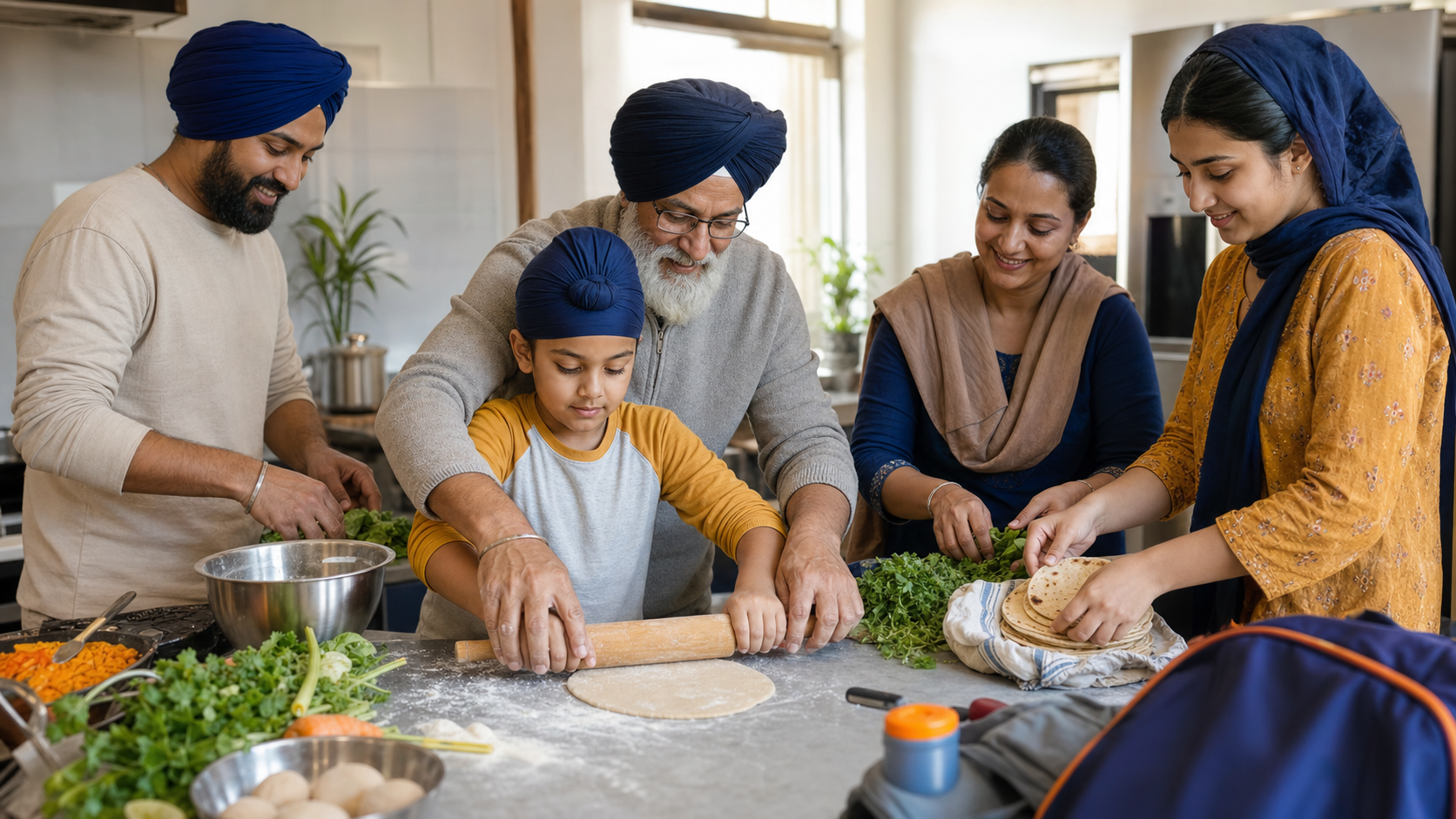
If your child knows what happens at the gurdwara but cannot explain why it matters, the problem is probably not a lack of exposure. Heritage has remained something around the child instead of becoming a language for choices, relationships, and responsibility.
Your task is not to reproduce the household of an earlier generation. It is to build a pattern your child can understand, practise, question, and eventually carry without constant supervision. That requires more than occasional festivals, lectures about pride, or rules enforced only when relatives are watching.
Decide what you are actually trying to transmit
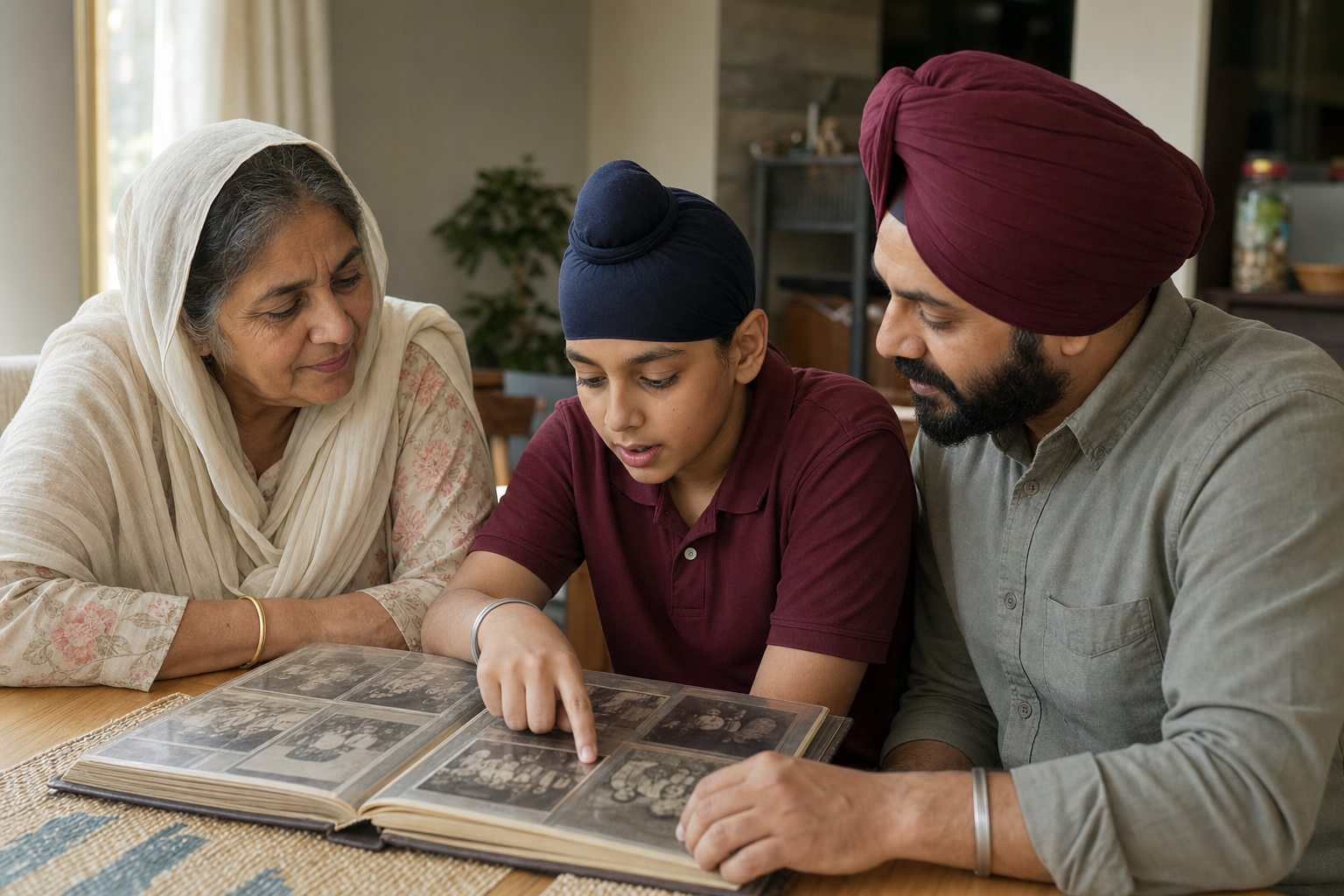
Sikh heritage is not an inventory of Punjabi food, clothing, music, surnames, and family photographs. Those can carry affection and memory, but they do not by themselves teach a child how to live as a Sikh. Nor is identity secured by collecting religious vocabulary that never enters conduct.
Begin with the tradition’s organising commitments. Ik Onkar, Naam, Kirat Karo, Vand Chhako, and seva connect spiritual understanding with remembrance, honest work, sharing, and service. Sarbat da bhala widens the moral horizon beyond the household or community to the welfare of all. The line from Guru Nanak through Guru Gobind Singh, culminating in the Guru Granth Sahib as the eternal Guru, gives these commitments a distinctly Sikh source and form.
Write a short family identity statement using language your child can understand. It need not sound like a creed. A workable version might be: “In this family, we remember the One, work honestly, share what we have, serve without seeking status, and stand for human dignity.” Then connect each phrase to Sikh practice and teaching. The statement is useful only if it helps your family decide what to do on an ordinary day.
Test your transmission plan with three practical questions:
- Knowledge: What should your child be able to explain in their own words about the Gurus, Gurbani, Sikh history, and the practices followed at home?
- Practice: What should your child be able to do, rather than merely recognise, such as reading Gurmukhi, joining simran, participating in kirtan, or carrying out seva?
- Belonging: Which relatives, teachers, elders, and peers will make Sikhi feel like a living community rather than a private parental project?
This also protects against a common mistake in dharmic households: confusing shared values with identical identities. Sikhism, Hinduism, Buddhism, and Jainism can meet around truthfulness, compassion, disciplined conduct, generosity, and non-harm. Children should learn that common ground. They should also learn that unity does not make the traditions interchangeable. Sikh identity has its own Gurus, scripture, institutions, disciplines, historical memory, and vocabulary.
Build a household rhythm that survives busy weeks

Festivals can intensify belonging, but the ordinary week carries heritage forward. A family that tries to teach everything during Vaisakhi or a holiday visit to relatives places too much weight on exceptional moments. Give Sikh learning a predictable place in the household calendar.
A durable rhythm has several layers:
- Daily remembrance: Begin the day with an age-appropriate portion of Nitnem, simran, quiet reflection, or attentive listening to a shabad. Keep the sequence stable enough that the child knows how to enter it. At another point in the day, ask where they noticed honesty, sharing, courage, or service in real life.
- Regular language practice: Read Gurmukhi aloud, build Punjabi vocabulary, and connect words to Gurbani or family conversation. Do not let pronunciation drills become the whole lesson. Ask what a line means, what question it raises, and how its teaching might change a choice.
- Sangat and seva: Attend the gurdwara as participants. Give the child a real responsibility in langar, shoe care, clean-up, welcoming, donation work, or another suitable form of service. A task makes belonging concrete.
- Story and memory: Make space for sakhis, Sikh history, and family migration or community memories. Ask the child to retell, illustrate, record, or dramatise what they heard. Retrieval and interpretation reveal more than silent recognition.
- Embodied skill: Where available, use kirtan, gatka, or another disciplined community practice to join attention, repetition, courage, and fellowship. Skill gives a young person a reason to return and a role among peers.
A Sikhi-centred learning rhythm can combine academic study with Nitnem, Gurmukhi, Gurbani vichaar, history, kirtan, gatka, and seva. You do not need to homeschool to use that principle. The important move is integration: language, history, ethics, and service should reinforce one another instead of competing as unrelated extracurricular activities.
Do not launch every practice at once. Choose a manageable anchor for remembrance, an anchor for literacy, and an anchor for community participation. Put them in the calendar before adding more. A modest rhythm that continues during demanding weeks will transmit more than an ambitious programme repeatedly abandoned.
Turn the child from an audience member into a contributor
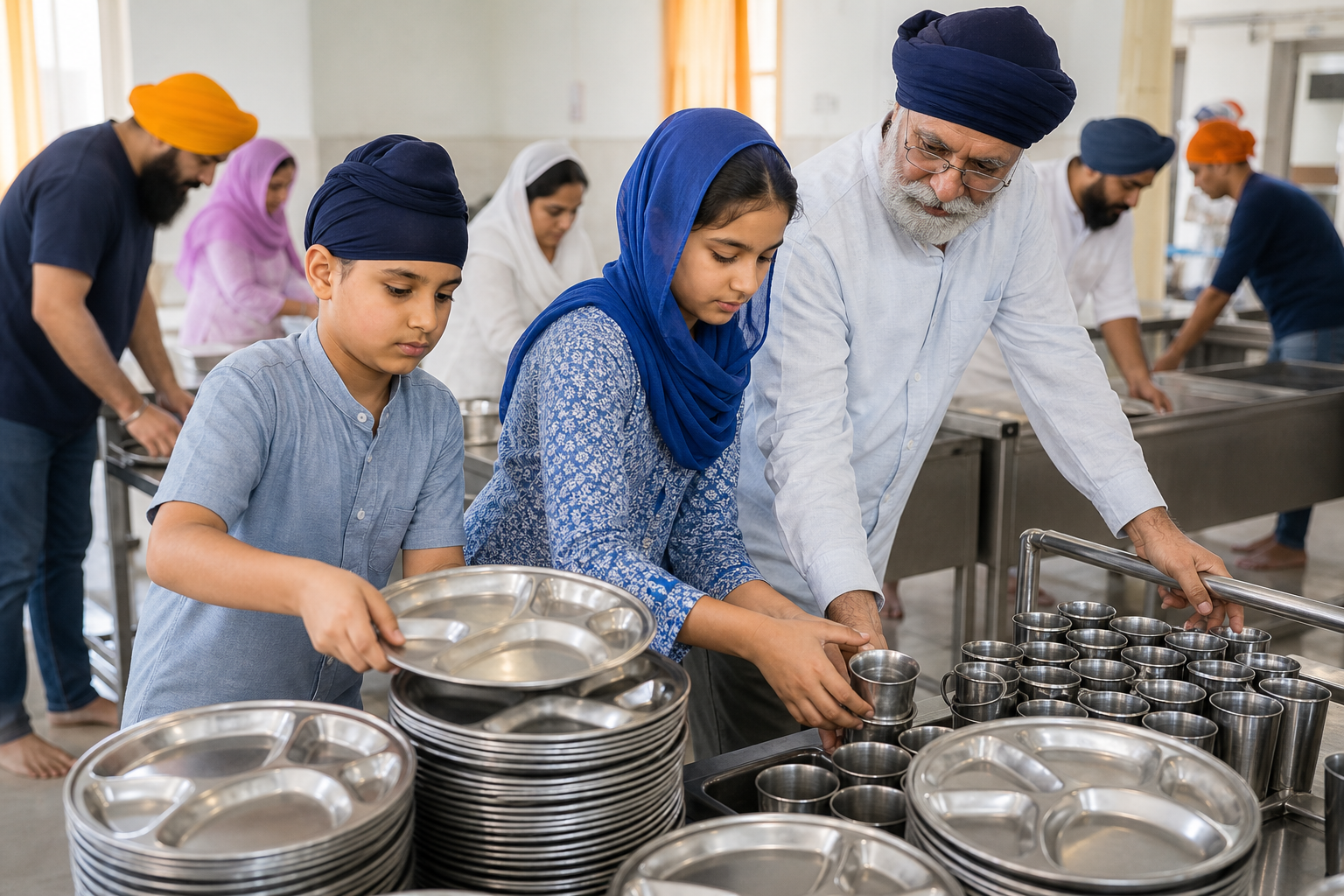
Children often spend cultural events being transported, dressed, instructed, photographed, and corrected. Adults do all the consequential work. That arrangement may create memories, but it does not teach ownership. Heritage becomes durable when the child produces something useful for another person.
Build projects with a visible result, a real audience, and an ethical purpose:
- Plan part of a langar: Prepare a budget, list quantities, identify responsibilities, and explain how the shared meal expresses equality and Vand Chhako. Mathematics, cooperation, and Sikh ethics now belong to the same task.
- Map a gurdwara: Draw or photograph its significant spaces, label what happens in each one, and ask why the layout serves worship, hospitality, and community life. This turns a familiar building into a subject of inquiry.
- Create a story: Adapt a sakhi or an episode of Sikh history into a script, audio scene, or illustrated narrative. Strong heritage storytelling requires more than a moral pasted onto the ending. It benefits from careful scene design, believable dialogue, consultation with elders, archival checking, and mentor feedback.
- Document family memory: Interview an elder about prayer, migration, work, language, seva, or a gurdwara community. Preserve the elder’s voice while distinguishing personal recollection from verified history. If the work will be shared publicly, check names and historical claims before presenting them as settled facts.
- Lead a service task: Let the child identify a need, help organise the response, and reflect on who benefited. Keep seva centred on the need being served, not on photographs or praise for the helper.
- Learn under a mentor: A kirtan teacher, Gurmukhi tutor, gatka instructor, historian, or trusted elder can provide skill, correction, and accountability that parents alone may not be able to supply.
Keep a simple heritage portfolio. It might contain Gurmukhi writing, recordings of recitation, project notes, family interviews, artwork, questions about Gurbani, and reflections after seva. The purpose is not to award identity points. It is to notice whether learning is becoming more articulate, independent, and connected.
Look for evidence that transmission is working. Can your child explain a practice without repeating your exact wording? Can they take a useful role at the gurdwara without waiting for a parent to direct every move? Can they connect a teaching to a decision at school or at home? Do they know which trusted adult to approach when you cannot answer a question? These are stronger indicators than attendance alone.
Meet questions about kesh and belonging without panic

Visible identity eventually meets the outside world. A child may ask why kesh matters, resist a routine, compare themselves with classmates, or wonder why other dharmic communities follow different disciplines. Treat that moment as part of heritage transmission, not as proof that transmission has failed.
Do not reduce kesh to personal style. Within Sikh life, unshorn hair carries meanings of devotion, discipline, belonging, and the courage to bear identity publicly. At the same time, “because our family says so” does not give a young person enough understanding to carry a visible commitment under pressure.
Use a calm sequence when the question arises:
- Ask what changed. Find out whether the immediate issue is school culture, teasing, convenience, comfort, a public activity, or a deeper disagreement about belief. Do not answer a question about social pressure as though it were merely a question about grooming.
- Explain the practice positively. Describe what kesh affirms before discussing what cutting it would mean. Connect the visible discipline to remembrance, integrity, courage, and membership in a living tradition.
- Let the child ask the difficult version. Questions about fairness, gender, consistency, or other family members should not be treated as disrespect merely because they are uncomfortable. If you do not know, say so and find someone qualified to help.
- Bring in credible relationships. A trusted Sikh mentor who listens well can make the practice intelligible in a way that a parental command cannot. Choose someone who will answer honestly, not shame the child or stage a loyalty test.
- Keep love and conversation intact. If a family member makes a choice you oppose, you can state the religious significance clearly without turning the household into a tribunal. Continued study, seva, sangat, and respectful dialogue preserve routes back to understanding.
Differences among dharmic traditions can actually sharpen this explanation. Jata in some Hindu ascetic settings and head-shaving in Buddhist or Jain disciplines do not establish a universal dharmic rule about hair. They show that traditions can use different bodily disciplines to cultivate intentionality, humility, renunciation, or commitment. The appropriate lesson is not that all choices mean the same thing. It is that a discipline must be understood within the path that gives it meaning.
The same approach applies to language loss, reluctance to attend the gurdwara, or discomfort with public Sikh identity. Name the value at stake, listen for the actual pressure, teach the history and practice, and preserve the relationship in which future understanding can grow. Shame may end a conversation quickly; it cannot supply the reasons a child will need when the family is absent.
Key takeaways for a family heritage plan
- Define Sikh identity through knowledge, practice, and belonging, not cultural display alone.
- Give remembrance, Gurmukhi or Punjabi learning, seva, and storytelling dependable places in ordinary family life.
- Let children make, lead, serve, explain, and teach instead of attending only as spectators.
- Use elders and mentors as living relationships, while checking personal memories before presenting them as public history.
- Teach shared dharmic ethics without blurring Sikh scripture, lineage, institutions, and disciplines into a generic spirituality.
- Discuss kesh and other visible commitments through meaning, inquiry, mentorship, and continued relationship rather than embarrassment or coercion.
- Measure progress by growing understanding, independent participation, moral application, and trusted community ties.
Start at your next family meal. Complete the sentence “In this family, being Sikh means…” and ask your child how that meaning appeared during the day. Then choose the next practice, project, or mentor relationship that can turn the answer into something lived.
References
- DharmaRenaissance Blog — Complete Guide to Sikhi-Centered Homeschooling: Proven Practices to Nurture Mind and Spirit
- DharmaRenaissance Blog — Discover SikhNet’s 2024 Scriptwriting Winners: A Complete, Inspiring Interview on Storytelling
- DharmaRenaissance Blog — Discover the Sikh Spectrum: The Complete, Proven Guide to Timeless Heritage for Today’s World
- DharmaRenaissance Blog — Discover the Deeper Meaning of Unshorn Hair: A Complete Guide to Family Identity, Change, and Dharmic Unity
