
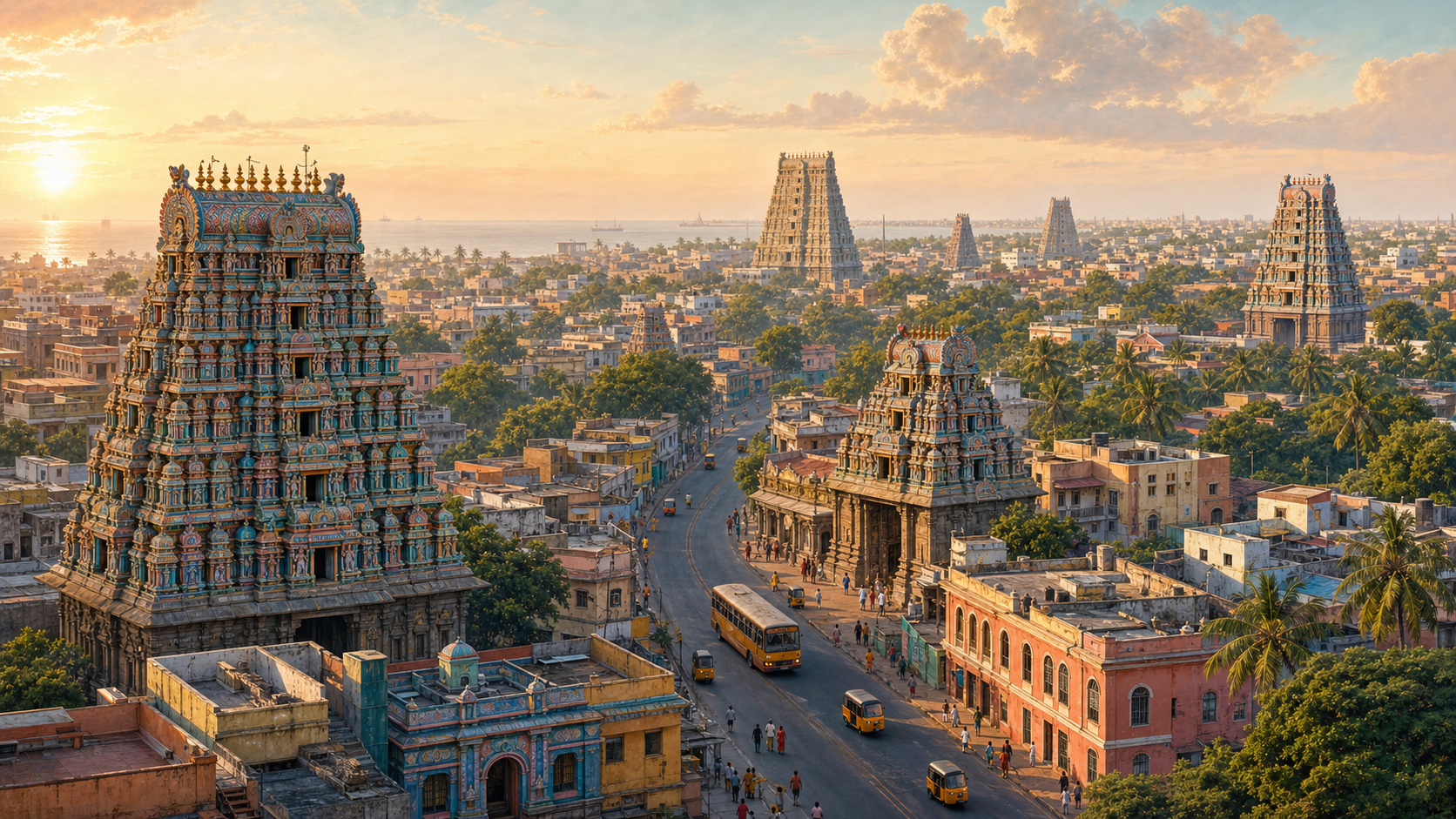
You want to see Chennai’s major temples without turning a pilgrimage into a race through city traffic. The practical answer is to organize the ten sacred landmarks by neighborhood: one northern and central arc, followed by one western and southern arc.
Use two days if completing the circuit matters and you are comfortable with full days. Use three if you want unhurried darshan, time to observe the temple arts, and room for a festival or schedule change. The order below is a travel framework, not a hierarchy among the temples.
Build the circuit around five neighborhood clusters
The ten temples are spread from Thiruvottiyur and George Town to Mylapore, Nanganallur and Chennai’s southeastern neighborhoods. Treating every temple as an isolated destination creates unnecessary backtracking. Grouping temples that share an area gives you a better chance of arriving composed rather than carrying the impatience of the road into the shrine.
| Route cluster | Temples | Neighborhoods |
|---|---|---|
| Northern anchor | Adi Pureeswarar Temple | Thiruvottiyur |
| Historic core | Kalikambal Temple and Sri Kandaswamy Temple | George Town |
| Central heritage arc | Parthasarathy Temple and Kapaleeshwarar Temple | Triplicane and Mylapore |
| Western and southern arc | Vadapalani Andavar Temple and Nanganallur Anjaneya Temple | Vadapalani and Nanganallur |
| Southeastern arc | Madhya Kailash, Ashtalakshmi Temple and Marundeeswarar Temple | Adyar, Besant Nagar and Thiruvanmiyur |
Do not attach a rigid clock time to every stop before you have checked current opening, puja and access information. Temple conditions can also change during festivals. Confirm the day’s details locally, then use live directions to adjust the sequence without breaking the neighborhood clusters.
If you prefer calmer darshan and gentler light for seeing sculptural details, make early morning and evening your principal visiting periods. Keep the middle of the day available for travel, food and rest rather than assuming that every temple will fit a continuous timetable.
Day one: Thiruvottiyur, George Town, Triplicane and Mylapore
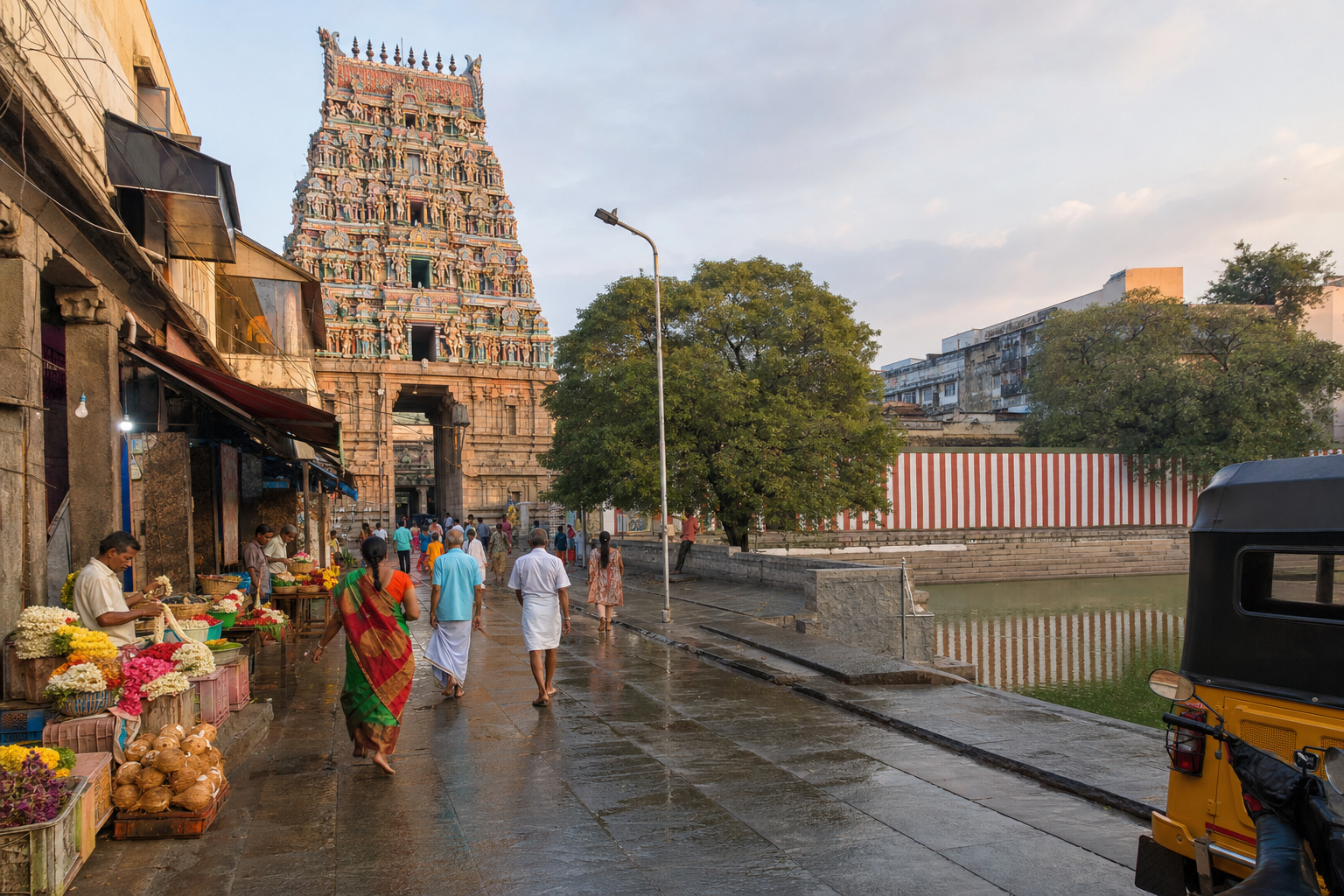
This first arc contains five temples but only four geographic stops. Begin in the north and work toward Mylapore. That prevents you from reaching central Chennai and then having to make a separate return to Thiruvottiyur.
- Begin at Adi Pureeswarar Temple in Thiruvottiyur. Make the northernmost destination your first anchor. Arrive early enough that the rest of the route does not pressure you to shorten the opening darshan.
- Continue to the George Town pair. Visit Kalikambal Temple and Sri Kandaswamy Temple as one neighborhood cluster, while treating them as two separate sacred encounters. If the current schedule at one temple creates a delay, check the other rather than leaving George Town and planning a return.
- Move to Parthasarathy Temple in Triplicane. This is the transition from the historic core toward the central heritage arc. Recheck the remaining time before entering so that the final Mylapore visit does not become a rushed formality.
- Conclude at Kapaleeshwarar Temple in Mylapore. The temple is a historic center of Shiva-Parvati worship at 234, Ramakrishna Mutt Road, Vinayaka Nagar Colony, Mylapore, Chennai, Tamil Nadu 600004. Its Dravidian architecture, layered iconography, ritual music and active community life justify keeping the final visit spacious rather than squeezing it between transport deadlines.
The George Town pair is the point most easily misread on a checklist: two names in one neighborhood still mean two darshans, two sets of local instructions and two opportunities to slow down. Do not budget it as though it were a single stop.
If the first day becomes too crowded, move Thiruvottiyur to its own early morning rather than cutting a few minutes from every temple. If you have only one day in Chennai, choose one compact arc – Triplicane and Mylapore, the George Town pair, or the three southeastern temples – instead of claiming to have meaningfully completed all ten.
Day two: Vadapalani, Nanganallur and the southeastern arc
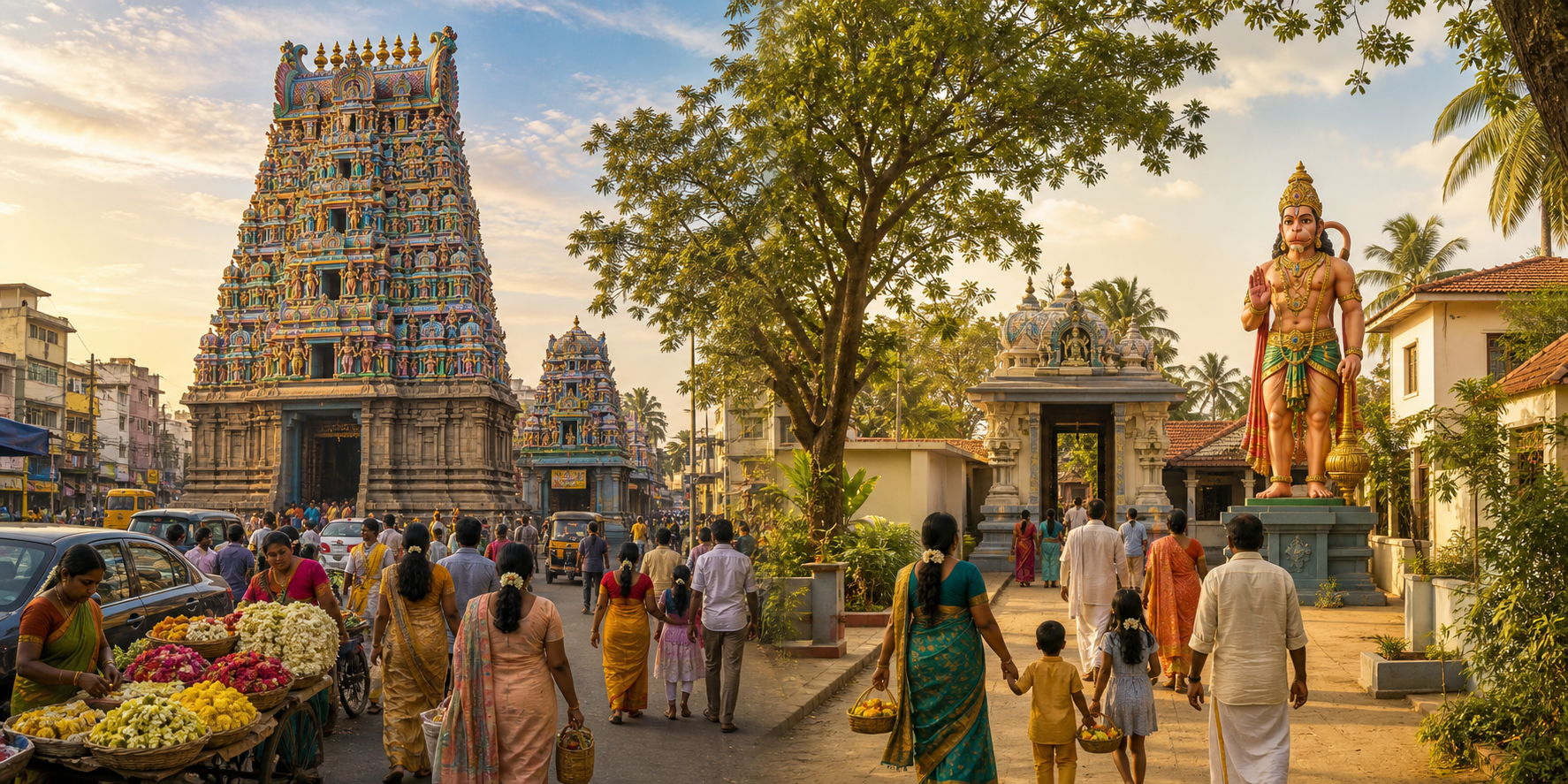
The second day crosses more distinct neighborhoods, so its success depends on preserving the order of the route. The sequence below assumes that you begin toward western Chennai. Reverse it if your accommodation or onward journey makes Thiruvanmiyur the more sensible starting point.
- Start at Vadapalani Andavar Temple in Vadapalani. Treat it as the western anchor rather than postponing it until after reaching the southeastern side of the city.
- Continue to Nanganallur Anjaneya Temple in Nanganallur. Complete this southern destination before turning toward Adyar and the coastal neighborhoods.
- Visit Madhya Kailash in Adyar. Use it as the entry point to the final three-temple cluster. Before leaving, check the current status of both remaining temples so that you can respond to a schedule change while you are still nearby.
- Proceed to Ashtalakshmi Temple in Besant Nagar. Protect enough time for darshan instead of treating the temple merely as a connector between Adyar and Thiruvanmiyur.
- Finish at Marundeeswarar Temple in Thiruvanmiyur. An evening conclusion suits a circuit in which the last hour is reserved for worship and attention rather than another cross-city transfer.
A three-day pilgrimage uses the same route logic with a gentler division. Keep Vadapalani and Nanganallur together on the second day. On the third, visit Madhya Kailash, Ashtalakshmi Temple and Marundeeswarar Temple as a dedicated southeastern circuit. This is the better choice if sacred art, temple music and time for reflection matter more to you than completing a list quickly.
Major festivals change the character of the visit. Processions, devotional music and community feasts are not delays outside the pilgrimage; they are part of the temple’s living calendar. If one is underway, remove another stop from that session or use the third day rather than fighting the pace of the celebration.
Give darshan priority without overlooking the temple arts
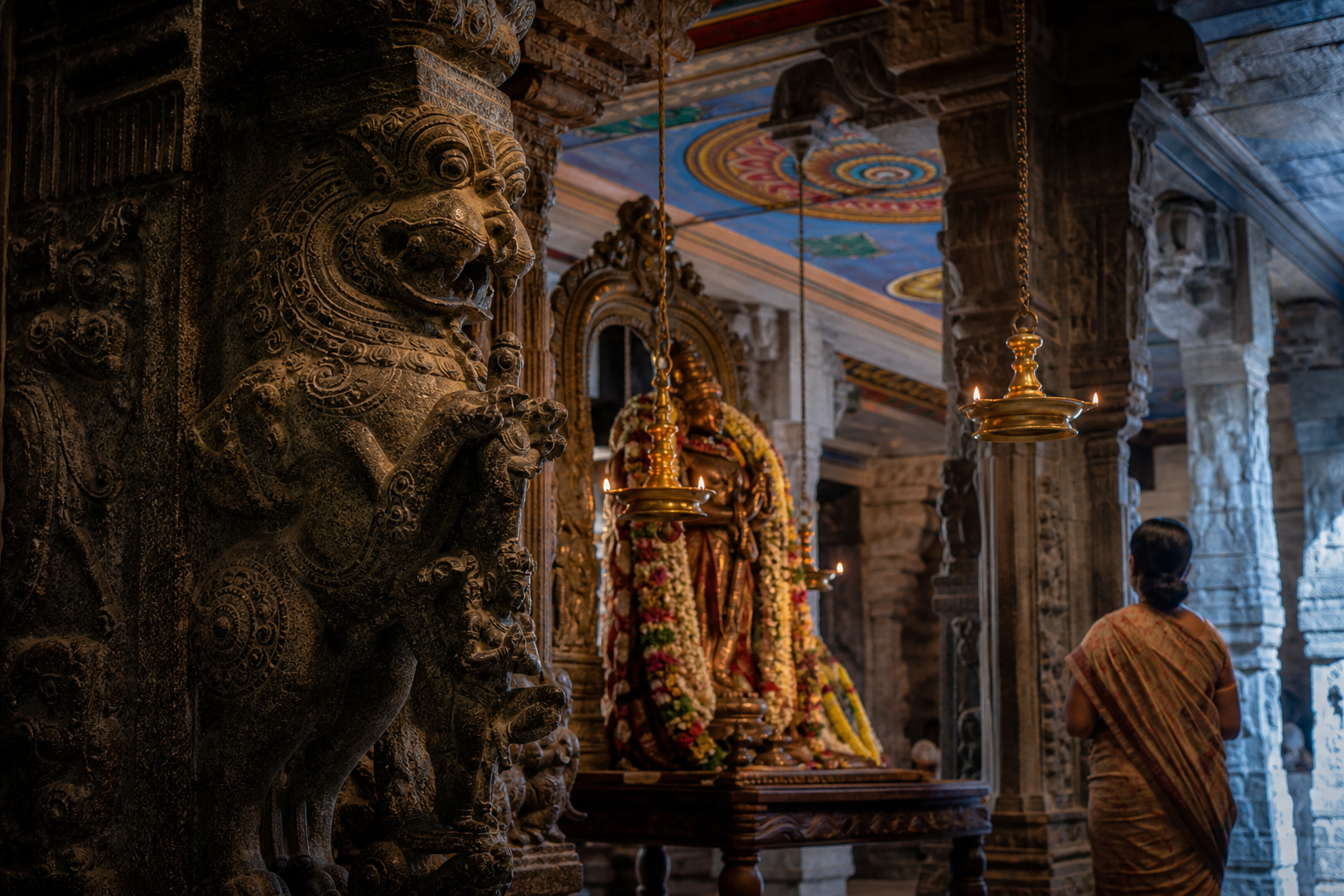
Chennai’s temples are active places of worship, learning and community life, not architectural displays with rituals happening in the background. The gopurams, mandapas, successive prakaras, images, music and movement become more intelligible when you see them within that living devotional order.
A simple four-part practice keeps the visit reverent while helping you notice more:
- Settle before entering. Put away the phone, follow local footwear instructions and allow your attention to shift from the road to the sacred precinct.
- Let darshan come first. Follow the movement of worshippers, avoid obstructing a queue or shrine entrance, and do not force architectural observation into the busiest point of worship.
- Read the space after the central encounter. Notice how a gateway tower, hall, enclosure, shrine arrangement and image guide your movement. At Kapaleeshwarar Temple, give particular attention to the relationship between layered iconography, ritual sound and community participation.
- Pause before leaving. Stand or sit outside the main flow and retain one concrete impression: a form, a sound, a gesture of worship or a moment of shared silence. This keeps ten visits from blending into one vague memory.
Basic etiquette makes that attention possible:
- Wear modest clothing suitable for an active place of worship.
- Keep your voice low, especially inside enclosed halls and near worship in progress.
- Follow each temple’s own rules for photography, footwear, queues and circulation; do not assume that a practice permitted at one shrine applies to the next.
- Move mindfully through the prakaras and leave clear space for devotees performing ritual actions.
- During a major festival, allow additional time for processions, music and community activity instead of building a tightly timed transfer.
Hindu devotees can undertake this circuit as pilgrimage, while visitors from Buddhist, Jain or Sikh backgrounds can approach it through the shared dharmic habits of reverence, disciplined attention and learning. Respect does not require flattening the traditions into sameness. Enter each Hindu shrine on its own terms and accept its local practices as part of what you have come to understand.
Key takeaways before you leave
- The complete circuit contains ten temples organized into five practical neighborhood clusters.
- For two days, use a Thiruvottiyur-to-Mylapore arc first, then a Vadapalani-to-Thiruvanmiyur arc.
- For three days, separate Vadapalani and Nanganallur from the Adyar-Besant Nagar-Thiruvanmiyur cluster.
- Verify current opening, puja, festival and access information before assigning exact arrival times.
- Use early morning and evening for calmer darshan and better conditions for observing sculptural details.
- Give ritual movement priority, then study the gopurams, mandapas, prakaras, iconography and community life without blocking worshippers.
- If a festival expands the visit, shorten the day’s itinerary rather than rushing through the sacred event.
Your next step is concrete: save the ten temple names into two map lists, pin Kapaleeshwarar Temple’s full address, and verify the current conditions for the first three stops on each day. If either list already feels crowded, choose the three-day version now. A Chennai temple circuit works best when the route protects your attention instead of consuming it.
References
