
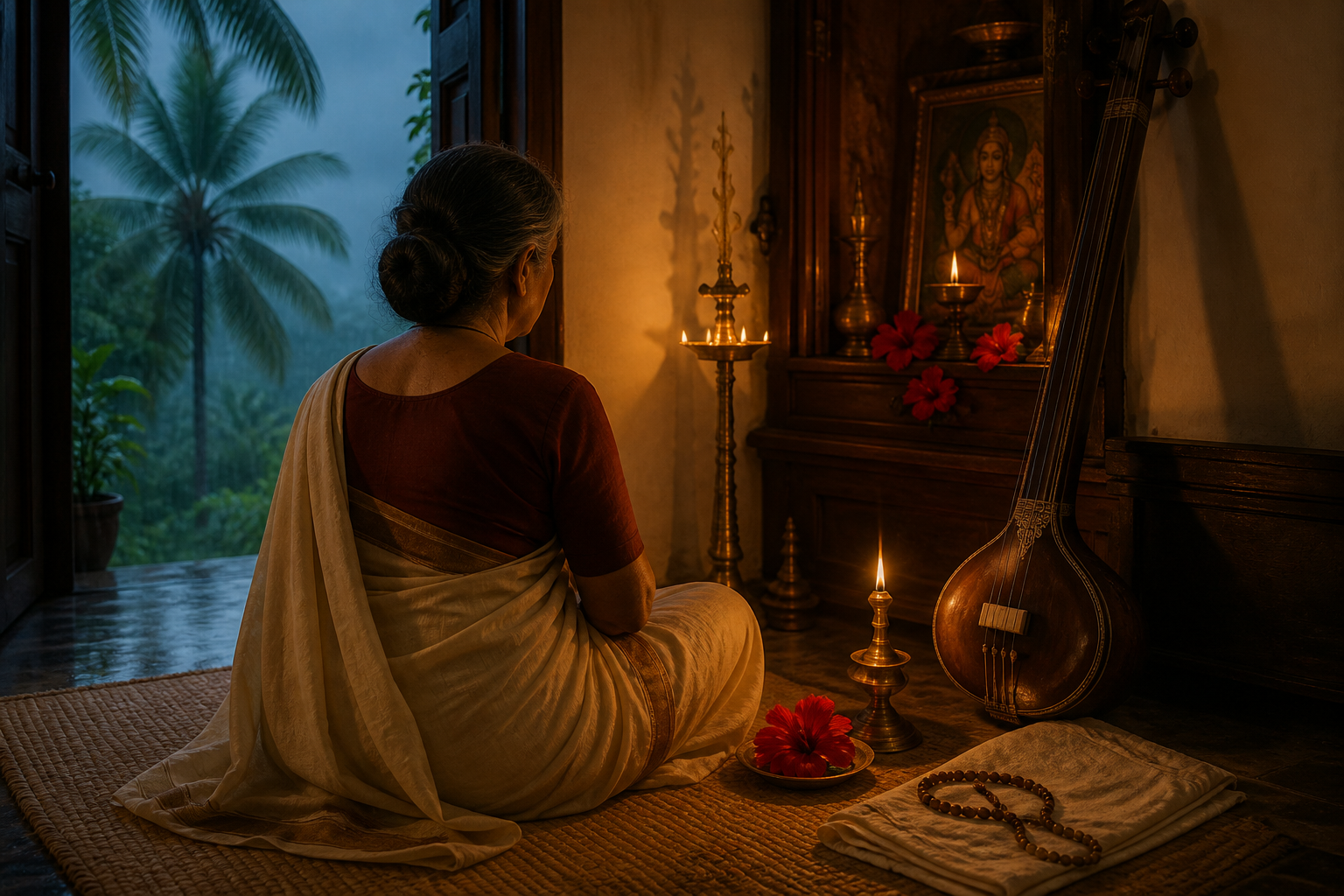
If you feel drawn to Lalita Sahasranama but hesitate because you were not born into a Hindu family, Kalabhavan Alice’s life offers a clear way to think about that concern. Your starting point matters, but it need not dictate the limits of your spiritual life.
Her path offers neither a shortcut nor a universal permission slip. It offers something more useful: a pattern of encounter, patient learning, regular practice, community and surrender. It shows how welcome and discipline can belong together.
A doorway through marriage, a bridge through music
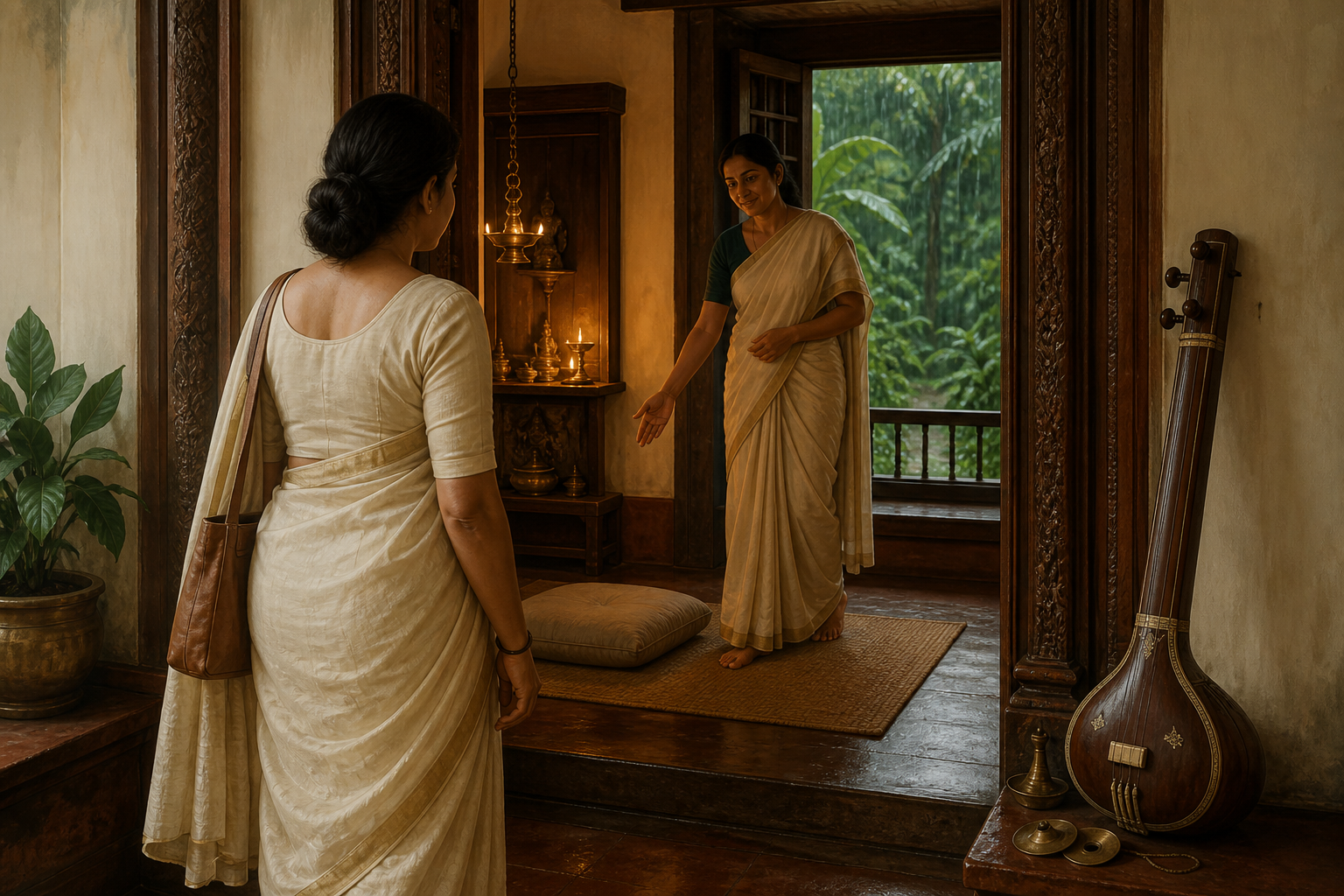
For generations of Kerala listeners, Alice has been known as Kalabhavan Alice, a singer associated with Kochi’s celebrated Kalabhavan troupe. Yet the spiritual practice that came to organize her life did not begin on a concert platform.
Alice was born into a Christian family in Kottayam. After marrying Unnikrishnan, a Hindu Nair, she moved to Kollam. The marriage met opposition, but it also brought her into sustained contact with a cultural and religious world she had not inherited at birth. Her husband introduced her to Lalita Sahasranama.
“I came to know about Lalita Sahasranama through my husband, Unnikrishnan.”
Kalabhavan Alice
That introduction did not mechanically produce devotion. Alice began visiting temples, observing customs, reading and trying to understand the traditions around her. Proximity created an opportunity; she chose what to do with it. This distinction matters if your own interest began through a spouse, friend, temple visit, performance or recording. A doorway is not yet a discipline.
Music made that doorway more intelligible. Alice completed graduate and postgraduate studies in music at Sri Swathi Thirunal College of Music in Thiruvananthapuram. Her career included professional singing, playback work and performances outside India. Carnatic music continually placed her in the company of Sanskrit vocabulary, Hindu deities, philosophical ideas and bhakti.
Her musical training was therefore more than a technical advantage. It allowed sacred sound and devotional meaning to meet within a form she already knew deeply. Acquaintance became fascination; fascination led to study; study matured into sadhana.
If you are wondering where to begin, notice the practical lesson. Begin through the doorway you genuinely have. It may be music, language, philosophy, temple culture or a relationship with a practitioner. Then move beyond attraction. Read, listen, observe and establish a practice that does not depend on novelty.
What nineteen years of chanting changed for Alice

Alice described a relationship with Lalita Sahasranama extending across about nineteen years of chanting. By then, the hymn was not an occasional devotional selection. She said she could no longer imagine her life without it.
Lalita Sahasranama presents a thousand names of the Divine Mother. Alice approaches those names not merely as information about a deity, but as sacred sound acting upon attention, embodiment and consciousness. In her understanding, chanting is a form of meditation and a way of relating to Brahman, the reality underlying the universe.
She also interprets the sounds through the language of subtle energy, describing their resonance within the human system and their influence upon the chakras beginning with Muladhara. That is her spiritual understanding, grounded in long practice. It should be received as devotional testimony rather than presented as a laboratory finding.
Alice says the discipline transformed her physically, mentally and materially. She does not describe an instant intervention. She describes gradual change: repeated chanting produced what she understands as positive vibrations, reshaped her outlook and reduced her tendency to worry excessively about life’s uncertainty.
The distinction between testimony and guarantee is essential. Alice’s experience tells you what the practice came to mean in one life; it does not promise identical outcomes on a timetable. Claims about physical or material benefits should not be turned into medical advice, financial expectation or a reason to neglect professional help. The hymn is sadhana, not a transaction in which a specified number of recitations purchases a desired result.
There is still something concrete you can evaluate. A regular recitation gives you a recurring occasion to gather your attention, hear your own restlessness and place uncertainty within a devotional relationship. Instead of asking whether a dramatic sensation has arrived, notice whether your pronunciation is becoming steadier, your attention less scattered, your understanding deeper and your response to worry less automatic.
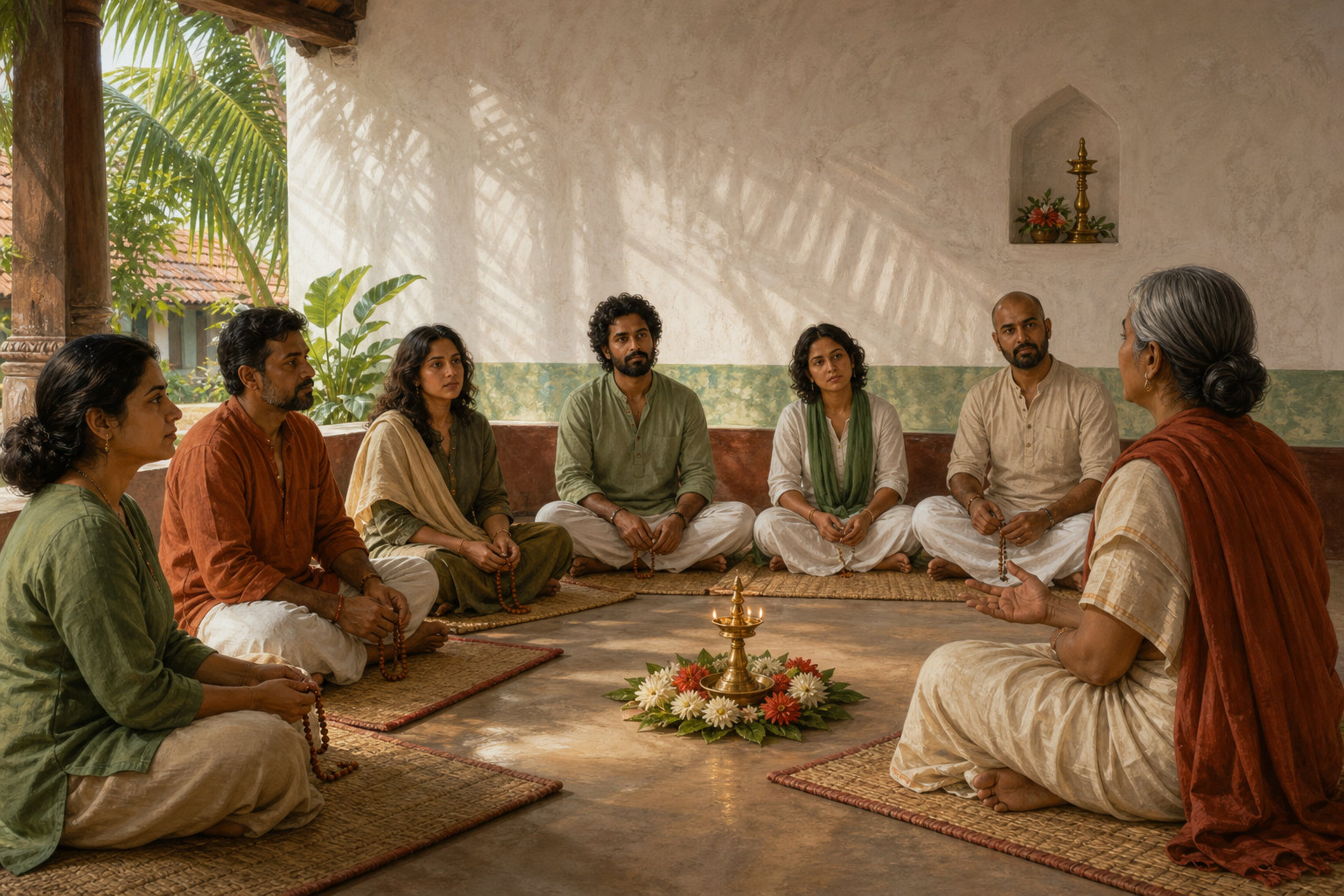
The practice has also become communal. Nearly twenty-five students were gathering each day at Alice’s home to chant. She was also teaching Rudram and Chamakam while continuing to study them herself. That last detail is worth holding onto: teaching need not mean declaring oneself finished.
Her birth is important, but it is not the whole story
The immediately striking fact is that Alice was born into a Christian family. If we stop there, however, we reduce a seeker to a curiosity: a Christian-born woman chanting a Hindu hymn. The more significant fact is what followed the first encounter.
She did not treat the tradition as an exotic soundscape or a temporary mood. She entered a Hindu family, encountered temple customs, read, asked questions, brought her musical formation into conversation with sacred language and sustained the discipline for years. The seriousness lies in that sequence.
Her journey therefore corrects two opposite mistakes. The first is to assume that birth alone determines whether a person can form an authentic relationship with a Dharmic practice. The second is to flatten distinct traditions into the vague claim that all religious forms are interchangeable. Alice’s path requires neither conclusion.
She moved toward a particular Hindu devotional world: the Divine Mother, Lalita’s thousand names, Sanskrit sacred sound, temple practice and the language of Brahman. Respecting the specificity of that movement makes her openness more meaningful, not less.
Sanatana Dharma appears here as hospitable without being shapeless. A person may arrive through circumstances she did not plan, but sustained participation asks something of her: attention, humility, study, repetition and a willingness to be changed. Inclusion is not indifference to practice.
If you belong to an interfaith family, do not turn Alice’s life into a weapon for winning an argument. An invitation to chant, visit a temple or listen to an explanation must remain an invitation. Share what the practice means to you, make room for questions and allow chosen participation to develop at its own pace. Coercion can reproduce the very gatekeeping that Alice’s journey helps us see beyond.
Nor does one person’s path settle every question about lineage-specific instruction. Customs can differ when practice moves from a publicly recited hymn into particular mantras or rituals. At that boundary, ask a qualified teacher what preparation or guidance the relevant tradition expects. Openness and respect for lineage do not have to compete.
How to begin without trying to imitate her life
You cannot reproduce Alice’s marriage, musical education or personal history, and you do not need to. The useful part to imitate is the movement from attraction to understanding and from understanding to disciplined repetition.
- Name what draws you. Is it devotion to the Divine Mother, the sound of the Sanskrit names, the philosophical vision or the steadiness of daily recitation? A clear motive helps you distinguish your own interest from borrowed enthusiasm.
- Learn the context before chasing speed. Use a reliable text and competent instruction. Listen closely to pronunciation, and study the meanings alongside the sounds. Alice’s route included reading, observing customs and trying to understand the tradition; it was never merely passive listening.
- Begin with a manageable portion. If the complete recitation is beyond your present ability, learn a smaller section clearly and repeat it until it is stable. Accuracy and continuity give you a firmer foundation than rushing through all the names.
- Let music help without turning sadhana into performance. A trained voice may support breath, pitch and memory, but devotional recitation is not an audition. Do not measure sincerity by vocal beauty or dramatic expression.
- Practise with others when possible. A teacher or chanting group can catch errors that become invisible in solitary repetition. A group also makes regularity concrete: you arrive, listen, correct yourself and chant with people who are learning the same discipline.
- Keep your claims proportional to your experience. Record whether you practised, what distracted you, which name or meaning held your attention and whether your response to uncertainty is changing. Do not force every passing emotion or fortunate event into a supernatural explanation.
- Ask before entering lineage-specific practices. If your learning expands from Lalita Sahasranama recitation into specialized mantra or ritual instruction, seek a teacher rooted in that practice. General enthusiasm is not a substitute for precise guidance.
- Remain teachable when others begin learning from you. Alice’s example is especially valuable here: she taught while continuing her own study. Sharing what you know should deepen your responsibility to learn accurately.
This approach also protects you from a common disappointment. A powerful first encounter can create the expectation that every recitation should feel powerful. It will not. Some days will feel attentive, others mechanical. The discipline lies in returning carefully enough that mechanical repetition does not become careless repetition.
Do not demand Alice’s reported results from your own practice. Ask a more honest question: are you becoming capable of staying with the names, their meanings and the presence they invoke? That is a question your own continuity can answer.
Key takeaways
- Birth describes where Alice’s journey began; it does not explain the depth of the practice she later chose.
- Carnatic music gave her a bridge into Sanskrit, bhakti and Hindu sacred thought, but repeated chanting turned familiarity into sadhana.
- Her accounts of physical, mental and material change are personal spiritual testimony, not guaranteed outcomes or substitutes for professional care.
- A respectful beginning combines reliable instruction, careful pronunciation, study of meaning, manageable repetition and community where available.
- Sanatana Dharma can welcome a seeker across inherited boundaries while still asking for rigor, humility and respect for lineage.
If Alice’s path has stirred you, make your next move modest and real. Find a trustworthy teacher or recitation group, choose a reliable text, learn a portion carefully and return to it at a fixed time. Curiosity can open the door, but only practice will show you what lies beyond it.
Her life is not an instruction to become another Kalabhavan Alice. It is evidence that an unexpected encounter can mature into a lasting relationship with the Divine Mother when a seeker gives it time, attention and devotion.
References
