

You may be able to chant a verse, recognize its translation, and still feel locked outside the text. That gap usually isn’t a lack of devotion or ability. It comes from trying to learn pronunciation, grammar, interpretation, and spiritual practice as if they were the same task.
Sanskrit becomes more manageable when you decide what access you actually want, then train for it in the right order. The path below will help you move from borrowed meanings toward accurate recitation, grammatical understanding, reflective inquiry, and a practice you can sustain.
Choose the sacred task before choosing a syllabus

Do not begin with the vague ambition to learn Sanskrit. Begin with a sacred task. You might want to pronounce a daily prayer correctly, understand a familiar verse without leaning entirely on a translation, follow a traditional commentary, or eventually read a text with grammatical independence. Each goal requires a different depth of study.
Write a one-sentence study contract before enrolling in a course or opening a grammar: ‘I am learning enough Sanskrit to recite this text accurately and explain the construction of each word with help from this teacher.’ Replace the recitation goal with reading, commentary study, or teaching if that is your real aim. The sentence forces you to name both the desired competence and the person or method that will correct you.
- For accurate recitation: prioritize sound, listening, metre where applicable, repetition, and correction. Recognizing letters on a page is not proof that you are pronouncing them correctly.
- For grammatical reading: learn how words are formed, how endings signal their roles, and how sandhi changes sounds at word boundaries. Your test is whether you can separate a sentence and account for its forms.
- For philosophical study: combine grammar with context, commentary, and dialogue. A dictionary gloss cannot by itself settle a philosophical interpretation.
- For transmission or teaching: add supervised recitation, command of the relevant tradition, and the discipline to distinguish textual wording from your own explanation.
Your chosen text must also determine your language path. Sanskrit is central to large bodies of Hindu sacred and philosophical literature, including Śruti, Smṛti, the Upanishads, and the linguistic disciplines associated with the Vedāṅgas. It is also an important language of Buddhist and Jain scholarship. Yet Sanskrit is not the original language of every Dharmic scripture. Buddhist and Jain study may lead you into Pali or Prakrit, while Sikh sacred learning centers paath, Gurbani vichaar, and the linguistic world of Gurbani and Punjabi.
Shared vocabulary creates bridges without making these languages or traditions interchangeable. Terms such as dharma, ahiṁsā, śānti, and yoga recur across Dharmic settings, while Punjabi contains inherited and learned Sanskrit-derived forms. The practical lesson is simple: Sanskrit may be your primary textual language, a scholarly bridge, or an aid to vocabulary, depending on the scripture you intend to study. Its wide linguistic reach is a reason to study it carefully, not a reason to force every Dharmic text into a Sanskrit frame.
Familiarity can also mislead you. English speakers already use words such as avatar, guru, karma, mantra, nirvana, and yoga. Recognizing them gives you an entry point, but it does not tell you how a Sanskrit sentence works. Treat a familiar loanword as the beginning of a question: What is its form here? What does the syntax require? How does this tradition use it in this passage?
Build sound, form, meaning, and reflection in that order

Sanskrit learning becomes brittle when one part races ahead of the others. A student may pronounce memorized lines beautifully but be unable to identify a verb. Another may complete grammar exercises yet stumble through the verse that motivated the study. A third may collect translations without knowing which meanings the Sanskrit construction can actually bear.
A stronger sequence keeps four layers connected:
- Establish a reliable sound model. Learn from a teacher or recitation model appropriate to the text. If you use Roman transliteration, use a system that preserves Sanskrit distinctions rather than informal spellings that erase them. If you use Devanagari, remember that reading the characters is still not the same as hearing and producing the sounds.
- Recite a manageable passage from memory. Listen, repeat, look away, recite, and accept correction. Do not keep adding new lines while the same errors remain unexamined. Precise repetition trains attention and exposes what silent reading lets you skip.
- Recover the word boundaries. Sandhi often changes the visible meeting point between words. In प्रति + एकः = प्रत्येकः, the final इ of प्रति becomes य् before the following vowel. Seeing the two inputs behind the joined form is the beginning of grammatical reading.
- Account for the forms. Do not merely memorize that रामः, रामौ, and रामाः are valid outputs. Ask what base and endings produce them, what each ending signals, and why that form belongs in the sentence. Apply the same habit to verbs such as पठति and नृत्यति.
- Construct the literal sense before importing an interpretation. Identify the words, their grammatical relations, and a restrained prose meaning. Only then compare commentarial explanations. This order does not diminish tradition; it lets you see where grammar ends and interpretation begins.
- Retrieve, discuss, and apply. Recite without looking, reconstruct a derivation, explain the passage in your own words, and bring one unresolved question to a teacher or study partner. Then ask what the passage demands of conduct, not merely what information it contains.
Keep one study page for each passage. The same page should hold all four layers, so none can quietly disappear:
| Layer | Question to answer | Evidence of progress |
|---|---|---|
| Sound | Can I reproduce the passage as taught? | I can recite it from memory and identify the corrections I still need. |
| Form | How are the visible words segmented and derived? | I can show the base, relevant change, and resulting form. |
| Meaning | What does the grammar permit me to say? | I can give a restrained prose sense without hiding behind a polished translation. |
| Reflection | What remains uncertain, and what does this ask of me? | I can state one real question and one concrete implication for conduct. |
This integrated method carries forward the strongest feature of traditional Guru-Shishya learning: recitation, memory, inquiry, contemplation, service, and ethical formation reinforce one another. Sacred language is not reduced to an academic code, but neither is devotion used as an excuse for imprecision.
Use Pāṇini to solve problems, not to intimidate yourself
Pāṇini’s Aṣṭādhyāyī can appear forbidding because it compresses a large grammatical system into extremely concise rules. Its real gift is not obscurity but procedure. Rather than listing only finished words, the system tells you how valid forms arise from defined inputs, operations, conditions, and exceptions. You learn to ask what happened, where it happened, and which rule licensed it.
You do not need to master the entire Aṣṭādhyāyī before reading a prayer. You do need to understand the habits of mind that make Pāṇinian grammar generative and exact.
- Pratyāhāra names a class of sounds compactly. The fourteen Māheśvara Sūtras provide the sound sequences from which these technical abbreviations are formed. For example, अच् denotes the vowels. A short label can therefore stand for an entire sound class inside a rule.
- Saṃjñā gives a precise technical name. वृद्धिरादैच् assigns the name vṛddhi to आ, ऐ, and औ. Once the name has been established, later rules can invoke it without restating the whole set.
- Utsarga-apavāda organizes general rules and exceptions. A procedure first considers the general operation, then checks whether the item belongs to an exception class. कर्तरि शप् helps derive पठति, while दिवादिभ्यः श्यन् supplies the exceptional operation used in deriving नृत्यति from a root in the Divādi class.
- Anuvṛtti carries necessary context forward. A condition supplied by one rule may continue into a following rule without being repeated. The compression works because the reader knows what has been carried over.
Consider इको यण् अचि. The rule operates on इ, उ, ऋ, and ऌ before a vowel, giving the corresponding semivowels य्, व्, र्, and ल्. This is the mechanism behind प्रति + एकः becoming प्रत्येकः. The point is not to admire the compact wording from a distance. The point is to use it to explain an observed form.
Now consider एचोऽयवायावः. In the relevant environment, ए, ओ, ऐ, and औ correspond to अय्, अव्, आय्, and आव्. The condition अचि is understood through anuvṛtti rather than repeated. Once you see the input class, transformation, environment, and carried context, the sūtra begins to behave like a working instruction instead of a riddle.
For every new rule, make a small prakriyā record:
- Write the starting form or forms.
- Name the relevant environment.
- Identify the general rule that appears applicable.
- Check whether an exception class overrides it.
- Show the intermediate change and final output.
- Test the explanation on a second example before treating the rule as understood.
This turns grammar into accountable reasoning. If you cannot show the inputs and steps, you have probably memorized an answer rather than learned the operation.
Should you memorize all fourteen Māheśvara Sūtras at the beginning? Do so early if your teacher or course actively uses pratyāhāras, because the inventory will become functional knowledge. If your present goal is elementary recitation and your course does not yet use Pāṇinian terminology, learn the required sound classes first and return to the sūtras when you can apply them. Technical recitation without application can become one more thing remembered but not understood.
Make sacred learning a relationship and a repeatable practice
Find correction, not merely information
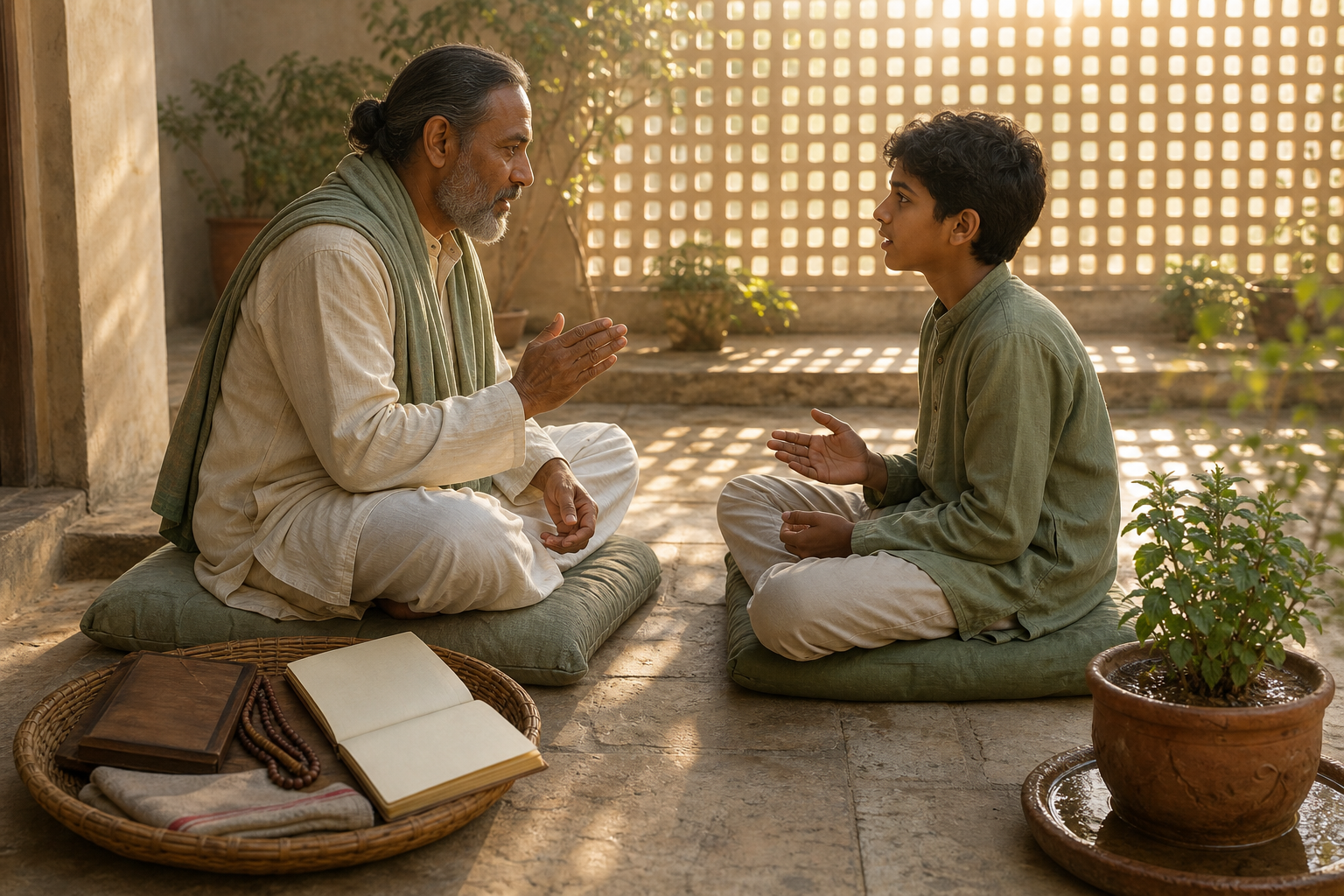
The Guru-Shishya framework is most useful when understood as a disciplined relationship of formation and feedback, not as a decorative appeal to the past. A guru or acharya does more than supply definitions. The teacher hears what the student cannot hear, corrects habitual errors, connects a rule to actual usage, and places learning inside a moral and spiritual context.
The student’s humility does not require intellectual passivity. Attentive listening, repeated practice, respectful questioning, reflection, and seva belong to the same discipline. A question asked after serious preparation is not a failure of reverence. It is evidence that the learner has begun to take responsibility for understanding.
Look for a teacher who can do the following:
- demonstrate the pronunciation or derivation being corrected rather than merely declaring you wrong;
- distinguish the wording of a text from grammatical explanation and from a tradition’s interpretation;
- invite precise questions while requiring the student to prepare before asking them;
- assign recitation, recall, analysis, and discussion rather than relying on passive lectures;
- state the limits of their competence, especially when moving between Vedic, classical, Buddhist, Jain, or Sikh textual settings; and
- treat satya, ahiṁsā, discipline, and service as conditions of sacred learning rather than ornaments added after intellectual mastery.
No teacher should need to pretend that every Dharmic tradition follows one curriculum. The shared inheritance lies partly in disciplined mentorship, ethical restraint, contemplation, communal learning, and the seriousness given to speech. Unity becomes more credible when differences of language, canon, and method are handled accurately.
Use a fixed cycle for daily svādhyāya
Motivation is unreliable; a fixed sequence is easier to sustain. At your regular study time, work through the same cycle:
- Recall: recite the previously learned passage once without looking.
- Correct: compare it with the form taught and mark the exact places requiring attention.
- Analyze: segment the passage and derive at least one form rather than trying to solve everything at once.
- Interpret: state the literal construction, then note how a commentary or tradition develops its significance.
- Question: write one doubt precise enough for a teacher or study partner to answer.
- Integrate: identify one implication for speech, action, attention, or service that can be observed in ordinary life.
At intervals, add a longer uninterrupted session for commentary, derivation, or dialogue. Pair or small-group discussion is especially useful because another person can challenge an assumed word division, an unexplained meaning, or a conclusion that the grammar does not yet support. The purpose is not argument for its own sake. It is to convert familiarity into discernment.
Precise memorization and oral recitation have been associated with changes related to memory, language processing, and sustained attention. Those associations should not be turned into a promise that every learner will receive an identical cognitive result. Nor should sacred learning be reduced to a productivity technique. Improved concentration is a worthy secondary fruit; the governing intention remains truthful understanding and disciplined practice.
This distinction matters. Bhagavad Gita 17.11 provides a frame for action undertaken as sāttvika yajña, without attachment to the result. Applied to study, that orientation changes what you measure. You still track errors, vocabulary, derivations, and passages learned, but you do not make display, speed, or prestige the purpose of svādhyāya.
Recognize the failure mode before it becomes a habit
- Translation-only study gives you conclusions without enough access to the construction. Correct it by segmenting and parsing a small portion of the passage before reading several polished renderings.
- Recitation-only study may preserve sound while leaving syntax opaque. Correct it by choosing one form from each recited passage and accounting for it.
- Grammar-only study can turn a sacred language into a collection of puzzles. Correct it by keeping one living text at the center of your exercises.
- Uncorrected solitary study lets pronunciation and analysis errors become familiar. Correct it by arranging periodic feedback from someone able to demonstrate the right form.
- Passive dependence on a teacher produces admiration without competence. Correct it by arriving with recalled material, a written derivation, and a specific doubt.
- Flattening Dharmic traditions mistakes shared values for identical languages and canons. Correct it by naming which text, language, lineage, and interpretive setting you are studying.
A balanced practice keeps sound, grammar, meaning, inquiry, and conduct in conversation. Leave one of them out for long enough and the weakness eventually appears in the others.
Key takeaways
- Begin with a named text and a defined competence, not the abstract goal of mastering Sanskrit.
- Train sound first, then recover word boundaries, account for forms, construct the literal sense, and enter interpretation through dialogue.
- Use Pāṇinian grammar as a procedure: identify the input, environment, general rule, possible exception, transformation, and output.
- Choose a teacher who offers demonstrable correction, permits prepared questions, and distinguishes grammar from interpretation.
- Keep daily svādhyāya small but complete: recall, correction, analysis, interpretation, one question, and one implication for conduct.
- Respect the distinct languages and canons of Hindu, Buddhist, Jain, and Sikh traditions even while recognizing their shared pedagogic and ethical inheritance.
Choose one passage you already care about. In your next session, recite it once, mark every place where you cannot recover the words, derive one form, and write one question for a qualified teacher. That loop is small enough to begin now and substantial enough to change how you meet the text.
References
- DharmaRenaissance Blog — Master the Vedic Education Blueprint: The Essential Guru-Shishya System Explained
- Dandavats — Essential Guide: Discover Sanskrit’s Proven Pathways into English via Greek, Latin, Persian
- Varnam — Discover Panini’s Ashtadhyayi: The Complete Guide to Maheshwara Sutras and Algorithmic Grammar
- Varnam — Master Deep Focus and Memory: Proven Benefits of Studying Sacred Texts across Dharmic Paths
