
If you encountered claims about the Mazgaon Ganesh procession, the question to ask before forwarding them is simple: what happened, what remains unproven, and what response will help identify the offender without putting devotees or residents in greater danger?
The allegation is serious. Throwing eggs toward a Bhagwan Ganesh murthi would be an insult to a sacred procession, not harmless mischief. Its seriousness, however, does not give anyone permission to invent the culprit’s identity or motive. Devotees can demand firm action while remaining exact about the evidence.
What happened during the Mazgaoncha Morya procession
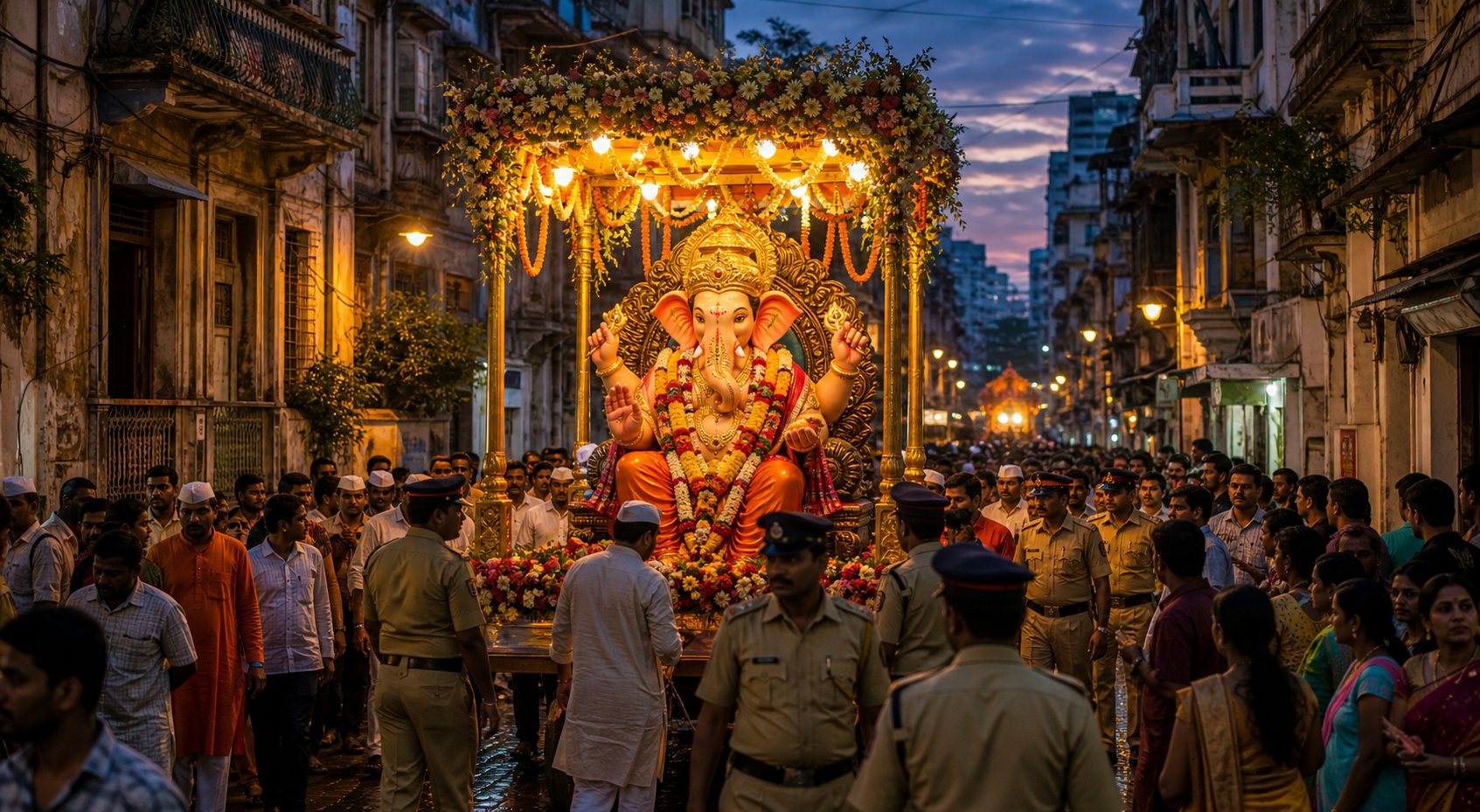
On Sunday, August 23, a large arrival procession marked the 80th anniversary of the Mazgaon Sarvajanik Utsav Mandal. When it reached the premises of Continental Heights Society, devotees said eggs were thrown from the society’s C Wing in the direction of the Ganesh murthi. One egg reportedly landed about 10 feet from the murthi.
Those words need to remain precise. The egg was reported to have landed near the murthi; the available facts do not establish that an egg struck it. The claim that eggs came from C Wing originated with people at the procession and still requires evidentiary confirmation.
Angry devotees gathered at the location. Workers associated with the Vishva Hindu Parishad and Bajrang Dal, as well as people from other Ganesh mandals, arrived and demanded that the responsible person be identified and arrested. Police registered a case against an unidentified person and began examining CCTV footage from C Wing. Senior police officer Jayant Meena appealed for calm, and additional security was deployed.
Akhil Kasar, president of the Mazgaon Sarvajanik Utsav Mandal, described the anger caused by an incident during the arrival ceremony of a mandal with an 80-year tradition. The immediate confrontation remained under control after police promised an investigation and appropriate action.
The factual boundary matters as much as the allegation

Three central questions remain unanswered: who threw the eggs, why they were thrown, and whether the person had any religious, political, or organisational affiliation. Police had registered the case against an unidentified person. Nothing in the reported police action identifies the thrower as Muslim, Islamist, or a member of any other community.
A suspected point of origin is not a suspect profile. Even if CCTV confirms that an egg came from C Wing, that fact alone does not identify a particular flat, resident, visitor, motive, or community. That is precisely why the footage and witness accounts have to be examined.
Calling the person unidentified does not minimise the act. It prevents an allegation against one unknown individual from becoming an accusation against every resident of a building or every member of a religious group. A pro-Hindu response should be especially disciplined here: our demand for justice loses credibility when certainty is claimed before evidence exists.
The setting makes the harm religiously charged even though motive has not been established. If the evidence shows that the murthi or procession was deliberately targeted, that finding should be stated plainly and followed by lawful consequences. Until then, describe the incident as a reported act under investigation.
What to do if you witness a provocation at a procession

A sudden insult near a murthi can produce anger within seconds. The most useful witnesses are the people who resist the urge to rush toward a building, confront bystanders, or publish an accusation before recording what they actually saw.
- Protect the procession first. Follow the mandal organisers’ and police instructions, keep access around the murthi clear, and prevent a crowd surge toward the suspected location.
- Separate observation from repetition. Record what you personally saw: the direction of travel, landing point, time, location, and your own viewing position. Label anything heard from somebody else as an unconfirmed account.
- Preserve original evidence. Keep the original photo or video file rather than only an edited clip, screenshot, or social-media repost. Do not crop away timing or location context that may help investigators.
- Give evidence to police promptly. Provide your contact details and a clear statement. Ask how your material will be received and recorded. Let investigators obtain building footage instead of attempting to enter private premises.
- Do not identify residents online. A window, floor, or wing does not prove who acted. Publishing names, faces, or flat numbers can expose uninvolved people and redirect attention away from the actual evidence.
- Use one verified public update. Mandal representatives should state what occurred, what police have done, and what remains unknown. That reduces the space in which altered clips and communal rumours spread.
If you were present but did not see the object being thrown, say so. Your footage of the landing point, crowd movement, or subsequent events may still be valuable. Honest limits make testimony stronger, not weaker.
Mandal security should be planned before the route moves

Mumbai reportedly has around 10,600 public Ganesh mandals, while approximately 28 lakh Ganesh murthis are expected to be installed across Maharashtra. At that scale, annual procession security cannot depend on improvisation after an object has already entered the route.
Mandals, building representatives, and local police should settle a basic operating protocol before a procession begins:
- Map residential frontages, narrow passages, crowd bottlenecks, and safe pause points along the approved route.
- Name mandal, police, medical, and building contacts who can reach one another immediately without sending a crowd to negotiate.
- Position cameras so they capture the murthi, nearby facades, the direction from which objects could arrive, and the surrounding crowd. Check that device clocks show the correct time.
- Agree on who preserves recordings, gathers witness details, and submits evidence if an incident occurs.
- Prepare a short holding statement that distinguishes a confirmed event from an unknown culprit or motive.
- Set conditions for pausing and resuming the procession so ritual continuity is protected without overriding an immediate safety concern.
After an incident, the useful questions are concrete. Has the relevant CCTV been secured? Have the people who saw the object’s trajectory given statements? What case details can police provide? When will an official update be issued? Has protection along the remaining route been reviewed?
This kind of follow-up keeps pressure on the investigation. It is more effective than demanding that social media identify a suspect from incomplete footage. Police should communicate enough to prevent a vacuum of information while withholding material whose premature release could compromise identification or expose uninvolved residents.
Key takeaways for devotees and organisers
- Devotees reported that eggs were thrown from C Wing of Continental Heights Society toward the Ganesh murthi; one reportedly landed about 10 feet away.
- The available facts do not say that an egg struck the murthi.
- Police registered a case against an unidentified person, began examining CCTV footage, and deployed additional security.
- The culprit’s identity, motive, religious affiliation, and organisational affiliation have not been established.
- Witnesses should preserve original files, record only what they personally observed, and submit evidence to police.
- Mandals should plan route security, evidence preservation, public communication, and crowd-control responsibilities before the procession starts.
If you share an update, use a fixed pattern: state what witnesses reported, state what police have confirmed, and state what remains unknown. That is not passivity. It keeps public pressure focused on identifying the person responsible while denying a provocateur the wider confrontation such an act may have been intended to create.
References
