

If you are trying to decide what to believe about Somnath, the usual choice – sacred memory or critical history – is a trap. A temple can carry authentic civilizational memory while particular claims about an episode still require precise evidence.
You do not have to choose between reverence and scrutiny. You need to know which question is being asked, what kind of evidence could answer it, and where a historian has moved from evidence into interpretation. That method lets you defend Hindu history without turning conviction into a substitute for proof.
Ask what kind of claim is actually being made
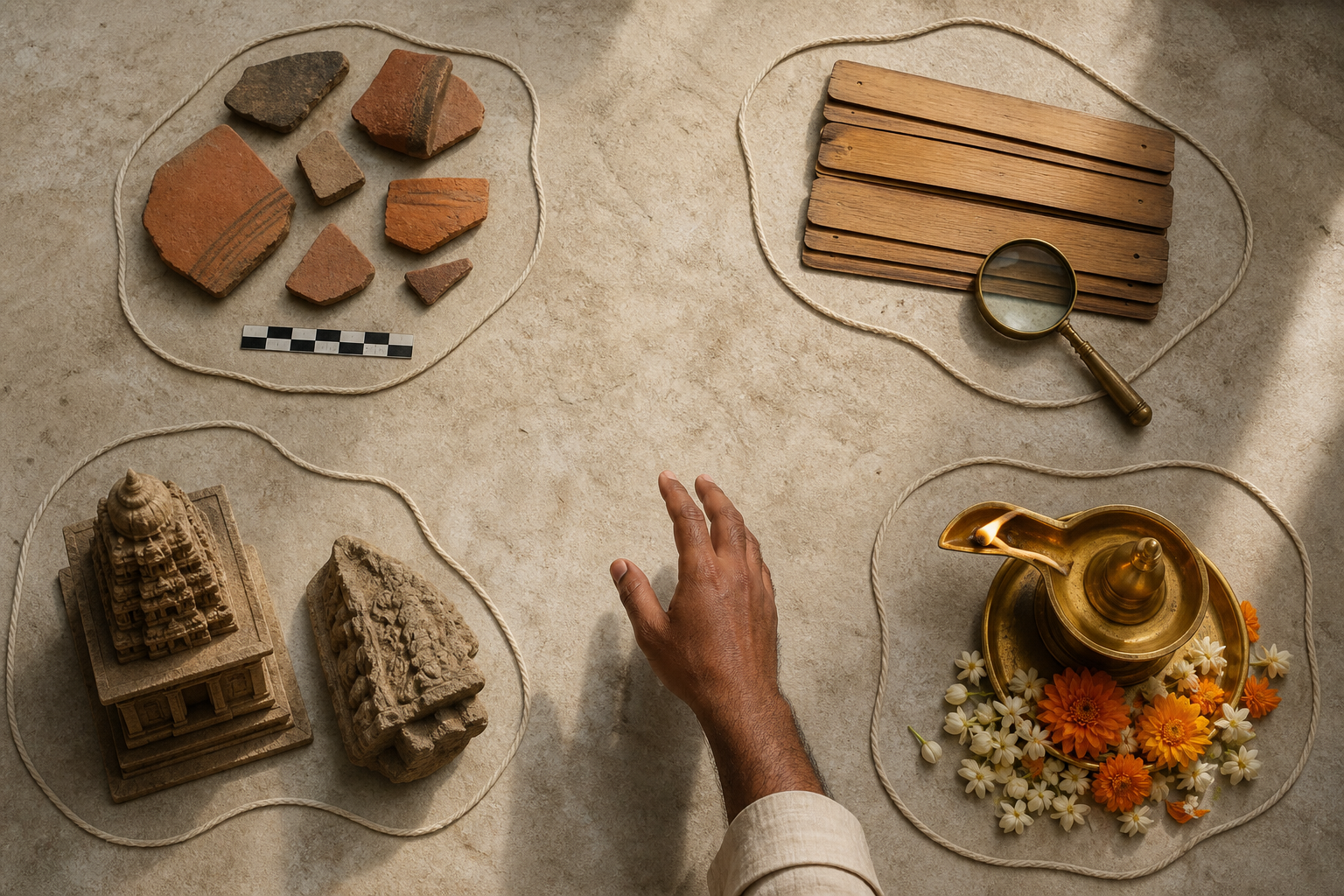
Arguments about Somnath often become confused because several different claims are compressed into one sentence. Separate them before deciding whether the sentence is sound.
- An event claim says that something happened: a structure was damaged, an image was removed, worship was interrupted, or a shrine was rebuilt.
- A motive claim explains why an actor did it: religious hostility, political domination, material gain, strategic calculation, or some combination.
- A continuity claim concerns what endured: worship, pilgrimage, community memory, custodianship, sacred geography, or the physical structure.
- A historiographical claim concerns how later historians handled the past: what they selected, omitted, emphasized, reclassified, or disputed.
These claims require different evidence. Physical damage may establish that destruction occurred, but it does not by itself identify every motive. A ruler’s religious language may matter greatly, but it still has to be related to the specific action under discussion. Continued worship can establish religious continuity even when the building changed. A charge of academic suppression requires more than an ideological label; it requires passages, omissions, citation patterns, or a demonstrable refusal to engage relevant evidence.
When you encounter a sweeping statement, rewrite it as several smaller claims. If the smaller claims cannot all be supported, the original statement was carrying more certainty than its evidence allowed.
Keep sacred memory and event history in the same frame
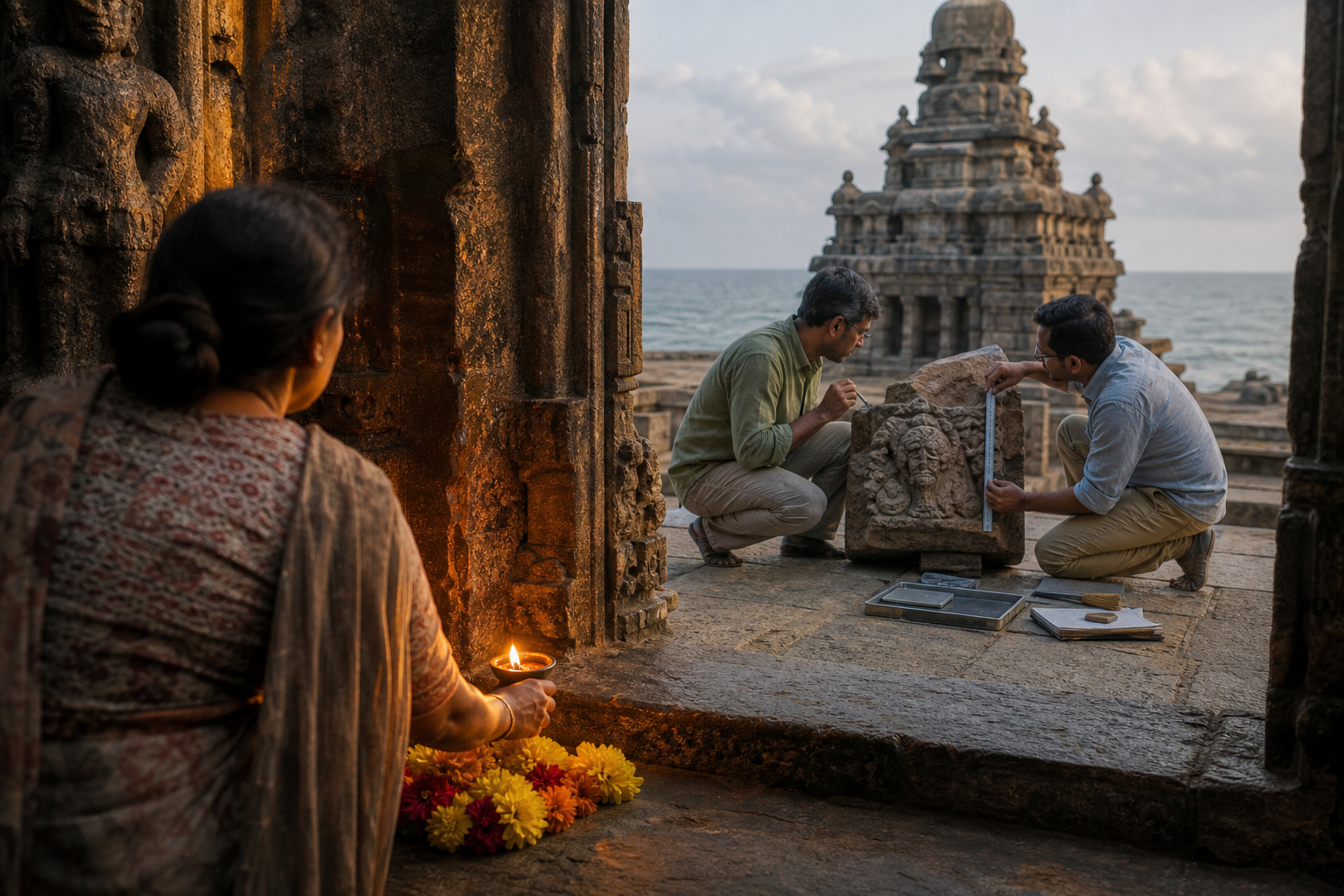
Sacred memory and event history do different work. Sacred memory tells you how a community understands a place, why worshippers return to it, and which losses or restorations they regard as civilizationally meaningful. Event history asks what occurred, when it occurred, who participated, and what surviving evidence can establish.
The first common mistake is to dismiss sacred memory because it does not resemble a modern administrative record. A tradition’s sustained attachment to a place is itself historically significant. It can preserve names, relationships, ritual priorities, and memories of rupture that a court-centered narrative ignores.
The opposite mistake is to treat every later sacred narration as if it were a contemporary eyewitness account. Reverence does not determine the date of a surviving description, establish the independence of its testimony, or settle the sequence of material changes.
A disciplined reading therefore labels evidence rather than ranking everything on one scale. Ask whether you are looking at remembered tradition, theological meaning, material evidence, a record close to the event, a later retelling, or a modern reconstruction. The categories may reinforce one another, but they are not interchangeable.
Read the present polemic without borrowing its shortcuts
One prominent pro-Hindu position charges a Romila Thapar-led secular and Marxist establishment with diminishing, suppressing, or misinterpreting evidence concerning temple destruction. It presents Meenakshi Jain as part of a corrective movement outside that academic establishment. This is an important historiographical charge, but it must be tested as a charge rather than adopted as a conclusion.
In Invincible Somnath: A Saga of Millennia, Jain brings geography, history, sacred narratives, destruction, and reconstruction into a single account. She approaches Somnath after working on Ayodhya, Mathura, Kashi, displaced deities, rebuilt temples, and colonial interpretations of Hindu society. That intellectual program helps you locate her questions and priorities. It neither validates nor invalidates an individual claim.
The same rule applies to Thapar. The words “secular” and “Marxist” may identify a school, method, or criticism, but they do not tell you what she argued in a particular passage. Do not attribute a thesis to a historian from an opponent’s thumbnail description. Look for the exact claim, the evidence cited for it, and the distinction – if any – between uncertainty about details and denial of the larger event.
- If someone alleges omission, ask which evidence was omitted and where it should have been considered.
- If someone alleges minimization, compare the historian’s language with the strength of the evidence rather than with your preferred rhetoric.
- If someone alleges exaggeration, ask which component is overstated: the event, its scale, its motive, its consequences, or its place in collective memory.
- If someone invokes an academic school as proof, return to the claim. Intellectual affiliation supplies context, not a verdict.
This standard is especially valuable for a pro-Dharmic readership. Hindu civilizational memory does not become stronger when every sympathetic assertion is exempted from scrutiny. It becomes harder to dismiss when event, motive, memory, and interpretation are stated with the degree of confidence each one deserves.
Build a claim ledger before deciding who is persuasive

You can turn a contentious account into something testable with a simple claim ledger. Use one row for each assertion rather than one row for each historian. This prevents reputation, institutional status, or ideological sympathy from deciding the case in advance.
| Claim type | Question to ask | Common overreach |
|---|---|---|
| Sacred significance | Which community, practice, or tradition gives the place this meaning? | Demanding that theological meaning behave like a material measurement. |
| Destruction or rebuilding | What event is alleged, and what evidence dates or describes it? | Turning repeated episodes into one continuous event, or erasing an episode because later rebuilding occurred. |
| Motive | Is the explanation contemporary, retrospective, inferred, or explicitly stated? | Assuming that political, economic, and religious motives must be mutually exclusive. |
| Continuity | Does continuity refer to the structure, worship, pilgrimage, memory, or institution? | Equating architectural discontinuity with the extinction of a sacred tradition. |
| Academic suppression | Which relevant evidence or interpretation was excluded, and can the pattern be demonstrated? | Using an ideological label as proof that evidence was deliberately hidden. |
Then work through the ledger in this order:
- Write an atomic claim. Replace “Somnath’s history was distorted” with a statement precise enough to check: a named interpretation omitted a particular kind of evidence or collapsed two distinct questions.
- Record the claim’s status. Is it presented as certain, probable, possible, symbolic, or devotional? Do not silently upgrade possibility into fact.
- Identify the nearest evidence. Distinguish a record close to an event from a later narration and a modern synthesis. Nearness does not guarantee truth, but distance increases the need to trace transmission.
- Map dependence. Two modern historians do not provide two independent testimonies if both rely on the same earlier account. Count evidence streams, not footnotes.
- State what the evidence cannot establish. A useful conclusion has a boundary. Write it down before moving to motive or civilizational meaning.
- Compare omissions symmetrically. Ask what each interpretation leaves unexplained. A destruction-only account can obscure endurance; a continuity-only account can obscure violence and loss.
Absence from one account is not automatically suppression. It may reflect scope, access, a judgment about reliability, or ideological discomfort. To distinguish those possibilities, check whether the evidence was acknowledged, assessed, rejected with reasons, or simply passed over. That is where a serious historiographical criticism begins.
Do not let destruction become Somnath’s entire biography
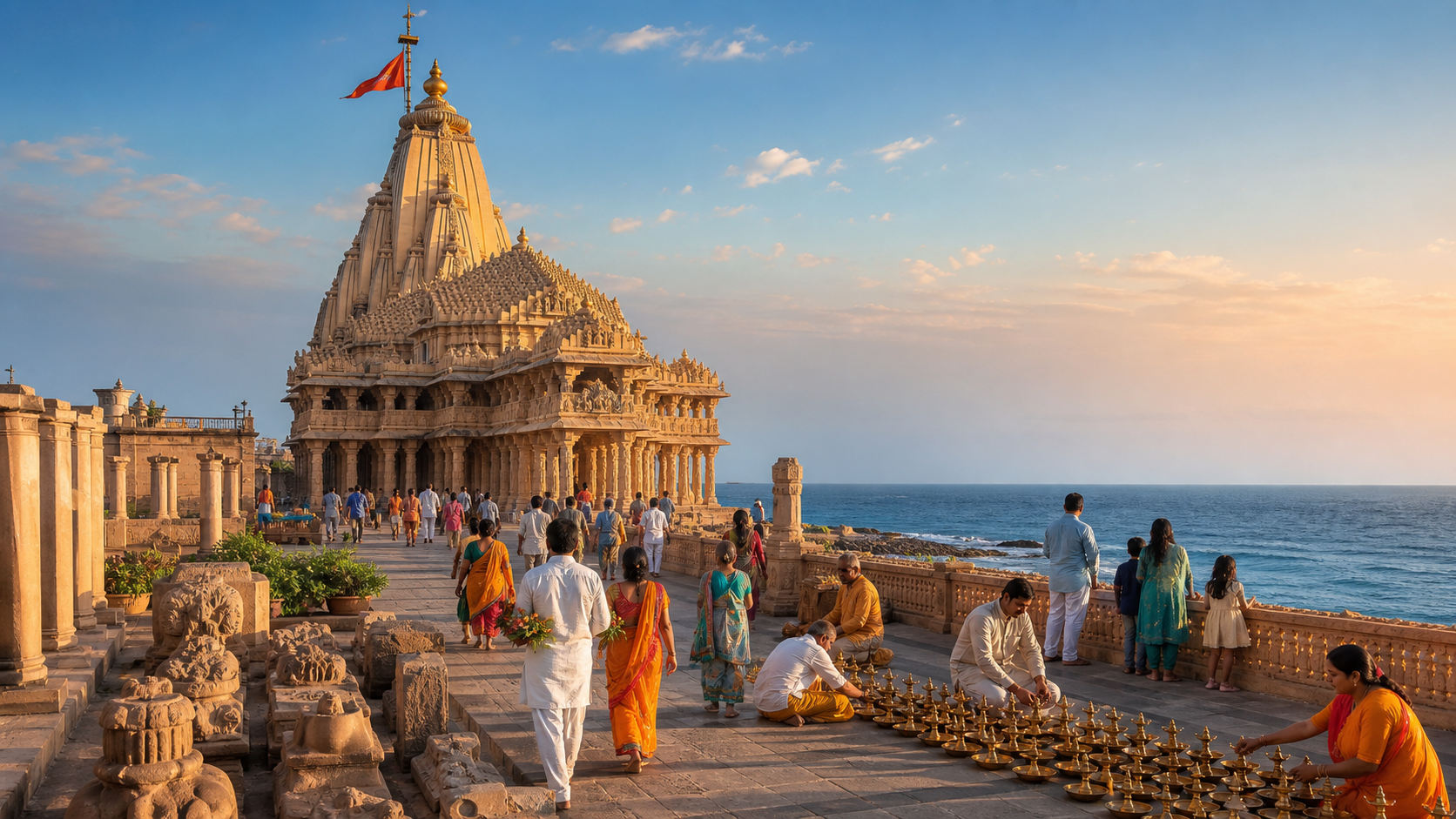
Somnath’s repeated destruction matters because violence against a sacred place can target far more than stone. It can affect worship, authority, memory, community confidence, and the public visibility of a tradition. Calling such an episode merely political can conceal its religious meaning; calling it merely religious can conceal the larger machinery of conquest and power. The categories can overlap.
Yet a narrative that ends with destruction leaves the aggressor as the only historical actor. Reconstruction changes the field. It directs attention to the people who preserved sacred memory, restored worship, mobilized resources, renewed patronage, and made the shrine meaningful in another political age.
When you assess a history of Somnath, therefore, look for two complete sequences: destruction and consequence, then recovery and transformation. Ask what was rebuilt, what changed, which practices continued, how the community narrated the rupture, and why restoration mattered in its own time. Reconstruction does not cancel destruction. Destruction does not exhaust the temple’s history.
This is where Dharmic historiography can make a substantive contribution. It can restore Hindu agency without denying evidence of loss, and it can treat a temple as a living sacred institution rather than only as an archaeological object or a trophy in a ruler-centered chronicle.
Key takeaways
- Separate event, motive, continuity, sacred meaning, and historiographical criticism before evaluating a claim.
- Treat sacred memory as historically significant without automatically treating every later narration as eyewitness testimony.
- Do not use “Marxist,” “secular,” “nationalist,” or “pro-Hindu” as a substitute for examining evidence.
- Test allegations of suppression at the level of passages, citations, omissions, and reasons given for rejecting evidence.
- Count independent evidence streams, not the number of modern writers repeating the same underlying account.
- Read destruction and reconstruction together so that neither violence nor Hindu agency disappears.
The next time you meet a confident claim about Somnath, pause before choosing a camp. Write the claim in one sentence, label its type, identify the nearest evidence, and mark the boundary of what that evidence proves. If the claim survives those four steps, you can carry it into public argument with both conviction and intellectual discipline.
References
