
If you encountered the Haveri Anjaneya temple case through an angry message or a short video, you probably want a direct answer: what actually happened, what remains unproved, and what should a concerned Hindu do now?
A serious violation of a sacred space was reported, a man was arrested, and local Hindus demanded action. Defending the temple now requires disciplined follow-through: preserve the facts, insist on a complete investigation, support appropriate religious restoration, and refuse speculation that could weaken a legitimate demand for accountability.
What happened at the Anjaneya temple in Shiggaon
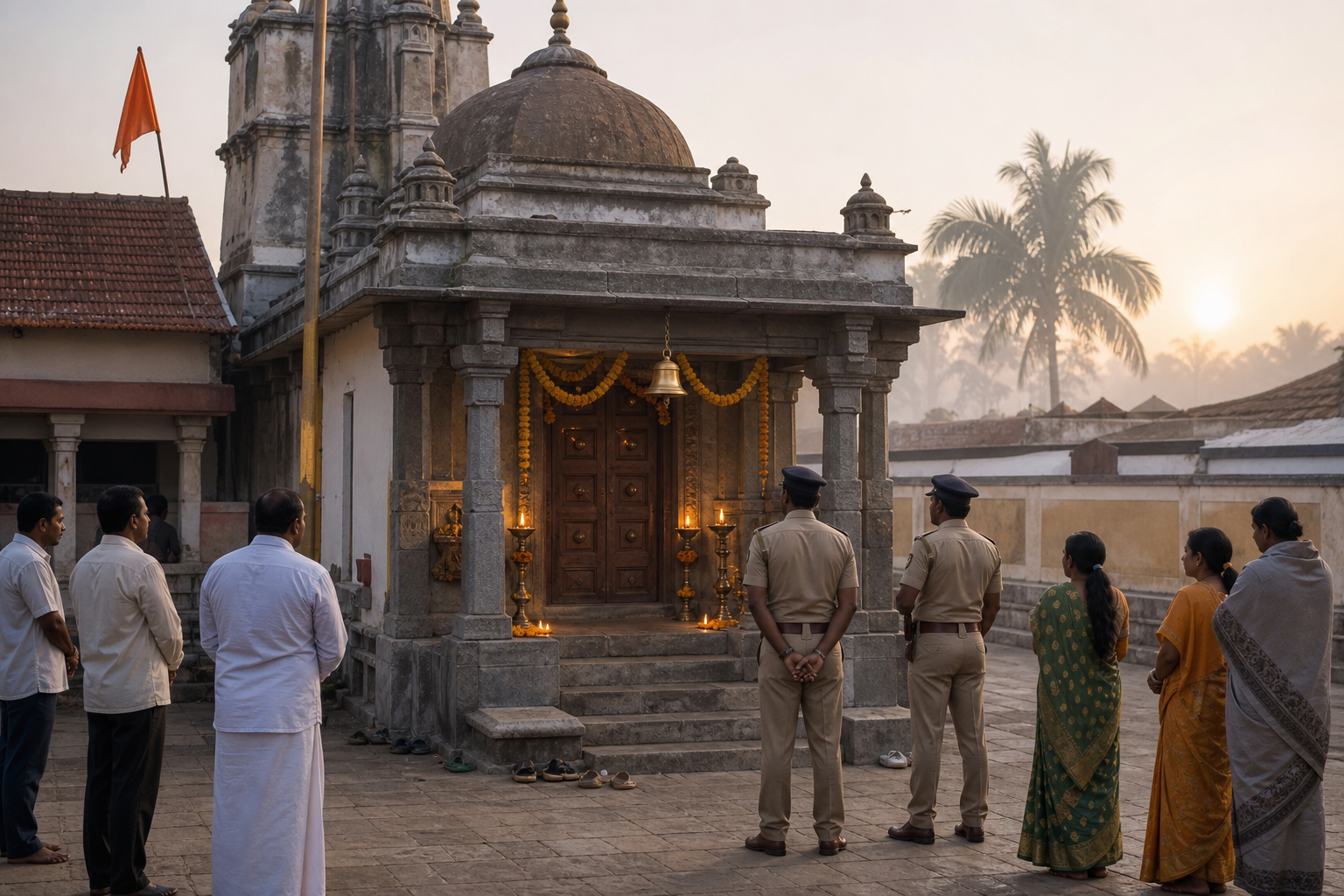
Police identified the arrested man as Mohammed Jaffer, aged 31. He was reportedly found urinating within the premises of an Anjaneya temple in Shiggaon, a town in Karnataka’s Haveri district, at approximately 9:30 on a Thursday night. Local Hindu residents reportedly confronted him at the location and handed him to the police.
Police arrested Jaffer and registered a case under applicable provisions of the Bharatiya Nyaya Sanhita. Hindu organizations and residents subsequently protested and demanded strict action. Additional police personnel were deployed around the temple and nearby parts of Shiggaon, while authorities appealed for calm.
One detail complicates any immediate conclusion about intent. The preliminary police inquiry found that Jaffer had been sleeping on the temple premises. Investigators were still examining why he entered the premises and what led to the act. Police had not publicly established a specific motive.
That uncertainty must be preserved. It does not make the alleged conduct acceptable, erase the temple’s desecration, or remove the need for prosecution where the evidence supports it. It means only that an act, a motive, and criminal guilt are separate questions. Each must be established on evidence.
Key takeaways
- The incident produced a police case, not merely an online allegation. Jaffer was taken into custody after local residents reportedly found him at the temple.
- The alleged location matters. The information available says “temple premises” but does not specify a sanctum, shrine, mandapa, courtyard, or another exact area. Do not add a more sensational location unless police establish it.
- Motive remains an open investigative question. A person’s name or religious identity does not by itself prove ideological intent, premeditation, or an organized conspiracy.
- Arrest is not conviction. Strict action means a prompt, evidence-based investigation and lawful prosecution, not declaring every disputed question settled in advance.
- Hindu concern is legitimate. Calm and accuracy are not requests to overlook desecration; they are the means by which the demand for accountability remains credible and difficult to dismiss.
Precise language protects both the temple and the case

In the first hours after an incident at a place of worship, three categories are often collapsed into one: what witnesses say they saw, what police have confirmed, and what people infer about motive. You should keep them separate whenever you discuss or share this case.
The reported act is specific: urination within the temple premises. The police response is also specific: arrest, registration of a case, investigation, and additional security. The asserted intention behind the act is not yet specific because police had not publicly determined it.
Calling Jaffer the accused is accurate. Saying that he was arrested is accurate. Saying that the incident offended Hindu religious sensibilities is a fair description of its evident effect. Declaring that police have proved a planned communal provocation, an extremist affiliation, or a conspiracy would go beyond the established facts.
This distinction is not a concession to those who trivialize attacks on Hindu institutions. Exaggeration creates an avoidable escape route: public debate shifts from the conduct at the temple to the accuracy of the people objecting to it. Precision keeps attention where it belongs – on the alleged violation, the evidence, the legal process, the security of the temple, and the dignity of its devotees.
The word “premises” deserves similar care. It establishes that the reported conduct occurred within the temple’s grounds, but it does not identify the exact sacred or functional area involved. The investigating authorities and temple management should clarify that location. Until they do, captions claiming that the act occurred before the murti or inside the garbhagriha should not be circulated as fact.
What devotees and temple committees can do now
If you want a response stronger than an angry social-media post, concentrate on the parts that preserve evidence, sustain legal scrutiny, and protect worshippers.
- Preserve original evidence. Anyone who directly witnessed the incident should record the time, exact location, sequence of events, and names of other direct witnesses while memory is fresh. Keep original photographs or recordings rather than repeatedly edited copies. Give relevant material to investigators; do not expose witnesses’ phone numbers or home addresses online.
- Do not coordinate witness accounts. Witnesses should describe independently what each person saw or heard. A group effort to make accounts sound identical can create inconsistencies and damage their evidentiary value.
- Create one factual incident log. The temple committee can record police visits, complaint or case details made available to it, damaged or affected areas, security measures, and communications with devotees. Label every entry as confirmed, reported, or pending verification.
- Ask narrow, answerable questions. Has the exact location within the premises been documented? What evidence has been collected? Which legal provisions were invoked? What stage has the case reached? Have police reached a finding on motive? These questions produce accountability without asking investigators to disclose information that could compromise their work.
- Let the temple’s own tradition guide purification. If ritual cleansing, punyahavachana, abhishekam, or another form of restoration is considered necessary, the relevant archakas and sampradaya authorities should decide the procedure. Online commentators should not prescribe a ritual without knowing the temple’s established practice.
- Keep public demonstrations disciplined. A peaceful protest can demand timely action, temple security, and equal enforcement. Organizers should state in advance that threats, damage, retaliatory acts, and harassment of uninvolved people are unacceptable. One accused person must answer for his own conduct; an entire community cannot be assigned collective guilt.
- Review access without obstructing darshan. Because police preliminarily found that the accused had been sleeping on the premises, the committee should examine closing checks, poorly monitored entry points, lighting, emergency contacts, and responsibility for the final nightly inspection. If cameras already cover the area, relevant footage should be preserved before routine deletion or overwriting.
If you personally hold material evidence, avoid turning it into a confrontation tool. Do not edit it into a communal montage, add claims you cannot verify, or encourage people to identify and approach relatives of the accused. Those actions can endanger people, expose participants to legal consequences, and distract from the alleged offence at the temple. Preserve the original and provide it through the appropriate investigative channel.
Sarva Dharma Samabhava must include equal protection

Sarva Dharma Samabhava cannot mean that Hindus must quietly absorb an indignity at a temple to prove their tolerance. Mutual respect has content. It requires people to respect the sacred boundaries of traditions other than their own, and it requires public authorities to respond consistently when those boundaries are violated.
Equal protection also requires consistency from us. The standard we demand for a mandir should be one we can defend as a general principle: no place of worship should be deliberately defiled, no accused person should escape scrutiny because the victimized community is expected to remain silent, and no uninvolved population should face retaliation for one person’s conduct.
This is not moral equivalence. It is a durable rule that protects Hindu temples without making their protection dependent on political convenience. When devotees ask for a proper investigation, prosecution supported by evidence, security proportional to the risk, and respect for necessary temple rites, they are making a concrete civic demand rather than an abstract appeal for harmony.
The response should remain centered on the temple. Temple authorities should be able to restore ritual order. Devotees should be able to worship without intimidation. Witnesses should be able to cooperate without exposure. Police should explain the progress of the case when doing so will not prejudice the investigation. These are measurable outcomes; a cycle of viral outrage is not.
What to watch before reaching a final judgment
The next meaningful developments are not louder slogans. They are factual findings that close the present gaps.
- The exact place and sequence: where within the premises the accused had been sleeping, where the alleged act occurred, and how local residents encountered him.
- The supporting evidence: direct witness statements, any available recordings, physical observations documented at the location, and the accused’s account as evaluated by investigators.
- The legal basis: the precise Bharatiya Nyaya Sanhita provisions invoked and whether the collected evidence supports every required element of those alleged offences.
- The finding on intent: whether investigators identify evidence of deliberate religious insult, intoxication, mental or physical incapacity, reckless conduct, or another explanation. None should be assumed merely to fill the present gap.
- The court process: whether allegations progress into formal charges and how the evidence is assessed. Police action begins accountability; it does not complete it.
- The temple’s recovery: whether appropriate ritual restoration, access controls, and security arrangements allow normal worship to continue.
An unproved motive is not proof that the incident was harmless. Equally, anger at the act is not proof of a motive investigators have yet to establish. Holding both propositions at once is the disciplined position.
If you share this case, share the distinction along with it: a grave act was reported at an Anjaneya temple, an accused man was arrested, and his intent remained under investigation. Then direct your energy toward the temple committee, preservation of evidence, peaceful civic pressure, and verified updates on the legal process. That is how outrage becomes protection rather than noise.
References

Leave a Reply
You must be logged in to post a comment.