
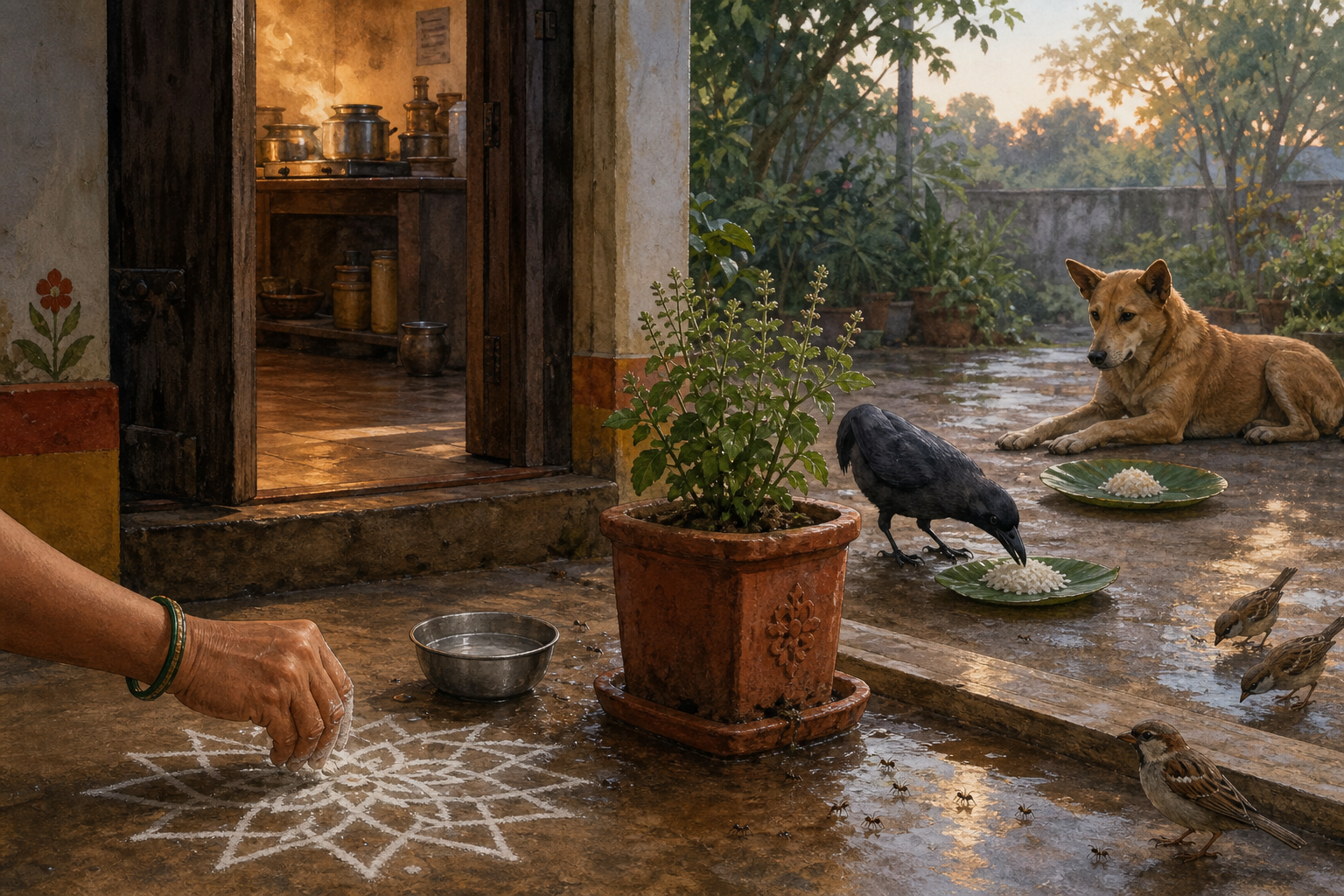
You may be trying to answer a deceptively practical question: what does a Hindu ecological ethic look like at home, when there is no forest campaign to join and no grand project to fund? The answer is often measured in a handful—rice flour at a threshold, the first cooked grain of a harvest, a plate set down for a dog, or a rice offering placed where a crow can find it.
These customs do more than attach sacred language to nature. At their best, they move food, attention, labour and gratitude beyond the human household. They give you a demanding test for ecological dharma: Who else benefits from the practice? What happens to its materials afterward? Does it build an enduring relationship, or only produce a festive image?
The household does not end at the front door
Modern environmental action is often imagined as something separate from ordinary life: a campaign, a policy, a donation or an occasional clean-up. Hindu ecological traditions begin at a smaller scale. They place responsibility inside recurring domestic and community routines.
That structure matters because a value repeated through action becomes harder to ignore. A daily kolam makes the threshold a place of giving. Mattu Pongal interrupts the human-centred story of the harvest. Kukur Tihar changes how a street dog is seen. An ancestral offering cannot be completed without the participation of a crow. The non-human being is not scenery around the ritual; it has a role in the ritual.
Three practical mechanisms are at work:
- Repetition: care is tied to a daily or seasonal rhythm, so it does not depend entirely on passing enthusiasm.
- Allocation: a portion of food, time or labour is deliberately reserved for someone outside the immediate human family.
- Attention: people learn to notice which animals arrive, when food is scarce and how human activity affects nearby life.
An ecological interpretation need not erase the theological meaning. A kolam can welcome Lakshmi and feed small creatures. Pongal can honour Surya while acknowledging the material relationships behind a harvest. A crow can carry ancestral meaning while remaining a living participant in an urban food web. Sacred meaning and practical consequence can operate together.
The reverse is also true: age alone does not make every custom environmentally sound. You still have to examine the material being used, the effect on the intended recipient and the waste left behind. Dharma requires discernment, not automatic approval.
Five traditions that turn reverence into reciprocity
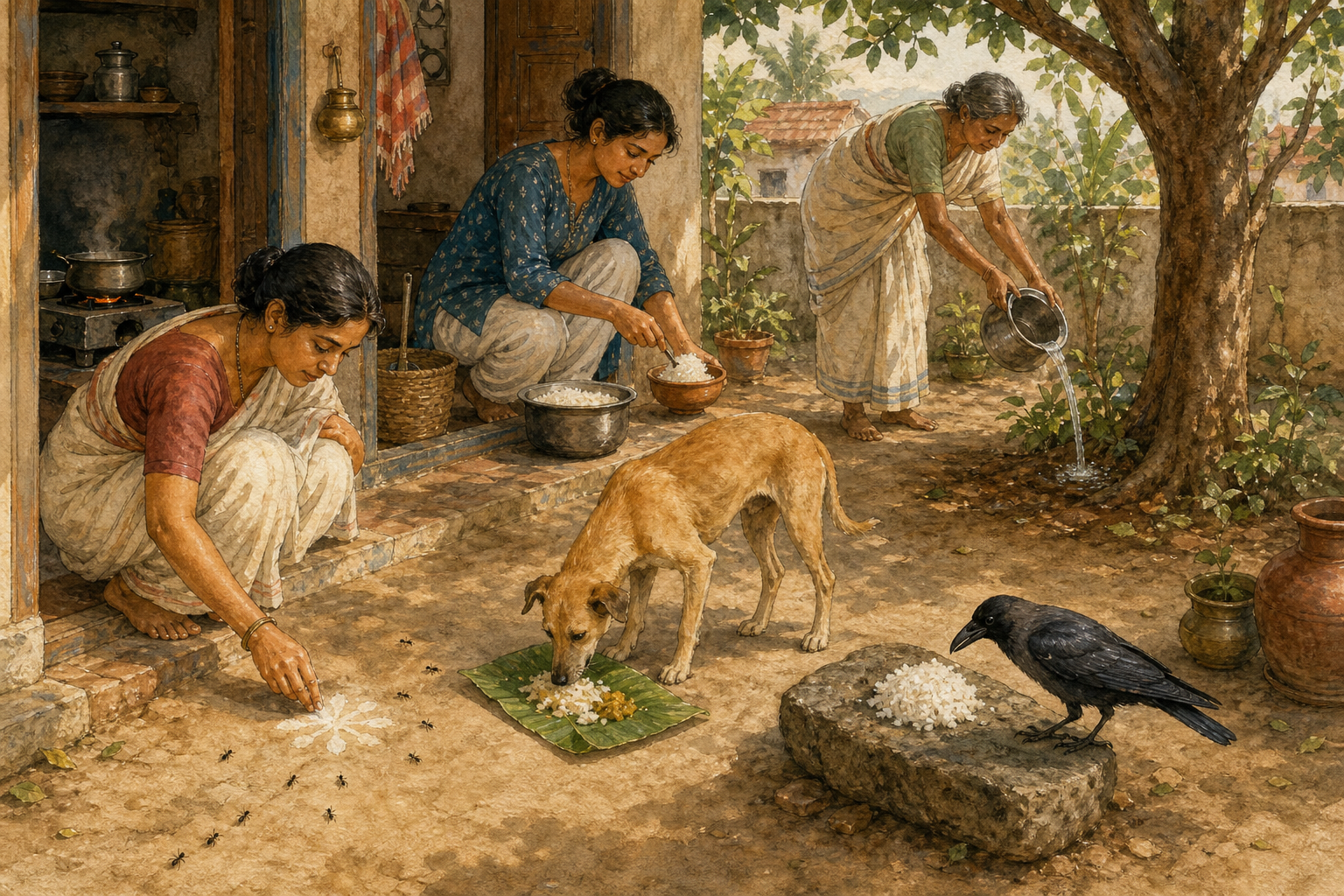
Kolam: make the threshold give something back
Across Tamil Nadu and other parts of southern Bharat, kolam patterns are traditionally renewed at the threshold with rice flour or rice paste. Their beauty welcomes auspiciousness, but the choice of material also makes the design available to ants, beetles, birds and other small inhabitants of the household environment. The previous pattern disappears through weather, sweeping and consumption; the next morning begins another cycle.
This is what separates a functioning ecological custom from nature-themed decoration. The traditional edible rice-flour pattern turns a boundary into a feeding place. Replacing that flour with plastic glitter or a persistent synthetic material may preserve the appearance while defeating the material logic.
If kolam belongs to your family or regional practice, preserve both dimensions. Use a modest amount of an appropriate edible material. Keep the area free of pesticides and plastic fragments. In a building where food at the doorway would create an infestation or violate shared-space rules, do not force the practice into an unsuitable location; use a managed courtyard or another permitted place where the offering can be observed and cleaned responsibly.
Pongal: remember every creditor of the harvest
Pongal arranges gratitude as a sequence. Bhogi marks a clearing for the new cycle. Thai Pongal offers the first boiled rice of the harvest to Surya. Mattu Pongal turns toward cattle, which are bathed, decorated and fed. Kaanum Pongal extends the celebration toward kin and community. The order gives the festival its ecological force: the crop is never treated as the achievement of an isolated consumer.
The sun, rain, soil, cultivator and draught animal all stand behind the meal. On Mattu Pongal, giving cattle a valued portion of the new crop recognises labour as a relationship rather than an extraction. In some rural communities, the observance is also associated with veterinary care, connecting honour with the animal’s physical welfare.
You can carry that principle even if you do not keep cattle. When celebrating a harvest festival, identify the actual chain behind your food. Name the cultivator, animal labour, soil, water and sunlight when teaching children why the first portion is offered. If you support working animals, direct help toward their sustained food, rest and professional care. Decoration without care reverses the festival’s moral order.
Kukur Tihar: replace nuisance-thinking with dignity
On the second day of Tihar in Nepal and parts of northern Bharat, dogs are honoured with tika, marigold garlands and food. The religious associations are layered: dogs are connected with Bhairava and with Yama’s gatekeepers. The public effect is unusually direct. A being commonly dismissed as a stray or nuisance becomes a recipient of ceremonial respect.
The durable lesson is not that one feast resolves every problem involving free-ranging dogs. It is that management without dignity becomes cruelty, while reverence that ignores an animal’s continuing welfare remains incomplete. Kukur Tihar brings pets and street dogs inside the ritual field, but the obligation should survive after the garland is removed.
If you participate, do not crowd, restrain or touch an unfamiliar dog merely to complete a photograph. A frightened animal may react defensively. Offer only suitable food in a safe location, and involve an animal-welfare professional or experienced local caregiver when sustained help is needed. Respect includes respecting the animal’s distance.
Pitru Paksha: let remembrance pass through the living world
During the shraddha observances of Pitru Paksha, families prepare pinda from rice, sesame and ghee for departed ancestors. On Sarva Pitru Amavasya, the concluding new moon, a crow’s acceptance of the offering carries special importance. Crows may be understood as messengers of Yama or representatives of the pitrs, so remembrance depends upon an encounter with a living creature.
This gives ancestral obligation an ecological form. The past is not sealed inside memory; it enters an exchange involving grain, bird, human and place. A rooftop, courtyard or riverbank becomes a meeting point between lineage and the present food web.
Practise that exchange without turning a sacred place into a dumping ground. Set out a small, unpackaged portion in a clean location. Do not leave plastic plates, foil, string or a mound of uneaten food behind. Watch what happens. If the offering remains, remove it responsibly rather than assuming that intention alone cancels the waste.
Ghughutiya: teach children to notice species and season
In Kumaon, Uttarakhand, Ghughutiya gives Makar Sankranti a distinctly Himalayan form. Children wear garlands made from shaped wheat-flour and jaggery sweets, sing to crows and then share the food with crows and returning migratory birds. A traditional story remembers crows saving the prince Ghughuti; the recurring feast turns gratitude into a lesson children can perform.
Its timing is as meaningful as its form. The feeding occurs near winter’s end in the Kumaon hills, when food can be scarce and migrating birds are returning. Children learn that birds are not a single anonymous category: crows, ravens and other visitors have recognisable appearances, movements and seasonal patterns.
The lesson to carry elsewhere is not that every bird in every region should receive the same sweet. Food appropriate in one inherited context should not become a universal feeding instruction. Teach children to observe local species, learn their seasons and seek sound local guidance before establishing a feeding routine. The educational goal is attentive kinship, not indiscriminate distribution.
Use five tests before calling a ritual ecological
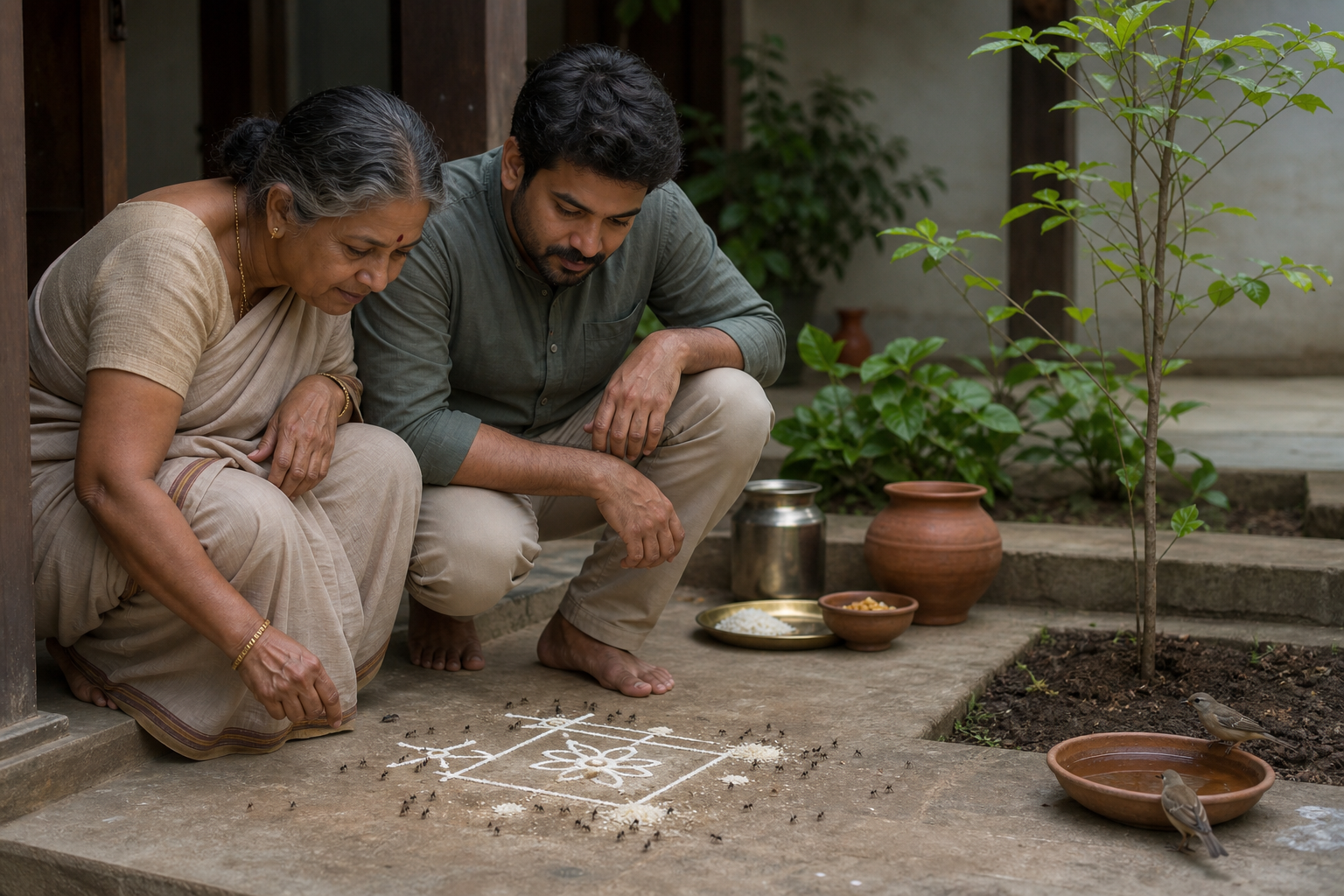
A ritual can retain its name and visual form while losing its reciprocal function. Use the following tests when organising a festival, adapting a family custom or deciding whether a modern substitute belongs in the practice.
| Test | Question to ask | Practical correction |
|---|---|---|
| Material | Can the material be eaten safely or return harmlessly to the environment? | Replace glitter, plastic decorations and persistent residues with simple biodegradable or traditionally edible materials where appropriate. |
| Recipient | Does the intended animal receive a real benefit, or is it being handled as a prop? | Prioritise suitable food, space and welfare over photographs or forced contact. |
| Scale | Is the quantity proportionate to what nearby animals can consume? | Begin with a small amount, observe the result and remove what remains. |
| Aftercare | Who is responsible for the site after the ceremony? | Assign cleanup before the event begins; do not leave packaging or spoiled food for someone else. |
| Continuity | Does respect survive beyond the auspicious day? | Link the observance to a repeatable household habit or sustained support for animal care. |
These tests keep two mistakes apart. The first is dismissing ritual as empty symbolism merely because it is religious. The second is declaring a ritual sustainable merely because it is inherited. A living tradition can withstand examination. Indeed, examining consequences is one way of protecting its dharmic purpose from hollow imitation.
Try a seven-day threshold practice
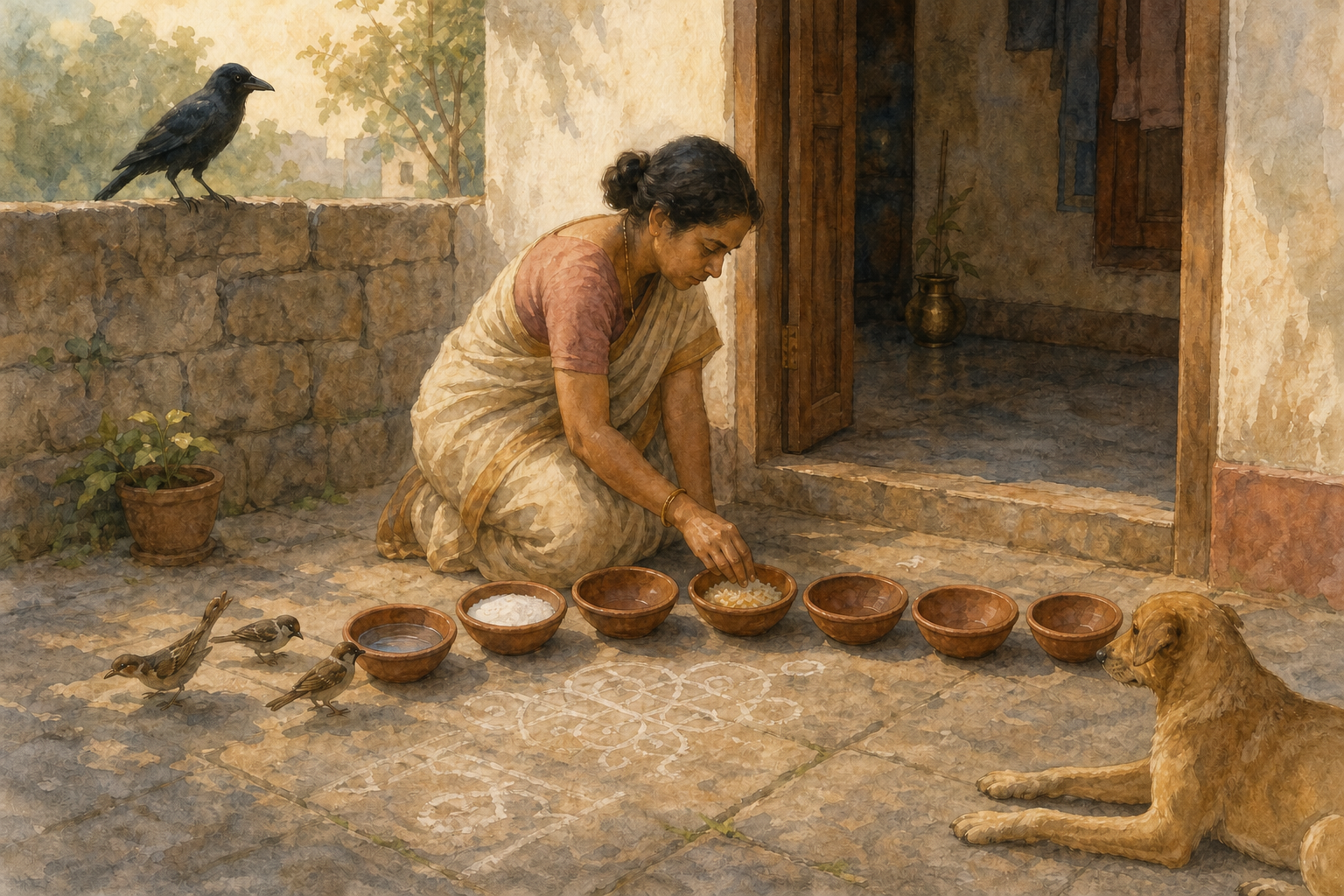
You do not need to invent a new festival or claim a custom that is not yours. Begin with one non-human relationship already visible from your home. A week is long enough to replace assumption with observation.
- Observe for three mornings. Note which ants, birds, dogs or other creatures actually use the area, and at what time. Do not put out food yet.
- Choose an authentic form. If your household has a kolam, bird-feeding or animal-care tradition, ask an elder how it was practised and which materials were used. If it does not, choose a simple act of care without pretending it is an inherited rite.
- Check the setting. Make sure the location is permitted, does not obstruct a shared path and will not bring animals into traffic or conflict with neighbours.
- Use the smallest workable amount. Choose a plain, suitable material and avoid plastic, glitter, string and chemical residue. For animal feeding, follow reliable local welfare guidance because appropriate food varies by species and place.
- Watch the result. Notice who receives the offering, who is displaced and whether the practice creates mess, aggression or unwanted concentration. Ecological care begins with the actual result, not the result you hoped to see.
- Clean the site. Remove uneaten material and every piece of packaging. If the practice consistently produces waste or conflict, change it.
- Choose a sustainable rhythm. Continue only at a frequency your household can maintain responsibly. A modest weekly act with aftercare is more truthful than a large annual display followed by neglect.
This exercise also reveals why these traditions endure. They train perception before they demand theory. Once you know which lives share your threshold, it becomes more difficult to treat the surrounding world as an empty stage for human activity.
Key takeaways
- Hindu ecological traditions work through reciprocity: food, gratitude and attention move beyond the human household.
- The theology and the ecological consequence need not compete; a sacred offering can also provide a material benefit.
- Traditional form is not enough. Material, quantity, animal welfare and cleanup determine whether a practice still serves its purpose.
- Do not universalise one region’s animal food or ritual technique. Preserve the principle while respecting local species, conditions and community rules.
- The strongest practice is repeatable: small enough to sustain, visible enough to teach and responsible for what it leaves behind.
Start at the nearest threshold. Learn the name or habit of one non-human neighbour, recover one family practice in its least wasteful form, and give it a rhythm you can keep. Hindu ecological dharma becomes credible when reverence changes what you place on the ground, whom you make room for and what you clean up afterward.
References

Leave a Reply
You must be logged in to post a comment.