

If you remember Shantanu mainly as Bhishma’s father, you can miss the decision pattern that makes his life so instructive. His tragedy is not that he loves, marries or desires companionship. It is that desire repeatedly weakens his willingness to question terms, speak openly and protect the future from the demands of the present.
That distinction matters to you because Shantanu’s failure is rarely dramatic at the moment it begins. It starts with a private longing, an uncomfortable condition and a silence that lets somebody else bear the cost.
The same failure appears in two different forms

Shantanu’s first great attachment is to Ganga. He accepts her condition that he must not interfere with her actions or question her. When child after child is taken from him, he remains silent because speaking would end the relationship. He eventually intervenes, but only after the conflict between his promise, his paternal duty and his conscience has become unbearable. Ganga then leaves, taking the surviving child who will later return as Devavrata.
The episode has a divine dimension: Ganga’s actions belong to a larger order that Shantanu does not initially understand. That cosmic explanation should stop us from turning Ganga into an ordinary criminal or the episode into a modern domestic anecdote. It does not, however, remove the human question placed before Shantanu. Why did he make an unrestricted promise before knowing what obedience might demand of him?
His later desire for Satyavati presents a different problem. Her father wants assurance that Satyavati’s future son will inherit the throne. Shantanu does not immediately dispossess Devavrata, which is an important act of restraint. Yet he cannot master the disappointment that follows. He withdraws into sorrow rather than accepting the limit, disclosing the conflict plainly or developing a solution that does not consume another person’s future.
Devavrata discovers the cause of his father’s unhappiness. He renounces his claim to the throne and then embraces lifelong celibacy so that no future child of his can challenge Satyavati’s descendants. The vow makes him Bhishma. Shantanu receives the marriage he wants, while his son pays for it with kingship, marriage and descendants.
This is why Shantanu can be understood as a righteous ruler who falls into the same pattern twice. The outward events differ, but the moral sequence remains recognizable:
- A powerful desire makes an extreme condition appear acceptable.
- Shantanu avoids asking what the condition could demand later.
- Silence preserves his immediate hope while moving the burden elsewhere.
- Another person absorbs an irreversible cost.
- The private compromise eventually becomes a dynastic problem.
The first failure is surrendering discernment to keep a beloved relationship. The second is allowing disappointed desire to recruit a devoted son. What goes unlearned is not a rule against love. It is the need to keep love answerable to dharma.
Bhishma’s vow reveals who actually paid for Shantanu’s desire
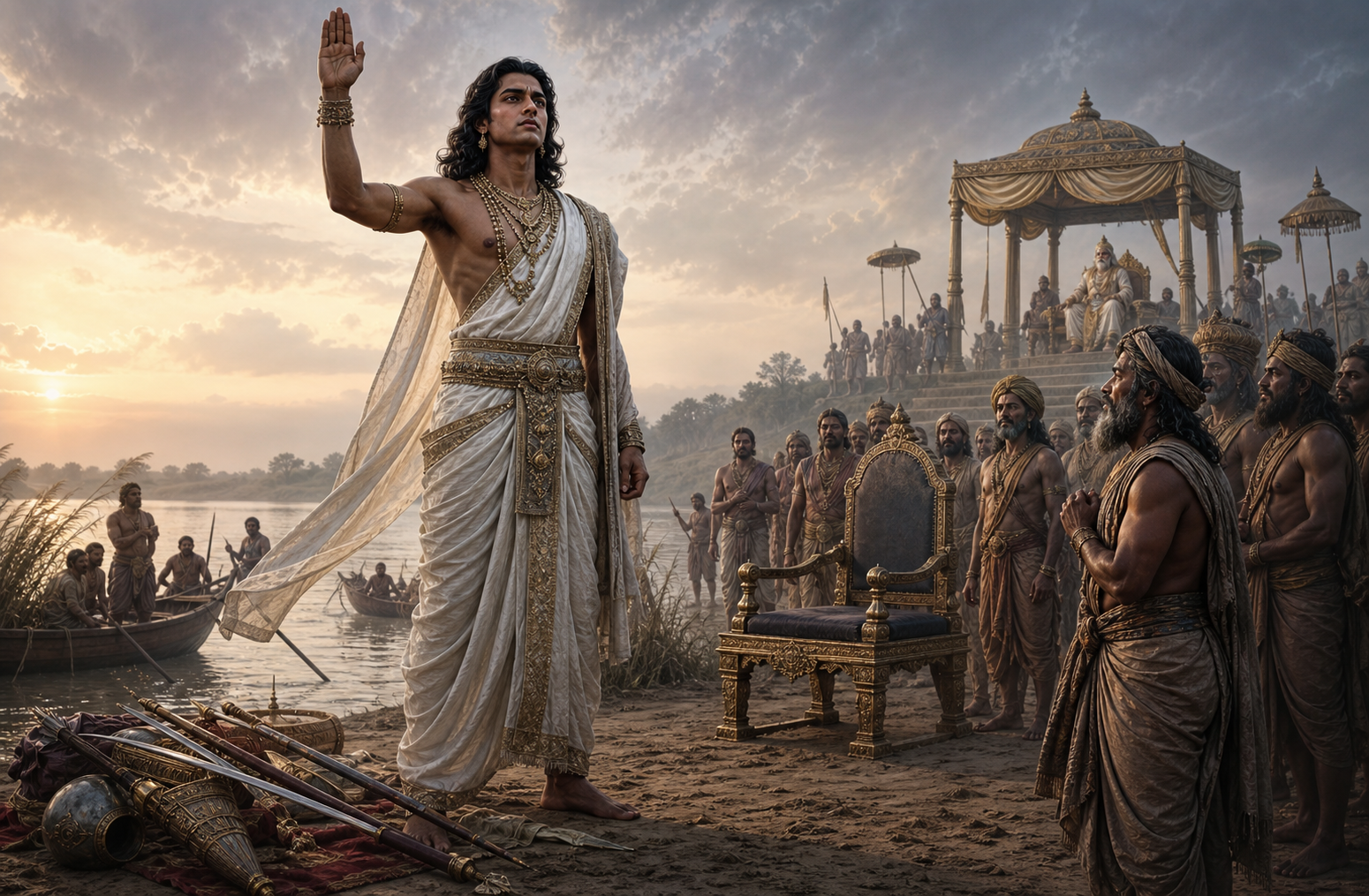
Bhishma’s renunciation is often remembered for its grandeur, and rightly so. It displays extraordinary loyalty, resolve and mastery over personal ambition. But admiration for the son must not conceal the condition that made such a sacrifice seem necessary.
Shantanu does not explicitly order Devavrata to renounce anything. That does not make the father morally irrelevant. A powerful person’s unspoken distress can exert pressure without becoming a command. The obedient son sees that his father’s happiness is blocked and concludes that his own future is the obstacle.
This gives you a precise way to recognize destructive desire: look beyond the person who receives the desired outcome and identify the person whose options have to disappear. Shantanu gains Satyavati without personally surrendering his kingship or lineage. Devavrata removes his own claim, marriage and possible children from the future. The benefit and the burden fall on different people.
Satyavati should not be made the villain in order to excuse Shantanu. She does not create his inability to govern his longing. Her father states a dynastic interest openly. Shantanu’s responsibility is to decide whether that condition is compatible with his existing obligations as father and king. Blaming the desired woman turns a lesson about male agency and royal duty into a warning against women, which is not what the moral structure requires.
Bhishma also remains a moral agent. He chooses the vow; he is not merely a passive victim. Yet voluntary sacrifice does not automatically make the surrounding arrangement just. A devoted person can choose nobly inside a situation that should never have required such a choice.
The vow also creates institutional rigidity. A supremely capable prince becomes permanently unavailable for succession, while the continuity of the Kuru house is concentrated in a narrower line. Later deaths and succession difficulties turn that rigidity into a dynastic crisis. It would be too simple to claim that Shantanu’s desire single-handedly causes the Kurukshetra war; the Mahabharata gives responsibility to many people across many decisions. But his choices help create the fragile structure within which later failures become more dangerous.
Kama is not the enemy; desire without dharma is
A shallow reading treats Shantanu’s life as proof that desire itself is corrupting. That conclusion does not fit the broader Dharmic understanding of human life. Kama has a legitimate place among human aims. Affection, beauty, intimacy and family life are not rejected simply because they can become sources of attachment.
The decisive question is whether kama remains governed by dharma. Desire becomes destructive when it demands that truth, proportion, duty or another person’s legitimate future be set aside. Shantanu’s longing crosses that boundary through several identifiable failures.
- He accepts terms without defining their moral limit. A promise to avoid interference sounds romantic until obedience conflicts with protection, conscience or public duty.
- He treats silence as neutrality. Silence actually preserves the desired arrangement and allows its cost to grow.
- He lets a private longing alter public succession. A king’s marriage cannot be treated as purely private when the condition attached to it determines who may rule.
- He benefits from another person’s irreversible sacrifice. Bhishma cannot later recover the family life and descendants excluded by his vow.
- He repeats the mechanism. The circumstances change, but desire once again outruns inquiry and transfers its cost.
This is a more useful diagnosis than calling Shantanu weak or lustful. He is capable of restraint, and he knows that duties conflict. His deeper weakness is failing to remain fully present inside that conflict. He either binds himself too early or becomes silent when an honest decision would disappoint him.
Dharma often becomes visible precisely where two real obligations collide. Keeping a promise matters. Protecting a child matters. Honoring an heir matters. Seeking companionship also matters. The responsible person does not erase one obligation so that another becomes emotionally easy. He names the conflict, consults those affected and refuses a solution whose apparent harmony depends on hidden ruin.
Use a Shantanu pause before accepting irreversible terms

You do not need a throne to repeat Shantanu’s pattern. It appears whenever a desired relationship, promotion, alliance or family outcome comes with a condition whose cost has not been spoken aloud. Before you promise, withdraw or let a loyal person rescue you, use the following test.
- Name the desire without decorating it. Write a plain sentence: I want this marriage, position, agreement or approval. This separates the desired end from the moral arguments you may be building around it.
- Write the condition exactly. Replace phrases such as unconditional support with the actions they could require. Ask what you would have to tolerate, conceal, surrender or prevent another person from doing.
- Identify every cost-bearer. Do not stop with the people signing the agreement. Include children, existing partners, colleagues, successors and anyone whose future options could narrow.
- Separate personal preference from role duty. Ask what you may freely choose as an individual and what your role as parent, trustee, leader or guardian forbids you from trading away.
- Reject proxy sacrifice as the default solution. If the plan works only because a loyal person gives up an inheritance, relationship, career or voice, bring that cost into the open before accepting the benefit.
- Invite counsel before making the vow. Explain the complete condition to someone who is not invested in giving you the answer you want. A promise that cannot withstand clear questions should not become irreversible.
- Check for recurrence. Ask where the same emotional mechanism has appeared before. The setting may be new even when the habit is not.
Pay special attention when you feel tempted to say that nobody is being forced. Bhishma’s example shows why formal freedom is not the whole test. Loyalty, hierarchy and love can lead a person to volunteer for a burden that the beneficiary should refuse to place on them.
The goal of this pause is not automatic renunciation. Sometimes the desire is legitimate and the condition can be renegotiated. Sometimes duties can be reconciled through disclosure, patience and a reversible arrangement. And sometimes dharma requires accepting disappointment. What you should not do is secure your preferred outcome by allowing silence to disguise its price.
Key takeaways
- Shantanu’s problem is not love itself but the surrender of discernment under the pressure of love.
- His first attachment shows the danger of accepting an unlimited condition before testing it against duty.
- His desire for Satyavati becomes destructive when Bhishma must eliminate his own future to satisfy it.
- Neither Ganga nor Satyavati needs to be vilified for Shantanu’s failure of judgement.
- Bhishma’s voluntary heroism does not erase the unfair transfer of cost from father to son.
- Shantanu does not single-handedly cause the later Kuru catastrophe, but his choices make the succession more fragile.
- Your practical test is simple: name the desire, define the condition and identify who loses options if you get what you want.
The next time a powerful wish arrives with a difficult condition, do not ask only whether you can obtain what you want. Ask what promise makes it possible, which duty that promise may silence and whose future will pay for your relief. Make that cost visible before devotion, hierarchy or sorrow turns it into somebody else’s vow.
References
