

You want your child to be secure, accomplished and long-lived. You also want your child to be truthful, compassionate and spiritually grounded. The difficulty begins when the choices that promise visible success seem to weaken the qualities that make success worth having.
Markandeya’s story brings that tension into the open. Its lesson is not that a parent should prefer a shorter life, dismiss safety or dictate a child’s destiny. It asks a more practical question: when outcomes cannot be guaranteed, what kind of person are you helping your child become?
Mrikandu had to define what made a life good

Before Markandeya was born, his father, the sage Mrikandu, undertook tapas for many years in the hope of having a son. Shiva appeared and presented him with a severe choice. He could have a virtuous, spiritually awakened and learned son whose life would last only until sixteen, or a longer-lived son without those qualities. Mrikandu chose the first.
The sacred narrative makes the alternatives unusually stark because an ordinary compromise would hide the issue. Mrikandu is not asked which school, profession or social advantage he prefers. He is asked what gives human life its deepest value when time itself is uncertain.
In the familiar continuation, Markandeya becomes devoted to Shiva. When death approaches at sixteen, he takes refuge in that devotion, and Shiva protects him from Yama’s claim. The ending matters, but it should not turn the story into a bargain: choose virtue, perform devotion and receive physical protection. Mrikandu did not know that ending when he made his decision. His choice therefore remains meaningful even before the divine intervention.
That is the first lesson for a parent. Dharma cannot be reduced to a strategy for obtaining the result you want. It is the way you prepare a person to meet whatever result arrives with truthfulness, steadiness and reverence.
This is a spiritual test, not a literal parenting rule
The story is sometimes compressed into the slogan “quality over quantity.” That is too thin. Taken literally, it could even excuse neglect. A child’s health, safety, education and material stability remain part of parental dharma. Long life is not treated as worthless, and preventable suffering is not made holy merely by giving it a spiritual explanation.
The real contrast is between two hierarchies of value. In one, survival, status and comfort are treated as sufficient ends. In the other, those goods serve the formation of a human being capable of wisdom and right conduct. Mrikandu chooses the second hierarchy.
This distinction also protects the child from a serious misreading. Markandeya is not valuable because he fulfils his father’s ambition. His own devotion becomes decisive. The parent chooses what to honour and cultivate; the child must eventually make dharma his or her own.
So the story does not authorize you to control a child’s career, friendships, marriage or spiritual life in the name of virtue. Nor does it mean that outward obedience proves inner growth. A child who performs every expected gesture out of fear may look disciplined while learning only how to conceal disagreement. Formation requires guidance, example, practice and progressively real responsibility.
Use Mrikandu’s choice in the decisions you actually face
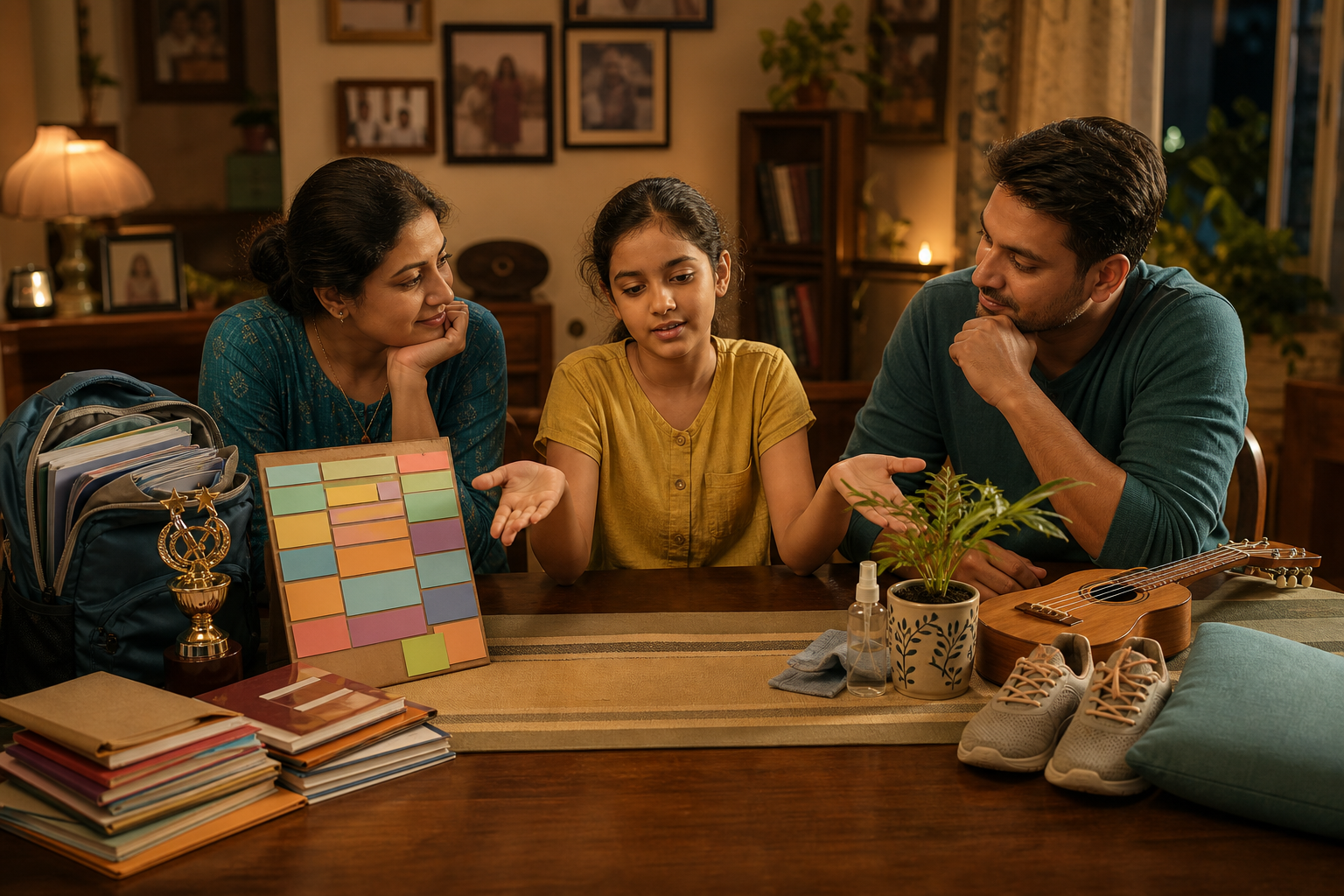
Modern parents are rarely offered a mythic either-or choice. You encounter smaller versions of it every week: marks versus honesty, prestige versus aptitude, convenience versus responsibility, consumption versus restraint, and compliance versus moral judgment. A simple decision process can keep the deeper priority visible.
- Name the desired outcome. Be concrete: admission to a particular programme, improvement in a subject, responsible use of a device, participation in family worship or preparation for a career.
- Name the quality you hope the decision will cultivate. Choose one that can guide conduct, such as truthfulness, self-restraint, courage, compassion, perseverance, gratitude or service.
- Examine the method. Ask whether the method strengthens that quality or quietly contradicts it. A demand for high marks that makes a child afraid to disclose a poor result is not cultivating responsibility.
- Protect legitimate necessities. Do not sacrifice safety, health, education or a child’s basic dignity to stage a dramatic lesson about character. Dharma disciplines power; it does not give parental power a blank cheque.
- Leave room for ownership. Set the boundary you are responsible for, explain the reason, and let the child make an age-appropriate choice within it. Responsibility grows when choices have understandable consequences.
Consider a child who admits to receiving a poor mark. If your first response makes honesty more painful than concealment, the family has operationally placed achievement above truth, whatever values are spoken during prayer. A better response is to acknowledge the truthful admission first, then examine preparation, distractions and the next concrete step. The academic problem still receives attention, but honesty is not punished for revealing it.
The same test applies to career decisions. You can discuss livelihood, aptitude, discipline, family obligations and service without treating one prestigious profession as proof of worth. Ask whether the path is honourable and sustainable, not merely whether it produces a title that reflects well on the family.
Dharmic formation begins with what the family rewards

Children learn a family’s real hierarchy from repeated reactions. They notice whether adults praise honesty only when the truth is convenient, invoke simplicity while competing for display, demand respectful speech while speaking contemptuously, or insist on self-control while indulging their own anger. A lecture cannot repair a pattern that the household rewards every day.
That makes parental example more demanding than parental instruction. If you want a child to admit mistakes, let the child hear you acknowledge one without an excuse. If you want restraint, make at least one visible family decision in which desire does not automatically become purchase. If you want seva, give time or effort together instead of treating generosity as a speech delivered to someone younger.
Watch especially for signs that aspiration has become control:
- Your child explains every choice only in terms of pleasing or angering you.
- Mistakes are hidden because protecting the family’s image matters more than correcting conduct.
- Religious practice is used mainly as a reward, threat or bargain for worldly success.
- Another child’s marks, career or devotion becomes the standard for comparison.
- You cannot accept a different path even when it is responsible, ethical and suited to your child’s capacities.
When one of these patterns appears, begin with a conversation rather than another command. Ask three questions: “What do you think is right here?” “What consequence are you prepared to accept?” and “What help do you need from us?” Then state the boundary that remains yours to set. This separates guidance from domination and gives the child practice in moral reasoning.
Key takeaways for parents
- Mrikandu’s choice places virtue and spiritual understanding above longevity as the sole measure of a good life; it does not make safety or long life unimportant.
- The parent can establish a hierarchy of values, provide practices and model conduct, but cannot manufacture a child’s inner realization.
- Test every parenting method against the quality it is supposed to cultivate. A method that rewards concealment cannot teach truthfulness.
- Give children choices proportionate to their maturity so that dharma becomes exercised judgment rather than permanent dependence.
- Judge the household by what it repeatedly rewards, not only by the values it publicly recites.
At the next difficult family decision, write down two things before responding: the outcome you want and the quality you want to cultivate. Reject any method that secures the first by weakening the second. That is how Mrikandu’s severe choice becomes a usable discipline in ordinary family life.
References

Leave a Reply
You must be logged in to post a comment.