

If you arrived at Sabarimala through a headline, you may feel pushed to choose between women’s dignity and religious freedom. That choice is too crude. It turns a difficult question about worship, authority, equality, and state power into a loyalty test.
A better question is available to you: when may a court or government override a religious community’s understanding of a temple observance, and what must be established before coercion is justified? Asking it does not settle the dispute in advance. It makes an honest judgment possible.
The dispute must be described before it is judged
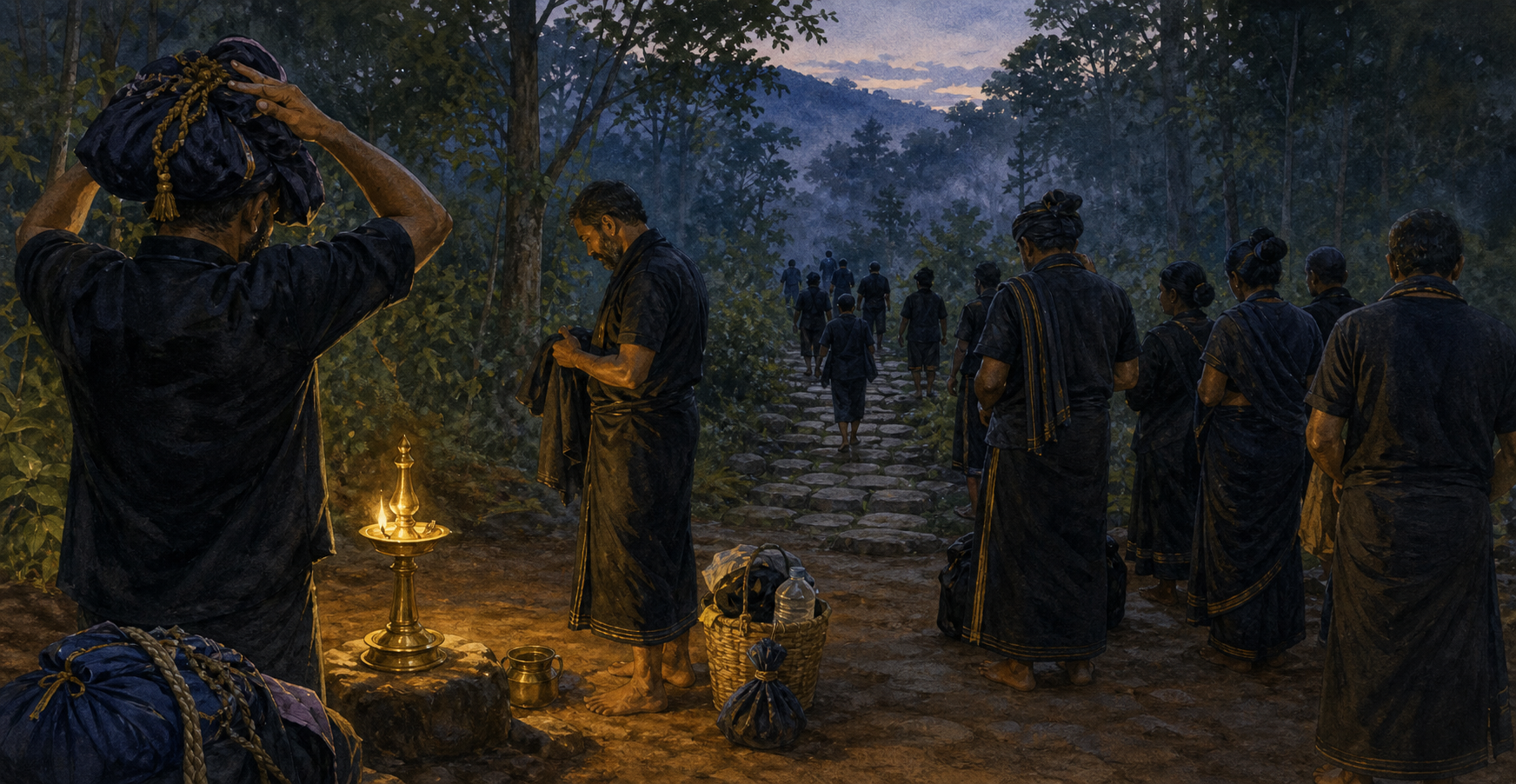
The immediate controversy is specific. In 2018, the Supreme Court allowed women of menstruating age to enter Sabarimala. Many devotees found the decision difficult to accept, while Kerala’s LDF government attempted to enforce it.
That is not the same as a general dispute over whether women possess equal human worth. Nor is it an abstract referendum on Hinduism’s treatment of women. It concerns an age-linked entry practice at a particular temple and the authority claimed for changing it.
This distinction matters because a temple is not merely a public venue with religious decoration. Its practices express a particular understanding of worship. At the same time, calling a rule religious cannot end every inquiry. Religious autonomy is a serious constitutional and civilizational claim, not a magic phrase that makes all criticism disappear.
Before you endorse either intervention or resistance, test the argument with six questions:
- What is the exact practice? State whom it concerns, where it applies, and what it regulates. Do not silently enlarge an age-linked restriction into a claim that Hinduism excludes women as a class.
- How do its practitioners explain it? Determine whether the rule is presented as a statement about social status, a discipline connected to worship, or something else. You cannot evaluate a religious practice accurately after replacing its own rationale with an opponent’s description.
- What concrete injury is alleged? Offence, exclusion from a particular sacred space, denial of equal civil status, coercion, and physical harm are not interchangeable. Each can matter, but each calls for a different argument and possibly a different remedy.
- Who has interpretive standing? Identify the temple authorities, devotees, women within the community, religious representatives, petitioners, and state institutions involved. No single faction should be allowed to impersonate everyone affected.
- Would the proposed principle apply to other faiths? A constitutional rule should survive a change of religious identity. If it sounds persuasive only when the institution is Hindu, it is not yet a neutral principle.
- Why is coercion necessary? Ask whether dialogue, a narrower remedy, internal deliberation, or another lawful route could address the claimed injury without transferring control of worship to the state.
This is not a substitute for a court’s legal analysis. It is a test of whether public arguments deserve your confidence.
Why forced compliance does not create religious legitimacy

A government can enforce physical access. It cannot manufacture theological acceptance. Religious observance depends on inherited meaning, discipline, trust, and voluntary recognition of sacred authority. When reform bypasses those foundations, the state may obtain a visible result while deepening the underlying conflict.
The aftermath of the 2018 ruling illustrates that gap. The LDF government’s attempt to enforce the decision became politically disastrous, and the ruling alliance later changed its position. Political cost does not prove that every devotional argument is legally correct. It does show that a judgment and an enforcement apparatus cannot, by themselves, confer legitimacy on a religious change.
Imposed reform can break down in three distinct ways:
- A category error: outsiders interpret every restriction as a declaration of inferiority, while practitioners understand the same rule as part of a temple-specific discipline. The practitioners may still be challenged, but their actual claim must be answered.
- A representation error: women, devotees, reformers, and traditionalists are treated as homogeneous blocs. Women who defend an observance are then dismissed as lacking agency, while women who oppose it are presented as speaking for every woman. Both moves erase real people.
- A legitimacy error: officials confuse the power to compel conduct with the authority to redefine worship. Legal authority and sacred authority may interact, but they are not identical.
The answer is not to freeze every inherited practice forever. Traditions remain alive partly because their communities interpret, defend, question, and sometimes change them. But internal reform is not simply state policy delivered through religious vocabulary. It requires genuine participation, an account of continuity, and trust that the sacred institution is not being treated as raw material for political engineering.
Consistency is equally important. Restrictions involving access or religious roles have existed in other major faith traditions. Presenting Sabarimala as proof that such restrictions are uniquely Hindu manifestations of misogyny or primitiveness avoids the harder constitutional task: formulating a principle that can be applied evenly across religions.
Asymmetrical scrutiny is not secularism. If the state claims authority to reorganize a Hindu practice in the name of equality, it should identify the general rule, the threshold for intervention, and the consequences for comparable practices elsewhere. Selective moral confidence is a warning sign, not a constitutional standard.
How to read the Constitution Bench verdict when it comes

The legal dispute no longer concerns only one entry rule. Review petitions arising from the 2018 judgment have expanded the matter to larger constitutional questions that may affect other faiths. As of August 2026, the Supreme Court had indicated that the Constitution Bench’s final decision was likely to be delivered in October 2026. A likely timetable is not a delivered verdict, so do not treat the expected outcome as settled law.
When the decision appears, the easiest reaction will be to ask only whether entry was permitted or restricted. That headline question is important, but the reasoning may have much wider consequences. Read the judgment through the following sequence:
- Find the scope. Does the Court decide a narrow Sabarimala dispute, or establish a general rule for judicial intervention in religious practices?
- Identify the right-holder. Does the reasoning protect primarily an individual claimant, a temple institution, a body of devotees, a religious tradition, or some combination of them?
- Examine the meaning of equality. Does equality require identical access in every religious setting, or can a temple-specific distinction survive when it has a religious rationale? Note what evidence the Court requires for either answer.
- Locate the trigger for intervention. What kind of harm or rights violation must be shown before civil authority may override religious autonomy?
- Run the cross-faith test. Replace Sabarimala with a comparable institution from another religion. Would the reasoning still be applied with the same confidence and reach?
- Read the remedy, not merely the principle. A court can recognize a right, invalidate a practice, direct immediate enforcement, or leave questions of implementation open. Those choices do not have the same effect on a living community.
- Separate the binding conclusion from broader observations. A memorable sentence in a judgment may attract attention without carrying the same legal force as its operative directions.
Do not rely on a partisan caption, a clipped quotation, or a television debate to perform this work for you. Anyone making operational decisions for a temple, government body, or organization should use the final operative judgment and qualified legal advice. Acting on an anticipated verdict or a headline summary can create real legal exposure.
A Dharmic route between paralysis and state control
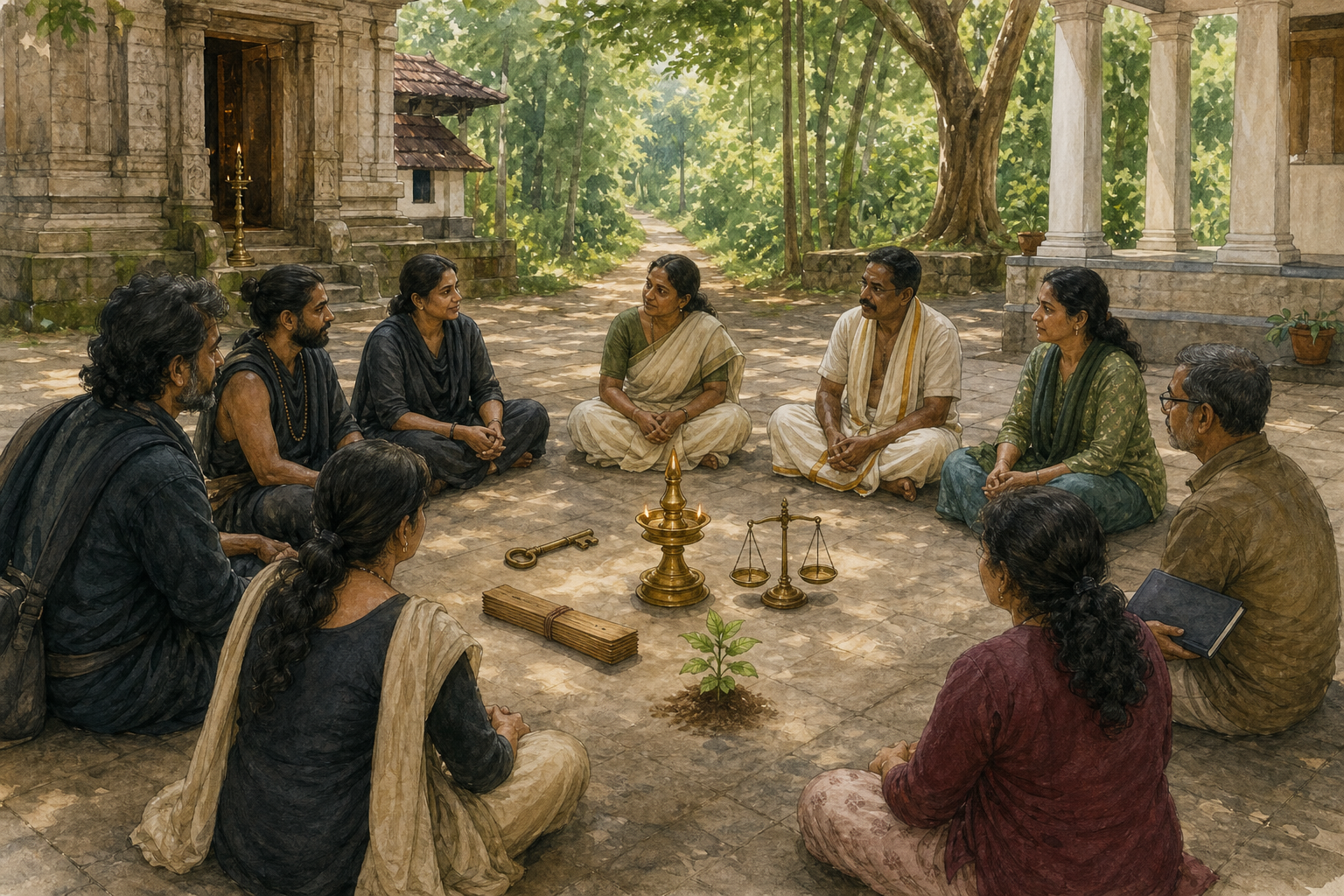
Dharma does not require you to choose between unthinking preservation and external redesign. The relevant discipline is discernment: understand what is being preserved, identify the actual objection, test the proposed remedy, and ask whether change can remain intelligible within the tradition.
A credible process for addressing a contested temple practice would include these steps:
- Publish a precise account of the observance. Temple representatives should explain its scope, rationale, limits, and place within worship. Sentiment alone will not answer a constitutional challenge.
- Make authority visible. Each side should identify the persons or institutions it regards as competent to interpret the practice and explain why. This exposes the difference between religious interpretation, political representation, and personal preference.
- Let women speak as participants, not symbols. Women devotees can hold different views. Their agency is denied when either camp accepts their voices only when those voices support a predetermined conclusion.
- Define the objection narrowly. Reform advocates should name the specific injury they seek to remedy. Condemning an entire tradition as misogynistic may generate attention, but it does not demonstrate why a particular state action is justified.
- Choose the least disruptive adequate response. Ask whether the remedy addresses the stated injury without unnecessarily transferring authority over other aspects of worship. If a narrower lawful response is rejected, the reason should be explicit.
- Use lawful and nonviolent channels. Review petitions, reasoned public advocacy, institutional representation, and community deliberation protect the credibility of the cause. Religious autonomy never licenses intimidation, violence, or abuse.
- Record the universal principle. State the rule in terms that could govern Hindu, Buddhist, Jain, Sikh, Christian, Muslim, or any other religious institution. If advocates retreat from the rule when the religious identity changes, the rule needs revision.
This process may not produce unanimity. That is not its promise. Its value is that disagreement remains attached to facts, reasons, and accountable authority. It also leaves room for a community to reconsider a practice without pretending that government compulsion and religious persuasion are the same thing.
Defenders of Sabarimala should therefore resist two temptations. The first is to answer every critic with outrage rather than explanation. The second is to imply that any judicial examination of religion is automatically illegitimate. A stronger defence states the practice accurately, presents its religious logic, recognizes the constitutional question, and demands an even-handed standard.
Reformers face a parallel discipline. They should not use women’s dignity as a shortcut around the need to understand the temple, demonstrate the injury, justify the remedy, and accept the same rule for other faiths. Equality deserves a better argument than a civilizational insult.
Key takeaways
- Sabarimala cannot be judged responsibly through the false choice of women’s dignity versus religious freedom; both claims must be examined.
- The 2018 verdict changed the legal position on entry, but government enforcement did not create devotional acceptance or lasting political legitimacy.
- A temple-specific, age-linked practice should be described exactly before anyone turns it into a verdict on all women or all of Hinduism.
- The Constitution Bench’s eventual reasoning may matter beyond Sabarimala because the review proceedings raised wider questions about religious practice.
- Any principle used to intervene in a Hindu institution should be clear enough to apply consistently to comparable practices in other religions.
- Durable reform requires precise reasoning, participation within the community, lawful conduct, and a remedy proportionate to the concrete injury claimed.
When the verdict arrives, pause before sharing the first triumphant or despairing headline. Read its scope, identify the rule it creates, and test that rule across faiths. Then decide whether the Court has resolved a rights conflict with constitutional consistency or merely transferred a sacred dispute into the machinery of state power.
References

Leave a Reply
You must be logged in to post a comment.