
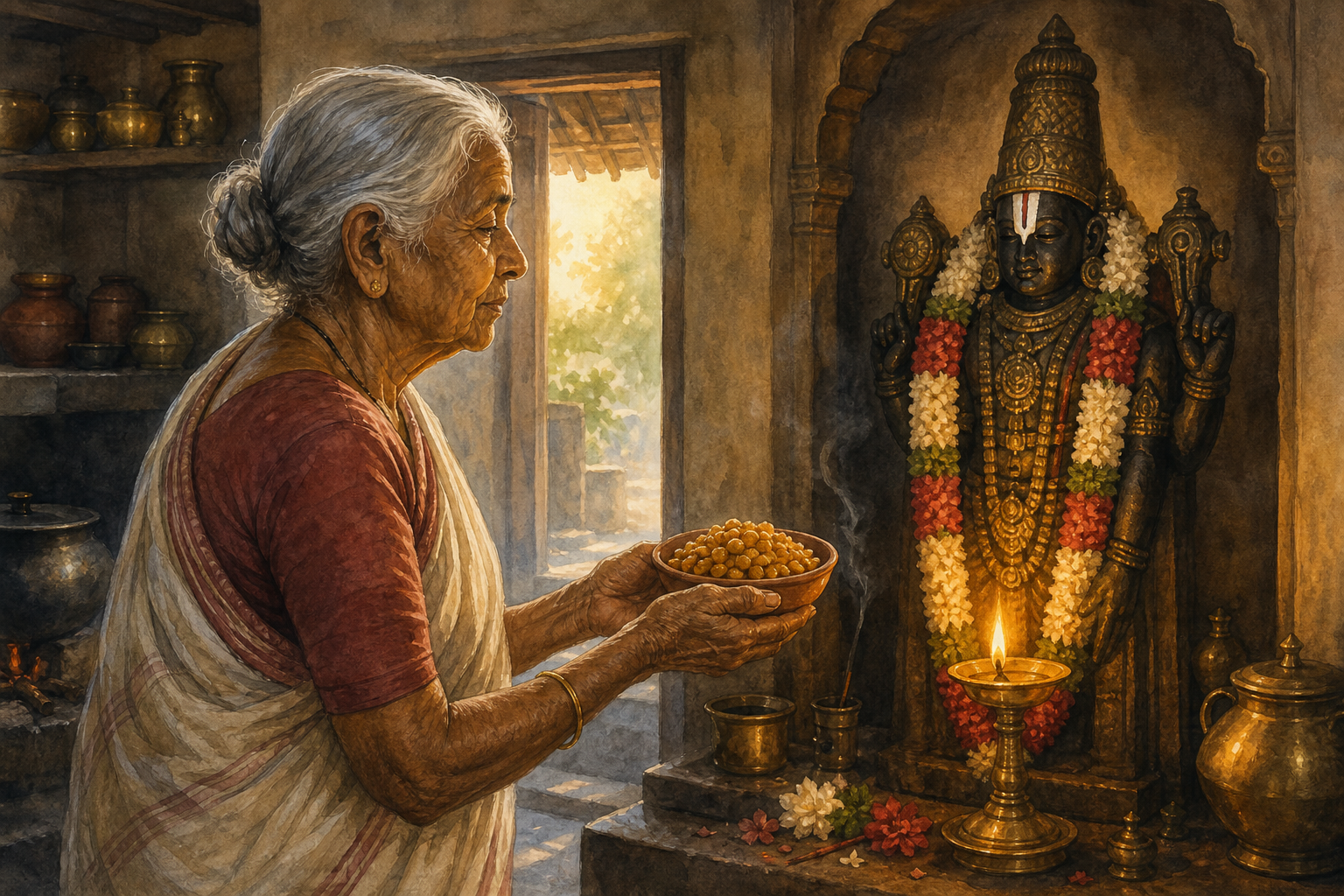
If you have looked at the magnificence of Tirumala and wondered whether a small offering from an ordinary kitchen could matter, Guggilla Avva gives you a direct answer. What reaches Bhagavan is not the market value of the food but the devotion carried with it.
You do not have to reproduce her plate to follow her path. You have to notice what turns food into an offering: attention, humility, freedom from bargaining, and trust that Bhagavan receives the devotee along with the gift.
The story is small because its measure is inward
The remembered core is deliberately spare: an elderly devotee named Guggilla Avva offers chickpeas to Bhagavan Venkateswara on the hills of Tirumala, and the Lord does not refuse her humble food. There is no royal feast at the center of the encounter. There is a devotee, an ordinary offering, and a responsive divine presence.
The expression that Bhagavan “could not refuse” should be understood as the language of devotional intimacy, not as a technique for compelling the divine. Avva does not overpower Venkateswara through a special ingredient. Her love leaves no separation between the one who gives, the gift, and the One to whom it is given.
This distinction matters when you tell the story to children, discuss it in a satsang, or use it in your own sadhana. Preserve its four firm anchors: Guggilla Avva, the chickpeas, Tirumala, and Venkateswara’s loving acceptance. Do not add a date, ritual formula, social identity, miraculous sequence, or elaborate biography unless you have a reliable tradition for that detail. Embellishment may make a tale longer while making its teaching less clear.
Within this form of bhakti, Bhagavan Venkateswara is not approached as a distant abstraction or an inert object. He is addressed as present, aware, and capable of relationship. That conviction changes puja from display into encounter. Before asking whether your offering is impressive enough, ask whether you are actually present while offering it.
What the chickpeas teach about bhava
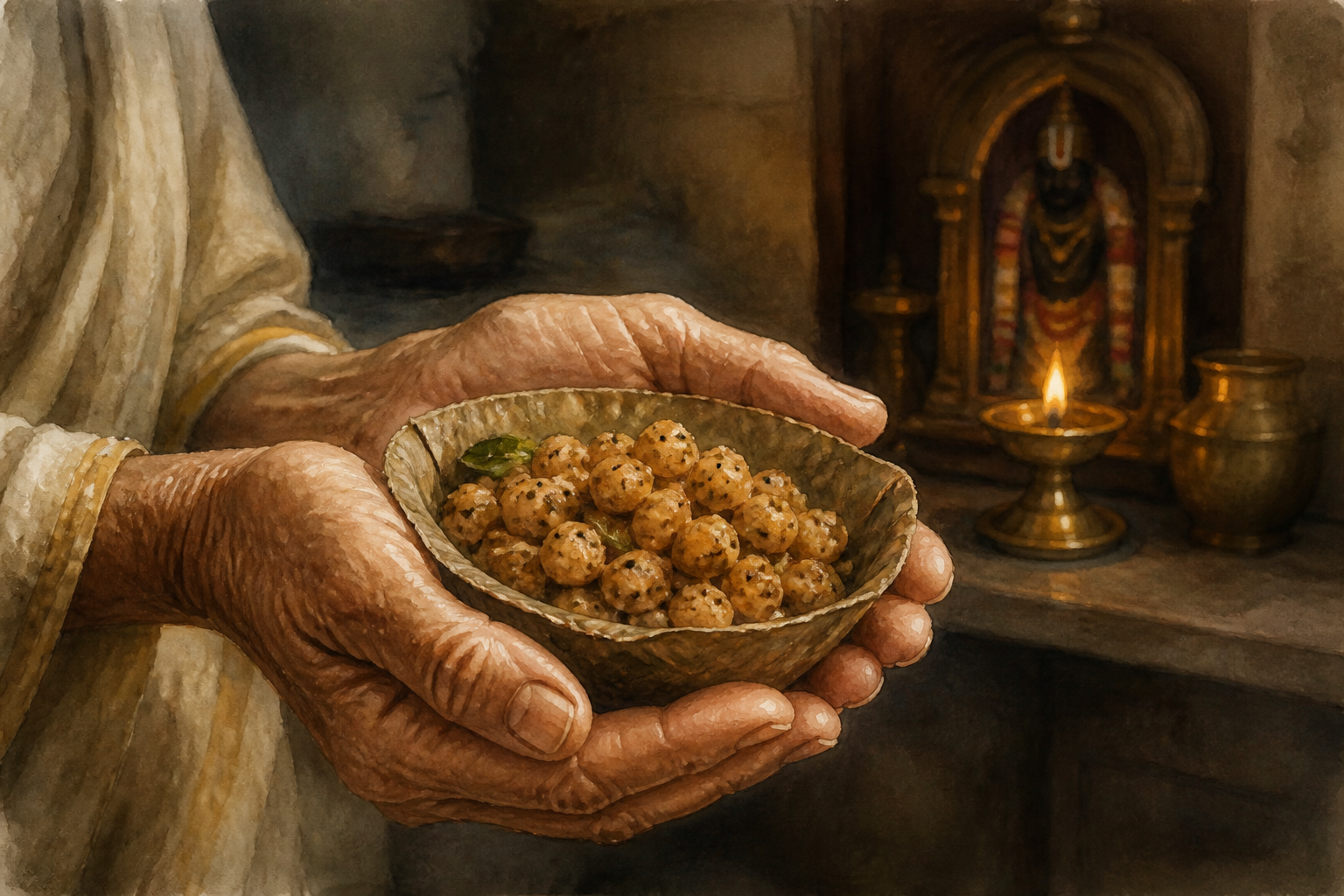
Bhava is sometimes reduced to strong emotion, but emotion alone is an unreliable measure. You may feel deeply and still be bargaining with Bhagavan. You may feel quiet and offer with complete steadiness. In this story, bhava is better recognized through the quality of the act: Avva gives what is hers to give, gives it directly, and does not make grandeur a condition of devotion.
The simplicity of the chickpeas does not mean that inexpensive food is automatically pure or that elaborate temple worship is spiritually inferior. A costly offering can be sincere, and a cheap one can be careless. Tirumala’s sacred magnificence and Avva’s modest food need not be placed in competition. The lesson is narrower and more demanding: material scale cannot monopolize Bhagavan’s grace.
You can test the bhava behind an offering with three questions. Is this honestly mine to give? Have I handled it with the care I would show an honored guest? Can I offer it without demanding a particular result in return? These questions expose the difference between devotion and a disguised transaction.
The chickpeas are therefore meaningful without becoming magical. They carry the memory of Avva’s love, but they are not a secret substance that guarantees divine favor. If chickpeas do not belong in your household practice or are unsuitable for you, choose an appropriate offering accepted in your sampradaya. Copy the sincerity, not merely the ingredient.
Bhava also does not cancel maryada, the discipline and proper conduct surrounding worship. Cleanliness, respect, temple rules, and the guidance of your tradition still matter. Simplicity removes vanity; it does not excuse carelessness.
Four ways a humble offering can lose its meaning
- Turning price into a measure of merit. Spending more may express generosity, but it does not purchase greater access to Bhagavan. Set a puja budget your household can sustain without anxiety, debt, or resentment. Then judge the offering by its care and honesty, not by comparison with another devotee’s plate.
- Using naivedya as a bargain. “I offered this, so Bhagavan must give me that” changes devotion into an invoice. You may certainly bring a wish, fear, or difficulty before Venkateswara. State it truthfully, but leave the outcome unpriced.
- Making chickpeas compulsory. Guggilla Avva’s food is central to her remembrance, but her example is not a universal ritual command. Follow your household or sectarian discipline. If you prepare chickpeas in her memory, do so as an act of remembrance rather than as a formula for obtaining a favor.
- Calling negligence simplicity. A hurried leftover placed before the deity without attention is not made profound merely because it is plain. Offer a small portion you can prepare and present properly. Reduce the quantity before reducing the care.
There is another subtle danger: admiring Avva while keeping her lesson safely in the past. A devotional story becomes useful only when it corrects your conduct. Notice where status enters your worship, where you perform for observers, or where you postpone devotion until you can arrange something impressive. Those are the places where her chickpeas still challenge you.
A six-step household practice inspired by Guggilla Avva
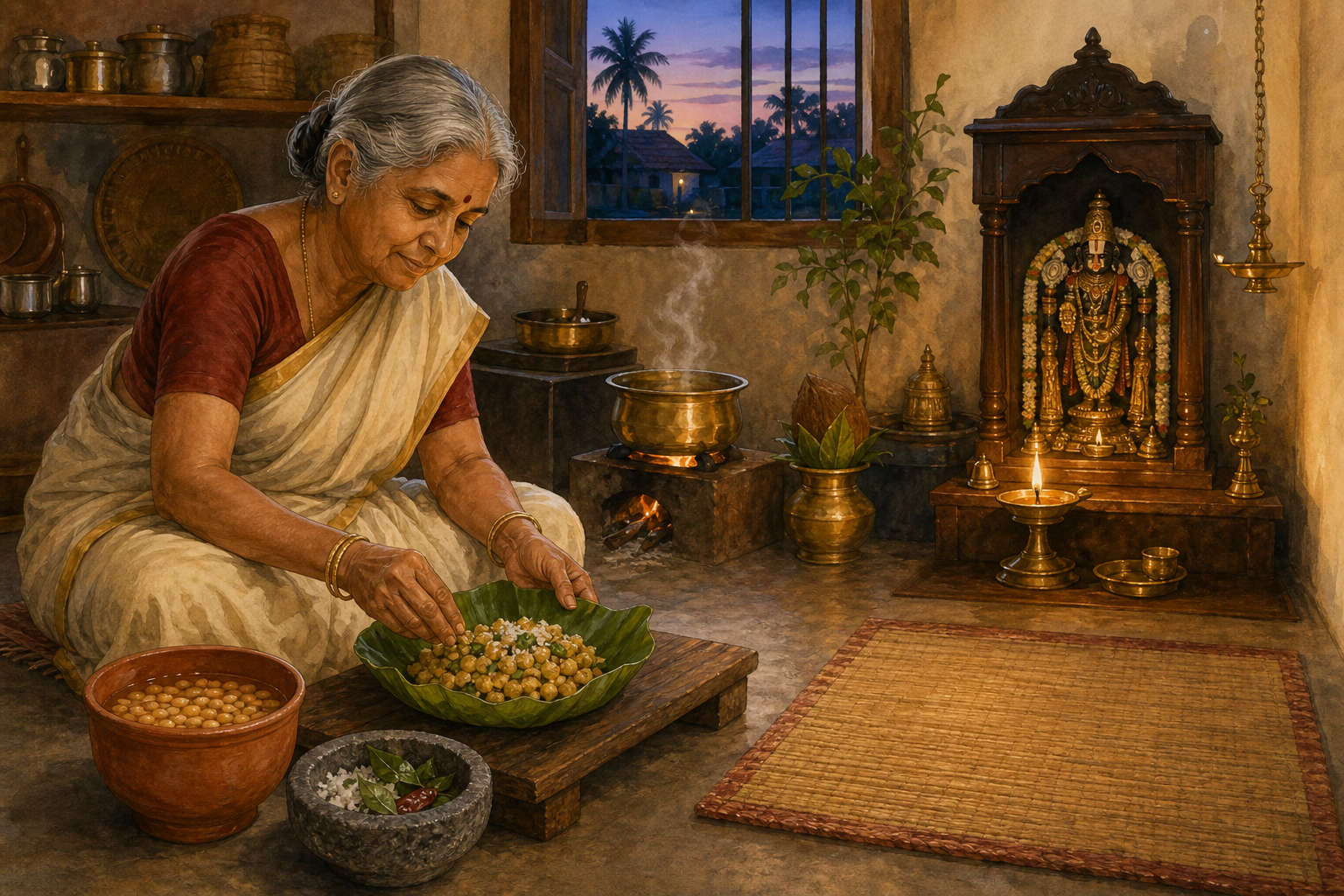
This is a reflective home practice, not a reconstruction of Avva’s actions and not an official Tirumala seva. Keep the customs of your family and sampradaya authoritative wherever they give specific instructions.
- Choose an ordinary day. Do not wait for a festival, a perfect schedule, or an expensive arrangement. Select a time when you can complete a short puja without rushing.
- Prepare a modest portion. Use food accepted in your Venkateswara tradition and suitable for the people who will later receive it. Set it aside cleanly according to your household practice. The amount should be small enough that none needs to be wasted.
- Present it without performance. Place the portion before Venkateswara as your tradition permits. Put away the phone, stop documenting the moment, and let the offering remain between the devotee and Bhagavan.
- Speak plainly. You do not need to invent ornate Sanskrit or imitate a ritual you have not learned. Use the prayers taught in your tradition, or offer a simple statement of gratitude and surrender in the language in which your devotion is honest.
- Notice the bargain forming in your mind. If you catch yourself attaching a demand to the plate, name the desire without pretending it is absent. Then release the claim that your offering obliges Bhagavan to fulfill it.
- Receive and share the prasada respectfully. Once the offering is completed according to your custom, consume or distribute the food without waste. Let one additional action carry the worship into daily life: feed someone in your household, share appropriate food with a willing recipient, or perform an unnoticed act of service.
If you visit Tirumala, follow the temple’s current instructions about what may be brought, offered, or distributed. A beloved legend is not permission to bypass temple order. Avva’s inward freedom and institutional discipline can coexist; devotion does not need rule-breaking to prove its authenticity.
Key takeaways for your Venkateswara devotion
- Guggilla Avva’s remembered gift is humble chickpeas, but the decisive offering is her uncalculated love.
- The story does not oppose simple home worship to the grandeur of Tirumala; it shows that wealth is not the price of divine nearness.
- Bhava is tested by attention, honesty, and freedom from bargaining, not by emotional intensity alone.
- Chickpeas may help you remember Avva, but they are not a compulsory or magical ingredient.
- A home practice inspired by her should remain clean, modest, consistent with your sampradaya, and connected to respectful sharing rather than waste.
At your next puja, make one offering small enough that nothing can hide the state of your attention. Prepare it carefully, place your desire before Venkateswara without pricing his response, and receive the prasada with gratitude. That is a practical beginning: not trying to make your plate resemble Avva’s, but allowing her devotion to correct your own.
References

Leave a Reply
You must be logged in to post a comment.